AI writing means using a language model to draft, restructure, or rewrite text that a person then edits, verifies, and takes responsibility for. It is a drafting aid with a narrow strength: producing fluent, grammatically clean sentences fast. It has an equally narrow weakness: it cannot confirm that anything it wrote is true. Everything useful about working with these tools follows from holding both facts in mind at once.
This guide is for people who write for a living or for a deadline. Researchers drafting a methods paragraph, content teams shipping weekly articles, students shaping an argument, analysts turning notes into a report. If you need a finished piece that survives scrutiny, you need a workflow where the model handles arrangement and phrasing while you handle claims, sources, and judgment. That split is the whole method.
What follows covers how to generate topic angles worth pursuing, which formats draft well and which do not, what actually happens inside the software, how to write prompts that save editing time rather than create it, a sequence that takes you from a blank page to a final draft, where these tools help with search work, what the free tiers genuinely offer, when hiring a person beats buying software, and the measurable gains teams report. There is also a section on what you need before you start, plus tips and the mistakes that cost the most time.
One caveat worth stating early, because it shapes the rest of the article. Fluency reads like confidence. A model will invent a plausible citation with the same even tone it uses for a verified one, which means your review process cannot rely on how the prose sounds. It has to rely on checking.
Key takeaways
- AI writing works best as a drafting and structuring aid, not a replacement for the person who owns the argument and checks the facts.
- Language models predict likely next words from patterns in training data, so they produce fluent prose without knowing whether any claim is true.
- Prompts that name the audience, format, length, evidence to use, and things to leave out produce first drafts you can actually edit.
- Every factual statement, citation, number, and quotation needs independent verification against the original source before publication.
- No-cost tiers are useful for outlines and rewrites, but they usually limit length, memory, and document handling in ways that matter for long-form work.
Using AI to Brainstorm Topic Ideas and Angles
Brainstorming is where AI writing pays off earliest, because a bad idea costs nothing to discard and a good angle saves hours of structural rework. Ask for twenty angles on a subject and you will usually find two or three that reframe the question in a way you had not considered. The rest will be generic, and that is fine. Volume is the point.
Before you start, you need three things: a defined audience, a question you actually want answered, and some raw material of your own such as notes, interview transcripts, or a reading list. Without those, artificial intelligence will hand you the average of everything written on the topic. With them, it can assist by testing your framing against alternatives. The best AI output at this stage is a list of candidate angles, not a draft. Judging which angle serves the reader stays with the writers who know the audience, and the editing decisions that follow are where an AI-powered suggestion becomes a real plan.
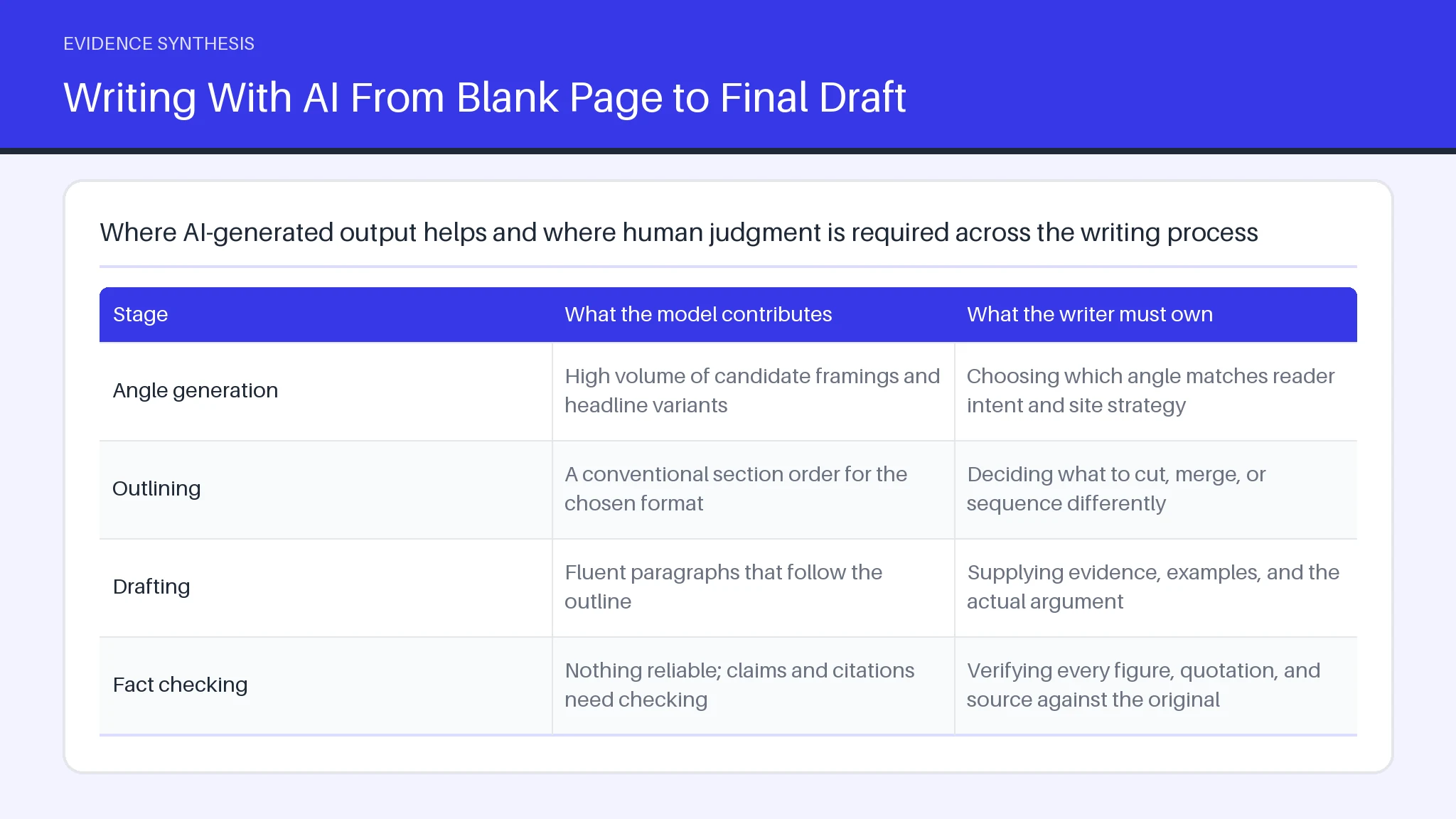
| Stage | What the model contributes | What the writer must own |
|---|---|---|
| Angle generation | High volume of candidate framings and headline variants | Choosing which angle matches reader intent and site strategy |
| Outlining | A conventional section order for the chosen format | Deciding what to cut, merge, or sequence differently |
| Drafting | Fluent paragraphs that follow the outline | Supplying evidence, examples, and the actual argument |
| Fact checking | Nothing reliable; claims and citations need checking | Verifying every figure, quotation, and source against the original |
What Content Formats Can AI Draft for You
Formats with predictable structure draft well; formats that depend on original evidence do not. Product descriptions, meta descriptions, email sequences, social captions, FAQ answers, release notes, job descriptions, and summaries of text you supply all have conventional shapes a model has seen thousands of times. Give it the inputs and it will produce a serviceable version in seconds, which is the most reliable use of AI tools in a content operation.
Long-form explanatory pieces sit in the middle. AI writing can assemble a credible outline and write connective tissue, but the sections that carry weight need your data, your interviews, and your reasoning. Pieces built on primary research sit at the hard end. Drafting a methods section or a findings summary from scratch produces plausible fiction, because the model has no access to what you actually did. If you are writing up a study, work from your own records and lean on a structural guide such as Research Paper: Structure, Sections and Writing Steps instead.
Creative work is the odd case. Poetry, dialogue, and scene sketches come out competent and bland, which makes them useful as raw clay for writers who will rewrite heavily. The best AI result here is a starting shape, not a finished piece. Across every format, treat AI-generated content as a first pass through your writing process: writing assistants shorten the distance to a draft, and the editorial standard that follows is unchanged.
How AI Writing Software Actually Works Under the Hood
These systems are large language models trained to predict the next fragment of text given everything before it. During training the model reads an enormous volume of writing and adjusts billions of internal parameters until its predictions match what actually came next. Nothing in that process stores facts as facts. It stores statistical relationships between words, which is why the output reads so naturally and why it can be confidently wrong.
Three mechanics explain most of the behavior you will notice. Tokenization splits your text into word pieces, so length limits are measured in tokens rather than words. The context window sets how much writing the model can consider at once, which is why a long document drifts off brief near the end and why pasting a full chapter sometimes pushes your original instructions out of view. Temperature controls randomness: low settings give repetitive but predictable writing, high settings give variety and more invention.
The practical benefits of using AI writing tools follow directly from those mechanics. Drafting speed improves because generating fluent sentences is exactly what the system optimizes for. Rewriting to a different tone or reading level works well because that is a surface transformation of writing you already supplied. Summarizing pasted source text is comparatively safe because the material sits inside the context window. Structural suggestions help because document conventions are strongly represented in training data.
What the mechanics do not give you is verification. A model that predicts plausible writing will predict a plausible citation, a plausible statistic, and a plausible quotation with the same fluency it applies to accurate writing. That is the single limitation every workflow has to design around.
Prompting Habits That Produce Usable First Drafts
A usable first draft comes from a prompt that specifies audience, format, length, evidence, and exclusions. Vague requests produce vague prose, because the model fills unstated gaps with the most average option available. Name the reader, state the word count, paste the source material, and list what to leave out. That last instruction matters more than most people expect: telling the system to avoid unsupported claims and to omit any statistic you did not provide cuts a large share of review time.
Four habits consistently improve AI-generated results. Supply your own material rather than asking the model to recall facts, since its grasp of what AI algorithms encode is statistical rather than factual. Request structure before prose, so you can fix the shape cheaply. Iterate in small passes instead of regenerating whole drafts. Ask for options with trade-offs named, which surfaces assumptions you can argue with.
Tone instructions deserve their own line. Models released by OpenAI and comparable labs default to a hedged, list-heavy register that experienced readers recognize instantly. Asking it to write in short declarative sentences, cut adjectives, and avoid summary paragraphs moves the AI content closer to how human writers actually write. Attempts to generate human-sounding prose still need a real edit; writing assistants smooth syntax but cannot supply the specific detail that makes written content credible. The judgment writers bring to that pass is what separates a draft from a publishable piece.
Writing With AI From Blank Page to Final Draft
A reliable sequence has six steps, and the order matters because each one constrains the next. Start by writing the question your piece answers in a single sentence, in your own words. Everything downstream inherits that framing, and a model cannot choose it for you.
Second, gather your evidence before any drafting begins: sources, data, notes, quotations, and links. Third, ask the AI writer to propose two or three outline options against that evidence, then pick and reshape one yourself. Fourth, draft section by section rather than all at once, pasting the relevant evidence with each request so the writing stays anchored to material you can defend.
Fifth, rewrite. This is the step people skip and the step that determines quality. Read the draft against your source notes and challenge every claim: where did this number come from, does this source say what the sentence implies, is this transition carrying an argument or just filling space. Cut the sentences that say nothing. Add the specific example the model could not know.
Sixth, verify and finalize. Check each citation against the original, confirm quotations word for word, and read the whole piece aloud once to catch the flat rhythm that generated writing tends to produce. For argument-led writing, the question-to-claim discipline in Essay Writing: Step by Step From Question to Claim transfers directly. The habit worth keeping is simple: the model drafts, you decide.
Can These Tools Support Your SEO Work
These tools support search work well at the structural layer and poorly at the evidence layer. Using AI for writing those elements saves hours a week on a content calendar of any size.
How AI writing tools work explains the boundary. A model predicts plausible text from training patterns, so it will happily report search volume, difficulty scores, or competitor rankings that it has no way to know. Those numbers must come from your analytics and keyword platforms. The same applies to internal link recommendations: a model guesses at URLs unless you paste your actual sitemap, and invented links are a common failure in generated writing.
Two trade-offs are worth naming. First, scale without editing tends to produce thin pages that all read the same, and a large volume of near-identical writing competes with itself. Second, the register that ranks is specific and concrete, while generated writing defaults to general and hedged, so the editing pass is doing real search work rather than cosmetic cleanup.
The practical division: let the software handle arrangement, variants, and summarizing text you already have. Keep topic selection, data, and the specific detail that answers a query firmly in human hands. That is also where evidence-led writing earns its keep, since a page built on verifiable sources holds up when rankings and reviewers both get stricter.
Which No Cost Drafting Options Are Worth Trying
Free tiers are worth trying for short, structural tasks and unsuited to long-form production. The general-purpose chat assistants offered at no cost by major model providers handle outlining, rewriting a paragraph for clarity, generating headline options, and summarizing text you paste. Browser and word-processor plugins built into tools you already use cover grammar fixes and tone changes. Open-weight models run locally cost nothing beyond hardware and keep sensitive drafts off third-party servers, which matters for unpublished research.
The constraints are consistent across categories. Shorter context windows limit how much of your document the system can hold, so long pieces drift. Older model versions often sit behind the free tier, which shows in the quality of AI-generated prose. Message caps interrupt a working session. File upload is usually restricted or absent, which removes the single most useful habit of pasting your own sources. Many free plans also reserve the right to train on your input.
A sensible test takes an hour. Give each candidate the same real task, compare the AI-generated output, and count how many minutes of editing each draft needs before it meets your standard. That number, not the feature list, tells you whether the use of AI for writing at this price point actually helps. Free tools suit writers doing occasional short tasks; writers with weekly volume will hit the ceiling quickly, and human writers remain the constraint on quality either way.
Should You Hire a Writer or Use Software
Hire a person when the work depends on judgment, access, or accountability; use software when it depends on volume and format. A specialist writer interviews sources, understands a regulated field, makes an argument that risks being wrong, and signs their name to it. No AI tools replace that, because the model has no stake in whether the claim holds.
Software earns its place on repeatable, high-volume output: hundreds of product descriptions, localized variants, internal summaries, first-pass rewrites. An AI-powered drafting step inside an existing editorial process also helps experienced writers move faster, which is different from replacing them.
The hybrid arrangement is what most teams land on, and its economics are specific. Generated drafts shift cost from writing to editing, and if the subject is technical, editing a confidently wrong draft can take longer than writing from scratch. Budget for that. Attribution and liability also sit with the publisher regardless of how the text was produced, which is reason enough to keep a named human reviewer on anything consequential.
A short decision test: if a factual error in this piece would harm a reader or your credibility, put a qualified person in charge of it. If the worst case is a bland sentence, automated drafting is fine. Free AI tiers are useful for testing where your own line sits before you commit a budget, and the AI-generated material you review during that test tells you more than any feature comparison. Using AI for writing at the formatting end while keeping people on the reasoning end is a defensible split.
The Real Gains AI Writing Brings to Content Teams
The measurable gain is time to first draft, and it is substantial. Work that starts from a blank page is slow because the hardest part is beginning. A generated outline and rough draft removes that friction, so the team spends its hours on evidence, structure, and the edit instead of on getting words onto the screen. Teams also report fewer stalled pieces, because a mediocre draft is easier to improve than nothing at all.
Using AI for content writing works best when it occupies a fixed position in an existing process. Define the question, gather sources, generate an outline, draft section by section with your evidence pasted in, rewrite against the sources, then verify and publish. The model sits at steps three and four only. Teams that let it touch step five or six find that errors reach readers.
Integrating AI-generated content with your writing takes three concrete safeguards. Mark generated passages in the draft so reviewers know where to look hardest. Require that every factual sentence trace to a source document, not to the model. Keep a named reviewer accountable for the final text, since fluent AI content reads as authoritative whether or not it is accurate. Those rules make AI-generated content auditable rather than mysterious.
Two practices improve quality further. Build a house prompt that carries your audience, tone rules, banned phrasings, and formatting standards, so every draft starts closer to your voice. Keep a short log of errors the model produced, which quickly reveals the categories it gets wrong for your subject matter and tells reviewers where to concentrate.
Common mistakes are predictable: trusting citations without checking them, regenerating instead of editing, pasting confidential material into consumer tiers, publishing at volume without differentiation, and letting generated writing set the argument rather than express one. Systematicly users working with research evidence apply the same discipline, treating AI-generated content as draft material and verified sources as the record. For appraising the studies you cite, Critical Appraisal: How to Judge If Results Can Be Trusted covers the checks.
Frequently asked questions
What is the 30% rule in AI?
The 30% rule is an informal editorial convention, not a technical setting or an industry standard. It holds that no more than roughly 30 percent of a finished piece should remain as generated text, with the rest rewritten, verified, or replaced with original material. No regulator or standards body publishes it, and no detection system measures it. Treat it as a rough prompt to edit heavily rather than a threshold that makes a draft acceptable.
What are AI words to avoid?
Words to avoid are the ones language models overuse, because readers now read them as a signal. The recurring offenders include delve, tapestry, realm, landscape, navigate, leverage, unlock, elevate, robust, seamless, and testament, along with openers like "in today's fast-paced world" and closers like "in conclusion." The structural tells matter just as much: triplet phrasing, a hedge in every sentence, and a summary paragraph that repeats what you just read. Cut them for concrete nouns and specific detail.
Which AI is better than ChatGPT for writing?
No single model is better for all writing, and the honest answer is that it depends on the task. Current frontier models from the major labs perform within a narrow band on general drafting, and differences show up in specific places: context window size for long documents, instruction adherence for tight briefs, tone flexibility for voice matching, and file handling for source-based work. Run your own real task through two or three candidates and compare how much editing each draft needs. That comparison beats any benchmark table.
How can I use AI to write something?
Writing with one of these tools follows a short sequence. State your question in a sentence, gather your sources, ask for two or three outlines, pick and reshape one, then draft section by section with the relevant evidence pasted into each request. Rewrite the result against your notes, check every citation and number against the original, and read the piece aloud before publishing. The model drafts; you decide what the piece claims.
How do I start AI for beginners?
Beginners should start with one small, low-stakes task on text they already have. Ask the tool to summarize a document you wrote, rewrite a paragraph for a named audience, or list ten angles on a subject you know well. Reviewing output on familiar material teaches you quickly where the tool is reliable and where it invents. Build up to longer work only once you can spot the errors.
Can people tell if you use AI to write something?
Readers often can tell, though not with certainty, and automated detectors are unreliable in both directions. Experienced editors spot generated text from uniform sentence rhythm, vague attribution, overused vocabulary, and a lack of specific detail. Detection software produces both false positives on careful human prose and false negatives on edited generated prose, which is why institutions increasingly treat its scores as a prompt for conversation rather than evidence. Heavy editing with concrete examples removes most of the signal, because it replaces generic text with things only you know.
What is the risk of using AI?
The main risks are factual error, source fabrication, confidentiality exposure, and sameness. Models invent citations and statistics in fluent prose, which means errors pass casual review. Text pasted into consumer tiers may be retained or used for training, a real problem for unpublished research or client material. Published volume without differentiation dilutes a site. Accountability also stays with the publisher, so a named reviewer and a verification step against original sources are the controls that matter most.