To write a thesis statement for your personal narrative, compress one lived experience, the change it produced in you, and the meaning you now assign to it into a single controlling sentence that sits at the end of your opening paragraph. That sentence is not a plot summary and not a moral. It is a claim about what the experience meant, written in language specific enough that no one else could make the same claim about their own life.
This guide is for students and early-career writers who have been asked for a personal narrative with a thesis and have discovered that the usual advice does not fit. Argumentative thesis templates ask you to state a position and preview three supporting reasons. A narrative claim works differently: the evidence is scene, detail, and sequence rather than cited sources, and the reader judges the claim by whether the story earns it. The gap between those two models is where most drafts stall.
What follows covers the practical mechanics. You will see where the thesis belongs in the drafting order, how to choose a memory that can support a claim at all, what the component parts of a narrative thesis are, a short exercise that turns a raw memory into a testable sentence, worked examples at different levels of specificity, and the revisions that distinguish a claim from a caption. Each section is written so you can apply it to a draft you already have open.
Treat the thesis as a working instrument rather than a finished product. Writers who successfully write a thesis statement for your personal narrative assignments usually produce three or four versions: one rough claim to start drafting, one sharpened after the first full draft, and one final version adjusted after the ending reveals what the story was actually about. For the wider mechanics of claims across longer projects, see our guide to thesis writing from statement to finished draft.
Key takeaways
- A narrative thesis names the experience, the change it caused, and the meaning you draw from it, so the reader knows what the story is for before the first scene starts.
- Write a thesis statement for your personal narrative after you have drafted the central memory, not before: the claim should describe the story you actually told.
- Keep the claim arguable in the narrative sense. If no reasonable reader could read the same events differently, the sentence is a summary, not a thesis.
- Strong personal narrative theses stay in one or two sentences, use concrete nouns instead of abstractions like growth or resilience, and avoid announcing the essay ("In this essay I will show").
- Check the thesis against your closing paragraph. If the ending has moved past the claim, revise the claim rather than forcing the ending back into it.
How to Write a Personal Narrative Essay From Start to Finish
A personal narrative essay is a first-person account of a real experience from the writer's own life, told with scene and detail, and shaped so the events add up to a point the reader can state back to you. It differs from a diary entry because it has a controlling claim, and from an argumentative essay because its evidence is lived detail rather than external sources.
The production sequence is predictable. Select a memory with a clear before and after. Draft the central scene in full, including dialogue and sensory detail, without worrying about framing. Identify the turning point, the moment where something shifted. Write a thesis statement for your personal narrative based on that turning point. Build the opening paragraph so it lands on the claim. Draft the remaining scenes in the order that makes the change legible, which is often chronological but need not be. Close on the consequence, not on a restated lesson. Then cut every sentence that explains what a scene already shows.
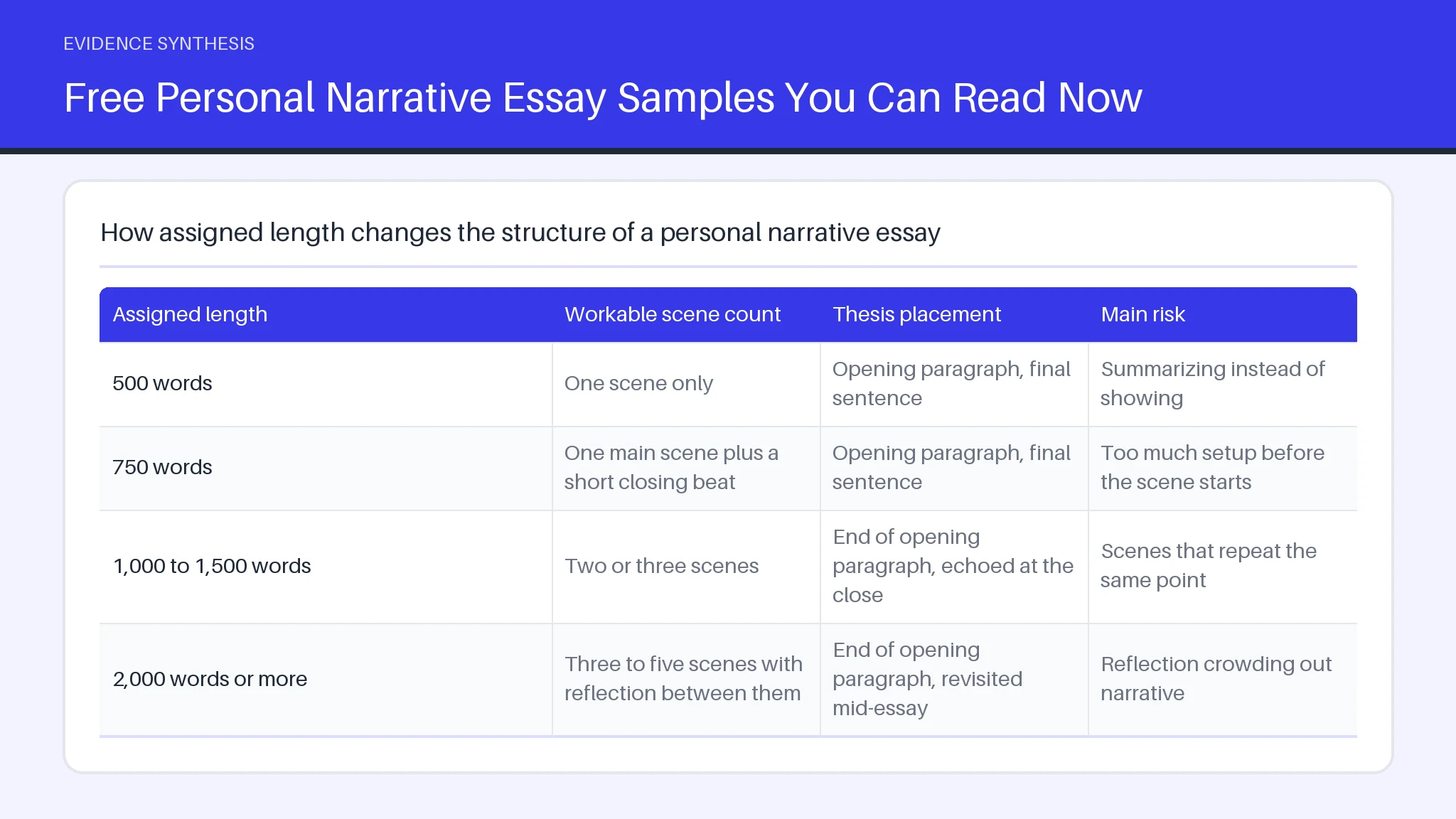
Word count changes what you can attempt. The table below sets out how length constrains structure in a personal narrative essay.
| Assigned length | Workable scene count | Thesis placement | Main risk |
|---|---|---|---|
| 500 words | One scene only | Opening paragraph, final sentence | Summarizing instead of showing |
| 750 words | One main scene plus a short closing beat | Opening paragraph, final sentence | Too much setup before the scene starts |
| 1,000 to 1,500 words | Two or three scenes | End of opening paragraph, echoed at the close | Scenes that repeat the same point |
| 2,000 words or more | Three to five scenes with reflection between them | End of opening paragraph, revisited mid-essay | Reflection crowding out narrative |
The 750-word assignment is the most common and the least forgiving. At that length you have roughly 120 words for the opening, 450 for the scene, and 180 for the close. Writers who try to cover a whole summer at 750 words produce a report. Writers who cover twenty minutes produce an essay.
What a Thesis Statement Does in a Narrative Essay
In a narrative essay the thesis sets the terms by which the reader interprets every scene that follows. Without it, a reader encountering a story about a failed audition does not know whether to read it as a story about talent, about parental expectation, or about learning to be ordinary. The claim tells them, and then the scenes either justify that reading or expose it as thin.
It also performs three jobs that are easy to overlook. It constrains selection, because any detail that does not bear on the claim becomes cuttable, which is how a 1,200-word draft becomes a disciplined 750-word essay. It fixes the tense of reflection, separating the person who lived the events from the person writing about them now. And it creates the standard against which your ending is measured, since a conclusion that contradicts the opening claim signals an unrevised draft rather than a complicated truth.
What the thesis does not do in this essay form is preview a list of body paragraphs. A reader who is told in advance that three scenes will follow loses the forward pull that narrative depends on. When you write a thesis statement for your personal narrative, state the meaning and withhold the sequence. The reader should finish the first paragraph knowing what is at stake and not knowing what happens next.
Where Crafting Your Thesis Fits in the Writing Process
The thesis belongs third in the drafting order, after memory selection and after a full draft of the central scene. Writing it first commits you to an interpretation you have not yet tested against the details, and most writers then bend the scene to fit the sentence rather than the other way around. The scene is the evidence. Read it before you decide what it proves.
A practical rhythm looks like this. Draft the scene cold. Leave it a day. Reread it and write one sentence naming what changed in you between the first paragraph and the last. That sentence is your working claim, and it only needs to be good enough to let you keep drafting. Once the full draft exists, test the claim against the ending and rewrite it to match what the finished story delivers to a reader who knows nothing about you.
This is also where a second set of eyes earns its place. Give the draft to one reader and ask a single question: what do you think this is about? If their answer and your thesis diverge, the gap is almost always in the scenes, not in the reader's comprehension. When you write a thesis statement for your personal narrative under deadline, that one question is faster and more reliable than another solo reread. Our step-by-step essay writing guide covers the same question-to-claim movement for argumentative work.
Choosing a Topic and Brainstorming Memories Worth Telling
A workable topic is a short span of time in which you changed your mind about something. That constraint rules out most of what students first propose, and it rules them out usefully: a topic covering a whole relationship, a whole year abroad, or a whole illness has no single turning point to anchor a claim.
Generate candidates by listing specifics rather than themes. Write down five moments when you were wrong in public, five when someone surprised you, five when you broke a rule you believed in, and five when you understood something a year too late. You now have twenty candidates instead of one abstract topic such as perseverance. Then test each one against three filters.
- Scene test: can you name the room, the hour, and two things you could hear? If not, the memory is a summary and will stay one on the page.
- Change test: can you state what you believed before and what you believed after in two short sentences? A topic without that contrast gives the thesis nothing to claim.
- Exposure test: are you willing for this reader, in this setting, to know this? Choose a topic you can tell honestly rather than one you will protect with vagueness.
The best remaining candidate is often the smallest. A topic about one argument over a dinner table will outperform a topic about a grandparent's entire life, because write a thesis statement for your personal narrative work depends on specificity you can actually deliver within the assigned length.
Free Personal Narrative Essay Samples You Can Read Now
Freely available narrative essay samples cluster in four places worth knowing. University writing centers publish annotated student work, often with marginal notes explaining why a claim functions; these are the most useful because the commentary shows the reasoning, not just the result. Public library databases carry archived literary magazines with professional personal essays. Open courseware from writing programs includes assignment sheets alongside model responses. And many public radio and newspaper essay series publish short first-person pieces in the 700 to 1,000 word range that match a typical assignment length closely.
Read a sample narrative essay twice and for different things. On the first pass, read for the experience as a reader would. On the second, mark where the controlling claim appears, where each scene begins and ends, and which sentences do reflective work rather than narrative work. Counting those sentences is instructive: in a tight 750-word essay you will usually find fewer than six reflective sentences in total.
Treat samples as structural evidence rather than style templates. Copying another writer's cadence produces a essay that sounds borrowed, while copying their architecture, one scene, one turn, one consequence, transfers cleanly to any subject. Where a sample is unannotated, write your own one-line statement of what you think its thesis is, then check whether the ending supports it.
The Parts That Make Up a Narrative Thesis Statement
A narrative thesis has four working parts: the subject, the specific experience, the change, and the significance. Subject identifies whose story this is and in what role, such as a new driver or an eldest daughter. Experience names the concrete event, not its category. Change states what moved, usually a belief, a relationship, or a sense of self. Significance tells the reader why the change still matters now, which is the part most drafts leave implicit.
Assembled, the parts read as one or two sentences: "The summer I worked nights stocking shelves, I learned that the adults I had quietly pitied were better at being tired than I would ever be, and that my own impatience was a luxury someone else was paying for." Subject, experience, change, and significance are all present, and a reader can test every clause against the scenes that follow.
The common failure is substituting a topic label for significance. "This essay is about resilience" names a category and leaves the reader nothing to hold. The repair is to replace each abstraction with the concrete thing it stands for: not resilience but the fact that you went back the next night. Abstractions tell the reader what to feel, while specifics let a reader arrive there and believe it.
Exercise: Write a Thesis Statement for Your Personal Narrative
A thesis statement is a single sentence, occasionally two, that states the central claim a piece of writing sets out to support, placed where the reader will encounter it early and can hold it in mind throughout. A personal narrative is a true first-person account of the writer's own experience, built from scene and detail and shaped toward a point. Combining the two means making a claim about meaning that your own remembered experience has to earn in front of a reader who was not there.
Work through this exercise with a draft open. It takes about twenty minutes.
- Step one. Write the memory in three sentences: what happened first, what happened at the turn, what happened after. No adjectives.
- Step two. Write what you believed before the turn, in one sentence beginning "I thought."
- Step three. Write what you believed after, in one sentence beginning "Now I know" or "Now I suspect." The hedged version is often the truer one and makes a better claim.
- Step four. Combine steps one and three into a single sentence that names the experience concretely and the shift precisely. This is your draft thesis.
- Step five. Delete every abstract noun in it and replace each with the concrete detail behind it.
- Step six. Read it to a reader who does not know the story and ask them what they expect the essay to contain. If their expectation matches your draft, the claim is working.
Two checks catch most remaining problems. First, the inversion check: can you write the opposite claim and have it still sound like a possible essay? "I learned that leaving was the right call" inverts to "I learned that leaving cost me more than staying would have," so the claim is genuinely arguable. "I learned a lot that summer" has no inverse and is therefore not a claim. Second, the stranger check: strip your name and the proper nouns, then ask whether a reader could still tell this belongs to one person and not to anyone. If it reads as generic, the specifics are missing.
To write a thesis statement is to make a promise about what the rest of the text will deliver, and in narrative that promise is tested by every scene a reader reads afterward. Keep the sentence in view while you revise. Each time you cut a scene, confirm the claim still holds; each time you add one, confirm it still needs to. Writers who write a thesis statement early and then never look at it again usually end up with an opening paragraph that describes a different essay from the one they finished.
Example Thesis Statements for Narrative Essays
Worked examples show the distance between a weak claim and a usable one more clearly than rules do. Each pair below comes from a common assignment prompt for a narrative essay.
- Weak: "Moving to a new school taught me about adapting." Revised: "Eating lunch alone for six weeks at a school of 1,400 taught me that I had always mistaken being liked for being known, and I have chosen friends differently ever since."
- Weak: "My grandfather's illness was a difficult time for my family." Revised: "Learning to lift my grandfather from his chair without hurting either of us ended the version of our relationship where he was the one who helped, and I was not ready for how much I missed being useless to him."
- Weak: "Playing soccer taught me teamwork." Revised: "The season I spent on the bench taught me that I had been treating my teammates as the background to my own story, and that the view from the sideline was the first honest one I had."
Each revision names a concrete experience, states a change in belief, and leaves a reader able to disagree. Each also fits the length of a standard essay, because the claim is narrow enough to prove in two or three scenes. If your own sentence could introduce someone else's essay without alteration, it is still a category label rather than a claim.
How to Sharpen Thesis Statements Across Different Essay Types
The sharpening method stays constant across essay types even though the evidence changes. In every case you name the specific subject, state the contestable position, and cut the abstractions that let a reader nod without understanding. What varies is what counts as proof: scene and detail in narrative work, cited sources in an analytical essay, criteria and comparison in an evaluative one, and documented mechanism in a scientific argument.
Three habits travel well. Write the claim last, after you know what the material supports. Test it by inversion, since a position no one could oppose is a description. And check it against your final paragraph, because the ending is where drafts quietly reveal the argument they actually made. Common mistakes also repeat across forms: announcing the structure, stacking two unrelated claims into one sentence, hedging so heavily that nothing is asserted, and leaving the claim buried in paragraph three where no reader will find it.
For longer research work the same logic scales up through a well-formed research question, and for structured evidence projects, teams working with tools such as Systematicly apply the equivalent discipline when they fix a review question before screening begins. The principle is identical: decide what you are claiming before you decide what to keep.
Frequently asked questions
What is a good thesis statement example?
A good thesis statement names a specific subject and takes a position that a reasonable person could dispute, in one sentence. "Night shift work reshaped how I judge the people I used to pity, because exhaustion turned out to be a skill rather than a failure" works because it is specific, contestable, and testable against what follows. Compare it with "Night shift work was a learning experience," which names no position at all. The usable test is whether you can write the opposite sentence and still imagine a serious piece of writing behind it.
What is a good example of a personal narrative?
A good personal narrative covers a short span of time in close detail and lets one change carry the whole piece. A strong example in outline: a student arrives early to apologize to a teacher, finds the classroom empty, waits forty minutes, rehearses the apology, and leaves without delivering it, realizing on the walk home that the rehearsal had been for an audience of one. It works because it is small, concrete, honest about an unflattering motive, and resolves without a tidy lesson.
Can you provide an example of a narrative thesis statement?
Here is a narrative thesis statement built from a single memory: "The night I lied about finishing my sister's college application, I discovered that I would rather be the family's reliable one than actually be reliable, and the distance between those two things has shaped every deadline I have met since." It names the event, the change in self-understanding, and the lasting significance, and it leaves a reader able to question the writer's reading of their own behavior.
What is a good thesis for a personal essay?
A good thesis for a personal essay states what the experience means to you now, not what happened. The difference is between "I spent three months caring for my mother after surgery" and "Three months of helping my mother dress taught me that the independence I had been protecting was mostly her gift to me." The first is a fact and cannot be argued with; the second is an interpretation the essay has to earn.
How to write a thesis for a personal narrative?
Write a thesis for a personal narrative by drafting the central scene first, naming what you believed before and after the turning point, and compressing the experience and that shift into one concrete sentence placed at the end of your opening paragraph. Then remove every abstract noun and replace it with the detail it stands for. Finally, reread the last paragraph of your draft and revise the thesis if the ending has outgrown it, which it often has.
Can you give me an example of a thesis?
A complete example, with the parts labeled in brackets so you can see the joints: "The spring I failed my road test twice [specific experience], I stopped believing that wanting something badly made me good at it [change in belief], which is the only reason I was patient enough to pass on the third attempt and patient enough since [significance]." Remove the brackets and it reads as a single natural sentence.
Can I use ChatGPT for my thesis?
ChatGPT and similar tools can help with a thesis in limited ways, and your institution's academic integrity policy decides whether even that is permitted, so check it before you start. Useful uses include pressure-testing a claim you wrote yourself, asking what a reader might misunderstand, or generating inversions to see whether your position is arguable. The limitation is structural: a language model has no access to your memory, so anything it produces about your experience is invented detail, which is both dishonest and, in a personal narrative, immediately obvious to a reader.