A qualitative meta-synthesis combines the findings of several primary qualitative studies into a new interpretation that none of the original studies produced on its own. Meta-synthesis quality analysis research systems 2026 is the practical question behind that work: how do you appraise the studies, record each decision, and present the resulting interpretation so that a reader, an editor or a peer reviewer can check it? This article answers that question for review teams who already know how to run a search and now have to defend the analytic half of a qualitative synthesis.
The reader this is written for is a doctoral candidate, a health services researcher or a methodologist who has thirty retrieved papers, a conflicting set of appraisal checklists, and a journal that wants to know which reporting guideline the write-up follows. By the end you should be able to choose between meta-ethnography, thematic synthesis and meta-aggregation on stated grounds, justify how many studies you included, decide what to do with mixed-methods and thinner papers, and report confidence in each finding with a recognized instrument.
Two things separate interpretive synthesis from the statistical kind. First, the unit of analysis is a concept, not an effect estimate, so there is no pooled number to anchor the result. Second, quality in a qualitative synthesis is distributed across the whole process: a clear question, transparent eligibility rules, a defensible sampling frame, an auditable coding trail, and an honest account of what the included literature could not tell you. Teams that treat appraisal as a single scoring step near the end usually discover that the analysis cannot be reconstructed from the paper they publish.
Where statistical pooling is the right answer, the mechanics belong elsewhere: our meta-analysis guide covers effect sizes, heterogeneity and forest plots, and Systematic Review vs Meta-Analysis sets out when pooling is appropriate at all. This article stays on the interpretive side. It assumes you have decided that numbers will not answer your question and that meanings, experiences or processes will.
What you need before you start. Five things should exist in writing before coding begins. A review question phrased with a qualitative framework such as SPIDER or SPICE rather than PICO. A registered or at least dated protocol that names the synthesis method and the appraisal tool. Eligibility criteria that specify what counts as a qualitative finding, since many mixed-methods papers report only a handful of quotations. A data extraction form that captures first-order participant accounts and second-order author interpretations separately. And a decision log for every judgment call, because meta-synthesis quality analysis research systems 2026 reduces, in practice, to whether those judgments were recorded while they were being made rather than reconstructed afterward.
Everything below follows the sequence a review team actually works through, in order, with the trade-offs each step forces.
Key takeaways
- Meta-synthesis quality analysis research systems 2026 describes the appraisal, documentation and workflow decisions that keep a qualitative evidence synthesis defensible, from eligibility screening through to how interpretive findings are reported.
- Sample size is governed by conceptual saturation rather than statistical power: most published qualitative syntheses settle between roughly 10 and 40 primary studies, and larger pools usually require purposive sampling to stay interpretable.
- Meta-ethnography, thematic synthesis and meta-aggregation answer different questions. Pick the method from the review question and the maturity of the literature, not from habit.
- ENTREQ and eMERGe cover reporting for qualitative synthesis, PRISMA 2020 still governs the search and flow of records, and GRADE-CERQual carries the confidence judgment for each finding.
- Quality appraisal in qualitative synthesis is rarely a simple exclude or include decision. Sensitivity analysis that removes thinner studies and retests each finding is more informative than a hard cutoff score.
Metasynthesis of Qualitative Research: Interpreting Meanings Across Studies
Metasynthesis interprets meanings across studies rather than averaging results across them. Where a statistical pooling exercise asks how large an effect is, a synthesis of qualitative research asks what an experience consists of, how people make sense of it, and why an intervention works differently in different settings. The output is a set of interpretive statements supported by evidence drawn from multiple primary accounts, not a point estimate with a confidence interval.
That difference changes what counts as data. In qualitative research, three layers of material sit inside every included paper. First-order constructs are the participants' own words. Second-order constructs are the original authors' interpretations of those words. Third-order constructs are what your review team builds by reading the second-order constructs against each other. Most weak syntheses collapse these layers, quote participants directly, and present a thin descriptive summary in place of analysis. Keeping the layers separate in extraction is the single most useful habit in qualitative synthesis work, and it is what allows a reader to see where your conceptual contribution begins.
The comparison with quantitative review logic is instructive rather than hostile. Both traditions require a documented search, explicit eligibility rules and an audit trail. Neither tolerates cherry-picking. What differs is the treatment of variation: heterogeneity is a problem to be measured and explained in pooled analysis, while in qualitative work contextual variation is often the finding itself. Researchers who come from trials backgrounds sometimes read disagreement between qualitative studies as noise when it is the signal that explains why implementation succeeded in one clinic and failed in another.
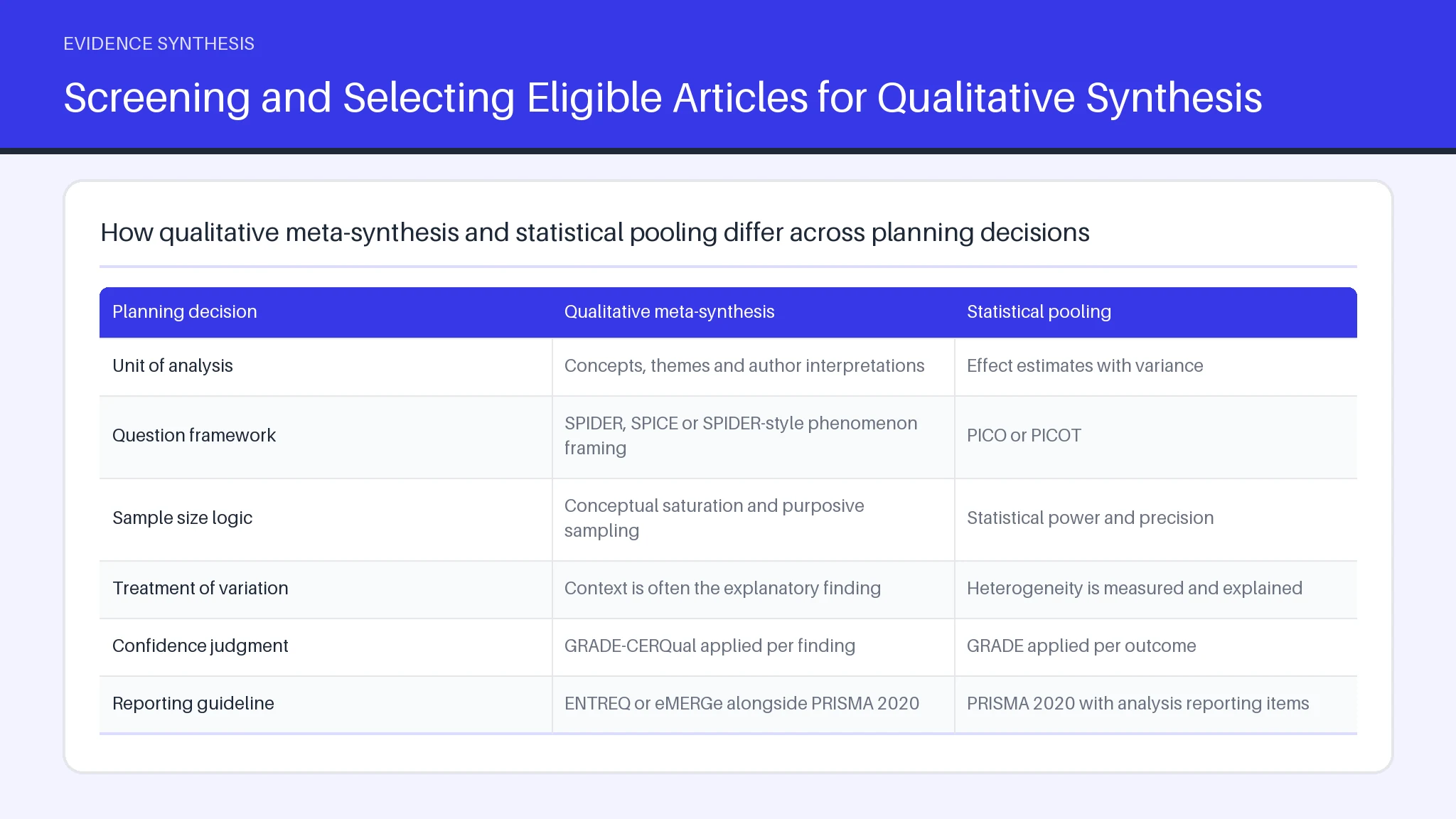
The table below sets out how the interpretive and statistical traditions differ on the points that most affect planning, and it is also a compact entry into meta-synthesis quality analysis research systems 2026 as a workflow question.
| Planning decision | Qualitative meta-synthesis | Statistical pooling |
|---|---|---|
| Unit of analysis | Concepts, themes and author interpretations | Effect estimates with variance |
| Question framework | SPIDER, SPICE or SPIDER-style phenomenon framing | PICO or PICOT |
| Sample size logic | Conceptual saturation and purposive sampling | Statistical power and precision |
| Treatment of variation | Context is often the explanatory finding | Heterogeneity is measured and explained |
| Confidence judgment | GRADE-CERQual applied per finding | GRADE applied per outcome |
| Reporting guideline | ENTREQ or eMERGe alongside PRISMA 2020 | PRISMA 2020 with analysis reporting items |
Treat the right-hand column as adjacent context. The mechanics of pooling sit in the meta-analysis guide; what matters here is that the two traditions ask structurally different questions and should not be judged by each other's standards.
How Many Studies Does a Qualitative Evidence Synthesis Need?
There is no fixed minimum, but most published reviews sit between roughly 10 and 40 primary studies, and the defensible answer is set by conceptual saturation rather than by a count. Qualitative evidence synthesis is the systematic combination of findings from several primary studies that address a related question, carried out with a documented search, explicit eligibility criteria and a transparent analytic method. Because the goal is interpretive depth rather than precision, adding studies stops helping once new papers no longer alter or extend the emerging concepts.
In practice three numeric zones matter. Below about six studies, a synthesis can still be publishable when the phenomenon is rare and the included papers are conceptually rich, but the review should be framed as an early mapping rather than a stable account. Between roughly 10 and 40 studies, most teams reach saturation on their central concepts while keeping the full dataset readable. Above about 40, the practical constraint bites: close line-by-line reading of several hundred pages of results sections becomes unmanageable for a small team, and sampling becomes the honest response. Reviewers often cite 12 to 15 as the point at which a meta-ethnography starts producing a genuinely new interpretation, but that figure describes typical experience, not a threshold anyone should treat as a rule.
Purposive sampling within a large retrieved set is legitimate and under-used. Rather than include every eligible paper, a team can sample for maximum variation across setting, population and date, or sample for conceptual richness by scoring how much interpretive material each paper offers. The requirement is that the sampling frame is stated before sampling, the criteria are reported, and the excluded studies are listed so readers can assess the choice. Researchers who sample silently invite the charge that the synthesis was shaped to fit a conclusion.
How many studies you need for a qualitative meta-synthesis also depends on which approach you have chosen. The main approaches to qualitative evidence synthesis fall into three families. Interpretive approaches, led by meta-ethnography, translate concepts between studies to generate new theory and work best with a smaller, conceptually dense set. Integrative or descriptive approaches, including thematic synthesis and framework synthesis, organize findings into descriptive and then analytical themes and tolerate larger, more heterogeneous pools. Aggregative approaches, chiefly meta-aggregation, pool findings into statements of actionable guidance and suit well-populated questions where practice recommendations are the point. A fourth group, including critical interpretive synthesis and realist synthesis, works across mixed study types when the question concerns mechanisms rather than experience alone.
Two further practical points rarely appear in the top-ranking discussions. First, count findings rather than papers when you justify sufficiency: a single ethnography may yield 40 coded findings while a brief mixed-methods paper yields two, so a study count overstates how much data a thin set actually contains. Second, record saturation as an event with a date and a study number in your coding log. Writing that concepts stabilized after the twenty-second study, with the following four studies adding only confirmatory material, lets readers assess the claim instead of taking it on trust. That record also feeds directly into the adequacy-of-data component when you assess confidence with GRADE-CERQual, and it is a core artifact of meta-synthesis quality analysis research systems 2026 as practiced by careful review teams. Statistical minimums for pooling are a separate question and are covered in the meta-analysis guide.
What Makes Meta-Ethnography Different From Other Synthesis Methods
Meta-ethnography is distinguished by translation: it treats the interpretations in each paper as accounts to be translated into one another rather than as data to be sorted into categories. Noblit and Hare set out the approach in 1988 for educational research, and health researchers adopted it because it produces explanatory theory rather than a tidier restatement of what the primary authors already said. The method runs through seven phases, from getting started and deciding what is relevant, through reading the studies and determining how they are related, to translating the studies into one another, synthesizing translations, and expressing the synthesis.
The analytic engine sits in three relationships between papers. Reciprocal translation applies when accounts are broadly congruent and one study's concept can stand in for another's. Refutational translation applies when accounts contradict each other, and the synthesis has to explain the contradiction rather than average it away. Lines-of-argument synthesis builds a whole from the parts by asking what the set of studies together implies about the phenomenon. Refutational translation is the phase most often skipped, and skipping it is the most common reason a published meta-ethnography reads like a thematic summary with different vocabulary.
Three features separate meta-ethnography from other synthesis methods in day-to-day work. It is iterative, so the inclusion criteria can legitimately shift as the conceptual focus sharpens, provided the shift is documented. It depends on conceptual density, which is why many teams apply criteria that favor papers with substantial interpretive content over papers with a single table of quotations. And it is labor-intensive: translating 20 studies demands repeated close reading that cannot be delegated to a screening pass. Teams that want a smaller analytic commitment across a broader set of qualitative studies should use a different method rather than a diluted version of this one.
For meta-synthesis quality analysis research systems 2026, the practical consequence is that meta-ethnography needs its own audit trail. A reader should be able to see the translation tables, the order in which studies were compared, and the point at which each third-order construct emerged. Qualitative analysis of this kind is reconstructable only if the intermediate products survive, which is why the eMERGe reporting guidance was written specifically for meta-ethnography rather than left to generic checklists.
Reporting Standards That Govern Qualitative Synthesis Write-Up
Three instruments govern the write-up of a qualitative synthesis, and they do different jobs. ENTREQ, published in 2012, is a 21-item statement covering the reporting of qualitative evidence synthesis from research question through to synthesis output. eMERGe, published in 2019, is the meta-ethnography reporting guidance built around the seven phases of that specific method. GRADE-CERQual is not a reporting guideline at all but a framework for judging how much confidence to place in each individual review finding, assessed across methodological limitations, coherence, adequacy of data and relevance.
PRISMA 2020 still applies to the search and selection half of the review. The flow of records, the databases queried, the date ranges and the reasons for exclusion are reported the same way they are in a quantitative review, and our PRISMA 2020 guide covers the checklist and diagram in detail. The common error is assuming PRISMA replaces ENTREQ or that ENTREQ replaces PRISMA. They cover different halves of the paper, and most journals expect both: PRISMA for the search, ENTREQ or eMERGe for how findings were produced and interpreted.
Researchers also need to decide which appraisal tool they will name in the methods and then actually use consistently. The CASP qualitative checklist is widely applied and easy for reviewers to recognize, though it was not designed to produce a score. Other instruments assess methodological rigor more systematically across sampling, reflexivity and analytic transparency. Whichever you choose, report the per-study judgments in an appendix rather than a single aggregate grade, because a reader needs to know which of your findings rest on the thinner papers.
Two reporting habits improve a qualitative synthesis more than any checklist compliance. State the review team's disciplinary backgrounds and prior positions on the topic, since interpretation is not independent of who performed it. And present each finding with its supporting studies named, its CERQual confidence rating and a short explanation of the rating. Unlike quantitative outcome reporting, where a pooled estimate carries its own precision, a qualitative finding carries no internal signal of how well supported it is. Making that support explicit is what separates a defensible synthesis from an essay with citations, and it is the reporting core of meta-synthesis quality analysis research systems 2026.
Screening and Selecting Eligible Articles for Qualitative Synthesis
Screening for a qualitative synthesis fails most often on one definitional problem: deciding what counts as a qualitative finding. A paper may be labeled qualitative in its abstract while reporting only three participant quotations inside a trial process evaluation, and a paper may contain rich interpretive material while describing itself as mixed-methods. Eligibility criteria therefore need to state a minimum data requirement, such as a results section presenting participant accounts with author interpretation, rather than relying on the study-design label alone.
Database filters are weaker here than in trial searching. Qualitative study design terms are inconsistently indexed, authors use varied vocabulary for the same methods, and sensitivity drops sharply when a team leans on a single published filter. Practical compensation involves searching several databases including at least one with strong coverage of nursing and allied health, running separate searches for method terms and for phenomenon terms, and adding citation chasing in both directions plus hand-searching the reference lists of existing reviews. Expect gray literature and theses to contribute meaningfully, because conceptual chapters often never reach journal publication.
At full-text stage, researchers should extract alongside screening rather than after it. Reading a paper closely enough to judge eligibility already reveals how much interpretive material it contains, so teams that capture a richness note during screening save a second reading pass later. Record for each included paper the method named, the theoretical framework used, the setting and the approximate number of distinct findings. That record supports purposive sampling if the included set turns out too large to read closely.
Dual independent screening remains the standard, with disagreements resolved by discussion rather than by a third-party tiebreak, because disagreements about qualitative eligibility usually reveal an ambiguity in the criteria that needs fixing. A short calibration exercise on 30 to 50 abstracts before full screening exposes those ambiguities early. The step-by-step mechanics of two-reviewer screening are covered in our guide to screening studies for a systematic review, and workflow support across platforms is compared in our tools comparison.
One decision deserves explicit documentation: whether appraisal results affect inclusion. Many teams include all eligible papers regardless of appraisal outcomes and handle quality through sensitivity analysis instead, which preserves conceptual contributions from methodologically thinner work while showing readers which findings depend on it.
Visual Presentation of Findings in Health Metasynthesis
Visual presentation in health metasynthesis exists to show which studies support which findings and how the findings relate to each other. Because there is no forest plot to anchor the result, readers rely on tables and diagrams to see the evidentiary structure, and a synthesis that presents only narrative prose asks readers to take the analysis on trust.
Four displays carry most of the load. A findings-by-study matrix lists each review finding down the rows and each included paper across the columns, marking which papers contributed to each finding; it immediately exposes findings supported by a single study. A summary of qualitative findings table, the CERQual equivalent of a GRADE summary table, pairs each finding with its contributing studies, its confidence rating and a short explanation. A conceptual map or line-of-argument diagram shows how third-order constructs connect, which is the only practical way to communicate an explanatory model built from multiple papers. A translation table, specific to meta-ethnography, shows how a concept from one study maps onto concepts in the others.
Captions and labels matter more than visual polish. Each figure should state what the display compares, how many studies contributed, and whether the arrangement is chronological, conceptual or hierarchical. Readers of a systematic review will scan a figure for the number of supporting studies before they read the surrounding text, so put that count where it can be found.
Two cautions apply. First, a diagram never replaces the semantic table or the written account of the findings; screen readers and text extraction tools need the tabular version, and journals increasingly require it. Second, resist displays that imply quantification. Counting how many qualitative studies mentioned a theme and charting the totals converts an interpretive result into a pseudo-frequency claim, because the denominator is the set of papers that happened to report that material rather than the set in which it occurred. If prevalence is the question, the review needed a different design.
Suggested placements for this article: a conceptual diagram comparing interpretive, integrative and aggregative synthesis families, placed near the decision framework, with alt text naming the three families and their outputs; and a findings-by-study matrix schematic near this section, with alt text describing rows as review findings and columns as included studies.
Choosing the Right Synthesis Approach: A Decision Framework
The synthesis approach follows from four inputs: the purpose of the review, the maturity of the literature, the conceptual density of the available papers, and the analytical capacity of the team. Working through those four in order produces a defensible choice faster than reading comparative methodology papers in the abstract.
Start with purpose. If the review must produce actionable statements for practice or policy, meta-aggregation fits, because it is designed to move from findings to categories to synthesized statements without adding new interpretation. If the review must explain a phenomenon or generate theory, meta-ethnography fits. If the review must describe and organize what is known in a field with no settled framework, thematic synthesis fits. If the question concerns how and why an intervention works across contexts, a realist or critical interpretive approach handles the mix of study types better than any purely descriptive method.
Next, assess literature maturity against the available papers. A field with 60 descriptive interview studies and no theoretical framework rewards descriptive organization; a field with 14 conceptually dense ethnographies rewards translation. Teams sometimes choose meta-ethnography for prestige and then discover their included papers offer no second-order constructs to translate, which produces a thin result whatever the method label says.
Then apply practical criteria. Line-by-line coding of multiple qualitative studies in thematic synthesis scales to larger sets but requires sustained coding discipline and a shared codebook. Meta-ethnography scales poorly beyond about 25 papers for a two-person team. Meta-aggregation needs findings that the original authors stated clearly enough to be extracted verbatim with their supporting illustrations, which rules out papers whose results sections blur description and discussion.
Finally, write the choice into the protocol with the criteria that produced it, along with the appraisal tool and the reporting guideline. Methodological drift during analysis is common and acceptable when it is documented; it is indefensible when the published methods section describes a method the team abandoned. Our guide on methodology versus methods covers how to phrase that justification, and the broader systematic review methodology guide sets the surrounding process in context.
One trade-off the ranking pages rarely state plainly: aggregative methods deliver outcomes that practitioners can act on but add little theory, while interpretive methods generate theory that is harder to implement directly. Choosing one means accepting the other's absence, and saying so in the discussion section is more credible than claiming both. A pooled statistical layer, if the question also has a quantitative arm, belongs in the separate strand described in our meta-analysis guide.
Published Reviews Built on Thematic Synthesis and Meta-Aggregation
Thematic synthesis sits between description and interpretation, which is precisely why it is the most used method in applied health reviews. Thomas and Harden set it out in 2008 as a three-stage procedure: line-by-line coding of the text of findings in the primary studies, organizing those free codes into descriptive themes that stay close to what the original authors reported, and then generating analytical themes that go beyond the primary studies to answer the review question. The third stage is where the interpretive work happens, and it is the stage weakest reviews truncate, stopping at descriptive themes and presenting them as a result.
The method earned its position because it maps cleanly onto the rest of systematic review practice. Coding the findings text line by line is a concrete, teachable task that two reviewers can perform independently and compare. The descriptive-to-analytical progression gives a visible audit trail from quotation to conclusion. And because thematic synthesis tolerates methodological variety among included papers, it handles the mixed pool that most searches actually return rather than requiring conceptually dense ethnographies.
Meta-aggregation, developed within the Joanna Briggs Institute tradition, takes a different stance. It extracts findings verbatim with their illustrations, rates each one for how well the illustration supports it, groups findings into categories, and then combines categories into synthesized statements written as guidance. The approach deliberately avoids reinterpretation, on the grounds that practitioners need statements they can act on and that adding a reviewer's interpretation on top of the authors' interpretations widens the distance from participants. Reviews using it typically report their synthesized statements alongside a ConQual rating rather than a CERQual one.
Published reviews in both traditions share recognizable features worth copying. They state the number of included qualitative studies and the number of extracted findings separately. They publish their coding framework or category structure as an appendix. They assess confidence in each finding rather than in the review as a whole. And they name the conceptual limits of the included literature, for example that all studies came from high-income urban settings, so readers can judge transferability instead of guessing.
A frequent mistake in applied reviews is treating thematic synthesis as interchangeable with thematic analysis of primary data. Review teams who make that substitution end up coding participant quotations extracted from papers as though they were their own interview transcripts, which strips those accounts of the analytic context the original researchers provided and quietly overweights studies that happened to print long quotations. Coding the authors' findings text, quotations included but in context, keeps the analysis anchored to what each paper actually reported and keeps the resulting outcomes traceable back to their sources.
Published Meta-Ethnographies That Generated New Theory
The meta-ethnographies that changed practice share one trait: they produced a model that no included study contained. Rather than reporting that patients found a treatment burdensome, they explained the structure of that burden and the conditions under which it tipped into nonadherence. That is the test of whether a translation-based methodology earned its cost, and it is a test many published reviews labeled meta-ethnography do not pass.
The best known examples in health research built explanatory accounts of how people live with long-term conditions, how patients decide whether to take prescribed medicines, and how stigma shapes help-seeking. In each case the analytical contribution came from the lines-of-argument phase, where the review team asked what the set of studies together implied rather than what each study said. The resulting conceptual frameworks were then tested and extended by later primary research, which is the clearest available evidence that a synthesis of multiple qualitative studies can function as theory rather than summary.
Reading those reviews for method rather than content yields several transferable habits. They report how many studies entered each translation and in what order, so the reader can follow the reasoning. They state refutational cases explicitly instead of smoothing contradictions, and they use those contradictions to specify the boundary conditions of the model. They include a reflexivity statement naming the team's disciplines and prior commitments. And they publish translation tables, which is the single artifact that lets an outside reader verify that third-order constructs were derived rather than asserted.
Three systematic cautions follow for anyone planning similar work. A translation-based synthesis across multiple qualitative papers cannot be rescued by sample size; adding studies to a thin conceptual pool produces a longer thin review. Criteria that privilege conceptual richness during selection have to be declared in the protocol, because applying them silently looks like selective inclusion. And the final model should be presented as a hypothesis for testing rather than a settled finding, since no amount of interpretive rigor substitutes for the quantitative or further qualitative work needed to check whether the model holds elsewhere. Teams that want the methodological reasoning behind these choices written out for examiners will find the framing in our guide to writing a research question useful at the planning stage.
Frequently asked questions
What is a meta-synthesis?
A meta-synthesis is a review method that combines the findings of several primary qualitative studies into a new, higher-order interpretation. It follows the same process discipline as any systematic review, with a documented search, explicit eligibility rules and dual screening, but its analysis translates and integrates concepts rather than pooling numbers. The output is a set of interpretive findings, often accompanied by a model or line of argument, each one linked to the studies that support it and rated for confidence.
Why do a meta-synthesis at all?
The reason to do one is that single qualitative studies are usually small, local and bounded by one setting, which limits what any of them can support on its own. Bringing them together tests whether a finding recurs across populations and contexts, surfaces contradictions that explain why an intervention works in one place and not another, and can produce an explanatory account that informs guideline development alongside effectiveness evidence. It also makes existing research go further: dozens of interview studies sit unused in the literature because no one has read them against each other.
Can I include mixed-methods or low-quality studies in a meta-synthesis?
Mixed-methods studies can be included when the qualitative strand is reported in enough detail to extract findings with their supporting data, and the usual practice is to extract only that strand. Low-quality studies are a judgment call rather than an automatic exclusion. Many teams include all eligible papers and handle quality through two mechanisms instead: a per-study appraisal reported in an appendix, and a sensitivity analysis that removes the thinner papers and checks whether any finding collapses. That approach keeps conceptual contributions from methodologically weaker work while telling readers exactly which conclusions depend on it. State your policy in the protocol, because deciding after you have seen the findings is where bias enters.
What is a qualitative systematic review?
A qualitative systematic review is a review that applies systematic review process standards, including a protocol, a documented search, dual screening, structured extraction and critical appraisal, to a body of qualitative primary research. In common use the term covers reviews that describe and organize qualitative findings without necessarily generating new theory, while meta-synthesis and meta-ethnography describe the more interpretive end of the same spectrum. Journals and readers use the labels loosely, so name both your review type and your synthesis method in the methods section rather than relying on the title to carry that information.
Which question framework should you use?
Use SPIDER or SPICE rather than PICO for experiential questions. SPIDER covers Sample, Phenomenon of Interest, Design, Evaluation and Research type, which fits questions about lived experience and keeps the search structured around a phenomenon rather than an intervention and comparator. SPICE covers Setting, Perspective, Intervention, Comparison and Evaluation and works well for service delivery and implementation questions. PICO remains the right frame when the review has a quantitative arm, and our PICO question guide covers that case. Whichever you pick, report it, because reviewers will check whether your search terms map to your stated framework.
What reporting guideline should I use for meta-synthesis?
Use ENTREQ for general qualitative evidence synthesis and eMERGe when the method is meta-ethnography, and report the search and selection with PRISMA 2020 in both cases. Apply GRADE-CERQual to rate confidence in each finding, or ConQual if you are working in the meta-aggregation tradition. Check the target journal's instructions before you write, since some specify a particular combination, and list the guidelines you followed in the methods section with a completed checklist as supplementary material.
How does this differ from primary thematic analysis?
Meta-synthesis differs from primary thematic analysis in what it codes and what it can claim. Primary analysis codes raw data the researchers collected themselves, with direct access to context, tone and the chance to probe further. A synthesis codes published findings, which are already the product of another team's interpretation and selection, so it works at one remove from participants and inherits every reporting decision the original authors made. That distance is why synthesis methods separate first-order, second-order and third-order constructs, why they report which studies support each finding, and why they treat the volume and richness of available findings as a limitation to be stated rather than a resource to be assumed.