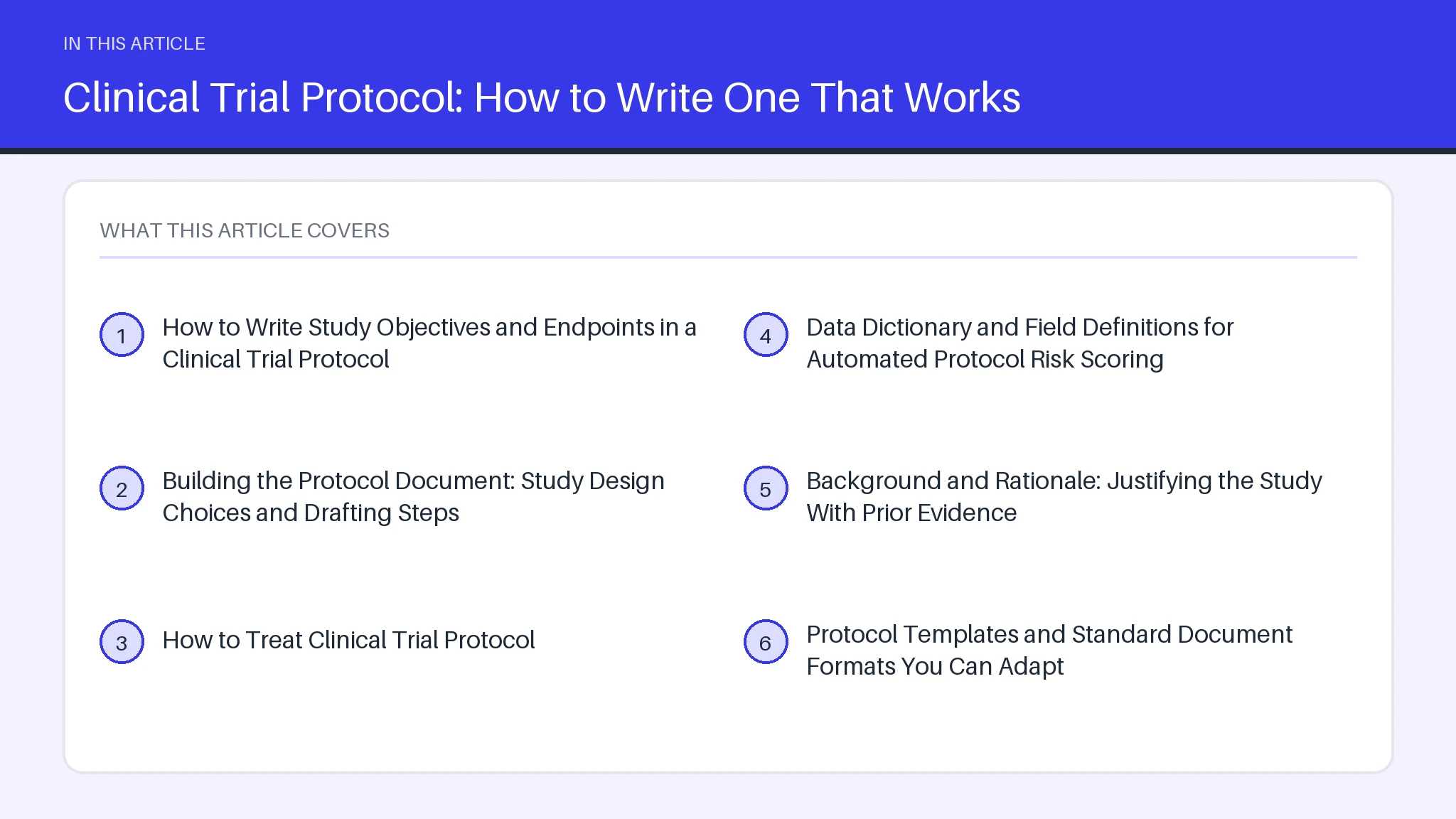
Clinical Trial Protocol: How to Write One That Works
A clinical trial protocol is the complete written plan for a clinical study: what question the study asks, who may take part, what will be done to them and when, how safety will be watched, and how the results will be analyzed. It functions as a contract between the sponsor, the investigators, the ethics committee, and the regulator. Once approved, the document governs the conduct of the study, and anything done outside it counts as a deviation.
By the end of this page you should be able to tell a strong protocol from a weak one, draft the sections that reviewers scrutinize most, and understand the trade-offs behind common design choices. It is written for clinical research associates, early-career investigators, medical writers preparing a first submission, and evidence synthesists who read protocols to judge whether a published trial matched its plan.
The emphasis here is practical. Rather than restating the standard table of contents that every template already supplies, this guide explains how objectives drive endpoint selection, how the schedule of assessments creates hidden operational burden, how risk-based monitoring plans map to protocol fields, and where a clinical trial protocol usually fails review. If you work downstream of trials rather than inside them, the same logic explains why prospective registration and protocol availability matter so much when appraising published evidence, a point covered in more depth in our research methods guide.
Key takeaways
- A clinical trial protocol is the controlling document for a study: it fixes the objectives, the eligibility criteria, the schedule of assessments, the safety reporting rules, and the analysis plan before the first participant is enrolled.
- Write objectives first, then endpoints, then procedures. Every visit, sample, and questionnaire in the schedule should trace back to a stated objective, or it should be cut.
- Primary, secondary, and exploratory endpoints carry different evidentiary weight. Only the primary endpoint is normally powered and alpha-protected; exploratory results are hypothesis generating.
- Standard templates from public funders and regulators cover structure, not content. Adapting one saves review time but does not remove the need for study-specific justification.
- Amendments, deviations, and unclear wording are the main sources of avoidable delay, so ambiguous phrasing in a protocol should be resolved before submission rather than in a later revision.
How to Write Study Objectives and Endpoints in a Clinical Trial Protocol
Study objectives state the scientific question in one sentence each; endpoints state the measurement that answers it. Write them in that order. An objective such as "to determine whether the investigational agent reduces hospitalization in adults with heart failure" tells the reader the purpose of the clinical study. The matching endpoint then fixes the variable, the method of measurement, the timing, and the analysis metric: all-cause hospitalization within 52 weeks of randomization, compared as a hazard ratio. When the two are written together, reviewers can see whether the measurement can actually support the claim.
Before you draft, you need three things on hand: the completed background and rationale, a defensible estimate of effect size and event rate for the sample size calculation, and the regulatory guidance relevant to your indication. Without the second, no statistician can size the study, and the whole document stalls.
A well-formed endpoint definition specifies the population analyzed, the time window, how missing datum points are handled, and who adjudicates the measurement. Vague constructions such as "improvement in symptoms" invite queries from ethics and regulatory reviewers and often force an amendment later. The essential elements of a clinical trial protocol are visible here in miniature: a clear question, a measurable answer, and a pre-specified rule for deciding. Publicly posted example documents, including the sort of clinical trial protocol example PDF that funders and academic sponsors release, are useful mainly for seeing how these fields are worded in practice.
One practical consideration is burden. Every additional endpoint adds visits, forms, and sites queries. Outline the endpoint set deliberately rather than collecting every measure a team member suggests.
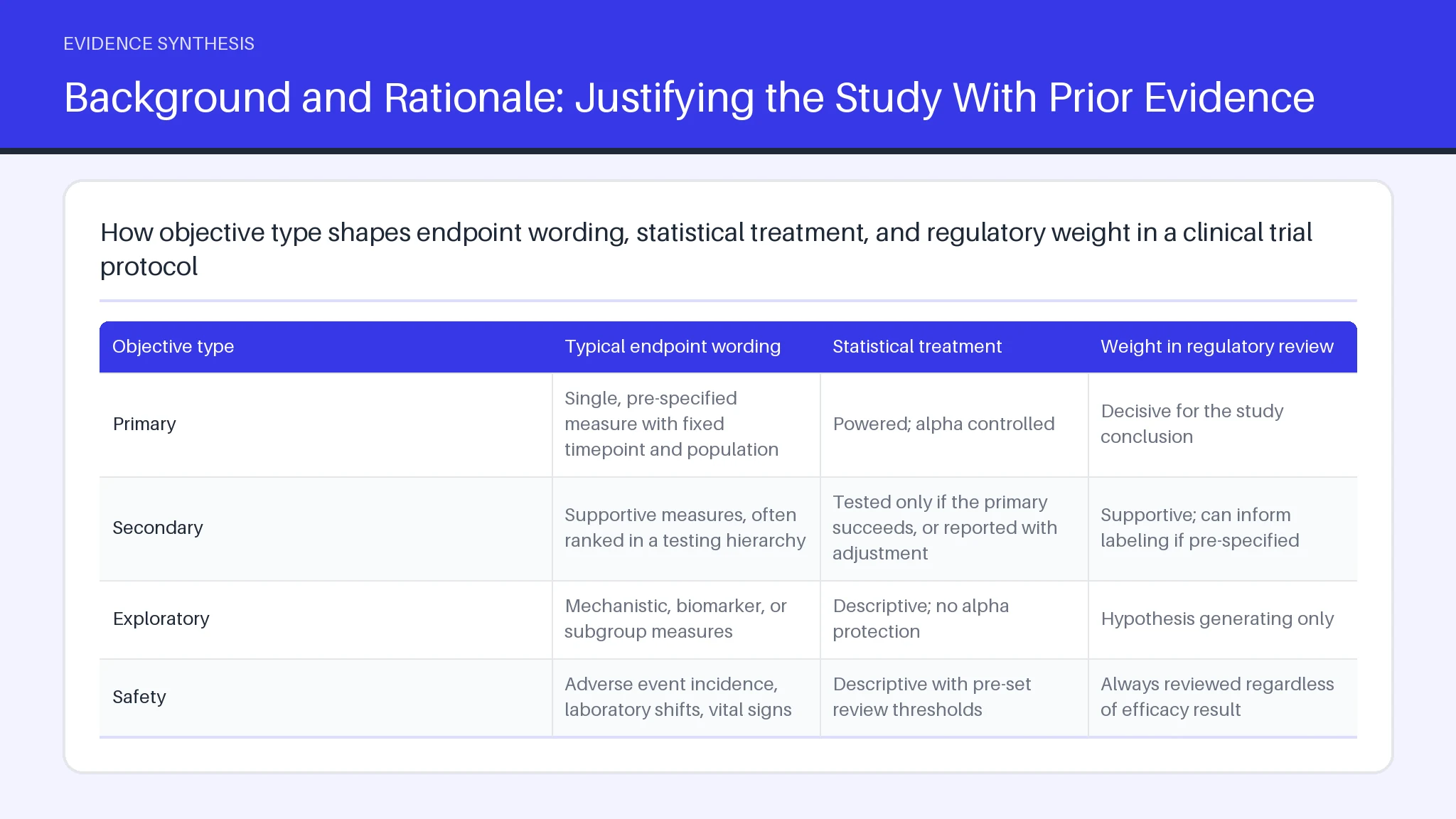
| Objective type | Typical endpoint wording | Statistical treatment | Weight in regulatory review |
|---|---|---|---|
| Primary | Single, pre-specified measure with fixed timepoint and population | Powered; alpha controlled | Decisive for the study conclusion |
| Secondary | Supportive measures, often ranked in a testing hierarchy | Tested only if the primary succeeds, or reported with adjustment | Supportive; can inform labeling if pre-specified |
| Exploratory | Mechanistic, biomarker, or subgroup measures | Descriptive; no alpha protection | Hypothesis generating only |
| Safety | Adverse event incidence, laboratory shifts, vital signs | Descriptive with pre-set review thresholds | Always reviewed regardless of efficacy result |
Building the Protocol Document: Study Design Choices and Drafting Steps
Design choices come before drafting, because the design determines which sections need the most work. Decide the allocation method, the comparator, the blinding level, and the number of arms first, then define eligibility, then build the schedule of assessments. A parallel-group randomized design keeps the statistical analysis simple and the interpretation clean. A crossover design reduces the participant count but adds carryover assumptions. An adaptive design can shorten timelines but requires pre-specified decision rules and a far more detailed simulation section.
Draft in this order: background, objectives and endpoints, design, population, interventions, schedule of assessments, safety and monitoring, statistical methods, then administrative and regulatory sections. Working backward from the schedule table is a common mistake; it produces visits nobody can justify.
Two aspects that reviewers test hard are the handling of missing datum and the stopping rules. State both explicitly. Also state how you will record and report protocol deviations in clinical trials, since a plan with no deviation process looks unprepared. Teams comparing clinical trial protocol solutions usually find the bottleneck is version control across reviewers rather than writing, and a clinical trial protocol example PDF from a public repository is often faster to adapt than starting blank. Ask a colleague outside the therapeutic area to evaluate the draft for plain-language clarity.
How to Treat Clinical Trial Protocol
Treat the protocol as a living, version-controlled instrument rather than a document you finish and file. Every approved version carries a number and date, every site must work from the current one, and every change to eligibility, dosing, or the assessment schedule needs a formal amendment with ethics and regulatory approval before implementation. Administrative changes such as a new contact address can usually go through a lighter route, but the distinction should be written into the document itself.
Practically, a sponsor should maintain a single controlled master file, a change log that records what changed and why, and a training record showing which staff were trained on which version. Each investigator and researcher on the delegation log should be able to name the current version without checking. When monitoring visits identify drift between practice and the written plan, the correct response is either retraining or an amendment, not silent tolerance.
Keep the analysis stable too. If you revise the statistical approach or the definition of a key datum field after unblinding, the credibility of the result falls sharply. Amend before data lock, document the rationale, and record every deviation with its assessment of participant impact. Applicable regulation in most jurisdictions requires that safety-relevant amendments be implementable immediately to protect subjects, with notification to follow. A publicly available clinical trial protocol example PDF will typically show this amendment history on its cover pages.
Data Dictionary and Field Definitions for Automated Protocol Risk Scoring
A data dictionary turns a narrative protocol into structured fields that software can score for operational and compliance risk. Instead of reading 80 pages, a reviewer checks whether each required field is populated and whether its value falls inside an acceptable band. This is where clinical trial protocol software earns its place: the scoring is only as good as the field definitions behind it.
Useful fields include design type, number of arms, blinding level, total visit count, visits per participant per month, number of invasive procedure events, cumulative blood volume, count of distinct laboratory assays, presence of a data monitoring committee, adverse event reporting window in hours, and the count of eligibility criteria. Each needs a written definition, a data type, an allowed range, and a source location in the document.
Risk weighting then follows the operational logic teams already use. A high eligibility criterion count predicts slow recruitment. A dense assessment schedule predicts missed visits. A missing independent safety review flags an ethic and governance gap. A vague statistical section predicts analysis-stage queries. Scores should prompt a human assessment, not replace it. Record the primary objective and the investigator delegation requirement as mandatory non-null fields, because a protocol missing either will fail review regardless of how well the rest scores.
Background and Rationale: Justifying the Study With Prior Evidence
The background section must show that the question is still open and that the proposed study is the right way to close it. That means summarizing what prior trials found, where they disagreed, and what remains uncertain, then linking that gap directly to your objective. A reviewer reading the rationale should be able to see why an existing body of evidence does not already answer the question, and why exposing new volunteers to study procedure and risk is justified.
Strong backgrounds cite a transparent evidence base rather than a convenience selection of supportive papers. Where a structured synthesis already exists, reference it and state its limitations; if one does not, a brief structured search of the literature is a defensible way to demonstrate equipoise, and the methods in our systematic reviews guide transfer directly to that task. Include known safety signals and the adverse event profile from earlier phases, even unflattering ones.
Ethics committees read this section to test the risk-benefit balance, so a research protocol that hides prior negative findings creates an avoidable ethic problem. The core element is honesty about uncertainty. Note also that a thin rationale is a documented predictor of later trouble, because underjustified assessments generate protocol deviations in clinical trials once sites find them impractical, and every GCP requirement about scientific soundness starts here.
Protocol Templates and Standard Document Formats You Can Adapt
Standard templates exist because reviewers read hundreds of documents and benefit from predictable ordering. Public research funders, national health agencies, and international harmonization bodies publish structures that cover the same core sections: synopsis, background, objectives and endpoints, design, eligibility criterion sets, interventions, schedule of assessments, safety reporting, statistics, quality control, ethic and consent arrangements, and data handling. Academic sponsors also publish therapeutic-area variants, for example a clinical trial protocol template phase i/ii gene therapy hemophilia format that adds long-term follow-up and immunogenicity sections.
Adapting a template saves drafting time and reduces the chance of omitting a mandated section. The limitation is that templates standardize headings, not thinking. Reviewers routinely receive documents where the boilerplate is intact but the study-specific content is thin, and that combination attracts more queries than a plain document with well-reasoned content.
When choosing between formats, the practical consideration is who will review it. Match the template your ethics committee and regulator expect, and keep one master outline across a program so that safety reporting language, adverse event definitions, and consent procedure text stay consistent between studies. Check that each template field maps to something your site staff and each investigator can actually perform, and that the participant-facing outcome measures and their assessment windows remain realistic. Teams evaluating clinical trial protocol solutions should confirm the tool supports their required template rather than imposing its own.
Download a Sample Clinical Trial Protocol to Use as a Model
Sample protocols are freely available from public sources, and they are the fastest way to learn house style. National health research agencies, large academic trial units, and journals that require protocol publication all release full documents. Many registries now host the approved document alongside the registration record, and several major journals publish the protocol and statistical analysis plan as supplements to primary results papers. Those supplements are especially useful because you can read the plan and the published result side by side.
Read a sample with a checklist rather than passively. Confirm that the primary endpoint in the document matches the registry entry, that the eligibility criterion list is short enough to recruit against, that the safety section gives a specific reporting window for each adverse event category, and that the ethical review and consent sections name who obtains consent and how capacity is assessed. Check that the schedule of assessments does not involve procedures with no stated purpose.
What a sample cannot give you is your own justification. Copying a sponsor's design without rebuilding the sample size calculation and the regulatory sections produces a document that reads plausibly and fails review. If you evaluate clinical trial protocol design software, test it against a real sample rather than a demo file, and outline which sections you still expect to write manually.
Primary, Secondary and Exploratory Endpoints: How They Differ
The three endpoint tiers differ in how much statistical protection they receive and therefore how much the result can be claimed. The primary endpoint is the single measure the study is powered to detect, it controls the type I error rate, and it decides whether the trial met its objective. Secondary endpoints are pre-specified and often ranked in a hierarchy, so they can support a conclusion when tested in order, but they cannot rescue a failed primary. Exploratory endpoints have no alpha protection and generate hypotheses only.
Getting the tiers right prevents the most common misreading of trial results, where a positive exploratory finding is reported as if it were confirmatory. State for each endpoint the analysis population, the timepoint, the handling of missing datum, and the measurement procedure. Each datum definition should be precise enough that two independent statisticians would produce the same number.
There is an ethical dimension as well. Burdening participants with measures that no analysis will use is hard to justify, so a sensible criterion for inclusion is whether the result will change a decision. Regulatory reviewers also expect the endpoint hierarchy to be fixed before unblinding, and some protocol design software will lock the hierarchy for exactly that reason. Long-term programs such as a protocol template phase i/ii gene therapy hemophilia structure often involve durability endpoints measured years after dosing, which must be outlined at the start.
Practical Tips for Writing a Clear, High Quality Protocol
The most reliable quality test is whether a site coordinator can run the study from the document alone, without phoning the sponsor. Write to that standard. Use one term per concept throughout, put every visit into a single schedule table with tolerance windows, and give each procedure a stated purpose. Number your sections so amendments can reference them precisely.
Common mistakes cluster in predictable places. Overlong eligibility lists slow recruitment. Assessment windows that are too narrow create deviations on day one. Two different definitions of the same variable in different sections force a query. Vague safety language leaves staff unsure what to report and when. A statistical section written after the design is frozen often reveals that the study cannot answer its own question. Do not collect datum you have no plan to analyze, because every extra datum field adds monitoring and query work.
Three practical habits help: run a mock site visit against the draft, ask a statistician to sign off before ethics submission, and involve a patient representative in reviewing participant-facing burden. Outline all regulatory submission dependencies early, since approval sequencing often drives timelines more than writing does. Protocol software can help with version control and cross-reference checks, but clarity remains a writing decision.
Frequently asked questions
What are clinical trial protocols?
Clinical trial protocols are the formal written plans that govern how a clinical study is designed, conducted, monitored, and analyzed. Each one states the scientific question, the eligibility rules, the treatments and comparators, the schedule of visits and measurements, the safety reporting duties, and the pre-specified analysis. They are approved by an ethics committee and, for regulated products, by the relevant national authority before enrollment begins.
What are the 5 stages of clinical trials?
Clinical development is usually described in five stages: preclinical work in laboratory and animal models, phase I studies assessing safety and dosing in small groups, phase II studies assessing preliminary efficacy and dose selection, phase III studies comparing the intervention against standard care in larger populations, and phase IV post-marketing surveillance after approval. Each stage needs its own protocol, because the question, the population, and the risk profile change at every step.
Can you give me an example of a protocol?
A simple protocol example runs like this: in adults aged 40 to 75 with type 2 diabetes and an HbA1c between 7.5 and 10 percent, randomize one to one to drug A or placebo for 24 weeks, with the primary endpoint being change in HbA1c from baseline at week 24, visits at weeks 0, 4, 12, and 24, and laboratory safety panels at each visit. An oncology study protocol would replace that endpoint with progression-free survival by blinded independent review, with imaging every eight weeks. A cardiology trial protocol might use a composite of cardiovascular death, myocardial infarction, and stroke, adjudicated by an independent event committee.
What are the essential elements of a clinical trial protocol?
The essential elements are the synopsis, background and rationale, objectives and endpoints, study design, eligibility criteria, intervention and comparator details, the schedule of assessments, safety and adverse event reporting rules, the statistical analysis plan including sample size, data management and quality control, ethics and informed consent arrangements, and the publication and data sharing policy.
What are the 13 principles of GCP?
The 13 principles of Good Clinical Practice in the ICH E6 guideline cover ethical conduct under the Declaration of Helsinki, favorable risk-benefit balance, primacy of subject rights and safety, adequate supporting information, sound scientific protocol, ethics committee approval, qualified medical care, staff qualification, freely given informed consent, proper record handling, confidentiality, manufacture to Good Manufacturing Practice, and systems to assure quality.
What does a clinical trial protocol look like?
In physical terms, a protocol looks like a numbered document of roughly 40 to 120 pages opening with a signed title page and a one to two page synopsis, followed by numbered sections and a large schedule of assessments table, with appendices for consent language, laboratory manuals, and scoring instruments. Master protocols look different: they hold shared infrastructure and eligibility in a core document while individual sub-studies, sometimes called arms or appendices, test separate interventions under that single umbrella.
What information should be included in one?
Every protocol should include enough information for an independent team to repeat the study: the question and its justification, who can and cannot take part, exactly what is given and measured at each timepoint, how harms are captured and escalated, how the data will be analyzed and by whom, and how the findings will be reported regardless of outcome.