Research Paper: Structure, Sections and Writing Steps
A research paper is a structured document that states a question, explains how you investigated it, reports what you found, and argues what it means. It rests on evidence you collected, appraised, and cited rather than on personal opinion. That definition matters practically: every section of the paper exists to let a reader check your reasoning, and the reader can only do that if the structure is predictable.
This guide is for students writing a first term paper, graduate researchers preparing a manuscript for submission, and anyone who has been handed a brief and a word limit and is not sure what goes where. By the end you will know the standard section order, roughly how many words each part deserves, how to build an outline you can actually draft from, how to write an introduction that lands a thesis, and how to compress the whole thing into a working abstract.
The information most guides leave out is the sequencing of the work itself. The order sections appear in the finished paper is not the order you should write them in, and the choices you make in the first two hours, how you record searches, how you name files, how you log which claim came from which source, determine whether the final week is calm or chaotic. Those decisions are covered here alongside the format rules.
Methods-heavy work sits on top of this same skeleton. If your project involves systematic searching or pooled results, the research methods guide and the complete guide to systematic reviews go deeper on design and reporting than a general writing guide can. Start here for structure, then layer method-specific standards on top.
Key takeaways
- A research paper presents an argument built from evidence you gathered and analyzed yourself, which is what separates it from an opinion essay.
- Most papers use the same seven parts: title, abstract, introduction, methods, results, discussion, and references. Reviews and argumentative papers swap methods and results for a themed evidence section.
- Decide your section word budget before you draft. A 3,000 word paper usually splits roughly 10% introduction, 15% methods, 25% results, 30% discussion, with the remainder across abstract, conclusion, and references.
- Write out of order. Methods and results are the easiest first drafts; the introduction and abstract are far faster once you know what you actually found.
- Keep your citation manager, screening notes, and data extraction in one place from day one, because reconstructing a search trail at the writing stage is the single most common time sink.
What Sections Make Up a Research Paper
Seven parts make up a standard research paper: title page, abstract, introduction, methods, results, discussion, and references. APA style groups these into the same sequence and adds front matter conventions such as a running head, author note, and a reference list in hanging indent. The major sections of an APA paper are the title page, abstract, main body, and references, with the main body subdivided into introduction, method, results, and discussion.
Not every paper carries all seven in full. An argumentative paper or a course-length research term paper example will often replace methods and results with two or three themed evidence sections, each one grouped around a claim rather than a data set. What never disappears is the logic: you introduce a problem, you show your evidence, you interpret it, and you cite the sources that support it. A conclusion paragraph may sit inside the discussion or stand alone, depending on the style guide you follow.
The distinction from an essay is worth stating plainly, because it drives every formatting decision. An essay can argue from reasoning alone. A research paper has to show where each claim came from, which is why the reference list is a structural component and not an afterthought.
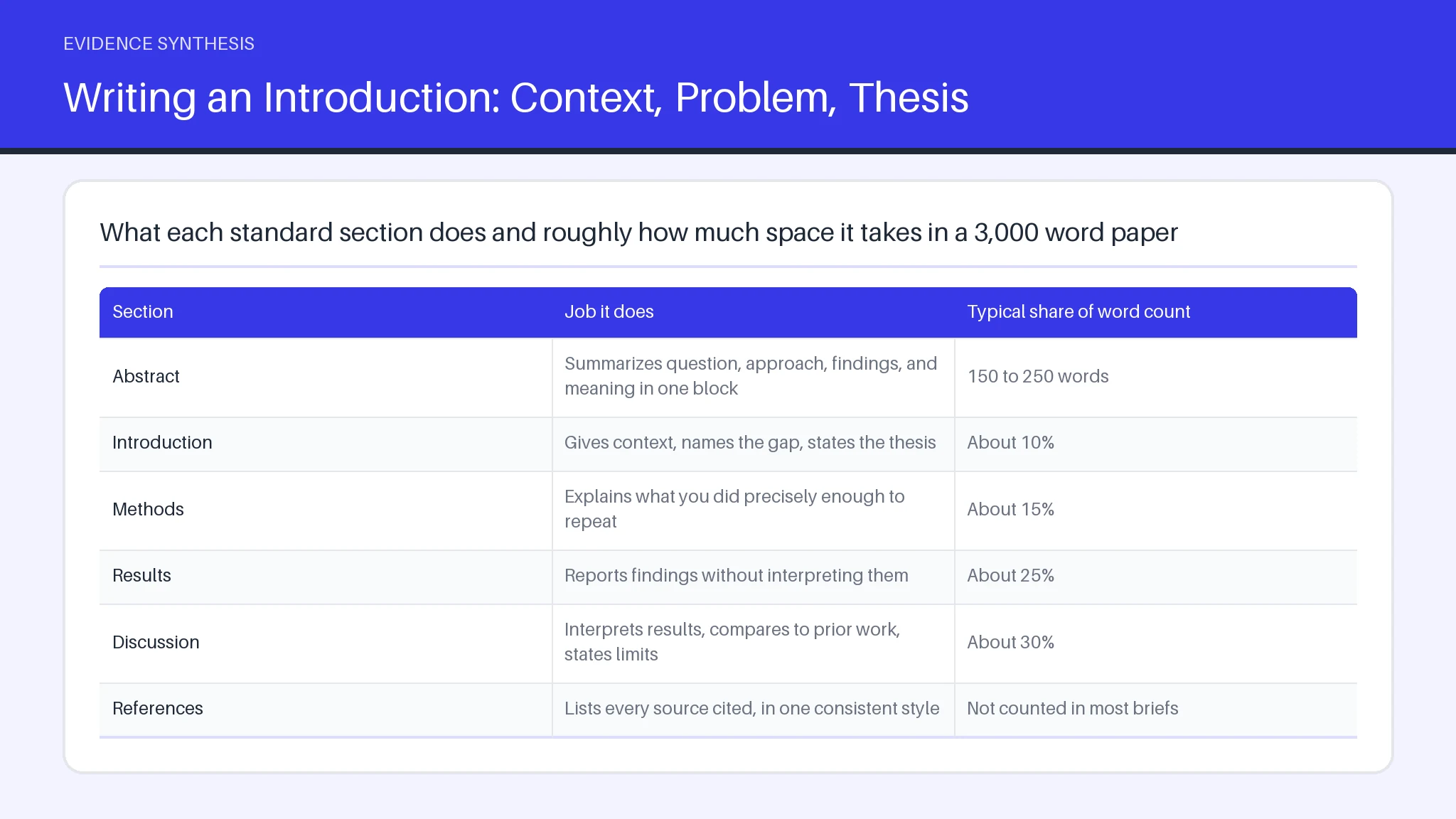
| Section | Job it does | Typical share of word count |
|---|---|---|
| Abstract | Summarizes question, approach, findings, and meaning in one block | 150 to 250 words |
| Introduction | Gives context, names the gap, states the thesis | About 10% |
| Methods | Explains what you did precisely enough to repeat | About 15% |
| Results | Reports findings without interpreting them | About 25% |
| Discussion | Interprets results, compares to prior work, states limits | About 30% |
| References | Lists every source cited, in one consistent style | Not counted in most briefs |
A definition in research paper terms is usually placed in the introduction, not in a glossary, so readers meet each key term the first time you use it.
Decoding Your Assignment Brief and Its Significance
An assignment brief tells you more than the deadline, and reading it closely saves rewriting later. Start by marking the verbs. "Evaluate" asks for judgment against criteria, "compare" asks for structured contrast, "investigate" expects primary data or a systematic search. A brief that says "critically discuss" and a brief that says "report" call for different proportions of evidence to interpretation, even at the same length.
Next, extract the constraints into a one-page checklist: word limit, citation style, number and type of permitted sources, whether secondary data is allowed, and how the work will be graded. If the rubric assigns 30% to analysis and 10% to presentation, that is a direct instruction about where your hours should go. How long should a research paper be is almost always answered in the brief itself, and a stated limit usually tolerates about 10% either side unless the assignment says otherwise.
The significance of a brief also sits in what it does not say. Silence on citation style means you pick one and apply it consistently. Silence on structure means the standard seven-part order is a safe default. When something genuinely is ambiguous, ask once, in writing, and keep the answer.
Finally, name your reader. A marker checking whether you met criteria and a journal reviewer checking whether your claims hold up need different amounts of background. A researcher writing for peers can compress context; a student writing for an examiner should show the reasoning. Either way, state the practical implication of your work explicitly rather than hoping the reader infers it, and cite the sources that made that implication credible.
Building a Working Outline Before You Draft
A working outline is a word-budgeted plan, not a list of headings. Build it in three passes. First, write the seven section names down the page. Second, under each one, write a single sentence stating what that section must prove. Third, assign a word count to every sentence-level claim so the total lands on your limit. You now have a document you can draft into in any order.
The useful discipline at this stage is to outline claims rather than topics. "Sampling" is a topic and tells you nothing; "the sample over-represents urban clinics, which limits generalization" is a claim you can write two paragraphs about and defend. Most weak drafts come from an outline made of nouns.
How granular you go should depend on how much of the evidence you have already read. If your reading is complete, outline to the paragraph. If you are still collecting sources, outline to the section and leave placeholders, because a rigid outline built on incomplete analysis forces you to bend findings to fit it.
Two practical additions pay off. Put your intended conclusion at the top of the outline as a working answer, then check at the end whether the evidence still supports it; if it does not, the conclusion changes, not the evidence. And tag each outline line with the source that supports it, so gaps in coverage are visible while they are still cheap to fix. Academic markers notice unsupported sections faster than they notice prose problems.
How Each Section Fits Together in Order
The sections form a chain where each link constrains the next. The introduction poses a question, the methods explain how you answered it, the results report the answer, and the discussion interprets it. If your discussion raises an outcome that never appeared in the results, or your results answer a question the introduction never asked, the chain is broken and a reader will notice immediately.
Use a simple consistency check before you submit. List the questions asked in the introduction, then confirm each one has a matching results paragraph and a matching interpretation in the discussion. One question, one result, one interpretation. This single pass catches most structural problems in an academic draft.
Proportions should depend on what is novel. Original data work earns a long results section; a synthesis paper earns a long analysis and discussion because the contribution is the interpretation, not the raw findings. How long should a research paper be at section level therefore shifts with paper type, but the order of the sections does not. Standard format keeps them in the same sequence so readers can navigate without reading linearly.
The discussion is where the paper earns its value. Treat it as three moves: what the findings mean, how they compare with prior work, and what the implication is for practice or future study. State limitations in the same place and in plain terms. A short conclusion then closes the loop by answering the opening question directly, without introducing new evidence.
Writing an Introduction: Context, Problem, Thesis
An introduction does three jobs in order: it establishes context, narrows to a specific problem, and states a thesis. Context means the minimum background a competent reader needs, usually three to five sentences. The problem is the gap, contradiction, or unanswered question in what is already known. The thesis is your one-sentence claim about that gap, and it belongs at the end of the introduction where the reader expects it.
Write the thesis as an arguable proposition, not a description of scope. "This paper examines remote work and productivity" is a scope statement. "Remote work raises measured output in individual tasks but reduces it in tasks requiring coordination" is a thesis, because someone could disagree with it and evidence could settle the disagreement. Every section after this should either support the thesis or qualify it.
The gap statement is where most introductions thin out. Instead of writing that little research exists, name what prior work did and what it left unresolved. A compact literature review inside the introduction, roughly two to four paragraphs in a student paper, does this well: it groups prior findings by theme and ends on the unresolved point. If you are drafting from a sample literature review for research paper structure, notice that the strongest ones argue toward a gap rather than listing studies chronologically. Our planning and writing resource on reviews covers that grouping in more depth.
Draft the introduction last. Once the results exist, the thesis writes itself in a single sitting.
How to Write a Research Paper Step by Step
Work through seven steps in this order, and the draft assembles itself. A research paper, remember, is a document that argues a position using evidence you gathered and cited, so each step below adds either evidence or argument.
- Choose and narrow your topic. Pick a topic where sources exist and a question remains open. Test it by trying to state it as a question with a debatable answer. Broad subject areas are not usable until you narrow them by population, setting, time frame, or outcome. A useful screen: if a single search returns either three results or thirty thousand, the topic is not yet sized correctly.
- Run a background scan. Spend two to three hours reading review articles on the topic before committing. This is the cheapest point at which to discover the question has already been answered.
- Fix the question and the thesis. Write both down in one line each. If you cannot, the topic is still too broad. Guidance on framing sits in our note on writing a research question that works.
- Search systematically and record as you go. Log the database, the exact query, the date, and the number of hits. This record costs minutes now and saves days later, and it is what lets anyone else verify your search. For database-specific syntax see the PubMed query guide.
- Build the outline. Convert your reading into claim-level headings with word budgets, then tag each claim with its supporting sources.
- Write a first draft, out of order. Start with methods, then results, then discussion, then introduction, then abstract. Draft fast and leave bracketed gaps rather than stopping to chase a citation. The purpose of a first draft is to get every argument on the page in roughly the right place.
- Revise in separate passes. One pass for structure, one for evidence and citation accuracy, one for format and one for sentence-level editing. Combining them is why revision feels endless.
What should you include in a research paper at minimum: a question, a described method, reported findings, an interpretation, stated limitations, and complete references. If any of those six is missing, a reader cannot judge the work.
On research paper format, decide the style guide before you draft rather than after. Style affects headings, in-text citation shape, table titles, and reference order, and retrofitting a format across forty citations is slow, error-prone work. Also choose your literature review placement early: inside the introduction for shorter papers, as its own section for longer ones. To write a research paper in a fixed timeline, work backward from the deadline and reserve at least 25% of your total time for revision, because the steps that slip are always the final ones.
Common Beginner Mistakes and How to Avoid Them
Six mistakes account for most weak first papers, and each has a cheap fix.
- Summarizing sources instead of arguing. A string of study descriptions is not analysis. Organize by theme or claim, then place studies inside those themes as evidence. If you need a model, a strong research paper example literature review groups three or four studies per paragraph under a shared finding.
- Starting to write before the question is fixed. Every paragraph then serves a slightly different paper, and the structure has to be rebuilt from scratch.
- Losing the citation trail. Record the source the moment you use a claim. Reconstructing which of forty PDFs contained a specific number is the most avoidable time loss in academic writing.
- Interpreting inside the results section. Report what you found there and save the meaning for the discussion. Mixing them makes it impossible for a reader to separate data from opinion.
- Paragraphs without a controlling idea. Each paragraph should open with the claim it will support and close having supported it. If you cannot summarize a paragraph in one clause, split it.
- Hiding limitations. Naming what your evidence cannot show strengthens the paper. Reviewers find the weakness anyway, and finding it yourself demonstrates judgment.
One further trap is scope creep during drafting. New sources keep appearing, and each feels essential. Set a cutoff date for new reading, note the late findings in a parking list, and address only those that would change your conclusion. A literature review in research paper form is bounded by your question, not by everything published on the topic.
Tools and Habits That Keep Your Writing on Track
Three categories of tool matter, and the habits around them matter more than the specific choice. A reference manager captures citations and generates the bibliography in your chosen style. A screening and extraction workspace tracks which sources you assessed, included, or rejected, and why. A writing environment with version history stops you from losing a good paragraph to an overzealous edit.
Beyond software, four habits do the heavy lifting. Keep one source of truth for your search log. Write at a fixed time each day rather than in long recovery sessions. Track word counts against your outline budget so overruns surface early. And read one paragraph aloud at the end of each session, which catches tangled syntax faster than any checker.
Match the tool to the type of research you are doing. A short argumentative paper needs a reference manager and nothing more. Evidence synthesis, where two reviewers screen hundreds of records against inclusion criteria, needs structured tracking, and platforms built for that work, including Systematicly, exist to hold screening decisions and extracted data in one auditable place. That kind of structure supports reporting guidelines such as PRISMA; our PRISMA 2020 guide sets out the checklist and flow diagram those guidelines require, and the comparison page lays out how workflow options differ. None of this replaces academic judgment about what your evidence actually shows.
Read a research paper example literature review in your own field before you finalize style choices. Field conventions on paragraph length, hedging, and citation density vary more than general writing advice suggests.
How to Write an Abstract, With a Worked Example
An abstract compresses the whole paper into 150 to 250 words using one or two sentences per section. Write it last, and build it from five moves: background, aim, method, findings, and meaning. Most publication guidelines specify the word ceiling and whether subheadings are allowed, so check the target venue before you draft. Because the abstract is the only part many people read, treat it as the primary entry point for your reader rather than as a formality.
Here is a worked example at 118 words, annotated by move:
Background. Remote work expanded rapidly after 2020, but its effect on team output remains contested. Aim. This study examined whether remote arrangements affect productivity differently for individual and collaborative tasks. Method. We analyzed 18 months of task completion records from 412 employees across six departments, comparing output before and after a permanent remote policy. Findings. Individual task completion rose 9%, while completion of tasks requiring three or more contributors fell 14%. Meaning. Remote policies may need to differentiate by task type rather than apply uniformly.
Notice what the example omits. No citations, no methodological caveats, no restated conclusion. It reports numbers rather than describing them qualitatively, which is what makes an abstract searchable. A definition in research paper abstracts appears only when a key term would otherwise be ambiguous.
If you are working from a research term paper example or a sample literature review for paper structure, apply the same five moves; only the method sentence changes, becoming a description of your search and selection approach. Summarize, do not tease. An abstract that withholds findings to encourage reading the full document fails its only job, and no reader will support a claim they cannot see.
Frequently asked questions
What exactly is a research paper?
A paper is a document that makes an evidence-based argument about a defined question. You gather sources or data, appraise them, analyze what they show, and cite everything you used. That evidence requirement is the dividing line between a paper and an opinion essay: an essay can argue from reasoning alone, while a paper has to show its sources so a reader can verify each claim independently.
What are the 7 parts of a research paper?
The seven parts are the title page, abstract, introduction, methods, results, discussion, and references. A simple structure example runs like this: title page with your title, name, and affiliation; a 200 word abstract; an introduction ending in a thesis; a methods section describing what you did; a results section reporting findings without interpretation; a discussion covering meaning, comparison with prior work, and limitations; and a complete reference list. Argumentative papers substitute two or three themed evidence sections for methods and results.
How can I write my it?
Begin by fixing your question and thesis in one sentence each, then build a claim-level outline with word budgets, then draft the methods section first. Methods is the easiest starting point because it describes work you have already done, so you get words on the page without needing new thinking. Draft the introduction and abstract last, once you know what you actually found. Working in this order typically removes a full rewrite from the process.
Where can I get a full it?
Full worked examples are best sourced from your own institution's writing center and from open-access journals in your discipline, where you can read complete published papers alongside their abstracts and reference lists. University libraries commonly publish annotated exemplars for course assignments, and repositories of open-access theses let you see how a long-form argument is structured end to end. Read two or three from your own field, because conventions on section length and citation density vary between disciplines.
Can I use ChatGPT for research?
Large language models can help with narrow, checkable tasks such as brainstorming search terms, tightening a paragraph you wrote, or explaining an unfamiliar statistical concept. They should not generate your citations, your findings, or your argument, because they produce plausible references that do not exist and cannot verify a source they have not read. Check your institution's policy before using any AI tool, disclose use where required, and verify every factual claim against the original source yourself.
How to get one for free?
Free access routes exist and are legitimate. Use your institutional login, search open-access repositories and preprint servers, check funder-mandated public archives such as PubMed Central, and request copies directly from corresponding authors, who are usually glad to send them. Many reference managers and writing tools also offer free tiers sufficient for a single paper.
What is the best site for research papers?
No single site is best for every need. Choose by task: a broad academic index for initial scoping, a subject-specific bibliographic database for systematic searching, and an open-access repository for full-text retrieval. Serious searching almost always means using two or more in combination, because coverage differs and no one database indexes everything in a given field.