Company Annual Report PDF Search Strategy That Works
A company annual report pdf search strategy is a repeatable sequence of steps that gets you from a company name to the correct, complete, citable PDF of its yearly report. The fastest version has four moves: confirm the exact legal entity name, go directly to the investor relations or financial reporting section of the company website, check the regulator's filing database for the matching statutory version, then save the file with its URL and retrieval date. Everything else is troubleshooting.
This guide is written for people who need the document for analysis rather than casual browsing: evidence synthesis teams building a grey literature search, analysts comparing several years of results, students citing corporate disclosures, and anyone who has to prove later where a number came from. It assumes you care about which version you found, not just that you found something.
A search strategy matters here for the same reason it matters in structured research. Unstructured searching produces inconsistent results that nobody can reproduce. A documented company annual report pdf search strategy produces the same set of files for the next person who runs it, which is the whole point if your work will be reviewed, audited, or updated next year. The sections below cover what sits inside an annual report, why it matters to different readers, how to write one if you are on the producing side, and how the report differs from a 10-K filing.
Key takeaways
- A company annual report pdf search strategy works best when you treat the company's own investor relations page as the primary source and regulator databases as the verification layer.
- Annual reports and 10-K filings overlap but are not the same document: the report is designed to persuade and explain, the filing is designed to disclose and satisfy regulators.
- Before you search, write down the exact legal entity name, the fiscal year end, and the ticker or registration number, because those three details resolve most dead ends.
- Record the file URL, retrieval date, and page numbers for every PDF you keep, so figures stay traceable when a company republishes or removes a file.
- Small and private companies rarely publish a designed annual report, so plan on statutory accounts, registry filings, or audited statements instead.
Annual Report Overview: What It Is and What It Contains
An annual report is a document a company publishes once each fiscal year to describe its financial results, operations, and direction to shareholders and other readers. It combines audited financial statements with narrative explanation, and in most public companies it is produced as a designed PDF intended for wide distribution. Knowing its standard parts is the practical foundation of any company annual report pdf search strategy, because you can tell within seconds whether the file you downloaded is the full report or an extract.
A comprehensive annual report normally contains a letter from leadership, a business and strategy overview, management discussion and analysis, the audited financial statements, the notes to those statements, the auditor's report, and governance information including board and executive compensation detail. The financial statements themselves include the balance sheet, the income statement, and the cash flow statement. The notes are where accounting policies, segment breakdowns, and contingencies live, and they are often longer than every other element combined.
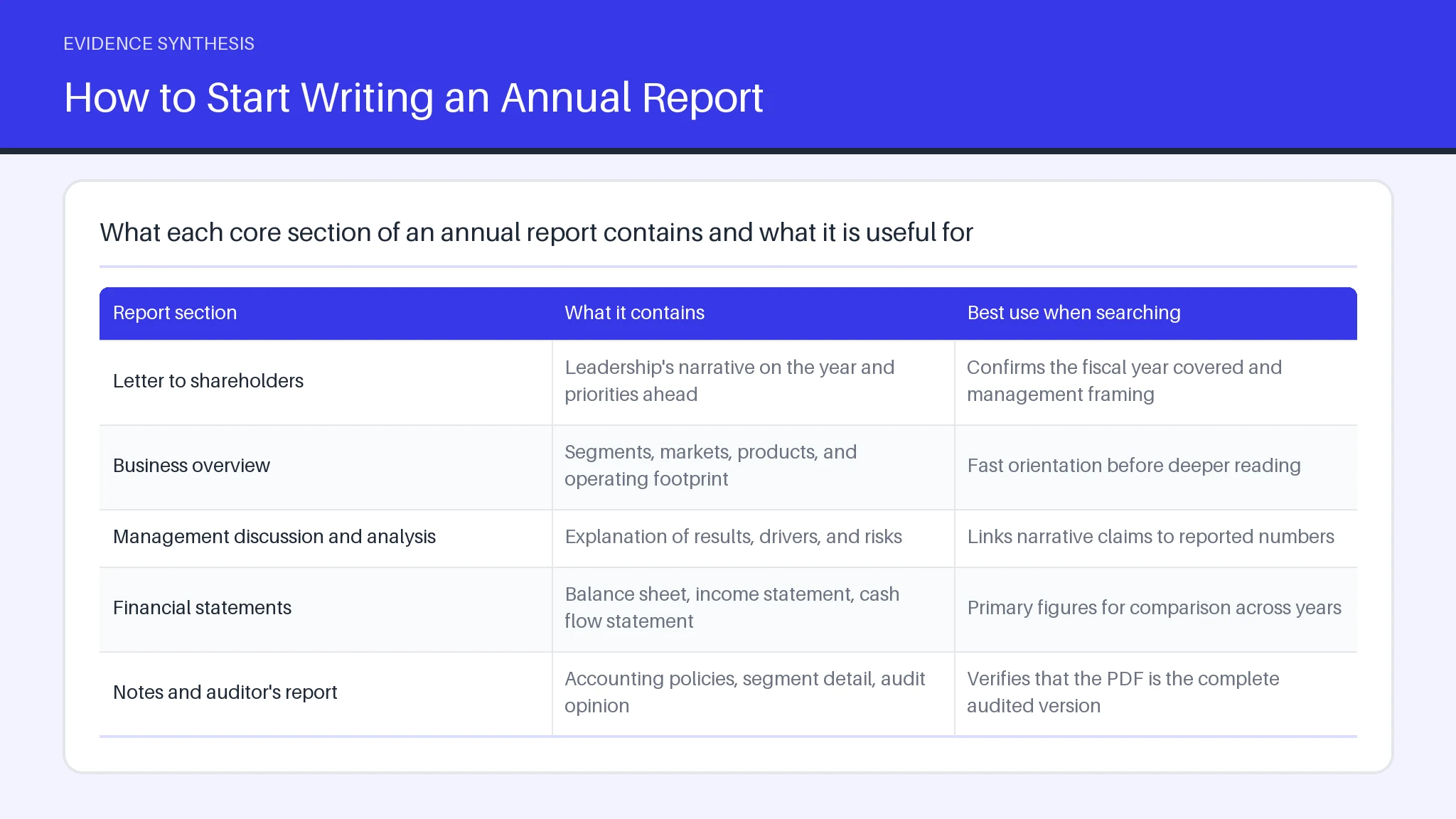
| Report section | What it contains | Best use when searching |
|---|---|---|
| Letter to shareholders | Leadership's narrative on the year and priorities ahead | Confirms the fiscal year covered and management framing |
| Business overview | Segments, markets, products, and operating footprint | Fast orientation before deeper reading |
| Management discussion and analysis | Explanation of results, drivers, and risks | Links narrative claims to reported numbers |
| Financial statements | Balance sheet, income statement, cash flow statement | Primary figures for comparison across years |
| Notes and auditor's report | Accounting policies, segment detail, audit opinion | Verifies that the PDF is the complete audited version |
A one-page financial summary or a highlights brochure is not the annual report, even when the file name suggests it is. If the PDF has no auditor's report and no balance sheet, keep searching. A search strategy pdf checklist of these five sections is the quickest completeness test available.
Why Annual Reports Matter to Your Business
Annual reports matter because they are the one document that forces a business to summarize a full year of decisions in a form outsiders can check. Lenders read them before extending credit. Procurement teams read them before signing multi-year contracts. Prospective employees and partners read them to judge stability. The same document that satisfies a reporting obligation becomes the reference other organizations rely on when they assess you.
Internally, the discipline of producing a comprehensive annual report exposes gaps. Preparing the balance sheet and its supporting notes surfaces accounting practices that were never written down, inconsistent segment definitions, and revenue recognition decisions that nobody documented at the time. Teams that treat the report as a compliance chore repeat the same scramble every year. Teams that treat each element as part of a maintained data set finish faster and answer auditor questions with less friction.
There is also a practical retrieval benefit. Companies that publish a stable, well-named PDF archive make themselves easy to research, and that directly supports anyone running a company annual report pdf search strategy against your organization. Broken links and unlabeled files push analysts toward third-party summaries you do not control.
What Investors and Stakeholders Gain From Annual Reports
Investors and stakeholders gain a single audited baseline they can compare across years and against competitors. That is the core importance of company annual reports: they replace selective updates and press releases with a verified record that carries an auditor's opinion. Every stakeholder group draws something different from it, which is why the document runs long.
An equity investor reads for margin trends, cash generation, and capital allocation. A credit stakeholder reads for debt maturities, covenants, and interest coverage. A supplier stakeholder reads for solvency signals before extending payment terms. A regulatory stakeholder reads for governance disclosures and related party transactions. An employee stakeholder reads for segment performance in their own business unit. A community stakeholder reads for environmental and social reporting. One document, six different reading paths, and each stakeholder needs a different route to navigate it.
The comparative value depends on consistency. If a company changes its accounting for leases or restates a prior period, a chart of five-year revenue growth can mislead you badly unless you read the notes explaining the change. This is the most common analytical error in annual report work: comparing numbers across years without checking whether the basis of preparation stayed the same.
For that reason a disciplined company annual report pdf search strategy collects at least three consecutive years rather than one. Restatements, reclassifications, and quiet definition changes only become visible when you hold the adjacent reports side by side.
Management Discussion and Analysis: Explaining Results and Outlook
Management discussion and analysis is the section where leadership explains why the numbers came out the way they did and what it expects next. It sits between the narrative front half and the audited statements, and it is where the most useful insight per page usually lives, because management has to connect specific results to specific causes rather than describing strategy in general terms.
Read it against the statements, not instead of them. A strong MD&A will highlight the drivers of revenue change, separate organic growth from acquisitions, name the one-off items affecting operating profit, and describe the accounting judgments that materially affected reported results. A weak one recycles marketing language and leans on a page of icon-driven graphics with no reconciliation to the financials. That contrast alone tells an investor something about reporting culture.
Three checks make this section far more useful. First, compare this year's stated outlook against last year's, since the gap between promise and delivery is more informative than either statement alone. Second, track the risk factor language year over year and note what was added or quietly dropped. Third, test whether non-standard performance measures reconcile to audited figures. A potential investor who does those three checks gets more from an annual report than one who reads the highlights page twice.
How to Start Writing an Annual Report
Writing an annual report starts with assembling the source data before anyone writes a sentence. Lock the audited financial statements first, because the balance sheet, income statement, and cash flow figures anchor every claim in the narrative. Drafting the story before the accounting is closed guarantees rewrites, and it is how inconsistent numbers end up in a published PDF.
This is your what you need before you start list: closed and audited company financial statements; a reconciliation schedule for any non-standard measure; prior year comparatives on the same basis; segment definitions confirmed with finance; each piece of financial datum traced to a named owner; the auditor's timetable; and a fact-check log for every figure that will appear in the narrative or in a graphic.
Then draft in this order: statements, then management discussion, then business overview, then leadership letter. Working backward from the audited base keeps the narrative honest and gives writers real insight to work with instead of adjectives. Assign one reviewer whose only job is checking that every number in the front half matches the back half. An investor who finds two different revenue figures in one PDF stops trusting the rest of it, and that is the sort of error a documented search strategy on the reader's side will surface immediately.
Writing the Letter to Shareholders From Leadership
The letter to shareholders is leadership's signed account of the year in plain language, and it should be written last so it reflects the finished report. Its job is to state what happened, what leadership decided, and what it is accountable for next. Every shareholder reading it is testing whether management describes the year the way the financial statements describe it.
Keep it to two or three pages. Open with the yearly result in a single sentence, name the two or three decisions that mattered most, and address the setbacks directly rather than leaving them for the risk section. A shareholder letter that omits a known problem loses credibility with the exact audience it is written for. Corporate boilerplate about being well positioned adds nothing an investor can use.
Write it in a voice a person could actually speak. Name specific numbers, attach them to specific choices, and avoid claiming outcomes that the audited figures do not support. Then apply the same discipline a researcher applies to a search strategy: check that every factual statement in the letter can be traced to a page in the report behind it. That single cross-check prevents most of the credibility problems a shareholder letter creates.
Define Your Report's Purpose and Audience First
Purpose and audience decide the length, tone, and structure of the report, so settle both before drafting. A report written mainly to satisfy a statutory filing requirement is organized around disclosure completeness. A report written mainly to attract capital is organized around strategy and results. Most organizations need both, which means deciding which audience leads and which is served by the appendices.
Name the primary reader explicitly. An institutional investor wants segment detail, reconciliations, and a clean balance sheet with every liability disclosed and dated. A retail reader wants an executive summary, a short strategy section, and a graphic or two that actually carry information. A regulator wants completeness and consistency with prior filings. A community reader wants program outcomes. Writing for all four at once produces a document that serves none of them well.
Once the audience is fixed, decide what each piece of financial datum in the front half is doing. If a figure does not support a decision the reader is making, move it to the notes. Corporate reports bloat because nobody is willing to cut, and the cost is that the important numbers get buried. The same reasoning applies to research reporting, where a documented literature search strategy pdf keeps the methods section tight instead of sprawling.
Annual Report Template for Nonprofit Organisations
A nonprofit annual report follows a different template because its readers are donors, grantmakers, and beneficiaries rather than owners of equity. The standard structure runs: mission statement, a letter from the executive director or CEO, program outcomes with measured results, a financial summary showing revenue sources and functional expense allocation, a statement of assets and each material liability, a donor and funder acknowledgment, and governance details including board composition.
The central difference is that a nonprofit reports on mission delivery rather than profit. Program outcomes carry the weight that earnings carry for a public company, so state them with numbers and methods: how many people served, measured against what baseline, over what period. Vague impact language leaves an informed donor unable to judge anything. Functional expense reporting matters just as much, because grantmakers compare program spending against administrative and fundraising costs.
Nonprofits are not always required to publish a designed report, but many publicly post one alongside their tax filings because it answers donor questions more effectively than a return does. Where a nonprofit funds research, the report should also describe how findings were gathered, and a linked literature search strategy pdf lets reviewers check the evidence behind the claims rather than take them on faith.
Annual Report vs 10-K Filing: Key Differences
An annual report and a 10-K are related but distinct documents, and they are not the same thing. In the United States, a public company must send an annual report to shareholders after each fiscal year and must separately file a 10-K with the Securities and Exchange Commission. The 10-K is the statutory disclosure document: standardized sections, dense risk factors, no design, and complete audited statements. The annual report to shareholders is the communicative version, and it may summarize the same results with narrative, photography, and highlight pages. Some companies staple a cover onto the 10-K and call it the annual report, which is legitimate and explains why the two files often look identical.
To find both, work in this order. Start with the company's investor relations page, which usually hosts a PDF archive going back several years. If the file is missing or truncated, go to the SEC's EDGAR full-text search and pull the 10-K by company name or ticker, which also lets you confirm the filing date and any later amendment. For non-US entities, the equivalent path is the national companies registry or the exchange's disclosure portal. If you still cannot find a designed report, the company may only publish statutory accounts.
Choose based on what you need. Use the 10-K when you need completeness, exhibits, and defensible disclosure. Use the annual report when you need management framing and strategy narrative. To work effectively, keep the URL, filing date, and version of every PDF you download, because companies replace files without notice and an undated download cannot be verified later. That habit is what turns a casual lookup into a reproducible search strategy pdf record, much like documenting a database query in evidence synthesis so a reviewer can rerun it. Systematicly applies the same principle to research searches.
Frequently asked questions
Where Can One Find a Company's Annual Report?
A company's annual report is usually found in the investor relations section of its own website, filed under headings such as annual reports, financial reporting, or results and presentations. Most public companies keep a PDF archive there covering five to ten years. If the archive is incomplete, regulator databases are the next stop: the SEC's EDGAR system for US registrants, and the national companies registry or stock exchange disclosure portal for companies listed elsewhere. Library and university subscription databases can supply older reports that companies have removed from their own sites.
What Information Is Included in an Annual Report?
An annual report includes audited financial statements, narrative explanation, and governance disclosures. The financial half covers the balance sheet, income statement, cash flow statement, statement of changes in equity, and the notes that explain accounting policies and segment results. The narrative half covers the leadership letter, business overview, and management discussion and analysis. Governance content covers board composition, executive pay, and audit arrangements. The auditor's report sits between the two halves and states whether the statements present the position fairly.
What Information Is Contained In An Annual Report?
The detail that distinguishes a complete report from a summary sits in the notes. Notes disclose revenue recognition policy, lease and pension obligations, tax reconciliation, related party transactions, contingent liabilities, subsequent events, and segment breakdowns that the headline statements combine. Any restatement of prior periods is disclosed there too. If you are comparing years, the notes are the only place that tells you whether the comparison is valid.
What should you know about small companies and annual report?
Small and private companies generally do not publish a designed annual report at all, because the shareholder distribution requirement applies to public registrants. What they usually file is statutory accounts or an abridged version with the relevant companies registry, often with reduced disclosure and no management commentary. For private companies, expect to work from registry filings, audited statements supplied under a non-disclosure agreement, or credit reference reports rather than a public PDF.
What should you know about 10 Reasons that Make a Company Annual Report Important?
Annual reports carry weight for ten practical reasons: they provide audited rather than self-reported figures; they enable year-over-year comparison; they disclose risk in writing; they document governance and executive pay; they support lending and credit decisions; they inform procurement and partnership due diligence; they give employees visibility into segment performance; they create an accountability record against prior forecasts; they satisfy regulatory obligations; and they serve as a citable primary source for research.
What should you know about key Components/ Sections of an Annual Report?
The key components in reading order are the leadership letter, business overview, management discussion and analysis, the four financial statements, the notes, the auditor's report, and the governance and remuneration sections. Treat the auditor's report and the notes as your verification anchors. A PDF missing either one is an extract, not the report, and should not be cited as though it were complete.