APA Format for a Literature Review: Rules and Structure
The format for literature review APA work follows the general APA 7 manuscript rules plus a small set of structural choices you make yourself. APA does not publish a separate template for reviews. You apply the same page setup used for any APA paper, then decide which sections the review needs: title page, abstract, introduction, a thematically organized body, a conclusion, and a reference list. Everything else, including headings, in-text citation style, and reference entry order, comes straight from the Publication Manual of the American Psychological Association.
This guide is for graduate students, early-career researchers, and anyone writing a review chapter for a thesis, a course assignment, or a journal submission. It covers page mechanics, the difference between a standalone review and a review section, how to learn from published examples without copying their structure, and where software helps. If you also need help with planning, judging, and synthesizing sources before you touch the format for literature review APA layout, our guide on how to plan, judge and write a review covers that upstream work.
Key takeaways
- APA 7 asks for a title page, running head-free student layout, double spacing, 1-inch margins, and a reference list that starts on a new page with hanging indents.
- A literature review is a section or a standalone paper, not an APA document class, so the sections you include depend on whether it stands alone or sits inside a longer work.
- In-text citations use the author date pattern, and every in-text citation must match one entry in the reference list exactly.
- Style choice changes mechanics, not argument: APA uses author date citations and a reference list, while MLA uses author page citations and a works cited page.
- Screening, extraction, and citation tracking done in review software reduces the rework that makes formatting slow at the end.
APA Title Page Overview: Every Element and Its Placement
An APA 7 student title page carries five stacked elements, centered and double spaced in the upper half of the page: the paper title in bold title case, the author name, the departmental and institutional affiliation, the course number and name, the instructor name, and the due date. A professional title page swaps the course block for an author note and adds a running head in the page header. That difference is the single most common formatting error in submitted reviews.
Use this overview as a placement check before you submit, whether you are working from a template for literature review APA layout or an APA format for literature review example you found in a journal.
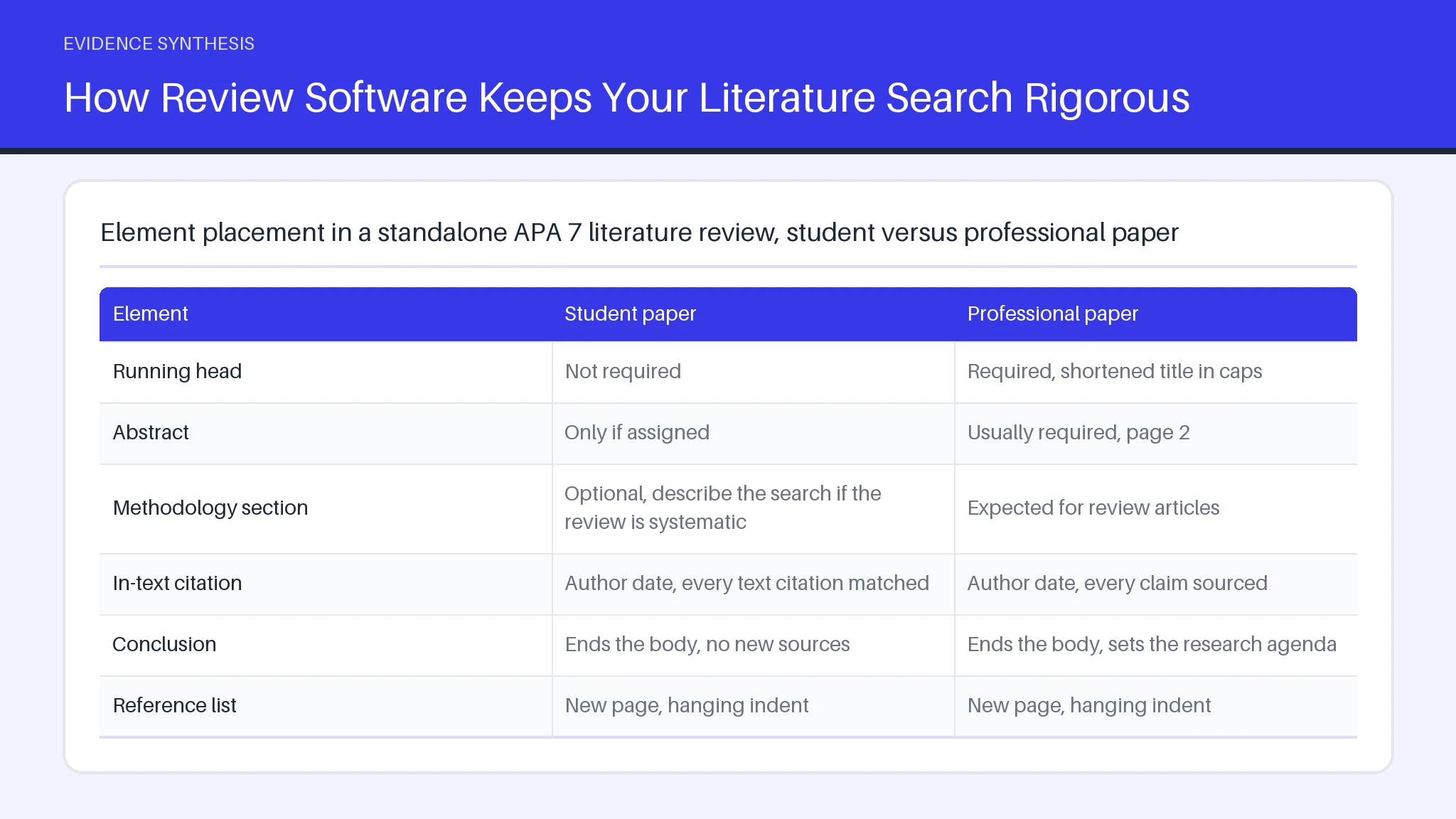
| Element | Student paper | Professional paper |
|---|---|---|
| Running head | Not required | Required, shortened title in caps |
| Abstract | Only if assigned | Usually required, page 2 |
| Methodology section | Optional, describe the search if the review is systematic | Expected for review articles |
| In-text citation | Author date, every text citation matched | Author date, every claim sourced |
| Conclusion | Ends the body, no new sources | Ends the body, sets the research agenda |
| Reference list | New page, hanging indent | New page, hanging indent |
Suggested visual: a labeled diagram of the student title page with the five stacked blocks called out in reading order.
How to Prevent Format for Literature Review APA
Preventing format for literature review APA errors is mostly about fixing the source of the error rather than the symptom. Four problems account for most rejected drafts. First, mismatched citations: a text citation appears in the body with no matching entry, usually because a source was cut during revision. Run a reconciliation pass in both directions. Second, wrong title page abstract handling: students add an abstract that was never assigned, or omit one a journal requires. Third, heading levels applied by look rather than by level, so a Level 3 heading is bolded and centered like a Level 2. Fourth, a methodology paragraph that describes no actual search, which undermines the credibility of your conclusion.
Set your document styles once, before drafting. Define Level 1 through Level 5 headings, double spacing, and hanging indents in your word processor rather than formatting by hand. When you consult literature review examples APA journals have published, check their heading hierarchy against the manual instead of assuming the journal followed it. That habit removes hours of late-stage academic writing cleanup.
APA 7th Edition Rules and the Sections Your Review Needs
APA 7 sets the mechanics: double spacing throughout, 1-inch margins on all sides, an accessible font such as 12-point Times New Roman or 11-point Calibri, page numbers in the top right, and a reference list beginning on its own page with entries alphabetized by author surname and formatted with a 0.5-inch hanging indent. The American Psychological Association updated the edition to drop the student running head and to require up to 20 author names before an ellipsis in a reference entry.
Section structure depends on scope. A standalone review needs a title page, optional abstract, introduction that states scope and inclusion logic, a body organized by theme or chronology, and a conclusion that names the gap your work addresses. A review chapter inside a thesis drops the title page and folds into the wider document. If you study a sample of literature review APA authors published in a disciplinary journal, note how much space they give to synthesis versus summary. Strong academic writing weights synthesis higher, and every claim carries a citation.
Learning From Example Literature Reviews Without Copying Them
APA 7 formatting guidelines for literature reviews give you the page mechanics, but published examples teach you the reasoning, and those are two separate lessons. Read an example for three things only: how the author grouped studies into themes, how they signaled disagreement between sources, and how they moved from evidence to a stated gap. Do not copy the section order, because it was shaped by that journal's requirements rather than by APA.
When you reuse formatting decisions from an example, verify them. Journals vary on whether they want a structured page abstract, on heading depth, and on how many levels of subheading they permit. The format for literature review APA rules in the manual are the fallback; journal instructions override them. Check the reference entries in any example against current rules too, since pre-2020 papers still show the old running head and the older reference patterns.
A practical test: take one paragraph from the example and count how many sources it cites. If a paragraph carries a single citation, the author is summarizing. If it carries three or four, they are synthesizing, and that is the formatting-independent skill you want to cite as your model.
How Review Software Keeps Your Literature Search Rigorous
Review software keeps a literature search rigorous by recording every decision as you make it, so the search is reproducible months later when a reviewer asks how you found your sources. The core functions are the same across categories of tool: deduplicate imported records, log inclusion and exclusion reasons at title, abstract, and full-text stages, store extracted data in structured fields, and export citations in a consistent format. When those records exist, you can write the search paragraph of your review from the log rather than from memory.
To generate a structured literature review outline from that log, group included studies by the variable that actually differentiates them, such as population, intervention, or measurement approach, then make each group one Level 2 heading. That gives you a review outline with real evidence under every heading instead of a review outline built from guesswork. The body of the review then follows that same order, with each thematic section opening on a claim and closing on what remains unresolved.
Keep style separate from structure. Software handles citation output; the American Psychological Association manual governs how each in-text citation looks. Tools such as Systematicly sit on the screening and extraction side of that split, and our software comparison sets out what each category of tool does before you write a literature review from a sample of literature review APA structures you have read.
Tools That Apply APA Formatting to Your Review Fast
Reference managers and word processor citation features apply APA style mechanics faster than manual entry, but they only work reliably if the source metadata is clean. Fix the record once at import, and every downstream citation inherits the correction.
To format in APA style step by step: set margins to 1 inch and line spacing to double; apply a defined heading style for each level rather than manual bolding; insert in-text citations as author date fields tied to your library; place the reference list on a new page with hanging indents and alphabetical order; then run a final check that each in-text field resolves to an entry.
To format in MLA style step by step: set the same margins and double spacing; add a header with your surname and page number; use a four-line first-page heading instead of a title page; insert in-text citations as author page rather than author date; and build a works cited page with hanging indents.
The practical trade-off is control. Automated formatting handles 90 percent of entries and fails predictably on reports, datasets, and preprints, which need manual repair in both APA style and MLA. Switching an entire document from MLA to APA mid-project is cheap with a reference manager and expensive without one, which is the strongest argument for adopting a manager before drafting rather than after.
Writing the Draft, Then Editing and Revising It
Draft the body before you format it. Write each thematic section as a claim, the evidence for it, the evidence against it, and what the disagreement means, then add every citation as you write rather than marking placeholders you intend to fill later. Placeholders are where citation and reference mismatches originate.
Editing runs in three passes, in this order. The first pass is argument: does each section advance the theoretical framing you set out in the introduction, or does it only summarize? The second pass is evidence: does every claim carry a citation, and do the numbers you quote match the source? The third pass is mechanics: spacing, headings, and reference entries.
When you write a literature review under deadline, resist reformatting during pass one. It feels productive and changes nothing about the quality of the synthesis. Read two or three literature review examples APA journals have published in your field to calibrate how much interpretation is expected, then aim above the level of an example of an APA style literature review that merely reports findings study by study.
Practical Tips for Writing a Stronger Literature Review
The five C's of literature review writing are cite, compare, contrast, critique, and connect. Cite the sources that define your research topic; compare what they agree on; contrast where their findings or methods diverge; critique the strength of the evidence rather than restating it; and connect the whole body of work to the question you are about to answer. Reviews that stop at the first C read like an annotated bibliography instead of an argument.
Four tips make the difference in practice. Cap your summary of any single study at two sentences, which forces synthesis. Organize by theme, not by publication date, unless your field genuinely developed chronologically. Record the page number with every extracted quotation, because retrieving it later costs far more time than capturing it. And build an APA literature review outline from your inclusion decisions so each heading has evidence behind it before you draft.
Two limitations worth stating in the text: searches capped at English-language sources or a single database will miss relevant work, and an author date citation tells the reader when a study was published but nothing about its quality. Say so explicitly. An honest limitation paragraph strengthens a review more than an extra citation does, and it is what separates a graded example of an APA style literature review from a publishable one. Our research methods guide covers how to describe those design choices precisely.
Getting a First Draft Down, With or Without AI
Before you start, you need four things: a defined scope, a search log with inclusion decisions recorded, full-text access to every included study, and a chosen citation style confirmed against your assignment brief or target journal. Without the search log, drafting stalls at the methodology paragraph.
Work outward from your APA literature review outline. Draft the body sections first, the introduction second, and the conclusion and summary last, since both depend on what the body actually establishes. Leave the reference section and reference list generation to the end, when your included set has stopped changing.
AI drafting tools can reorganize your own notes and tighten prose, and they are useful for producing a first pass on a thematic section. They are not a source. Every citation an AI tool produces needs verification against the original record, because fabricated references pass visual inspection easily. For a dissertation chapter, that verification step is not optional. A template for literature review APA layout handles spacing and headings; it cannot confirm that a cited study says what your draft claims.
Frequently asked questions
What are some tips for writing a good literature review?
Strong reviews come from a narrow scope, a documented search, and synthesis rather than sequential summary. Limit each study to two sentences of description, group sources by theme, state where the evidence conflicts, and name the gap your work addresses. Record decisions as you make them so the search paragraph writes itself.
How should I start my literature review?
Start with scope. Write one sentence stating the population, concept, and time window you will cover, then run your search and record what you include and exclude. Draft the first body section from your largest evidence group, not the introduction, because the introduction depends on what the body turns out to contain.
What makes a well-written literature review?
A well-written review makes an argument. Each paragraph opens with a claim, cites multiple sources as evidence, explains disagreement between them, and connects back to the review's purpose. It also states its own limitations, including databases searched and language restrictions.
What are the five C's of literature review writing?
The five C's are cite, compare, contrast, critique, and connect. Cite the defining sources, compare their agreements, contrast their divergent findings and methods, critique the quality of the evidence, and connect the body of work to your question.
Why study literature review examples?
Examples show you how experienced authors group studies, signal disagreement, and move from evidence to a stated gap. They calibrate how much interpretation your field expects, which no style manual specifies.
Where to find literature review examples?
Look in disciplinary journals that publish review articles, in university thesis repositories, and in the review sections of published papers in your field. Prefer post-2020 examples so the formatting reflects current rules.
APA Style vs. MLA Style: What’s Different?
APA uses author date in-text citations and a reference list; MLA uses author page citations and a works cited page. APA requires a title page for most papers, while MLA uses a four-line first-page heading. Both use double spacing, 1-inch margins, and hanging indents.