A sample narrative paper is a short, finished essay built around a story. It shows how a writer turns one experience into a structured piece with a clear point. If you read one closely, you can see what the genre expects: an opening that drops you into a moment, a middle that builds tension through action and detail, and an ending that reflects on what changed. This guide is for middle school, high school and college students, and for teachers who want models to discuss in class.
By the end, you will be able to read a sample narrative paper as a set of working parts. That lets you borrow its structure without borrowing its words. The sections below define the narrative essay and the personal narrative, compare five common forms of narrative writing, walk through a short original sample step by step, and annotate key lines to show why each choice works. You will also find a checklist of what to gather before you draft and a list of common mistakes to avoid.
One clarification saves time. In academic research, "narrative" also names a type of review article. A narrative review is a qualitative summary of published studies. It often serves as background for a research paper and often has no methods section. That genre, the narrative literature review, is a qualitative summary of research on a particular topic that often serves as background for a research paper or stands alone as an article. This article sticks to the writing-class meaning: a story you tell to make a point.
Key takeaways
- A narrative paper tells one story in order and uses it to make a point. The point is what separates it from a plain recap of events.
- Strong models follow a beginning, middle and end, and most of their length goes to one scene, not to background.
- Take structure from models, never sentences. Map what each part does, then write your own version.
- Expectations rise with grade level, from clear sequence in middle school to layered reflection in college.
- In research writing, a "narrative review" is something else: a qualitative summary of published studies, not a personal story.
Sample Narrative Paper Examples That Show the Genre in Practice
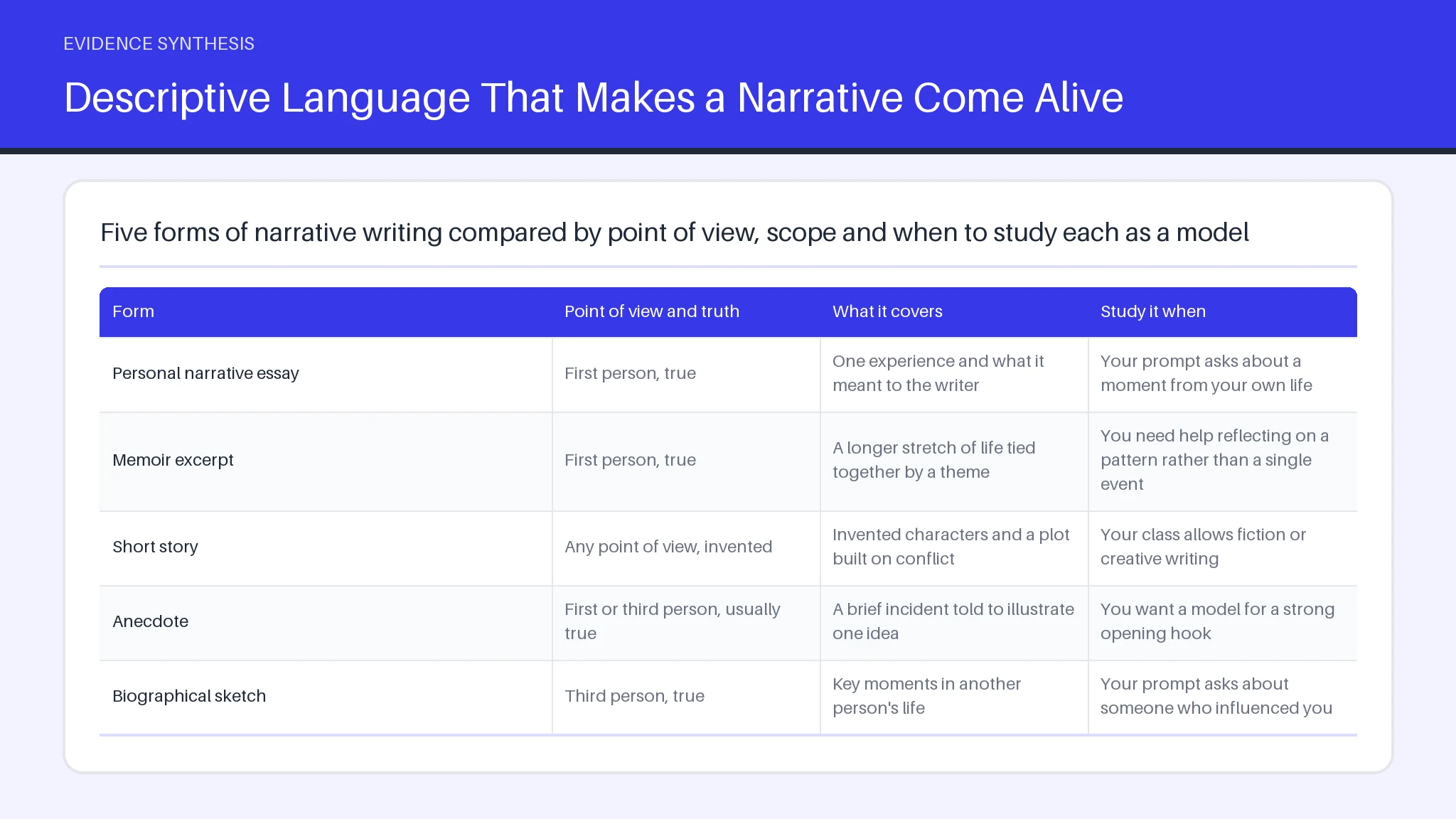
Five common examples of narrative writing are the personal narrative essay, the memoir excerpt, the short story, the anecdote and the biographical sketch. All five use characters, a setting, a sequence of events and a turning point. They differ in who tells the story, how much of it is true and how much ground it covers. Those differences decide which one is the right model for your assignment.
| Form | Point of view and truth | What it covers | Study it when |
|---|---|---|---|
| Personal narrative essay | First person, true | One experience and what it meant to the writer | Your prompt asks about a moment from your own life |
| Memoir excerpt | First person, true | A longer stretch of life tied together by a theme | You need help reflecting on a pattern rather than a single event |
| Short story | Any point of view, invented | Invented characters and a plot built on conflict | Your class allows fiction or creative writing |
| Anecdote | First or third person, usually true | A brief incident told to illustrate one idea | You want a model for a strong opening hook |
| Biographical sketch | Third person, true | Key moments in another person's life | Your prompt asks about someone who influenced you |
Match the model to the prompt before you study it. A prompt about your own life calls for a true, first-person sample narrative paper. A creative writing prompt may let you learn from a short story instead. Fiction teaches plot and pacing well, but it can push a personal assignment toward made-up drama that a teacher will question.
Next, look at how each model spends its length. In most school assignments, the opening and the conclusion are short, and the body paragraphs carry the scene, the dialogue and the turning point. If a model you admire spends half its length on background, it will teach you the wrong outline for a focused topic. Set it aside, or study only its strongest scene.
How to Structure a Narrative Paper With a Beginning, Middle and End
A narrative paper is an essay that tells a story in a clear order and uses that story to make a point. The point, whether stated outright or implied, is what separates the paper from a diary entry or a list of events. Most strong models follow a three-part shape:
- Beginning: A compelling first line puts you inside a moment, and the next few sentences supply the who, where and when. Hint at the stakes early so the story has a direction.
- Middle: Events build toward a turning point. Show actions, choices and emotions as they happen instead of summing them up afterward. Keep time moving forward unless a flashback has a clear job.
- End: The conclusion resolves the conflict and reflects on what changed. One honest insight works better than a sweeping moral.
When you check a sample narrative paper against this shape, you'll see that the middle usually takes the most space. If your topic is too big to fit there, narrow it to a single afternoon, conversation or decision. For help putting the point into words, see our guide to writing a thesis statement for your personal narrative, which also walks through the full drafting process.
Turning a Memory Into a Polished Personal Narrative Draft
A personal narrative is a true, first-person story about something you lived through, told so that others understand why it mattered. It differs from a memoir because it stays with one experience, and from fiction because the events are real. You can choose the order, trim dull stretches and rebuild dialogue from memory, but you should not invent what happened.
What you need before you start:
- Keep the assignment prompt for your personal narrative open beside your draft so you can check each scene against what you were asked to write.
- One specific memory with a clear before and after.
- Rough notes on what you saw, heard, smelled and said in that moment.
- A model at your grade level to compare against.
- Time for at least two drafts, since a polished personal narrative rarely comes out right the first time.
With those in hand, writing a personal narrative comes down to these steps:
- Freewrite everything you remember about the moment without stopping to edit.
- Circle the turning point, the instant something changed. Cut anything that doesn't lead toward it or away from it.
- Draft the story as scenes, with action and speech, not summary.
- Add a short reflection that names what you understand now.
- Revise by putting your draft next to a sample narrative paper and the rubric, and check each part against both.
Personal Narrative Samples With a Step-by-Step Writing Walkthrough
Personal narrative samples are easiest to learn from when you break them into the moves the writer makes. The short passage below was written for this guide as a practice model:
The whistle blew, and my legs refused to move. Seven swimmers dove while I stood on the block, goggles fogging, until my coach's voice cut through the echo: "Go, Maya!" I went, and I finished last by a full body length. By the final wall, I had stopped caring about the clock and started noticing that I was still swimming.
- Hook: The first sentence starts at the moment of tension, not with background.
- Sensory anchor: Fogging goggles and an echoing voice give vivid, physical proof of panic.
- Dialogue: One short line adds pressure without a long exchange.
- Low point: Finishing last by a full body length makes the stakes concrete.
- Reflection seed: The final sentence turns from the result to what it meant, which a full ending would expand.
Apply the same five labels to any sample narrative paper you study, then to your own personal narrative draft. Any label you can't find shows you what to add.
How Sensory Detail and Precise Wording Bring a Narrative to Life
Sensory detail and precise wording make a narrative feel lived rather than reported. Specific nouns and strong verbs do most of the work. "The screen door slapped shut behind me" gives the reader a sound, a motion and a mood, while "I went outside" gives nothing. Reach beyond sight when you can, but pick details that connect to the story's point instead of listing everything in the room.
- Swap general words for exact ones, so "a dog" becomes "our limping beagle."
- Replace feeling labels with physical evidence. Instead of "I was nervous," write "I read the same line of the program four times."
- Use dialogue only when the exact words change something, and keep each line short.
- Keep descriptive passages tight during action, and let them open up in quieter moments.
Precise wording matters most at the end of the essay. A conclusion that says "it taught me a lesson" leaves the reader with nothing to hold on to. Returning to one image from the opening, now seen differently, closes the story with meaning.
Descriptive Language That Makes a Narrative Come Alive
Good description comes from specific sensory detail, not from piling up adjectives. Instead of "the lab was busy," write what the reader would notice: "three centrifuges hummed while someone recalibrated the pipettes for the fourth time." The concrete version shows the pressure without naming it.
- Choose precise nouns and verbs. "Slumped" says more than "sat tiredly."
- Use more than sight. Sound, smell, and texture anchor a scene.
- Show feeling through action. A shaking hand on a consent form signals nerves better than "I was anxious."
- Ration detail. Describe what matters to the turning point and cut the rest.
When you study a sample narrative paper, mark the sentences that create a picture and notice where they sit. Strong writers often save dense detail for key moments and keep transitional paragraphs lean so the pace holds.
Narrative Essay Samples for Middle School, High School and College
A narrative essay is nonfiction that tells a story to make a point. The personal narrative essay is its most common school form: a true story from the writer's own life, told in first person. Students get this assignment at every level, but expectations rise at each stage.
- Middle school: A single event told in clear order, transition words such as "first" and "later," some dialogue, and a closing sentence that states what the writer learned.
- High school: A focused scene, a deliberate hook, pacing that slows at the turning point, and reflection that goes past a simple moral.
- College: A distinct voice, layered reflection and, in many courses, a link between the personal story and a wider idea, issue or reading.
When you look for narrative essay examples for students, choose ones written at or slightly above your level. A polished college piece can overwhelm a seventh grader, and middle school essay examples won't show a college student how to handle complex reflection. Check the source, too. Models shared by teachers or campus writing centers are more likely to reflect classroom expectations than anonymous essays posted with no context.
The steps for writing a narrative essay stay the same at every level. A reliable personal narrative essay outline has five parts:
- Hook and setting: Open inside the moment, then place it in time and space.
- Context and stakes: Explain what you wanted, feared or expected.
- Rising action: Two or three short scenes that build pressure.
- Turning point: The instant something changes.
- Resolution and reflection: What happened next and what you understand now.
A short middle school essay might give each part a single paragraph, while a longer college essay expands the rising action and the reflection.
Using a Sample Narrative Paper to See How the Format Works
Studying a model closely shows you how the narrative format works, from the order of events to the balance between scene and reflection. The most useful method is a reverse outline, where you rebuild the plan the writer must have followed.
- Number each paragraph and write one line on its job: hook, context, scene, turning point or reflection.
- Mark each sentence as scene (action, detail, speech) or reflection. Strong models tend to save most of the reflection for the end.
- Highlight the descriptive phrases and ask what each one tells the reader about the stakes.
- Note every jump in time and how the writer signals it.
Once the map is on paper, hold it up against your own plan. If yours spends three blocks on background before anything happens, the reader will lose interest. If your draft lacks the vivid moments the model relies on, you know where to revise. This side-by-side check turns a model into a plan you can use, not just a vague source of inspiration.
How a Sample Narrative Paper Works, Shown Through Examples
A sample narrative paper follows one experience from start to finish, and each part has a clear job. Here is how that plays out in a short example about a student's first research lab shift.
- Hook: "The centrifuge alarm went off before I had taken off my coat." The opening drops the reader into a specific moment.
- Rising action: The writer mislabels twelve samples and has to tell the lab manager. Concrete stakes keep the story moving.
- Turning point: The manager shows how a simple checklist prevents the error. Naming the writer's emotions here, such as embarrassment turning into relief, makes the shift believable.
- Reflection: The ending explains what changed: the writer now double checks every label.
A compelling example works because it shows a single change in the narrator, not a list of events.
Engaging Narrative Essay Samples Across Many Topics
Engaging narrative essay samples cover a wide range of subjects, but the strongest ones share one habit: they zoom in on a small, specific moment inside a larger experience. An essay about moving to a new country is broad. An essay about the first time you ordered lunch in a new language has a scene, a conflict and a clear change.
Use these subject groups to brainstorm. Each one can anchor a short essay:
- Family: A recipe passed down, a holiday that went wrong, an argument that changed a relationship.
- School and learning: Failing a test you studied for, or one comment from a teacher that stuck.
- Sports and hobbies: A lost game, the day you quit or the day you came back.
- Work and responsibility: A first shift at a job, or a babysitting emergency.
- Identity and culture: A name others mispronounced, or a tradition you explained to a friend.
- Challenge and loss: A move, an illness in the family, a goodbye.
Painful experiences can produce strong essays, but you decide how much to share. Pick a subject you're comfortable having a teacher or classmates read. A quiet story told honestly often works better than a dramatic one told in summary.
Annotated Narrative Essay Samples With Line-by-Line Commentary
An annotated narrative essay pairs key lines from a model with short notes on what each line does. Here is the swimming passage from earlier, annotated line by line:
- "The whistle blew, and my legs refused to move." The essay opens mid-action, with the conflict in the first sentence.
- "goggles fogging" One physical detail stands in for panic, so no feeling word is needed.
- "Go, Maya!" Two words of speech raise the pressure and bring in a second character.
- "I had stopped caring about the clock" This line shifts attention from the result to what it meant, which the essay's ending would develop.
Tips and common mistakes:
- Starting the essay with an alarm clock or a dictionary definition instead of the key moment.
- Summarizing a whole year when one scene would do.
- Ending with a generic moral such as "never give up" instead of a specific insight.
- Copying a model's sentences or signature images. Borrow the structure, then write every line of your essay yourself.
Frequently asked questions
What is an example of a narrative paper?
In research publishing, a narrative paper usually means a narrative review, which summarizes, interprets, and critiques a body of literature on one topic. Recognized types include state-of-the-art, critical, and integrative reviews. One published example follows a researcher studying interprofessional education who finds randomized trials, qualitative investigations, and critical perspectives, along with tensions between nursing and medical journals. She chooses a meta-narrative review. A strong sample narrative paper also explains which databases, time frames, and study designs it searched, and why.
What is a narrative paper?
In evidence synthesis, a narrative paper is a narrative review: a type of knowledge synthesis grounded in its own research tradition. A systematic review often focuses on a narrow question and uses a prespecified method to combine similar studies. A narrative review can include a wide variety of studies and give an overall summary with interpretation and critique. Examples include state-of-the-art, critical, and integrative reviews. Authors should still explain which search terms, databases, and study types they included, and why.
What are 5 examples of narrative writing?
In research writing, five examples come from the narrative review family. A general narrative review summarizes a wide variety of studies on a topic, with interpretation and critique. State-of-the-art, critical, and integrative reviews are three named types of narrative review. A meta-narrative review fits when different research communities, such as nursing and medical journals, discuss a topic in conflicting ways. Whichever sample narrative paper you study, check that the authors explain which search terms and databases they used, whether they included grey literature, and why.
How do you start a narrative paper?
Start a narrative paper by naming your topic and explaining why a broad synthesis suits it. Narrative reviews work well for topics that are complex or broad, under-researched, or well studied but ready for a new perspective. They can draw on a wide variety of studies and offer an overall summary with interpretation and critique. Early on, explain which search terms, databases, time frames, and study designs you included and why, and note whether you used commentaries or gray literature. Expect to repeat cycles of searching, analysis, and interpretation.
What are the five rules of narrative writing?
For a sample narrative paper written as a review, the guidance in "Narrative Reviews: Flexible, Rigorous, and Practical" gives working principles rather than a numbered rule list. First, explain which search terms and databases you used and why. Second, give your reasoning for each inclusion choice, such as time frame, study design, or grey literature. Third, plan for repeated cycles of searching, analysis, and interpretation. Fourth, include the pivotal or seminal papers on your topic. Fifth, go beyond summary and offer interpretation and critique of the whole body of literature.
What is the best sentence to start a narrative essay?
No one sentence works best for every paper. For a narrative paper in the research sense, meaning a narrative review, a strong first sentence states where the topic stands now and why it needs a fresh synthesis. That fits what narrative reviews do: describe what is known on a topic, critique the body of literature, and offer insights on advancing the field. If your topic is under-researched, open with that gap. If the field is well developed, open with the new perspective your review brings.
What are some good sentence openers for narrative writing?
If your sample narrative paper is a narrative review, choose openers that fit what that format is meant to do. A PMC article on narrative reviews says they describe what is known on a topic, offer interpretation and critique, and should explain which databases, time frames, and study designs were included and why. Useful openers follow those tasks: "Current research on this topic shows...," "We searched [database] from [years] because...," "In contrast, the nursing literature frames...," and "One limitation of this body of work is...." Each one tells the reader what that part of your synthesis is doing.