If you searched for the Keng-Yen Huang Uganda cohort study, here is the short answer: the name refers to a research program, not one stand-alone observational cohort. Keng-Yen Huang is listed in the Department of Population Health at New York University's School of Medicine (PMC author record). Huang has led a series of Ugandan studies on young children's mental health, parenting and school-based prevention. The core design is a school-level trial. Whole schools, not individual pupils, were assigned either to deliver an evidence-based early childhood intervention or to serve as comparisons, and the children, parents and teachers in those schools were measured while the program ran.
The difference matters if you cite the work. If a reviewer codes these papers as a cohort design, they will pick the wrong risk-of-bias tool. If a reader treats them as ordinary trials that allocated individuals, they will overstate how precise the results are. This guide is for systematic reviewers, graduate students, program planners and funders who need to read the Uganda papers accurately, pull out the right details and judge how far the results travel. By the end, you should be able to name the design, list the child and implementation outcomes, explain where the qualitative interviews fit, and decide where these studies belong in a synthesis of school-based child mental health work in Sub-Saharan Africa.
Three indexed papers hold most of the publicly visible detail. The first looks at parental depression and how it relates to parenting and to children's physical and mental health in an African setting. The second, titled Transportability of an Evidence-based Early Childhood Intervention in a Low-Income African Country, reports implementation and effectiveness outcomes for the early childhood program. It uses two established implementation models to describe context, adoption and reach. The third paper studies moderators of intervention effects on parenting practices in an early childhood trial. It lists Huang in NYU's Department of Child and Adolescent Psychiatry and shows the question that runs through the wider body of work: for which families, and under what conditions, does a parenting-focused program change what happens at home?
What you need before you start. A careful reading takes a little preparation:
- Full texts, not abstracts. The measurement details are in the methods sections, including which instruments already had evidence of reliability and validity in Uganda.
- A settled review question. Decide early whether you care about child outcomes, implementation outcomes or both. If your question is still loose, the guide on how to write a research question that works covers the basics.
- An extraction form built for cluster designs. Add fields for the unit of allocation, the number of clusters, the intracluster correlation, the comparison condition and every implementation measure.
- Working knowledge of two models. The Consolidated Framework for Implementation Research (CFIR) and RE-AIM organize the context and reach measures, so you need to know what their domains mean.
- A plan for pooling. If you plan to combine these results with other trials, choose a clustering adjustment before you see the numbers. The meta-analysis guide covers pooling methods in general.
Take effect sizes, sample counts and follow-up intervals straight from each paper's results tables. A secondary summary, this one included, can't replace the source when you extract data, and a small copying error in cluster counts can distort a pooled estimate.
The work gets attention because it tests an idea with large practical stakes. In many low- and middle-income countries, child mental health care is scarce and tied to clinics. A program delivered through ordinary early childhood classrooms could, in principle, reach far more families than specialist services. The Uganda studies test that idea with a comparison group, track implementation alongside effect, and use locally validated measures where possible (transportability trial). That combination is why the Keng-Yen Huang Uganda cohort study keeps showing up in reference lists on school-based prevention, parenting support and global child mental health.
The "cohort" label sticks because the children in each school enroll together and are followed through the program. In everyday speech, that makes them a cohort. In design terms, though, the evidence comes from comparing groups of schools that were allocated by chance. For the general difference between following a group over time and taking a single snapshot, see the site's explainer on longitudinal and cross-sectional designs. For this program, remember that allocation, not just follow-up, defines what the results can show.
The sections below follow the order a reviewer usually works in. They start with the trial design, then cover the question of scale, the prevention logic, the treatment gap behind the program, the outcomes, the qualitative sampling and the SMART Africa context. The last section covers what the evidence can and cannot support.
Key takeaways
- The Keng-Yen Huang Uganda cohort study is best read as a set of school-level trials and linked analyses on early childhood mental health. It is not one stand-alone observational cohort.
- Whole schools were assigned to study arms, so results have to be analyzed and pooled with clustering in mind.
- The transportability trial reports implementation and effectiveness outcomes together. It uses CFIR to describe context and RE-AIM to estimate adoption and reach.
- Where possible, the team used measures already shown to be reliable and valid in Uganda, and it reported psychometric properties for its own sample.
- Parental depression is part of the problem the program is meant to address. It connects caregiver mental health to parenting and to children's physical and mental health.
How the Cluster Randomized Trial Assigns Schools to Study Arms
In a cluster randomized trial, chance decides which groups get a program, and everyone in a group shares that group's assignment. In the Uganda work, the groups are schools. The choice follows from how the intervention works. Teachers are trained, classroom routines change, and parents are reached through the school. Splitting the children in one school between the program and comparison conditions would be close to impossible, because a teacher who has learned new behavioral strategies can't switch them off for half the class.
Assigning whole schools solves that contamination problem, but it creates new ones. Each one changes how you should read the results:
- Fewer independent units. Statistical power depends heavily on the number of schools, not just the number of children. A trial with thousands of pupils in a handful of schools can still be underpowered.
- Correlated children. Pupils in the same school share teachers, neighborhoods and routines, so their scores move together. The intracluster correlation (ICC) measures how strongly they do.
- Baseline imbalance. With relatively few clusters, chance can leave the arms unequal on school size, fees or staffing. Look for stratified or matched allocation, and look for baseline tables at both the school and child level.
- Timing of enrollment. If families enroll after their school's arm is known, the people who agree to take part may differ between arms. Check whether consent and baseline measurement happened before or after allocation was revealed.
- Knowledge of assignment. Teachers and parents in program schools know they are in the program, and that alone can shift their ratings of child behavior. Ratings from independent observers and direct measures of the child therefore carry extra weight.
The design effect is the quickest way to see what clustering costs. It equals 1 + (m - 1) × ICC, where m is the average number of children measured per school. As an illustration only, with 20 children per school and an ICC of 0.05, the design effect is 1 + 19 × 0.05 = 1.95. In that case, 400 children carry about as much information as 205 independent children. When a cluster trial reports results without adjusting for clustering, a common fix in evidence synthesis is to divide the sample size by the design effect before pooling. Check the analysis section first. Many cluster trials already use multilevel models that handle clustering, and correcting twice would make the results look less precise than they are.
Knowing the assignment matters most for outcomes that depend on someone's judgment. Suppose the same teachers who delivered the program also report on disruptive behavior or anxiety symptoms. Their reports are more open to expectation effects than a structured child task scored by a trained assessor who doesn't know the school's arm. When you extract outcomes, record who rated each one, not just the name of the instrument.
The school is also the delivery system, so assigning whole schools lets the team study implementation at the level where decisions are made. The transportability trial uses CFIR to describe the inner setting and individual contexts and RE-AIM to estimate adoption and reach (transportability trial). One allocation can therefore answer two questions: did child health outcomes change, and did the delivery system take up the program? An improvement in child behavior with weak adoption tells a different story from modest effects with strong reach. The combined framework is what lets a reader tell those stories apart.
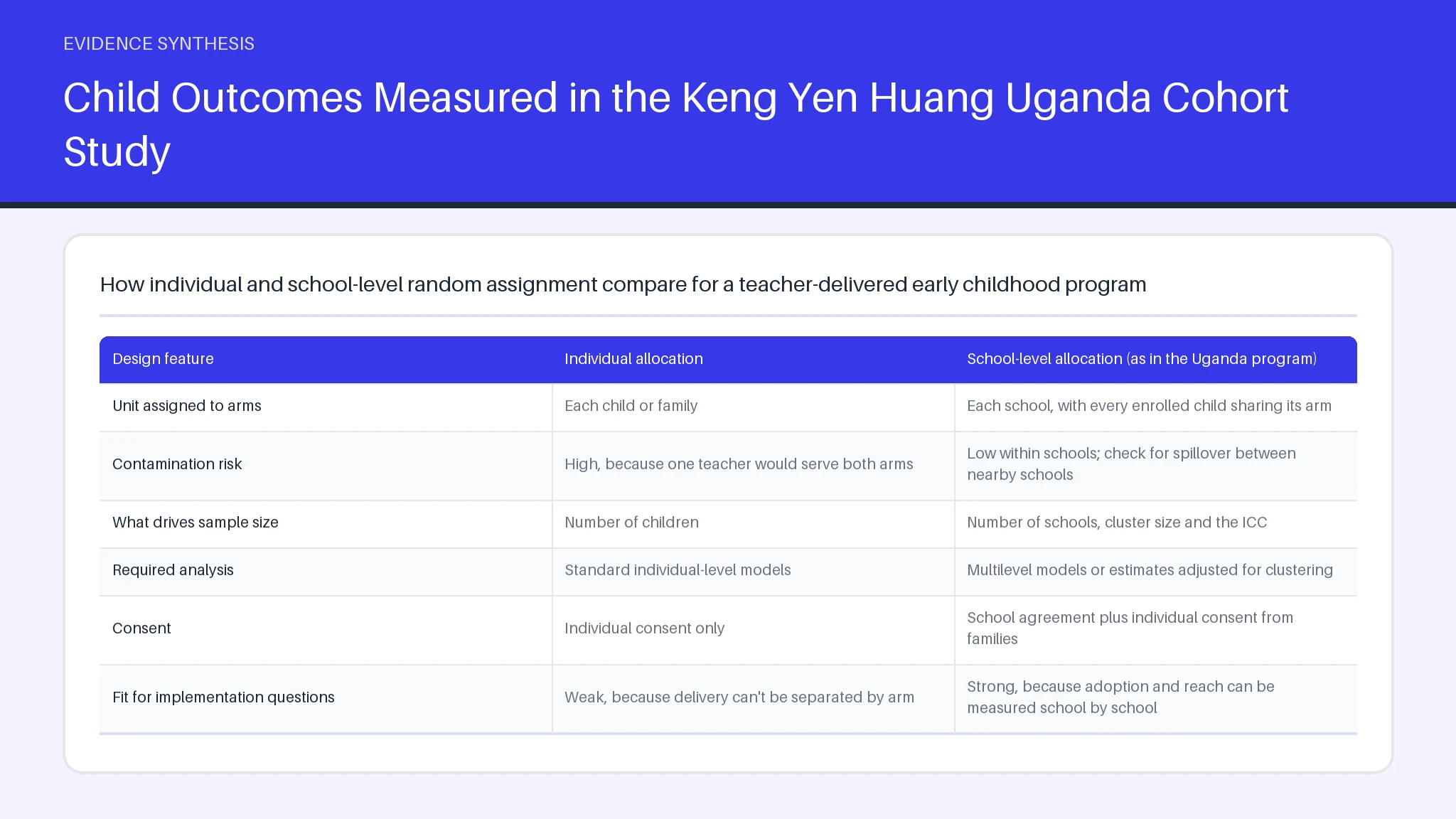
The table below compares allocating individual children with allocating schools for a program that teachers deliver to young children.
| Design feature | Individual allocation | School-level allocation (as in the Uganda program) |
|---|---|---|
| Unit assigned to arms | Each child or family | Each school, with every enrolled child sharing its arm |
| Contamination risk | High, because one teacher would serve both arms | Low within schools; check for spillover between nearby schools |
| What drives sample size | Number of children | Number of schools, cluster size and the ICC |
| Required analysis | Standard individual-level models | Multilevel models or estimates adjusted for clustering |
| Consent | Individual consent only | School agreement plus individual consent from families |
| Fit for implementation questions | Weak, because delivery can't be separated by arm | Strong, because adoption and reach can be measured school by school |
| What a reviewer should extract | Sample size and outcome data by arm | Number of clusters, average cluster size, ICC and adjustment method |
One more practical point for a systematic review: label the study as a cluster randomized trial in your characteristics table, and use risk-of-bias questions written for cluster designs, including recruitment bias and baseline imbalance between clusters. The site's critical appraisal guide covers the broader question of whether results can be trusted. The clinical trial protocol guide explains how objectives and endpoints are set before a trial starts.
How Well Does Teacher Training Work at Scale in Ugandan Schools?
The honest answer: a trial can show whether a program transfers to a new setting when it has support, but it can't show on its own what happens when a ministry or a large school network runs the program independently. The Uganda transportability trial answered the first question. The answer to the second, about scale, depends on what the implementation measures reveal about the conditions the program needed in order to work.
Three stages are easy to blur. Efficacy asks whether a program works under ideal, tightly controlled conditions. Effectiveness asks whether it works in ordinary settings with ordinary staff. Scale-up asks whether it keeps working when the developers step back, local systems supply the trainers and coaching gets thinner. A transportability trial sits between the first two stages and points toward the third. Its question is whether an evidence-based intervention developed elsewhere can be delivered by Ugandan teachers in Ugandan schools and still help children.
When effects shrink as a program spreads, implementation scientists call it voltage drop. The Uganda transportability trial gives you concrete places to look, because it reports its implementation and outcome measures alongside measures of the inner and individual contexts (per the CFIR) and of adoption and reach (per RE-AIM):
- Training intensity. Research teams often provide more workshops, coaching visits and feedback than a school system can keep up. Record how much training and follow-up support teachers got, and who provided it.
- Teacher factors. CFIR's individual domain covers a teacher's knowledge, beliefs about the program and confidence in using it. Teachers who are new, stretched across large classes or skeptical of new behavioral strategies may deliver less of the program.
- School context. The inner setting includes leadership support, staffing, timetables and competing priorities. Schools that already host other health or education programs, such as HIV awareness sessions or literacy drives, may have less teacher time to spare.
- Family engagement. Parent participation in program sessions can drop when sessions become less convenient, transport costs rise or the research team stops sending reminders.
- Who enrolled. Schools that volunteer for a trial are often better organized or have more motivated heads. Check how schools were recruited and whether any said no, because volunteer schools can make adoption and fidelity figures look better than they would elsewhere.
RE-AIM is a useful way to read these signals. Reach is the share of eligible children and families who actually take part. Adoption is the share of invited schools and teachers who agree to deliver the program. Implementation covers fidelity and dose. Maintenance asks whether delivery continues after research support ends. The transportability trial uses RE-AIM to estimate adoption and reach (transportability trial). That makes it more useful for decisions about scale than a trial that reports only child scores.
For planners, the practical test is whether the conditions behind any improvement in child behavior can be recreated. A program that needed weekly expert coaching is a very different proposition from one that worked with a few training days and peer support. If the papers don't state the level of support clearly, treat that as a limitation for scale. Don't assume the lighter version will work.
In a systematic review, it helps to code each trial on a simple delivery scale: led by the developers, delivered locally with research support, or led by the school system. The Uganda work belongs in the middle category unless a paper shows otherwise. Keeping these categories separate lets you assess whether effect sizes fall as delivery moves away from the research team. That is the most useful single question a scale-up evaluation can answer.
Cost is the other missing piece in many trials like this one. Teacher time, substitute cover during training, materials and supervision all add up, and a ministry will weigh them against other uses of the same budget. If a paper has no cost data, note that. If it does, record what was counted, because costing methods vary widely between studies.
What a Prevention Approach to Child Mental Health Looks Like
A prevention approach starts before problems become entrenched. It doesn't wait for a child to be referred with severe behavior difficulties. Instead, it builds the skills and relationships that make those difficulties less likely, and it does this for every child in a setting, not only those already struggling. The Uganda program follows this logic by working through early childhood classrooms and the families connected to them.
Researchers usually separate three levels. Universal programs reach everyone in a population, such as all the children in a preschool class. Selective programs target groups at higher risk, such as children who live with a depressed caregiver. Indicated programs target children who already show early signs of a problem. Promotion overlaps with universal approaches, but it focuses on building strengths rather than only reducing risk. Those strengths include self-regulation, social skills and warm, consistent parenting.
A population-level approach to child mental health promotion in LMICs rests on a simple calculation. Specialist services are scarce, so treating children one at a time will never close the gap. A program that shifts average outcomes slightly across thousands of children can prevent more cases than an intensive service that reaches a few dozen. The trade-off is that the improvement for each child tends to be small, and that directly affects how a trial should be designed and read.
In practice, a school-based prevention program for young children usually combines three strands:
- Classroom practices. Teachers learn routines and strategies that build self-regulation, praise positive behavior and handle disruption without harsh discipline.
- Parent engagement. Parents attend group sessions or get materials that reinforce the same strategies at home, often with a focus on positive parenting and consistent responses.
- Home and school alignment. When teachers and parents use similar language and expectations, children get the same message in both places.
Moving that model to Uganda takes contextual adaptation, not just translation. Norms about discipline, typical class sizes, the languages spoken at home and the time parents can spare all shape what a session looks like. Household stress matters too. Where poverty, caregiver illness (including HIV) or bereavement affect many families, a universal program reaches children with very different levels of risk, and the same session may land differently for each of them.
That variation is why the question of moderators matters. Huang's work on moderators of intervention effects on parenting practices asks which families benefit most from an early childhood program. In a universal design, a small average effect can hide large gains for high-risk families and little change for everyone else. When you read results, look for subgroup analyses by baseline risk, and check whether they were planned in advance or added after the main analysis.
Three features make prevention trials harder to evaluate than treatment trials:
- Floor effects. Many children start with few problems, so symptom scales have little room to show change. Measures of strengths may pick up change better.
- Delayed benefit. Some gains, such as fewer conduct problems in later school years, only show up long after the program ends. Short follow-up can miss them.
- Engagement drives dose. Parent participation in group sessions varies widely. A universal program's effectiveness depends on enough families taking part to change the classroom and home environment.
For an evaluation, the Uganda cluster randomized trial of an early childhood intervention offers one model: it paired effectiveness outcomes with implementation measures, used the CFIR to characterize inner and individual contexts and RE-AIM to estimate adoption and reach, and relied where possible on measures with demonstrated reliability and validity in Uganda. For a reviewer, they argue for caution when comparing a universal school program with a targeted clinical intervention. The effect sizes answer different questions, so don't rank them side by side as if they measured the same thing. If you are mapping this literature, an overview of systematic review methods can help you decide how to group universal and targeted studies before synthesis.
The Child Mental Health Treatment Gap in Low- and Middle-Income Countries
The treatment gap is the share of people who need mental health care but don't get it. For children in low- and middle-income countries, the gap is wide for reasons that add up. Specialists are few and tend to work in capital cities. Most existing services were built for adults. Posts for child and adolescent mental health are scarce in many district health systems, and families who do find help often face long journeys, fees and stigma.
Young children face an extra barrier: their difficulties are easy to miss. Closing that gap requires evidence from the settings themselves, which is why a cluster randomized study in Uganda tested whether an evidence-based early childhood intervention could transfer to a low-income African country and, where possible, measured its implementation and effectiveness outcomes with tools that had demonstrated reliability and validity in Uganda. Teachers often see these children every day, which is one reason the Uganda program puts teachers at the center of delivery.
Measurement is part of the gap. Without screening and assessment tools that work in local languages and cultures, neither clinics nor researchers can tell how many children need support or whether a program helps. The transportability trial deals with this in two ways. Where possible, it uses measures with demonstrated reliability and validity in Uganda, citing earlier validation work by Nakigudde, Bauta, Wolf and Huang (2016). It also reports psychometric properties for its own sample (transportability trial). For a reviewer, that is a meaningful sign of quality. Imported instruments with no local validation can misclassify children and blur intervention effects.
Caregiver mental health is the other half of the picture. Huang's paper on parental depression and its associations with parenting and children's physical and mental health in a Sub-Saharan African setting looks at how a caregiver's depression relates to the way they parent and to their children's health. Read its findings as associations, not proof of cause. The reasoning behind it is still clear: if a depressed caregiver struggles to parent warmly and consistently, a service focused only on the child leaves a key risk in place.
That is why school-based programs with a parenting strand appeal to planners in low-resource settings. They reach caregivers through a channel families already use, they don't need a mental health specialist at every session, and they can support the adult and the child at the same time. The trade-off is depth. A parent group at a school can't treat severe depression, so programs like this work best when there is a referral route for families who need more.
Three practical points follow if you are extracting data from this literature:
- Record caregiver measures. If a trial measures parental depression or stress at baseline, note it. It may explain why effectiveness differs between families, and it is a possible moderator in your synthesis.
- Record how families entered the study. Families recruited through schools are not the same as families who seek care at a clinic. School samples include more children with mild difficulties or none at all. That suits universal prevention, but it changes how the effect sizes compare with those from clinical trials.
- Record engagement. Parent participation figures show how much of the parenting strand families actually received. This matters when a null result might reflect low attendance rather than an intervention that doesn't work.
Child Outcomes Measured in the Keng Yen Huang Uganda Cohort Study
Keng-Yen Huang's Uganda research measures two broad kinds of results, and you need to keep them apart when you extract data. In the cluster randomized transportability trial, the authors describe "implementation and effectiveness outcome measures." They also report additional measures that characterize the inner and individual contexts defined by the Consolidated Framework for Implementation Research (CFIR) and estimate parallel aspects of adoption and reach under RE-AIM (transportability trial). Effectiveness measures tell you what changed. Implementation measures tell you how the program was taken up. Context measures help explain why both varied.
The trial's title states its central question: can an evidence-based early childhood intervention transfer to a low-income African country (transportability trial)? The measurement plan follows from that question. Effectiveness measures address whether the program changed child outcomes and related adult practices. Implementation measures address whether the program was adopted, whom it reached and what conditions it ran under. The context measures, organized by CFIR, describe the inner setting and the individuals involved.
Before you extract anything, copy the exact aims and hypotheses from the methods section of each paper. A secondary summary can compress a multi-aim trial into one headline. That hides the difference between a question about effectiveness and a question about implementation, and those two questions need different data fields on your form.
Related papers by the same author help you map the wider body of work. One paper examines parental depression and its associations with parenting and with children's physical and mental health in a sub-Saharan African setting (parental depression paper). Another paper lists Keng-Yen Huang with New York University's Department of Child and Adolescent Psychiatry. It examines moderators of intervention effects on parenting practices in an early childhood randomized controlled trial (moderators paper). Check each paper's methods for setting, sample and recruitment period before you treat it as part of the same study. A shared author does not mean a shared dataset, and counting one sample twice would distort any pooled estimate in a meta-analysis.
Child outcomes to extract. The transportability trial says that, where possible, it used measures with demonstrated reliability and validity in Uganda, citing Nakigudde, Bauta, Wolf and Huang (2016). It also says it reported psychometric properties for the current study sample (transportability trial). So you can record two separate pieces of evidence for each child measure: prior validation in Uganda and reliability in this sample. Build each extraction row around these fields:
- Domain: the area the measure covers, such as behavior, social and emotional skills or physical health.
- Instrument: the tool's name and version, exactly as the paper gives them.
- Rater: who completed the measure, as stated in the methods.
- Timing: when each wave of data was collected relative to the program.
- Prior validation: whether the paper cites evidence of reliability and validity in Uganda.
- Sample psychometrics: the reliability figures reported for the study's own participants.
Use these domains as a checklist, not as a description of the Uganda instruments. The parental depression paper is a useful prompt here. It links caregiver depression to children's physical health as well as their mental health, so a form that records only behavior scores could miss part of what this body of work measures.
Child outcomes show whether children changed. Implementation measures show whether the program happened as intended and for whom. The transportability trial names two RE-AIM dimensions directly, adoption and reach. It also measures the inner and individual contexts set out in CFIR. Record each one as the paper reports it:
- Adoption: the share of eligible settings and staff who agreed to deliver the intervention, with the denominator the paper uses.
- Reach: the share of eligible children and families who took part, and any comparison the paper reports between participants and non-participants.
- Inner context: the features of the delivery setting the paper measures under CFIR.
- Individual context: the characteristics of the people delivering the program that the paper measures under CFIR.
You may also want to check for other implementation measures, such as fidelity, dose or session attendance, and acceptability. Look for each one in the methods. If a paper does not report a measure, write "not reported" instead of leaving the cell blank. That way, later readers can tell a measure the paper left out from one your team overlooked.
Linking the two sets. When a trial measures implementation and effectiveness together, you can ask whether child outcomes track implementation. If outcomes improved most where adoption and reach were highest, that pattern fits the program's theory of change. If they did not, the explanation could lie in the core components or in what the implementation measures captured. You can only examine either possibility when a trial reports both sets of measures, so extract them into linked rows that share the same cluster or site identifier.
Household context. Factors such as caregiver depression, poverty and family illness, including HIV, can help you assess whether a study sample resembles the population your review targets. Capture these factors where a paper reports them, and mark the field "not reported" where it does not.
Measured versus reported. A trial can collect more measures than any single paper presents. Compare the measures listed in each methods section with the results tables, and look for a protocol or registry entry. With the full list in hand, you can spot selective reporting more easily, and you avoid reading a set of positive findings as stronger than the evidence allows. For writing up this step, see the PRISMA guide.
How Participants Were Selected for the Qualitative Interviews
In an implementation trial, qualitative interviews explain the numbers. They show why some schools adopted the program readily and others didn't, what teachers changed to make sessions workable and how parents experienced the groups. The publicly indexed records of the Uganda work say little about how interviewees were sampled. So the most useful thing a reader can do is learn what good selection looks like and check each paper against it.
Interview samples in studies like this are almost always purposive rather than random. The goal is not to estimate how common a view is. It is to capture the full range of experiences that matter for implementation. Strong designs usually sample along several dimensions at once:
- Role. Teachers who delivered the program, head teachers or school leaders who approved it, trainers or coaches, and parents who did or didn't attend sessions.
- Implementation level. Schools or teachers with high and low fidelity or adoption. This lets researchers compare barriers and facilitators instead of inferring them from successful sites alone.
- Study arm. Some trials also interview staff at comparison schools to understand usual practice and any spillover.
- Setting features. School type, size or location, where these could plausibly shape delivery.
The most common weakness is interviewing only enthusiasts. If the teachers interviewed were the ones who volunteered, or the ones the research team found easiest to reach, the account of barriers will be thin. Look for a statement of how interviewees were identified, who chose them and whether anyone who was invited declined.
Building the interview guide on an implementation framework is a sign of rigor. When questions follow CFIR domains, such as the inner setting, the characteristics of the people delivering the program and the implementation process, the qualitative data can be lined up directly against the context measures the transportability trial already collected (transportability trial). The same framework can then organize the coding, which makes it easier to compare findings across schools.
Sample size in qualitative work is judged by adequacy, not by a formula. Researchers often say they stopped when new interviews stopped adding new themes, which is sometimes called saturation, but the term is used loosely. A better sign is a clear account of how the team decided it had enough, ideally with interviews spread across the sampling dimensions above rather than bunched in one role.
Sensitive topics need careful handling in this setting. Conversations about family stress, discipline at home, caregiver illness or HIV status call for private interview spaces, interviewers who speak the participant's language and consent processes that make clear what will and won't be shared with the school. Parents may hesitate to criticize a program their child's school offers, so who conducts the interview matters. Independent interviewers tend to hear more candid accounts of parenting challenges than teachers or program staff would.
Several practices enhance the credibility of the analysis. They include double coding a subset of transcripts, keeping a documented codebook, writing reflexive notes on the interviewers' own position and checking interpretations with participants or local partners. Translation deserves its own scrutiny. Back-translation or bilingual coding helps make sure meanings in local languages survive into the analysis.
In a review, a structured quality assessment of the qualitative component is worth doing even if your main question is about effectiveness. Reporting checklists such as COREQ, covered in the research methods guide, are a quick way to see what the authors described and what they left out. Researchers who come from child and adolescent clinical trials sometimes skip this step, but the interviews often hold the lessons that transfer best to new sites.
How SMART Africa Shapes the Keng Yen Huang Uganda Cohort Study
SMART Africa is the research and training collaboration behind the Uganda study protocol. As its full name (Strengthening Mental Health and Research Training) suggests, it has two goals: producing evidence on child mental health and building the regional workforce that can produce that evidence. Both goals shape how the Uganda work is designed, and you need to know about both to judge it.
Capacity-building collaborations of this kind usually shape a trial in a few practical ways. Each one is worth checking against the Uganda papers:
- Local leadership. Programs like this tend to put local investigators and staff at the center of recruitment, training and data collection. That usually helps cultural fit and long-term sustainability, but it also means the team is learning as it goes.
- Shared measures. Collaborations often push for common instruments across sites, so that child behavior problems, anxiety and family functioning are measured in comparable ways. The transportability trial's emphasis on instruments with prior validation in Uganda fits this pattern.
- Implementation focus. A program meant to strengthen systems cares whether an intervention can survive inside existing schools and services, not only whether it works under research conditions.
- Training through doing. Junior researchers learn trial methods, qualitative analysis and implementation science on live studies. That builds skills, but it can make early data collection more variable.
The focus on implementation is the clearest sign of this influence. The transportability trial combines two models (transportability trial). CFIR is a framework for describing the contexts that help or hinder delivery. RE-AIM is a framework for estimating how far a program reaches and how widely it is adopted. Pairing them is typical of implementation research, which treats the delivery system as something to study rather than background noise. For readers, this means the papers can answer questions that matter to ministries and school networks, such as how many schools took up the program, alongside the usual question of effectiveness.
Context also shapes priorities. In much of the region, child mental health competes for attention and funding with HIV, malaria, nutrition and maternal health programs. Many health interventions for young children in low-income countries have centered on survival, so mental health has had to make its case. A collaboration that trains local researchers and generates local evidence helps make that case, because local decision makers often find findings from their own schools more persuasive than results from other continents.
A careful reader should weigh some trade-offs. Studies run inside a training program may get more research support than a routine rollout would, which can make implementation figures look better. Several studies under one umbrella can share staff, measures and sometimes schools, so a review should check that it isn't counting overlapping samples twice. And because collaborations often publish several papers from one dataset, secondary analyses can multiply. In your extraction sheet, link each paper to its parent trial so that each intervention is counted only once in any pooled estimate.
So for an evaluation of the Uganda work, SMART Africa is more than a footnote. It explains why the trial measures implementation as carefully as change in children, why local validation of instruments gets so much attention and why the qualitative and quantitative strands are designed to inform each other. These features add value. They also set conditions that any later systematic effort to scale up the program would have to account for.
Can School-Based Programs Promote Child Mental Health Across Low-Resource Countries?
School-based programs are a credible route to better child mental health in low-resource countries, but the evidence base is still narrow. The Uganda program is best read as a strong test case, not a final answer. Whether its results generalize depends on how closely another country's schools, teachers and families match the conditions the trial created.
Pediatric mental health needs and service challenges in LMICs. The need comes from young populations, heavy exposure to poverty and household adversity, and health systems that weren't built with children's mental health in mind. The service challenges follow: few trained child specialists, limited referral routes, little routine screening and funding that favors infectious disease and survival. Where HIV and other chronic illnesses affect many caregivers, children may also carry the strain of illness or loss at home. These pressures are why planners look to schools. Schools already reach many young children every day, and their staff can be trained.
Strengthening Mental Health and Research Training in Sub-Saharan Africa (SMART Africa): Uganda study protocol. The Uganda protocol is part of this regional effort to pair research with training. If you are judging generalizability, the protocol shows what the team planned before any results were known: the unit of allocation, the primary outcomes, the planned analyses and the implementation measures. Comparing the protocol with the published results is also the most direct way to spot changes to outcomes or analysis plans.
Effectiveness-implementation aims and hypotheses. Hybrid effectiveness-implementation designs come in three broad types. A type 1 hybrid focuses mainly on effectiveness and collects some implementation data along the way. A type 2 hybrid gives both about equal weight. A type 3 hybrid focuses mainly on implementation strategies while still tracking client outcomes. The transportability trial reports implementation and effectiveness measures side by side and uses CFIR for context and RE-AIM for reach. That seems to put it near the middle of the spectrum, but check the paper itself for how its authors classify it. In designs like this, hypotheses usually come in pairs. One predicts that children in program schools will do better than children in comparison schools. The other predicts that stronger school and teacher contexts will go with higher adoption, fidelity and reach.
Contributions to the literature. The Uganda work adds four things that reviewers often struggle to find in school-based trials from low-resource settings:
- A test of whether an evidence-based early childhood program can be transported to a low-income African country, rather than designed locally from scratch.
- Implementation measures collected alongside effectiveness measures and organized by recognized implementation models.
- Attention to whether measures are valid in Uganda, with psychometric properties reported for the study sample.
- A family lens that links caregiver depression and parenting to children's physical and mental health.
Limitations and directions for future research. Several limitations are common in trials like this. Check for each one in the Uganda papers instead of assuming it applies:
- One country, selected schools. Results from the participating Ugandan schools may not hold in rural areas, other school systems or other countries.
- Rater knowledge. Teacher and parent ratings can reflect expectations, especially when the same adults delivered or received the program.
- Follow-up length. Short follow-up can't show whether gains last into later schooling, when many behavior problems either settle or get worse.
- Research-supported delivery. A research team may provide more training and coaching than a school system can sustain, so effectiveness under routine delivery is still an open question.
- Cost. Without cost data, planners can't compare the program with other uses of the same budget.
These limitations point to clear needs for future research: trials with longer follow-up, independent or direct child measures, delivery led by school systems, cost-effectiveness analysis and replication in other countries in the region. Studies that test lighter versions of the program, with fewer training days or peer coaching, would speak directly to scale. So would studies that link child health outcomes to education records, since school systems also care about attendance and learning.
How to place this evidence in a review. Group universal school programs separately from targeted or clinical health interventions, because they answer different questions and enroll different children. Code each study's delivery level, from led by the developers to led by the school system. Extract cluster counts and ICCs so that you pool correctly. And treat the implementation findings as evidence in their own right, not as background. A sound evaluation of whether school programs work across low-resource countries needs both kinds of evidence, and the Uganda work offers both. As the number of studies grows, the comparison of review software on this site can help you pick a tool for managing screening and extraction. The judgment calls above are still yours to make.
Tips and common mistakes.
- Don't label it a cohort design in your tables. Code the trials as cluster trials, and code the parental depression paper by its own design.
- Don't pool without checking clustering. A cluster trial that wasn't adjusted for clustering looks far more precise than it is.
- Don't double count. Link secondary analyses to their parent trial.
- Don't ignore the rater. Record who scored each child measure.
- Do record implementation context. Adoption, reach and fidelity tell readers whether a result could be repeated.
- Do check the protocol. Compare planned and reported outcomes before you assess reporting bias.
Frequently asked questions
Which factors matter most when evaluating a Keng Yen Huang uganda cohort study?
Start with the design. The Uganda trial of an evidence-based early childhood intervention is reported as a cluster randomized controlled study, not a cohort study, so confirm how clusters were defined and analyzed. Next, keep effectiveness outcomes separate from implementation outcomes. The authors used CFIR to describe inner and individual contexts and RE-AIM to estimate adoption and reach. Finally, check measurement quality. Where possible, the team used measures with demonstrated reliability and validity in Uganda, and it reported psychometric properties for the current study sample.
How can you compare the main options related to a Keng Yen Huang uganda cohort study?
Compare what each paper says about itself. The transportability paper is a cluster randomized controlled study of an early childhood intervention in a low-income African country. It reports implementation and effectiveness outcomes and draws on the CFIR and RE-AIM frameworks. Where possible, it used measures validated in Uganda and reports psychometric properties for its own sample. The parental depression paper examines associations between parental depression, parenting, and children's physical and mental health. The moderators paper examines moderators of intervention effects on parenting practices in an early childhood randomized trial.