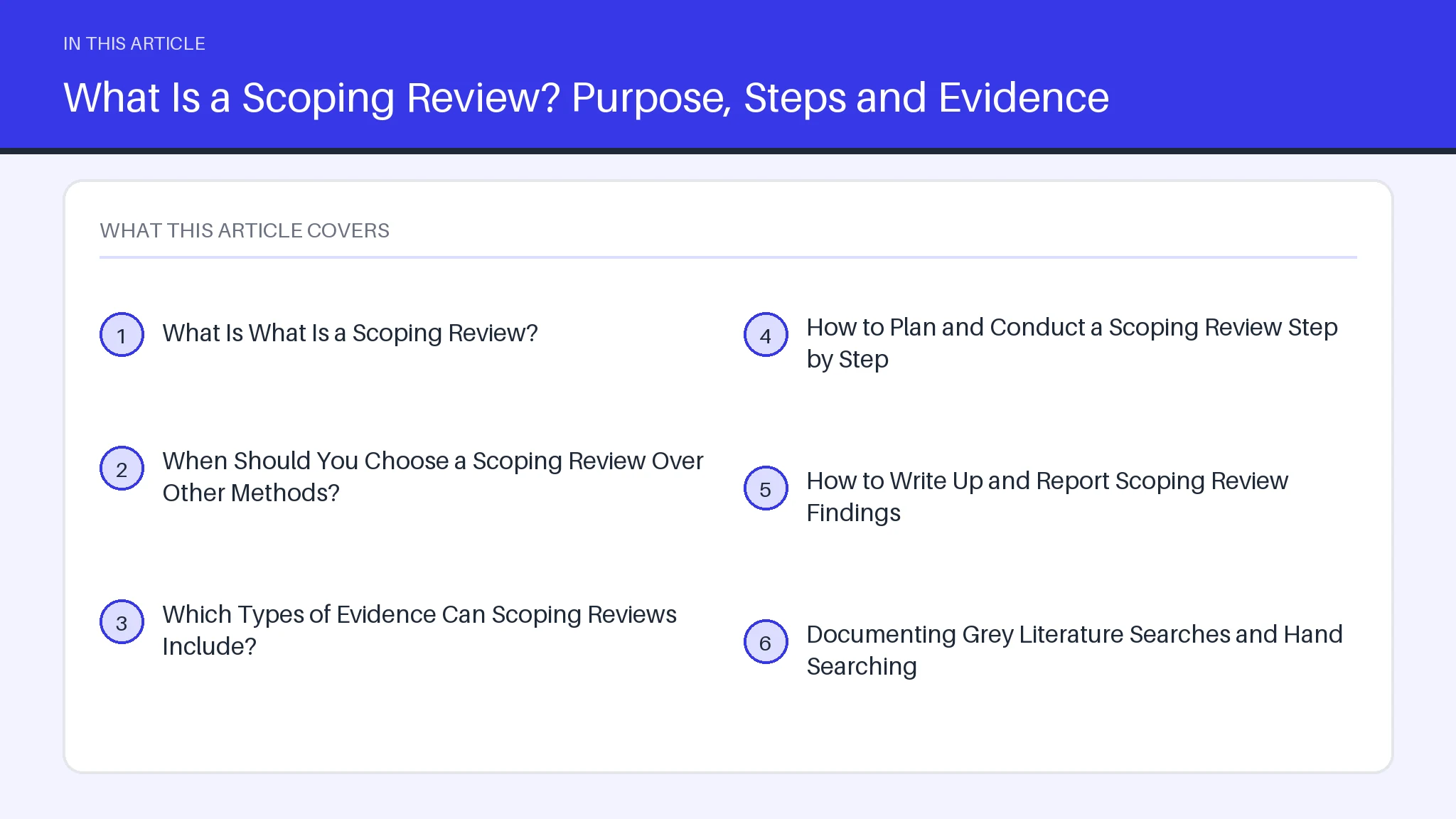
Scoping Review: What It Is, When to Use One, and How to Run It
A scoping review is a form of evidence synthesis that maps the literature on a topic rather than answering a narrow question about whether something works. It asks what evidence exists, how concepts have been defined, which populations and settings have been studied, what methods have been used, and where the gaps are. A systematic review narrows; a scoping review surveys.
Choose one when a topic is broad or emerging and you do not yet know what is out there, when terminology is inconsistent, when the relevant work spans designs that cannot sensibly be combined, when you want to identify gaps, or when you need to establish whether a full systematic review is feasible. If your question is already focused on the effect of an intervention on an outcome and comparable studies exist, a systematic review is the better fit.
Most teams follow the Arksey and O'Malley framework, the refinements from Levac and colleagues, and the JBI methodology, and report against PRISMA-ScR. PROSPERO does not accept scoping reviews, so protocols are usually posted on the Open Science Framework or a similar repository, or published in a journal that accepts protocols. The sections below cover how the method differs from related review types, the step-by-step process, frameworks and software, and where to find librarian support.
What Is a Scoping Review and When Should You Use One?
A scoping review is a form of evidence synthesis that maps the literature on a topic rather than answering a narrow question about whether something works. Instead of pooling results to produce an effect estimate, it asks what kinds of evidence exist, how concepts have been defined, which populations and settings have been studied, what methods have been used, and where the gaps are. Like a systematic review, it is secondary research: it uses a protocol, a documented search, transparent eligibility criteria, and a reproducible selection process. The difference is the purpose. A systematic review narrows; a scoping review surveys.
The clearest reasons to choose this method are practical. You perform a scoping review when a topic is broad or emerging and you do not yet know what is out there; when the terminology is inconsistent and part of your job is to clarify how authors use a concept; when the body of work spans study designs that cannot sensibly be combined, such as trials, qualitative studies, surveys, policy documents, and gray literature; when you want to identify gaps to justify a new primary study or grant application; or when you need to establish whether a full systematic review is even feasible. If you already have a focused question about the effect of an intervention on an outcome and expect comparable studies to exist, a systematic review is the better fit.
On the question of what "level" a scoping review occupies: it does not sit neatly on the traditional hierarchies used to grade intervention evidence, because it is not designed to produce a graded answer. Those hierarchies rank study designs by their ability to support causal claims, and a scoping review makes descriptive claims about a literature. The strength of what you can say is bounded by the studies you include and by the fact that most scoping reviews do not formally appraise them. It is best described as a descriptive, exploratory synthesis, and it should be reported as such rather than presented as a basis for practice recommendations.
The methodology most reviewers follow traces back to the Arksey and O'Malley framework, the refinements proposed by Levac and colleagues, and the current guidance from JBI, whose manual chapter is the most detailed operational source available. The steps in sequence: define your objective and review questions; specify inclusion criteria, usually structured as Population, Concept, and Context (PCC) rather than PICO; write a protocol describing how you will search, screen, extract, and present findings; run a comprehensive search across multiple databases plus gray literature sources; screen titles and abstracts against your criteria, then full texts; chart the data using a purpose-built extraction form; analyze and summarize the charted data; present the results with a PRISMA flow diagram plus tables and visual maps; and discuss the findings relative to your original objective, including gaps and implications for future research. An optional consultation step, in which stakeholders or clinicians review your preliminary map, is recommended in the Levac refinements and is worth considering when the results are meant to inform practice or policy.
For reporting, use PRISMA-ScR, the scoping review extension of the PRISMA statement. A conventional manuscript format works well: a title that identifies the work as a scoping review, a structured abstract, an introduction establishing why a scoping approach was chosen, a methods section stating your protocol and its registration or availability, results built around the flow diagram and charted characteristics of included sources, and a discussion that separates what the literature contains from what you can conclude. Limitations belong in their own paragraph. Scoping reviews are published routinely across health, social science, and education journals, and many journals also publish scoping review protocols, which is a useful way to timestamp your methods.
Registration is where scoping reviews differ from systematic reviews administratively. PROSPERO does not accept scoping review registrations, so there is no mandatory registry. Registration is not formally required, but prospective transparency is still expected by most reviewers and editors. Common solutions are posting the protocol on the Open Science Framework or a similar repository, depositing it in Figshare or an institutional archive, or publishing it in a journal that accepts protocols. Whichever route you take, state it explicitly in your methods and make the protocol accessible.
Can you do one alone? Technically yes, and single-author scoping reviews are published. Methodologically, the guidance assumes at least two people screening independently with a documented process for resolving disagreements, and solo screening introduces a real risk of inconsistent application of criteria. If you have no co-reviewer, the workable compromises are to recruit someone to independently screen a random sample and calculate agreement, to have a librarian peer-review your search strategy, to pilot your eligibility criteria and charting form on a small set of records before committing, and to declare single-reviewer screening as a limitation. Reference management and review software help by enforcing an audit trail, handling deduplication, and keeping screening decisions and reasons for exclusion recorded, but they do not substitute for a second judgment.
There is no target number of articles. The yield is a consequence of how broad your question is and how tightly your criteria are drawn, and it varies enormously by field and topic maturity. Scoping reviews often include far more sources than systematic reviews on similar subjects, because they admit multiple designs and gray literature. Treat the count as diagnostic rather than as a goal: if you find only a handful of eligible sources, your question may be too narrow, your search too restricted, or the gap you have found may itself be the finding. If your searches return an unmanageable volume, tighten the concept or context boundaries and update your protocol to record the change, rather than quietly narrowing mid-screening.
The limitations are inherent to the design and should be stated rather than apologized for. Most scoping reviews do not assess risk of bias or methodological quality, which means you can describe what exists but not how trustworthy it is. Results are descriptive; you cannot infer effectiveness, and quantitative pooling is out of scope. Breadth comes at the cost of depth, and the trade-off can obscure important differences between included sources. Broad questions invite scope creep, and inconsistent charting across a large heterogeneous set threatens reproducibility. Because gray literature searching is less standardized than database searching, coverage may be uneven. Finally, the work is not faster than a systematic review simply because appraisal is omitted; large volumes of records to screen and chart usually mean the opposite.
How a Scoping Review Differs From a Systematic Review
The clearest way to separate the two is by the question each one is built to answer. A systematic review asks a closed, specific question, typically framed around a population, an intervention or exposure, a comparator, and an outcome, and sets out to answer it by pooling or narratively synthesizing the studies that meet tightly defined eligibility criteria. A scoping review asks an open question about a body of literature: what has been studied, how, by whom, with what designs, and where the gaps are. It maps the field rather than adjudicating a question within it.
That difference in purpose drives every downstream methodological choice. Systematic reviews usually restrict eligible study designs, because the design determines whether a study can contribute to the answer. Scoping reviews generally cast wider: randomized trials, cohort studies, qualitative work, case reports, protocols, guidelines, and gray literature may all be eligible if they speak to the concept being mapped. Scoping reviews also tend to be iterative in a way systematic reviews are not, it is accepted practice to refine inclusion criteria as you learn what the literature actually looks like, provided you document the change and its rationale.
Critical appraisal is the other well-known divergence. Systematic reviews assess risk of bias in each included study, because the credibility of the answer depends on the credibility of the inputs. Scoping reviews do not require formal appraisal, since the output is a description of the literature rather than a claim derived from it. Some teams appraise anyway when they want to comment on the maturity of an evidence base; if you do, be explicit that appraisal was descriptive and did not drive inclusion or exclusion.
Synthesis differs accordingly. A systematic review may produce a meta-analytic estimate or a structured narrative synthesis oriented toward an effect. A scoping review produces a charted account: tables and figures organized by study characteristics, concepts, populations, geography, publication year, or whatever categories the mapping question implies. The recognizable deliverables are an evidence map, a gap analysis, and often a recommendation about whether a full systematic review is warranted and how it should be scoped.
Reporting standards mirror the split. Scoping reviews report against PRISMA-ScR, the scoping review extension, while systematic reviews use PRISMA 2020. Methodological guidance for scoping reviews most commonly cites the Arksey and O'Malley framework, its refinements by Levac and colleagues, and the JBI manual. Registration also works differently: PROSPERO does not accept scoping reviews, so teams typically deposit the protocol with Open Science Framework, Figshare, or a similar repository, or publish it in a journal that accepts protocols.
On timelines, the honest answer is that a scoping review is not reliably faster than a systematic review, and it is frequently slower. The relief you get from skipping critical appraisal is often more than offset by a broader search, looser eligibility criteria, and therefore a much larger volume of records to screen. A scoping review that maps an entire field can return several times the title-and-abstract volume of a narrowly framed systematic review on one intervention.
What actually determines duration is worth being concrete about, because it is what you can plan around. The main drivers are the number of records returned after deduplication; how many screeners you have and whether you are screening in duplicate; how many data fields you are charting and how much judgment each requires; whether gray literature, non-English sources, or citation chasing are in scope; how quickly full texts can be retrieved; and how long your team takes to reconcile disagreements and, in scoping reviews specifically, to stabilize the charting categories. Consultation with stakeholders, an optional stage in the Arksey and O'Malley framework, adds calendar time that is largely outside your control.
Rather than budgeting a fixed number of months, estimate from your own screening rate. Run the search, deduplicate, then have the team screen a sample of a few hundred records and measure records per hour per screener. Multiply out across the full set, add the full-text stage at a much slower per-record rate, and add charting time based on a pilot of five to ten studies. That gives you a defensible projection grounded in your actual team and question. Build in slack for the iterative refinement that scoping reviews invite, rescreening after a criteria change is common and should be planned for, not treated as failure.
Choose a scoping review when you genuinely do not know the shape of the literature, when the concept is emerging or defined inconsistently across fields, when you need to establish whether enough evidence exists to justify a systematic review, or when the goal is to inform a research agenda. Choose a systematic review when the question is already sharp, the relevant designs are identifiable, and someone needs an answer they can act on. If you find yourself wanting to draw a conclusion about effectiveness from a scoping review, that is a signal the question should have been framed as a systematic review from the outset.
Choosing Between Mapping, Rapid, Narrative, and Umbrella Review Methods
A scoping review is one option among several, and the label you choose has real consequences: it determines how you search, how many reviewers touch each record, what you extract, how you report, and how long the project takes. The most common mistake is picking the method first and then bending the question to fit it. Work in the other direction. Write your question in a single sentence, identify who will act on the answer and when, then ask which method is capable of producing that answer. If the sentence contains the words "how much better" or "does it work," you are heading toward a systematic review with synthesis, not a scoping review. If it contains "what exists," "what has been studied," "how is this defined," or "where are the gaps," a scoping review or evidence map is usually the right family.
Scoping reviews and mapping reviews sit close together and are sometimes used interchangeably, which causes avoidable confusion in peer review. Both aim to characterize a body of literature rather than pool results. The practical distinction is in the output and the level of description. A scoping review typically follows a structured, published framework, reports against PRISMA-ScR, and produces a narrative account of the evidence supported by tables that describe populations, concepts, contexts, study designs, and outcomes measured. An evidence and gap map is more often built as a structured, browsable matrix, usually intervention by outcome, with each cell populated by linked records so a reader can click into the underlying studies. If your funder or partner wants a living, navigable product that a program team will return to repeatedly, plan for a map and budget for the data structure and visualization work from the start. If they want a report that explains what the literature looks like and why the gaps matter, plan for a scoping review. Deciding this early matters because a map forces you to fix your categories before extraction begins, while a scoping review lets categories emerge and be refined as you go.
Rapid reviews are defined by a constraint, not a question type. Choose one when a decision has a date on it and that date will not move. The method is a systematic review or scoping review with documented, deliberate shortcuts: fewer databases, date or language limits, single screening with verification of excludes, single extraction with a second check on key variables, or narrower inclusion. What makes it a rapid review rather than a sloppy one is that every abbreviation is chosen in advance, justified, and reported so readers can judge the risk it introduces. Guidance from the Cochrane Rapid Reviews Methods Group is a reasonable starting point for deciding which corners are safest to cut. The honest answer to "how much faster is it?" depends entirely on your team size, topic breadth, retrieval volume, and how much of the work is parallelizable, so do not promise a timeline before you have run a scoping search and seen the record count. Run that search first; the number it returns is the single most useful input to any planning conversation.
Narrative reviews remain the right choice for a narrow set of purposes: building or critiquing a theory, arguing for a research agenda, teaching a field to newcomers, or writing the framing section of a grant. They allow the author to select and interpret sources freely, which is exactly what makes them unsuitable when the reader needs to know that nothing important was left out. If anyone downstream will use your review to justify a decision, a purchase, a guideline, or a policy, the absence of a documented search and selection process will be a problem. A useful test: could a competent stranger, given your methods section, retrieve approximately the same set of studies? If the answer is no and that matters, upgrade to a scoping review, which gives you much of the interpretive latitude of a narrative review inside a transparent process.
Umbrella reviews, also called overviews of reviews, are appropriate when the literature has already been synthesized several times and your real question is about the state of that synthesis. Choose this when a preliminary search returns multiple systematic reviews covering overlapping ground and stakeholders are asking which to believe or how they differ. Your unit of analysis becomes the review, not the primary study, and two tasks dominate the workload. First, appraising the included reviews with an instrument designed for that purpose, such as AMSTAR 2 or ROBIS. Second, managing overlap: the same primary studies frequently appear in several included reviews, and readers cannot interpret your findings unless you show them how much duplication exists. Build a citation matrix mapping primary studies against included reviews, and consider reporting overlap using an established measure such as the corrected covered area. Do not skip this step; it is the part reviewers of overviews notice.
Beyond the question itself, three practical factors usually settle the choice. The first is the maturity of the literature: emerging and heterogeneous fields suit scoping reviews and maps, while well-trodden fields with existing syntheses suit umbrella reviews. The second is what has to happen with the answer, and by when. The third is your actual capacity, reviewer hours, information specialist access, and content expertise for extraction. Be realistic here. Broad scoping questions can return retrieval volumes that overwhelm a small team, and the fix is almost always to narrow the concept or context rather than to abandon dual screening.
Whichever method you choose, write the choice and its rationale into a protocol before you screen, and set up your review software to match. That means configuring the screening workflow for the number of reviewers your method commits you to, building extraction forms that mirror your planned charting or mapping categories rather than a generic template, and enabling the reporting outputs you will need at write-up, a PRISMA-style flow record for any method with a documented search, a category structure that exports cleanly to a matrix for a map, and a way to record which primary studies sit inside which included review for an overview. Registering or publicly posting the protocol, where your review type allows it, also protects you if the scope shifts partway through.
Scope shift is common and not shameful. Teams frequently discover mid-project that their scoping review has surfaced enough comparable trials to justify a full systematic review, or that a planned systematic review has too little to synthesize and is better reported as a scoping review or map. Handle it by documenting when and why the change was made, what was already completed under the original plan, and what was redone. A staged approach, scoping review or map first to define the landscape, targeted systematic review second on the tractable slice, is often the most efficient route to a defensible answer, and it is easier to fund in two pieces than to rescue one overreaching project.
The Step by Step Process for Conducting the Review
A scoping review follows a defined sequence, and the order matters more than it does in less structured evidence work. Most teams work from the framework Arksey and O'Malley outlined, later refined by Levac and colleagues and formalized in the JBI methodology for scoping reviews, with reporting handled through PRISMA-ScR. The steps below reflect that consensus. Treat them as a workflow rather than a checklist to be filled in retrospectively: decisions made at step two constrain what you can honestly claim at step seven.
1. Define the objective and question. Start by writing the purpose of the review in a sentence or two. Scoping questions are deliberately broader than the focused comparisons used in effectiveness reviews, but broad is not the same as vague. The PCC mnemonic, Population, Concept, Context, gives you the three elements to pin down. If you cannot state which population, which concept, and which context you are mapping, you are not ready to search. This is also the point to be explicit about why a scoping review is the right choice: to map the extent and nature of a literature, clarify definitions, identify gaps, or determine whether a full systematic review is feasible.
2. Write and register a protocol. Draft the protocol before any searching begins. It should specify the question, eligibility criteria, search strategy, screening process, the data you intend to chart, and how you will present results. PROSPERO does not accept scoping reviews, so teams typically deposit protocols on Open Science Framework, Figshare, or a similar repository, or publish them in a journal that accepts protocol manuscripts. Registration is not a formality, it is the record that lets readers see which decisions were planned and which were made after seeing the evidence.
3. Develop the search strategy. Build the search with a librarian or information specialist if you have access to one. Work from the PCC elements, combining controlled vocabulary (MeSH, Emtree) with free-text terms, and translate the strategy for each database rather than pasting one syntax across all of them. Scoping reviews commonly search beyond the standard bibliographic databases: gray literature, dissertations, government and agency reports, professional association documents, and conference abstracts often hold the material that defines the boundaries of an emerging field. Record every database, platform, date limit, and language restriction, along with the date each search was run, and save the full strategies for the appendix. Supplement the database searches with citation chasing, checking reference lists and forward citations of the records you include.
4. Deduplicate and set up screening. Export results in a structured format (RIS, NBIB, or CSV) and load them into your review software. Deduplication comes first; overlapping database coverage means a substantial share of records will appear more than once, and screening duplicates wastes reviewer time and corrupts your counts. Then configure screening as two stages: title and abstract, followed by full text. Before either stage, run a calibration exercise in which all reviewers screen the same small sample and discuss disagreements. This is where you discover that your eligibility criteria are ambiguous, and it is much cheaper to fix them then than halfway through.
5. Screen in duplicate. Two reviewers screen each record independently, with a documented process for resolving conflicts, discussion first, a third reviewer if discussion stalls. At the full-text stage, record a specific reason for every exclusion, because those reasons populate the exclusion boxes in your PRISMA-ScR flow diagram. Refine criteria as you go if you must, but write down what changed and when. Iterative refinement is accepted practice in scoping reviews; undocumented refinement is not.
6. Chart the data. Charting is the scoping review's equivalent of data extraction, and it is iterative by design. Build a charting form from your protocol, study identifiers, design, setting, population, concept-specific variables, key findings, then pilot it on a handful of included sources and revise. Expect the form to grow as you see what the literature actually contains. Have a second reviewer verify charted data, either on every record or on a defined sample, and state which approach you took. Formal critical appraisal is optional in scoping reviews; if you choose to appraise, say so, name the tool, and explain how the results inform your interpretation.
7. Collate, summarize, and report. Results are usually presented as descriptive counts, tables, and visual maps, publication years, geographic distribution, study designs, populations, and how the concept has been operationalized, paired with a narrative account of what the map shows and where it is empty. No pooling, no effect estimates. Report against the PRISMA-ScR checklist and include the flow diagram with counts at each stage. If your protocol included stakeholder consultation, describe who was consulted, at what point, and how their input shaped the review.
How long the process takes depends on the breadth of your question, the number of records retrieved, how many reviewers you have, and whether gray literature searching is involved, a tightly scoped question with two full-time reviewers behaves very differently from a broad map screened by a part-time team. Estimate your timeline after the searches are run and you know your record count, not before.
Frameworks, PRISMA ScR Reporting Standards, and Software Tools
Every scoping review needs two decisions made early and documented: which methodological framework will structure the work, and which reporting standard will structure the write-up. These are not the same thing. A framework tells you what steps to carry out and in what order; a reporting standard tells you what a reader must be able to find in the finished manuscript. Choosing both before you search is what keeps a scoping review from drifting into an unstructured literature summary.
The foundational framework is Arksey and O'Malley's five-stage approach: identify the research question, identify relevant studies, select studies, chart the data, and collate, summarize, and report the results, with an optional sixth stage of consultation with stakeholders. Levac and colleagues later published recommendations that sharpen each stage, most usefully the advice to link the question to a clear purpose, to treat study selection and charting as iterative and team-based rather than linear, and to distinguish analysis from interpretation when reporting. The JBI methodology for scoping reviews builds on both and is the most prescriptive of the three: it requires an a priori protocol, frames eligibility with PCC (Population, Concept, Context) rather than PICO, and specifies how objectives, questions, and inclusion criteria should align. If your review is destined for a journal that expects JBI conventions, or if you want the tightest audit trail, JBI is the practical default. Arksey and O'Malley with Levac's refinements remains entirely acceptable and is common in policy and health services work. What matters is that you name the framework you followed and then actually follow it.
For reporting, use PRISMA-ScR, the scoping review extension published by Tricco and colleagues in 2018. It contains 20 essential items and 2 optional items, and it differs from PRISMA 2020 in ways that trip people up. It speaks of "sources of evidence" rather than "studies," because scoping reviews routinely include guidelines, theses, reports, and other gray literature. Critical appraisal is not a required item; if you do appraise, you report how, and if you do not, you say so and explain why. There is no expectation of pooled effect estimates, subgroup analysis, or certainty-of-evidence grading. What PRISMA-ScR does hold you to is transparency about the question, the eligibility criteria, the full search strategy for at least one database including all limits and dates, the selection and charting process including how many reviewers were involved and how disagreements were resolved, and a flow diagram accounting for every record from identification through inclusion. Fill in the checklist as you write, not afterward, and submit it as a supplementary file.
Registration is a common point of confusion. PROSPERO does not accept scoping reviews. The practical alternatives are to post the protocol on the Open Science Framework or a similar repository with a timestamped DOI, or to publish it in a journal that accepts protocols. Either way, register or post before screening begins, and record any subsequent deviations with a short rationale. Because scoping review searches are broad and eligibility often gets refined once the team sees what the literature actually looks like, mid-review changes are normal; the reporting expectation is that you disclose them rather than avoid them.
On tooling, think in terms of stages rather than platforms. For search development, translation tools such as the Polyglot Search Translator help move a strategy between database syntaxes, MeSH analysis tools help you check subject heading coverage, and text-mining approaches can surface candidate terms from a seed set of known-relevant papers. Expect to have a librarian or information specialist review the strategy regardless of what software you use; a peer review instrument such as PRESS is worth applying even though it is not mandatory for scoping reviews.
For deduplication and screening, the working requirements are that the software handle large record sets without slowing down, support blinded independent screening by two or more reviewers with a conflict-resolution view, log every decision with a timestamp and reviewer, and export the exact counts you need for the flow diagram. Scoping reviews often return record volumes well beyond what a typical intervention review handles, so pay attention to record limits, import formats, and whether full-text PDFs can be stored alongside citations. Dedicated review platforms handle this; a reference manager plus a shared spreadsheet also works if the team is small and disciplined about version control, but it puts the audit trail on you.
Charting is where scoping reviews differ most from systematic reviews in practice. Build the charting form as a structured template, pilot it independently on a handful of included sources, compare results, and revise before charting the rest. Because the form is expected to evolve, choose a tool that lets you add fields and re-visit already-charted sources without breaking the dataset: a platform extraction form, a purpose-built data capture system such as REDCap, or a well-designed spreadsheet with one row per source and controlled vocabularies in each column. Export in a format you can analyze, since the output of a scoping review is usually descriptive counts and a map of the literature.
Finally, plan the outputs. Flow diagram generators produce PRISMA-compliant figures from your screening counts. Evidence gap maps, heat maps, and bubble charts, built in mapping software, Tableau, or R, are often the most informative part of a scoping review because they show where evidence clusters and where it is absent. Whatever you use, keep the underlying charted dataset and share it as a supplement; it is the piece other researchers will reuse.
Where to Find Librarian Support, Training, and Methodological Guidance
A scoping review lives or dies on its search. Because the point is to map what exists on a topic rather than answer a narrow effect question, the search usually has to be broad, multi-database, and often supplemented with gray literature, which is exactly the kind of work an information specialist does every day. If you are affiliated with a university, academic medical center, or teaching hospital, your first stop is your library's liaison, subject, or clinical informationist service. Most libraries publish a request form or consultation booking page for evidence synthesis support; search your library site for "systematic review service," "evidence synthesis," or "research consultation." If you cannot find one, email the librarian assigned to your school, department, or college and ask directly whether they support scoping reviews. Many libraries treat scoping, rapid, and systematic reviews under one service umbrella, so do not assume you are out of scope because the page says "systematic review."
Contact the library before you write your protocol, not after you have started screening. The decisions a librarian can most usefully influence, which databases to search, how to translate concepts into controlled vocabulary and free text across platforms, whether your inclusion criteria are operational enough to screen against, whether the topic is even searchable as framed, are all baked in by the time you have a spreadsheet of results. An early conversation also protects you from the most common and most expensive scoping review mistake: discovering mid-screening that the search missed a whole literature and having to rerun and rescreen everything.
Ask the library what its service model is, because these vary widely. Some offer a single one-hour consultation and leave you to run the search. Some will build, translate, and document the full search strategy and expect co-authorship in return. Some maintain a tiered model where an internal team gets a collaborative service and external requesters pay a fee or are turned away. A few will peer review a search strategy you have already drafted without joining the project. None of these is unusual, and none is a slight, they reflect staffing. Ask up front, and ask how far in advance requests need to be made; lead times depend entirely on how many librarians the institution employs and how many reviews are already queued, so the only reliable answer comes from the library itself.
Settle the authorship question in the same conversation. Under the widely used ICMJE authorship criteria, a librarian who designs the search, translates it across databases, runs it, and drafts the search methods section has typically made a substantial intellectual contribution and should be offered co-authorship; someone who answered a twenty-minute question about database access has not. The awkward version of this discussion is the one that happens at submission. Have it at the start, put it in writing, and specify who is responsible for reporting the search in enough detail for another team to reproduce it.
If you have no institutional library, you still have options. In the United States, the Network of the National Library of Medicine (NNLM) runs regional offices and offers free classes, webinars, and on-demand training on searching PubMed and supporting evidence synthesis, open to unaffiliated researchers. Hospital libraries sometimes serve community clinicians and residents beyond their own staff. State libraries, state health department libraries, and public library systems can help with document delivery even when they cannot help with strategy. The Medical Library Association and its evidence synthesis and expert searching communities are useful for finding independent information specialists who consult on a contract basis, which is a normal arrangement for teams at small organizations, nonprofits, and consultancies with no library of their own.
For methodological guidance, go to the sources written specifically for scoping reviews rather than adapting systematic review guidance by eye. The JBI Manual for Evidence Synthesis includes a dedicated, freely available chapter on scoping reviews that walks through question formulation, the population-concept-context framing, protocol content, charting, and presentation of results. PRISMA-ScR is the reporting extension for scoping reviews and is available through the PRISMA and EQUATOR Network sites along with its explanatory paper; read it before you write the protocol and use it as a drafting outline, not a submission-day checklist. The Arksey and O'Malley framework and the later Levac and colleagues refinement remain the conceptual foundation most published scoping reviews cite. For search reporting specifically, the PRISMA-S extension tells you what a reproducible search description contains, and the PRESS checklist is the standard instrument librarians use when peer reviewing another librarian's strategy.
Two practical notes on registration and protocols, since these come up constantly. PROSPERO's remit is focused on reviews with health-related outcomes and it has historically not accepted scoping reviews; check its current scope before assuming you can register there. Teams commonly post scoping review protocols on the Open Science Framework or Figshare, or publish them in a journal that accepts protocols. Either way, timestamping the protocol before screening begins is what gives your eligibility criteria and charting plan credibility.
For training, the useful distinction is between methods training and software training, and you need both. Methods training comes from JBI's scoping review workshops and training programs, university-run evidence synthesis courses and boot camps, library workshop series, Cochrane's learning materials for the searching and screening components, and free NNLM offerings. Software training is usually best taken from the tool's own documentation and webinars, because interfaces change faster than course materials. Whichever route you take, ask whether the training covers charting and synthesis of a heterogeneous evidence base, that is the stage where scoping reviews most often stall, and where generic systematic review courses have the least to say.
Finally, build in a second pair of expert eyes even if you have librarian support. A colleague in another department, a librarian at a partner institution, a methods listserv, or a subject expert who knows the literature well can all tell you the same thing your own team cannot: which obvious body of work is missing from your results. Send them your draft strategy and a handful of papers you know should be found, and ask them what else should have turned up.