Rapid Review: Methods, Steps and When to Use One
A rapid review is a structured evidence synthesis that keeps the logic of a full review but simplifies or omits selected steps so results arrive in time to inform an actual decision. Timeframes typically run from two to twelve weeks rather than the twelve to twenty four months a full synthesis often demands. The method is used most heavily by health departments, hospital networks, guideline panels, funders and policy units who need defensible evidence before a committee meets or a budget closes.
Reading this guide will help you decide whether an accelerated approach suits your question, choose which steps to compress, and document those choices so reviewers and end users can judge the result fairly. It is written for research teams, health librarians, clinical policy advisers and postgraduate researchers who already understand the fundamentals of structured evidence synthesis and now need to work faster without pretending the shortcuts do not exist.
The most common misconception is that speed is achieved by working harder within the same design. In practice, a defensible rapid review earns its time savings through explicit scope decisions: a single well bounded question instead of four, two or three core databases instead of eight plus grey literature, single reviewer screening with a verification sample instead of full duplicate screening, and targeted rather than exhaustive risk of bias assessment. Each of those decisions has a known effect on what you might miss, and each should be recorded before searching starts.
What you need before you start. Bring five things to the first planning conversation: a named decision and its immovable deadline; a commissioner who will confirm the question in writing and accept a stated level of uncertainty; an information specialist or librarian who can build and run the search; at least two people available for concurrent screening and extraction; and a short protocol template that captures the abbreviations you intend to make. Reference management and screening software, agreed inclusion criteria, and a plan for who signs off findings complete the set. Teams that skip these steps usually lose more time to rework than they saved by cutting corners, and the resulting summary is harder to defend when someone asks what was left out.
Key takeaways
- A rapid review is a form of evidence synthesis in which parts of the standard review process are simplified or omitted so that findings reach decision makers in weeks rather than months.
- Speed comes from deliberate design choices, not from carelessness: narrower questions, fewer databases, single screening with verification, and abbreviated appraisal are all documented shortcuts that must be declared in the protocol.
- The main trade-off is precision and coverage against timeliness, so teams should record every deviation from full methods and state plainly how it might affect confidence in the conclusions.
- Established guidance from bodies such as the Cochrane Rapid Reviews Methods Group, the World Health Organization and Australian health agencies gives review teams defensible defaults instead of ad hoc shortcuts.
- Choose an accelerated approach when a real decision has a fixed deadline, the question is bounded, and the commissioner accepts a documented level of uncertainty.
What Is Rapid Review?
Tricco and colleagues defined the approach in 2015 as a form of knowledge synthesis in which components of the systematic review process are simplified or omitted to produce information in a timely manner. That definition matters because it locates the difference in process, not in question type or evidence base. A rapid review can address effectiveness, harms, diagnostic accuracy, cost or acceptability. What changes is how much of the standard machinery you run, and how openly you report the parts you set aside.
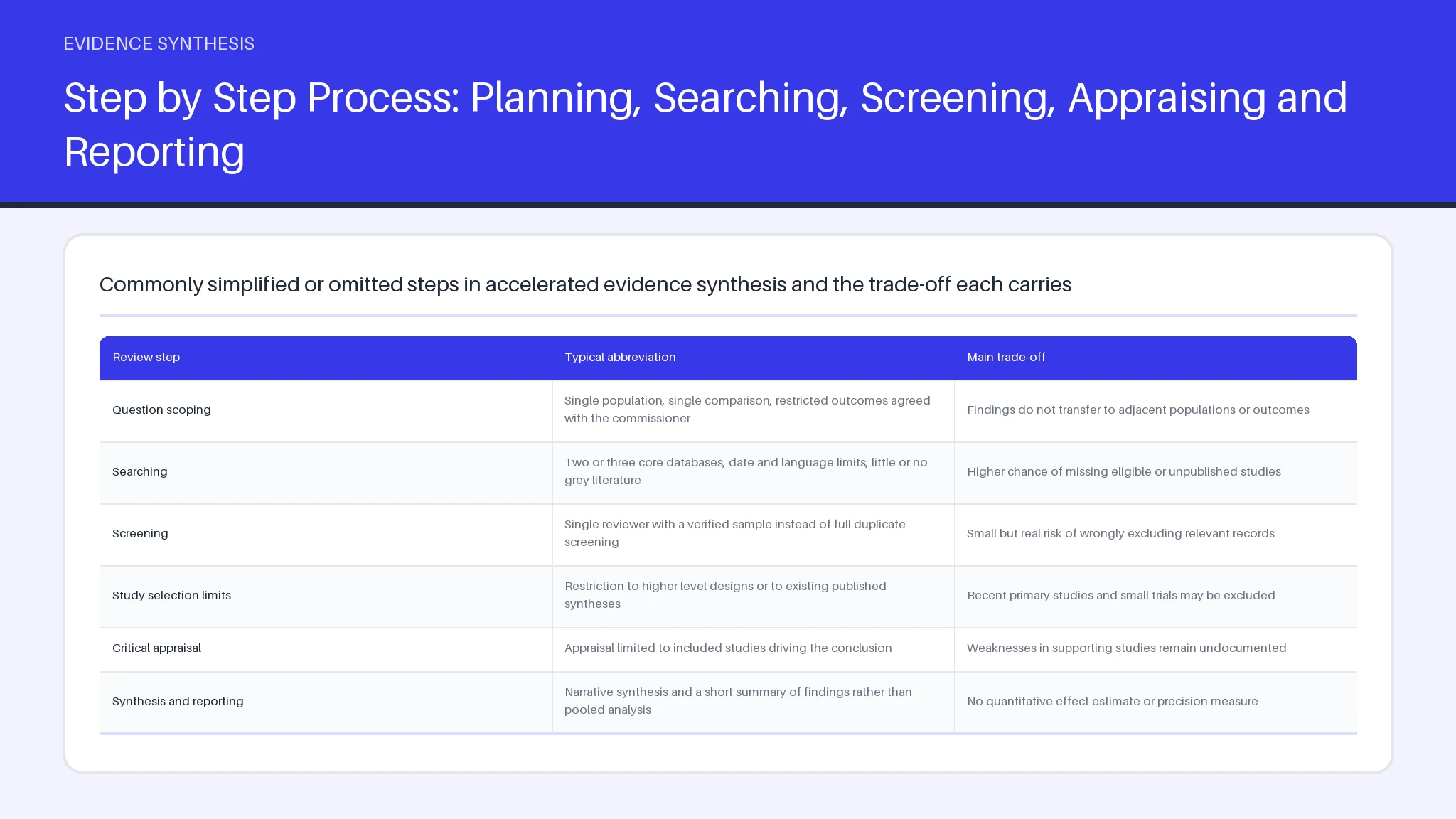
The practical decision is therefore not "fast or rigorous" but "which specific step do I compress, and what do I lose". The table below sets out the most frequently abbreviated steps and the trade-off each one carries, so a team can build a defensible plan rather than improvising under deadline pressure.
| Review step | Typical abbreviation | Main trade-off |
|---|---|---|
| Question scoping | Single population, single comparison, restricted outcomes agreed with the commissioner | Findings do not transfer to adjacent populations or outcomes |
| Searching | Two or three core databases, date and language limits, little or no grey literature | Higher chance of missing eligible or unpublished studies |
| Screening | Single reviewer with a verified sample instead of full duplicate screening | Small but real risk of wrongly excluding relevant records |
| Study selection limits | Restriction to higher level designs or to existing published syntheses | Recent primary studies and small trials may be excluded |
| Critical appraisal | Appraisal limited to included studies driving the conclusion | Weaknesses in supporting studies remain undocumented |
| Synthesis and reporting | Narrative synthesis and a short summary of findings rather than pooled analysis | No quantitative effect estimate or precision measure |
Types of Rapid Evidence Reviews and How Their Scope and Methods Vary
The label covers a family of products rather than one fixed design, and the scope you promise should match the label you use. Four forms appear most often in practice.
- Evidence summary or briefing note. One to three weeks. Draws mainly on existing published syntheses and guidelines to answer a single, tightly framed question for a committee. No new appraisal of primary studies.
- Rapid evidence assessment. Four to eight weeks. Runs a documented search of two or three databases, applies stated eligibility criteria, and appraises included studies with a short tool. This is the form closest to a compressed full synthesis.
- Rapid scoping exercise. Used when the question itself is unsettled. It maps what evidence exists, in what volume and of what type, without appraising or synthesising effects, and often precedes a decision about whether a longer project is warranted.
- Rapid overview of existing syntheses. Searches for and compares published reviews on a topic, then reports where they agree, disagree or leave gaps. Efficient when a topic is already well reviewed but the reviews conflict.
Scope drives every other choice. Deciding early which of these products you are producing tells you how many databases to search, whether appraisal is in or out, and what the final rapid review can honestly claim. Naming the form in the protocol also protects the team from scope creep once early results start raising interesting side questions.
Strengths and Limitations: Speed Versus Rigour and Risk of Bias
The strength of the approach is fit for purpose timeliness. Evidence delivered before a decision is made can change that decision; a flawless synthesis delivered afterwards cannot. Accelerated work also costs less, uses fewer staff days, and lets teams triage many questions instead of exhaustively answering one. For emerging topics with thin literature, a short project can establish quickly that the evidence base is too sparse to support a change of policy, which is itself a useful finding.
The limitations are specific and predictable. Restricting databases and languages introduces selection and language bias. Single reviewer screening carries a modest error rate that duplicate screening would catch. Skipping grey literature and trial registries raises exposure to publication bias, which tends to inflate apparent benefit. Abbreviated appraisal means unmeasured confounding or high attrition in individual studies may go unremarked. Where a topic is contested, two teams working rapidly from different search strategies can reach different conclusions.
Two practices reduce that risk without much added time. First, run a targeted sensitivity check: search one additional database or one registry late in the process and see whether anything material appears. Second, record every deviation from full methods in a short limitations table and state the direction of likely bias for each. A rapid review that names its weaknesses is far more usable to a decision maker than one that quietly hides them.
How Rapid Reviews Compare With Scoping, Umbrella and Full Evidence Syntheses
Choosing between review types is a question of purpose, not prestige. A scoping exercise asks what evidence exists and how it is distributed; it maps rather than answers. An umbrella or overview of reviews sits above the primary literature and compares what existing syntheses have already concluded. A full synthesis aims for exhaustive retrieval, duplicate screening, formal appraisal and, where appropriate, pooled analysis. Each of these designs answers a different question, and the differences between a full synthesis and a pooled analysis are worth understanding before you commit to any timeline.
An accelerated project overlaps all three. It can borrow the mapping function of a scoping exercise, the reliance on published syntheses typical of an umbrella review, or the effectiveness question of a full synthesis, then run whichever of those designs it has chosen on a compressed schedule. That flexibility is why teams sometimes conduct rapid work as a scouting step: results indicate whether a longer, fully resourced project is justified and, if so, which comparisons matter most.
The important distinction to hold onto is that time is not the only variable. Deciding to conduct rapid work changes the strength of the claim you can make, so the reporting must change too. A well written rapid review states the question it answers, the evidence it searched, and the confidence a reader should place in the result. If the commissioner needs a precise pooled effect estimate with confidence intervals, no amount of compression will deliver it and a full quantitative synthesis is the right choice.
Step by Step Process: Planning, Searching, Screening, Appraising and Reporting
Work the sequence below in order, and hold each stage to a fixed date rather than to an ideal standard. Teams that conduct rapid work successfully treat the calendar as a design constraint from day one.
- Confirm the question and the deadline. Agree the population, intervention, comparator and outcomes in writing with the commissioner, along with the date findings are needed and what decision they feed.
- Write a short protocol. Two to four pages covering eligibility, databases, limits, screening model, appraisal tool and synthesis plan. Record every planned abbreviation. The same discipline used to write and register a protocol applies here in shorter form.
- Run the search with an information specialist. Two or three core databases, plus one registry if harms or ongoing trials matter. Save the exact strategies and dates.
- Screen with verification. One reviewer screens titles and abstracts; a second independently checks a sample of at least twenty per cent, and all full texts are checked by two people. Our guide to screening studies covers the mechanics.
- Extract and appraise selectively. Use a pre piloted form with the minimum fields needed, and appraise the studies that carry the conclusion.
- Synthesise and report. Narrative synthesis, a flow of records consistent with PRISMA reporting, a limitations table, and a one page summary written for the decision maker.
Anyone planning to conduct rapid review work for the first time should build in a mid point checkpoint where scope can be cut, not expanded.
Methodological Guidance and Handbooks for Conducting Accelerated Reviews
Several bodies publish interim guidance that gives teams defensible defaults. The Cochrane Rapid Reviews Methods Group produced recommendations covering question refinement with the knowledge user, search limits, single reviewer screening with partial verification, single extraction with verification, and risk of bias assessment restricted to primary outcomes. The World Health Organization published practical guidance for rapid reviews to strengthen health policy and systems, aimed at teams supporting decisions in constrained settings. In Australia, health departments and evidence units commission this work routinely, and their published rapid review reports are a useful model for how deviations should be documented.
Reporting guidance is less settled than conduct guidance. PRISMA remains the reference point for describing how records moved from search to inclusion, and most teams adapt it rather than replacing it. Where an item cannot be met, the honest approach is to report it as not applicable and explain why.
Read the guidance before the deadline arrives, not during. Teams that decide to conduct rapid review work with a pre agreed set of methodological defaults spend their scarce time on the evidence rather than on arguing about process. Keep a one page internal standard that records which defaults your unit uses, and revise it as the guidance evolves.
Toolkits, Checklists and Further Reading for Review Teams
Every experienced team eventually assembles its own working kit. At minimum, keep the following where the whole team can reach it: a two page protocol template with a mandatory field for declared abbreviations; a saved set of database search blocks for your recurring topics; a screening form with clearly worded eligibility rules; a short appraisal tool matched to your usual study designs; a limitations table template; and a one page summary format that leads with the answer, then the confidence, then the caveats.
Reading that repays the time includes the Tricco and colleagues definitional work, the Cochrane interim recommendations, and WHO practical guidance. Published examples matter just as much as guidance documents. Reading three or four completed reports in your field shows how much detail a credible summary of findings actually needs. Our tools comparison and the Systematicly journal collect further practical material on screening, extraction and reporting workflows.
Software choice is a real time factor. Deduplication, screening on multiple devices, structured extraction and automatic record counts remove hours of manual bookkeeping from any rapid review method. The gain is administrative rather than methodological, so it should be described as such in your report. Where automation assists screening, state what it did and how human reviewers checked it.
When Should You Choose an Accelerated Review Over a Full Synthesis?
Choose the accelerated route when four conditions hold at once. A real decision is pending with a fixed date. The question can be bounded to one population and a short list of outcomes. The commissioner will accept, in writing, a stated level of uncertainty. And the topic is not so contested that a partial search would be indefensible. If any of those fails, either renegotiate the brief or run a full synthesis.
Avoid the approach when the output will underpin a national guideline recommendation, a regulatory submission, a legal proceeding, or a funding decision that cannot be revisited. In those cases exhaustive retrieval and duplicate screening earn their cost. Also avoid it where the evidence base is enormous and heterogeneous, because narrowing the search enough to hit the deadline would leave the conclusion resting on an arbitrary slice of the literature.
Tips and common mistakes. Fix the deadline first and design backwards from it. Say no to added outcomes once searching has begun. Do not describe abbreviated work as a full synthesis in the title or abstract, and do not leave the limitations section to the final hour. The most frequent failure is over claiming: a sound rapid review method produces a modest, clearly bounded answer, and presenting it as more than that damages the team's credibility on the next question.
Frequently asked questions
What is a rapid review?
It is a form of knowledge synthesis in which components of the standard review process are simplified or omitted so findings arrive in a timely manner, following the definition set out by Tricco and colleagues in 2015. In practice that means a narrower question, fewer databases, tighter limits and single reviewer screening with verification, all declared in the protocol.
What is a rapid review vs. systematic review?
Both share the same logic: a stated question, pre specified eligibility, a documented search and transparent reporting. The difference is completeness. A full synthesis aims for exhaustive retrieval and duplicate screening and often takes twelve months or more, while the accelerated version accepts documented gaps to deliver in weeks and hedges its conclusions accordingly.
What are the pros and cons of rapid reviews?
The advantages are timeliness, lower cost, fewer staff days, and the ability to triage several policy questions instead of exhaustively answering one. The disadvantages follow directly from the shortcuts. Restricted searching increases the chance of missing eligible studies and raises exposure to publication and language bias. Single reviewer screening carries a small error rate. Abbreviated appraisal can leave weaknesses in individual studies undocumented. None of these are fatal if they are declared, but they do limit what the findings can be used to justify.