Dichotomous Research Questions: Formats and Examples
Dichotomous research questions are survey or interview items that allow exactly two answer options, most often yes or no, true or false, or agree or disagree. You use them when the thing you are measuring is genuinely binary: someone either holds a license or does not, either completed a course or did not, either consented or declined. Used that way, a binary item produces clean, unambiguous data that needs no interpretation before analysis.
This guide is written for researchers, analysts, evaluators, and product and program teams who design their own instruments and then have to defend the resulting numbers. It covers what makes an item dichotomous, the formats beyond a plain yes or no, how to place and word two option items so they do not collapse under pressure, when a rating scale is the better choice, and copy ready examples you can adapt.
The practical goal is judgment rather than a template. By the end you should be able to look at any draft item and decide quickly whether dichotomous research questions will capture what you actually need, whether the two options are truly exhaustive, and what you will lose by removing the middle ground. That decision is easier to make before fielding an instrument than after, when the only remaining option is to explain a distribution you cannot interpret.
Key takeaways
- Dichotomous research questions offer exactly two answer options, such as yes or no, true or false, or agree or disagree, and they work best when the underlying reality is genuinely binary.
- A two option item is fast to answer and simple to tabulate, but it discards intensity, so it suits facts, eligibility, and screening rather than attitudes or satisfaction.
- Poor binary items usually fail for one of three reasons: the two options are not mutually exclusive, the wording hides two questions inside one, or a middle answer is the truthful answer for many people.
- Placement matters as much as wording. Put binary screeners first, use them to drive skip logic, and follow a sensitive yes no item with one open ended probe.
- When you need degree rather than presence, a rating scale gives you more analytic room; when you need a clean gate or a compliance record, the binary format wins.
What Is a Dichotomous Question and How Does It Work?
A dichotomous question is a closed item with two answer options that are mutually exclusive and, together, cover every possible answer. The respondent picks one; no third path exists. That structure is what makes the item useful. Because the answer space is fixed, each response maps directly to a single stored value, usually 1 or 0, so you can count, cross-tabulate, and route without cleaning free text first.
Mechanically, three things happen when a respondent answers a yes no item. The instrument records a binary value, that value becomes available to skip logic so later questions appear or disappear, and the aggregate becomes a proportion rather than a mean. Proportions are easy to report and easy to compare across waves, which is why screening batteries and eligibility checks lean on this format so heavily.
The limitation is equally structural. Dichotomous research questions collect presence or absence, not degree. If you need to know how strongly someone feels or how often something happens, a two option item forces people with very different experiences into the same bucket, and no amount of analysis will recover the difference afterward.
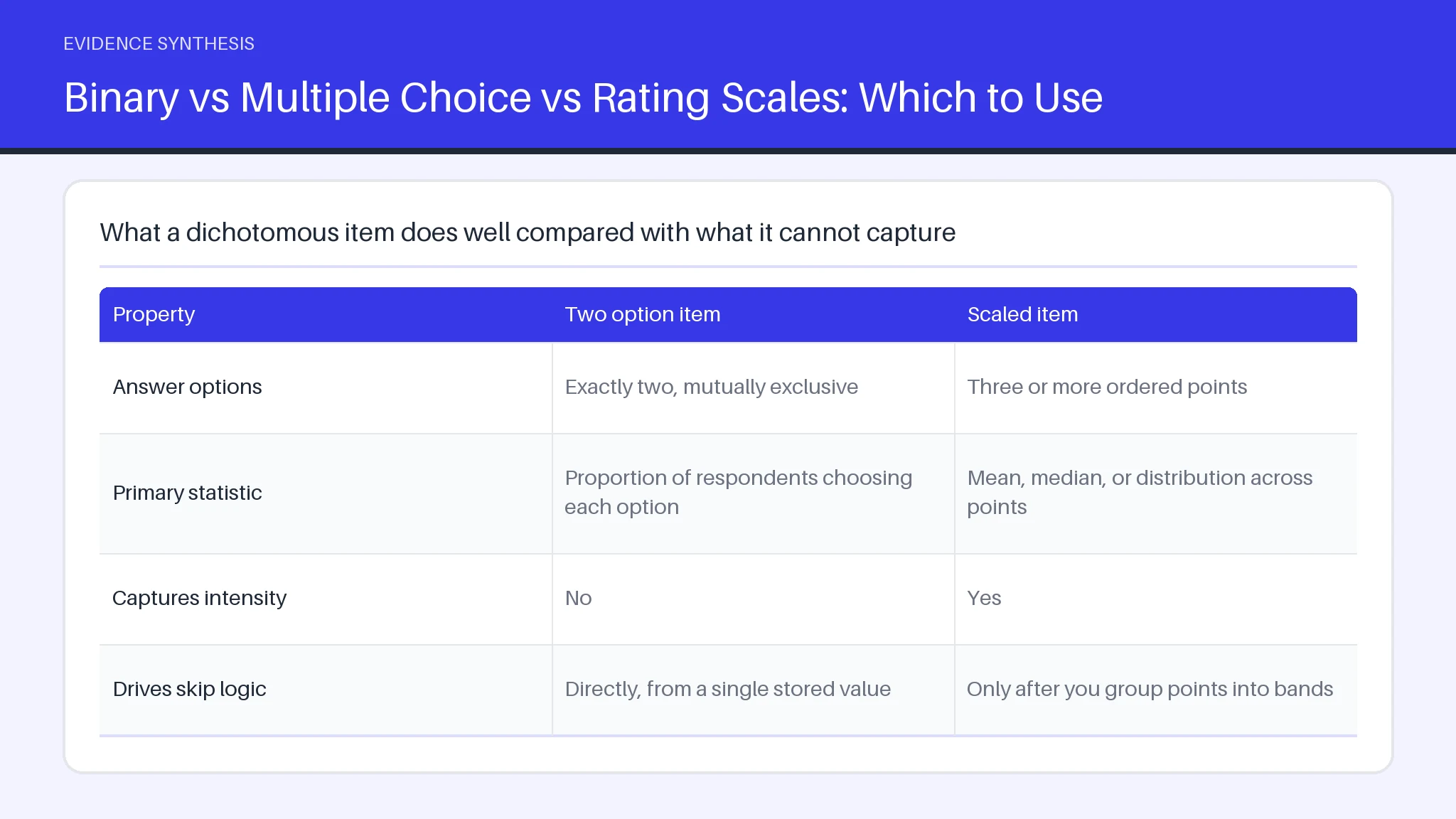
| Property | Two option item | Scaled item |
|---|---|---|
| Answer options | Exactly two, mutually exclusive | Three or more ordered points |
| Primary statistic | Proportion of respondents choosing each option | Mean, median, or distribution across points |
| Captures intensity | No | Yes |
| Drives skip logic | Directly, from a single stored value | Only after you group points into bands |
Common Binary Question Formats Beyond Simple Yes or No
Yes or no is only the most familiar of several two option formats, and choosing the right wording pair changes how easily people answer. True or false suits factual knowledge checks, because it invites recall rather than self-assessment. Agree or disagree suits statements of position. Did or did not suits behavior over a stated period. Male or female, or any other category pair, only works when the pair is genuinely exhaustive for your population, which is often the point where a binary item should be replaced.
Two further formats are worth knowing. A forced choice pair asks respondents to pick between two desirable options, which breaks the habit of agreeing with everything. A checkbox that a respondent either ticks or leaves blank is also a binary item, even though it does not look like one, and it records the same underlying value.
Matching format to content is the whole skill. Dichotomous research questions fail most often when a designer reaches for yes or no out of habit rather than because the answer space really has two doors.
Deploying Two Option Questions: Placement, Wording, and Response Options
Placement decides how much work a two option item can do. Put eligibility and consent items at the very start, before you spend a respondent's attention on anything else, and wire them to skip logic so ineligible people exit in seconds rather than filling pages you will later discard. That single decision protects your field budget, which is usually the scarcest resource in any study.
Wording rules are short and unforgiving. Ask about one thing only; an item like "Did you receive and read the policy?" produces uninterpretable data because a no could mean either half. Avoid negatives, since "Do you not agree" reverses the answer for careless readers. Define the time frame explicitly, because "recently" means different things to different people.
For response options, keep both labels visible and equally weighted, and add a separate "prefer not to say" path only where refusal is meaningful, such as a compliance record. Do not label that path as a third substantive answer; keep the yes no distinction intact so the two option data stays clean.
Are Dichotomous Research Questions Effective in Survey Design?
Dichotomous research questions are effective when the construct is genuinely binary and misleading when it is not. That is the whole test. Effectiveness here means the item returns data you can defend, not simply data you can chart.
The common types fall into four families. Factual or behavioral items record whether something happened. Eligibility and screening items decide who continues. Consent and policy items create a record. Forced choice items make a respondent commit to one of two positions. Dichotomous survey questions are simply these families as fielded instrument items, with the answer set fixed at two and the stored value reduced to a single flag that later logic can read.
Applied work shows where the format earns its place. Product teams use it to confirm behavior before probing it: "Have you used the export feature in the past 30 days?" gates a whole branch of follow-ups. In market research, a two option item cleanly separates category buyers from non-buyers before any attitude question is asked.
The difference between a bad and a better item is usually visible on the page. "Was our support helpful?" is bad, because helpfulness is a matter of degree and a yes hides everything you needed to learn. "Did our support resolve your issue in this contact?" is better, because resolution genuinely has two states and the answer is verifiable. Likewise, "Do you like our pricing?" should become "Have you upgraded your plan in the past year?" Ask the binary version of a fact, and keep the scaled version for the opinion.
Binary vs Multiple Choice vs Rating Scales: Which to Use
Choose a binary item for presence or absence, multiple choice for category membership, and a rating scale for degree. That single rule resolves most design arguments. Use dichotomous question formats when the answer is verifiable and the middle ground would be noise, such as certification status, consent, or a compliance attestation where the record itself must be unambiguous.
Multiple choice earns its place when several distinct categories exist and forcing them into two would hide real variation, for example primary reason for cancellation. A rating scale earns its place when you want to detect movement over time, because a small shift in satisfaction shows up on a five point scale and disappears entirely in a yes no split.
The trade-off is analytic. A binary item gives you proportions, tight sample requirements for large effects, and simple reporting. Scaled data gives you means, variance, and the ability to model change, at the cost of more interpretation and more careful handling of the resulting data.
Examples of Dichotomous Research Questions You Can Copy
Working examples are faster to adapt than rules. Each item below has two mutually exhaustive options, a defined time frame where relevant, and a clear analytic purpose.
- Screening: "Are you currently employed in a role that involves patient care?" (yes or no)
- Eligibility: "Were you enrolled in the program before January 1?" (yes or no)
- Behavior: "Did you complete the onboarding checklist in your first week?" (yes or no)
- Knowledge: "The policy applies to contractors as well as employees." (true or false)
- Consent: "I agree to my anonymized responses being used in reporting." (agree or disagree)
- Forced choice: "Which matters more in your next purchase, lower price or faster delivery?"
Each of these can carry skip logic. A yes no question about program enrollment, for example, can route respondents to a dated follow-up block while everyone else skips it, which keeps the instrument short and the resulting data easier to segment without post-hoc filtering.
How Binary Questions Fit Within Closed Ended Question Types
A binary item is the simplest member of the closed-ended family, which also includes multiple choice, multiple select, ranking, and rating scales. What unites them is a fixed answer set defined by the designer; what distinguishes the binary version is that the set has exactly two members and needs no coding step before analysis.
Because of that simplicity, two option items usually sit at the structural joints of an instrument. They open a screening block, they close a consent block, and they act as gates between sections. A yes no question placed at a joint costs a respondent almost nothing and saves everyone else a page of irrelevant items.
They also carry a known risk. A binary format with no neutral path can push acquiescence, where respondents default to yes. You manage that by mixing forced choice pairs into the instrument, varying the direction of statements, and reserving binary items for facts rather than attitudes so the data stays interpretable.
Open Ended Question Examples to Pair With Binary Items
An open ended follow-up recovers the reasoning that a two option item throws away. The pattern is to ask the binary question first, then probe only the branch you care about, so you collect narrative from a defined subgroup rather than from everyone.
- After "Did our support resolve your issue in this contact?" ask no respondents: "What was left unresolved?"
- After "Have you used the feature in the past 30 days?" ask yes respondents: "What task were you trying to finish?"
- After a screening item excludes someone, ask: "Which of these activities does your current role involve?"
- After a consent decline, ask: "What would make you comfortable taking part?"
Two rules keep this manageable. Limit the questionnaire to two or three open items in total, because each one adds coding time. And never make an open follow-up mandatory after a binary answer, since a required text box turns a fast item into a drop-off point and biases the sample toward people with strong views.
When a Two Option Format Beats a Likert Scale
A two option format beats a Likert scale whenever the answer is factual, the item is a gate, or a neutral midpoint would attract respondents who actually have a clear position. Facts do not have degrees. Asking someone to rate their agreement that they completed a training course invites hedging where a verifiable yes or no exists, and the midpoint then absorbs answers you needed to separate.
Gates behave the same way. Any item that drives skip logic works best as a binary flag, because a five point answer has to be collapsed into bands before it can route anyone, and the band boundaries become an unexamined design decision.
The third case is length. When a questionnaire is long or fielded on a phone, replacing three scaled items with three binary ones measurably shortens completion time, and the two options remain mutually exclusive so the screening logic stays sound. Keep the scale only where intensity is the finding, such as satisfaction tracked across quarters, and follow the same discipline you would apply to any research design decision: choose the measure that matches the construct.
Frequently asked questions
What are 5 examples of research questions?
Five examples show the range of what a research question can look like. A descriptive question asks what proportion of nurses completed refresher training in 2024. A comparative question asks whether outcomes differ between two clinic models. A relational question asks how workload relates to reported burnout. A causal question asks whether a reminder email increases appointment attendance. An evaluative question asks whether a program met its stated targets. Only the first and fourth reduce neatly to dichotomous research questions, which is why a well-structured research question should be written before you pick an item format.
What is a dichotomy question?
A dichotomy question is an item that splits the answer space into two parts with nothing in between. Its distinguishing feature is exhaustiveness: every respondent must fit one of the two options, so "full-time or part-time" only qualifies if nobody in your population is unemployed or on leave.
What are 5 good survey questions examples?
Five reliable survey questions combine formats. Ask a screening item first, such as whether the respondent used the service in the past month. Follow with a behavior count. Add one rating scale for satisfaction. Add one multiple choice item on primary reason. Close with a single open question asking what one change would help most. That sequence gives you a gate, a magnitude, an attitude, a category, and a narrative.
What is an example of dichotomous?
An example of a dichotomous measure is smoking status recorded as current smoker or non-smoker. The variable has two states, each observation belongs to exactly one, and analysis reports the proportion in each group rather than an average.
Can you give me an example of a dichotomous question?
A clear binary item for a workplace study is: "Did you attend the mandatory safety briefing this quarter?" with yes and no as the only options. It is verifiable, time-bound, and single-barreled, and it can gate a follow-up block about what prevented attendance.
Can you give me an example of a dichotomy?
An everyday dichotomy is whether a light switch is on or off. There is no third position, so the two categories are exhaustive and the classification is never ambiguous.
Can you give me an example of a true dichotomy?
A true dichotomy is one where the two categories are naturally exclusive rather than imposed by the designer, such as whether a participant is alive or deceased at follow-up. Most social and attitudinal variables are false dichotomies by comparison: they are continuous underneath, and splitting them into two groups discards information you may need later.