Samples of Quantitative Research Questions by Type
Samples of quantitative research questions are model questions written so the answer arrives as a number: a percentage, a mean, a count, a correlation, or a difference between groups. This article gives you those models across psychology, marketing, education, health, and workplace research, then shows how to adapt each template to your own population and measures. It is written for students designing a first study, researchers drafting a proposal, and analysts who need a survey that produces data worth analyzing.
The useful distinction is not quantitative versus qualitative in the abstract. It is whether your question specifies something measurable. "How do students feel about online classes?" produces stories. "What percentage of first-year undergraduates report studying more than 15 hours per week for online courses?" produces a number you can compare across semesters. Both are legitimate research, but only the second sets up a statistical test.
Good samples of quantitative research questions share three parts. They name the population precisely enough to sample it. They name the variable or variables in terms of how those variables will be measured, not in terms of an abstract concept. And they state the comparison or relationship being tested, so the analysis follows automatically from the wording.
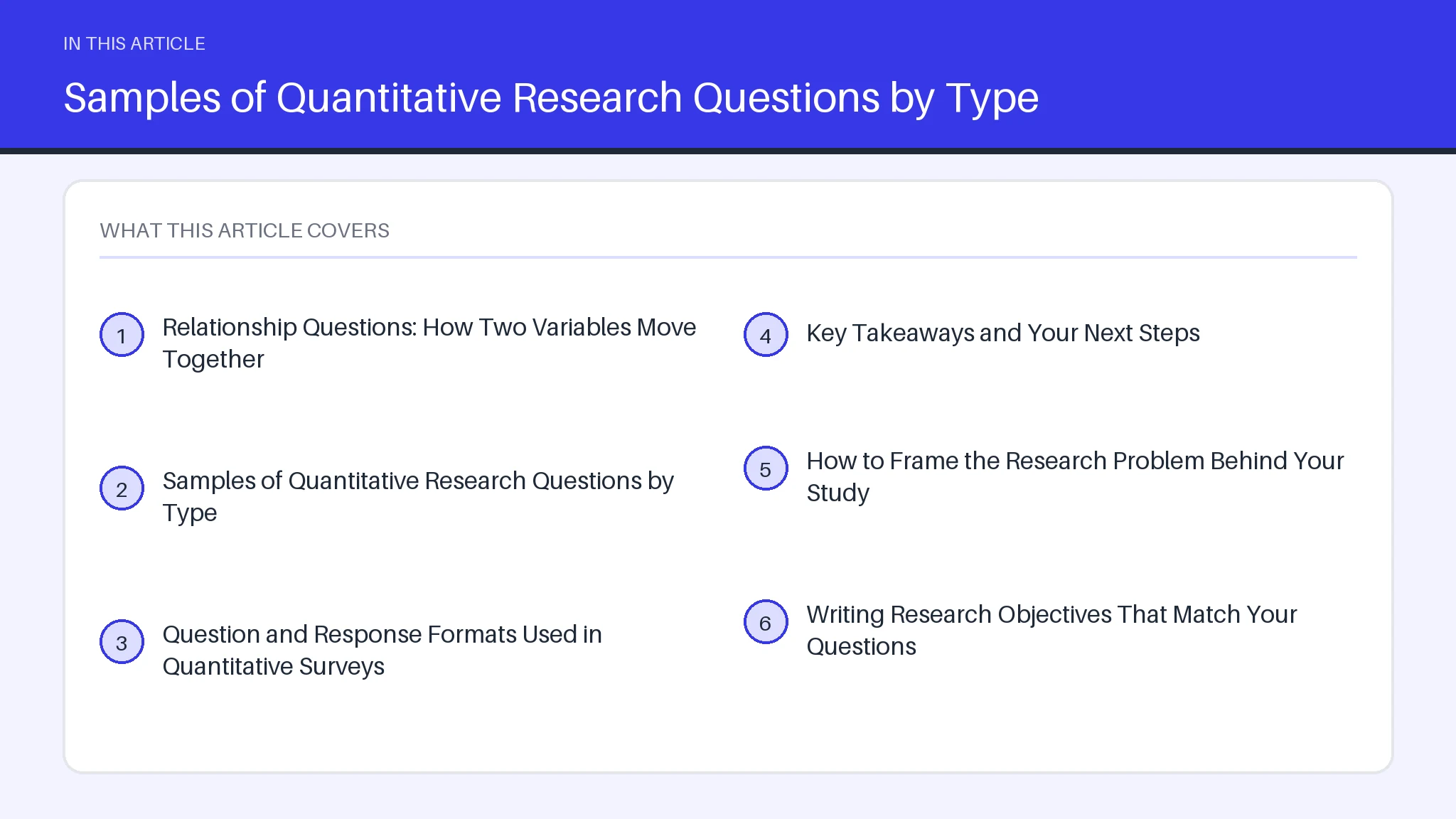
What follows covers the four question types with worked examples, the response formats that turn each question into scoreable data, how to frame the research problem underneath the question, and how to write objectives that match. There is also a table showing how relationship questions map to the statistics that answer them, plus a set of gender-focused examples that demonstrate how a demographic characteristic works as a grouping variable rather than an outcome. If you need the broader methodological context, the research methods guide covers study design and reporting in more depth.
Key takeaways
- Samples of quantitative research questions fall into four workable families: descriptive, comparative, relationship, and causal. Pick the family first, then write the wording.
- Every usable question names the population, the measured variable or variables, and the timeframe, so a reader can tell what will be counted before any data is collected.
- Descriptive questions ask how much or how often, comparative questions ask whether groups differ, relationship questions ask whether two measures move together, and only controlled designs support causal claims.
- Match each question to a response format you can actually score: rating scales, frequency counts, test scores, or continuous measures such as hours, dollars, or milligrams.
- Write the analysis plan at the same time as the question. If you cannot name the statistic that answers it, the question is still too vague to field.
Relationship Questions: How Two Variables Move Together
Relationship questions ask whether two measured quantities rise and fall together, and by how much. They do not claim that one causes the other. A well-formed relationship question names both variables, states the direction you expect if you have a hypothesis, and identifies the population in which the association is being tested. A weak version asks "Is there a link between sleep and grades?" A usable version asks "What is the correlation between average nightly sleep duration in hours and semester grade point average among full-time undergraduates?"
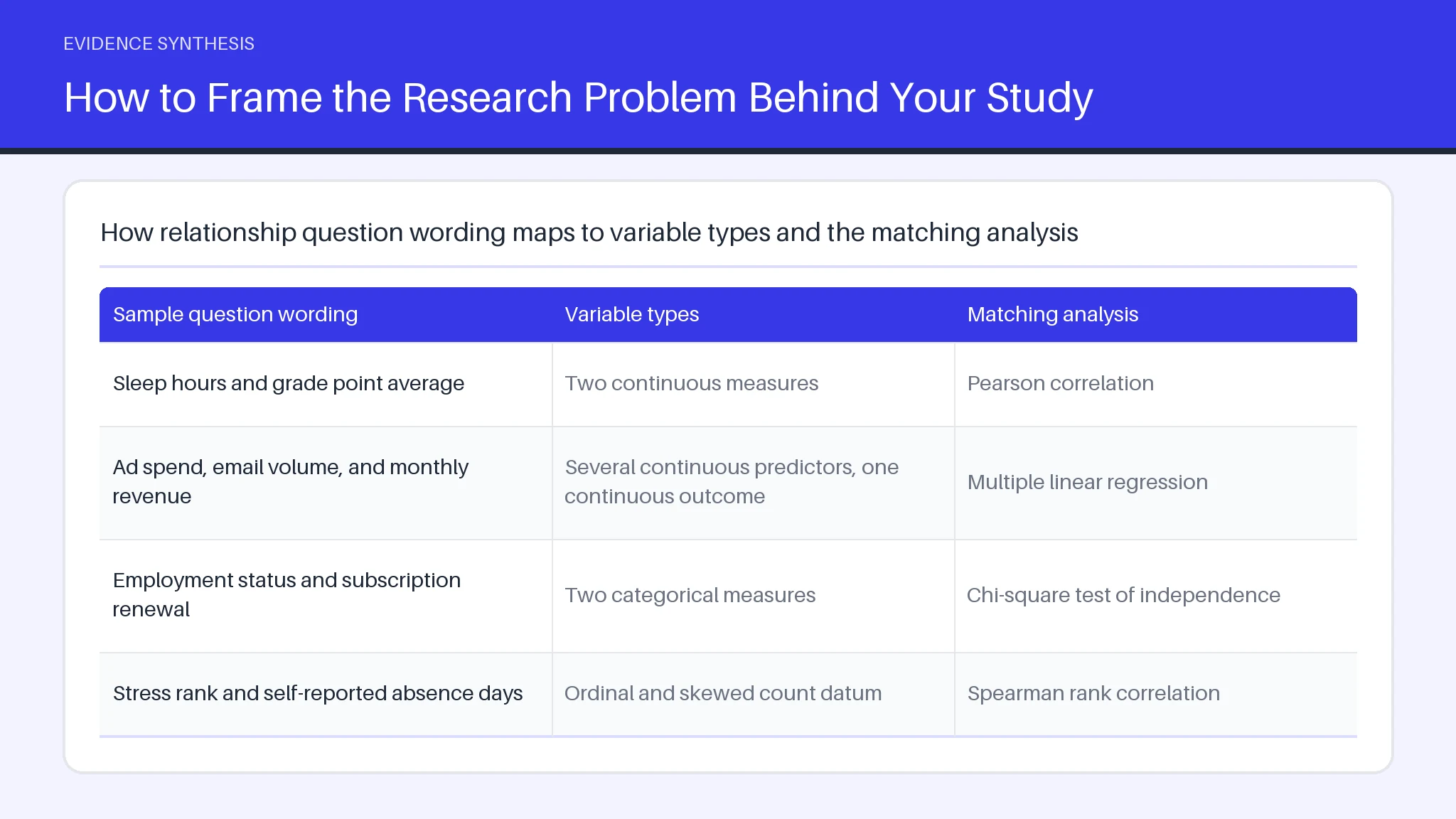
The choice of statistic depends on how each variable is measured, and this is the detail most sample lists skip. Two continuous measures call for a Pearson correlation. A continuous outcome predicted by several variables calls for multiple regression. Two categorical variables call for a chi-square test of independence. Ranked or badly skewed data call for Spearman's rho. Deciding this before you field the survey stops you from collecting a variable at the wrong level of measurement.
The table below maps common sample question wordings to the variable types and the analysis that answers them, and it should highlight why wording and statistic have to be planned together. These are illustrative pairings, not results from any particular study.
| Sample question wording | Variable types | Matching analysis |
|---|---|---|
| Sleep hours and grade point average | Two continuous measures | Pearson correlation |
| Ad spend, email volume, and monthly revenue | Several continuous predictors, one continuous outcome | Multiple linear regression |
| Employment status and subscription renewal | Two categorical measures | Chi-square test of independence |
| Stress rank and self-reported absence days | Ordinal and skewed count datum | Spearman rank correlation |
Interpretation matters as much as the test. Report the effect size alongside the p value, because a weak correlation can reach significance in a large sample and still mean almost nothing in practice.
Samples of Quantitative Research Questions by Type
Quantitative questions are questions whose answers are numbers produced by measurement rather than interpretation. They differ from qualitative questions in what they ask for: qualitative work asks how people experience or explain something and returns text, while quantitative work asks how much, how many, how often, or how strongly and returns values you can count, average, or test. Many strong projects run both, using qualitative interviews to generate the constructs and quantitative items to measure them at scale.
Five clear examples of quantitative research questions, one from each common domain, show the pattern in practice. In psychology: "What is the average score on the Perceived Stress Scale among graduate students in their final semester?" In marketing: "What percentage of customers who received a discount email completed a purchase within seven days?" In education: "Do students taught with spaced retrieval practice score higher on the end-of-term exam than students taught with massed review?" In health: "What is the relationship between weekly minutes of moderate exercise and resting heart rate among adults aged 40 to 60?" In organizational research: "How many hours per week do remote employees report working beyond their contracted schedule?"
Ten further examples of quantitative research span the same families. Descriptive quantitative research questions include: what proportion of high school seniors own a laptop; how often shoppers visit a store per month; what is the mean daily screen time among 13-year-olds. Descriptive work on gender includes: what percentage of engineering faculty positions are held by women. Descriptive stress items include: how many nights per week do nurses report fewer than six hours of sleep. Comparative examples include: do men and women differ in reported work-life conflict scores; do paying and free users differ in weekly sessions. Relationship examples include: is social media use associated with anxiety scores; does class attendance predict academic performance. A causal example: does a four-week mindfulness program reduce stress scores relative to a waitlist control.
Question banks advertising 100+ quantitative research questions to ask in your research surveys are useful for inspiration, but copy no item without rewriting the population and timeframe. Clinical projects often use the PICO structure instead, and sample PICO questions for nursing research are covered in the PICO question guide. These samples of quantitative research questions work best as skeletons you fill with your own measures.
Question and Response Formats Used in Quantitative Surveys
Response format decides whether your question produces data you can analyze or a pile of text you cannot. Closed formats dominate quantitative surveys: single-choice items, multiple-choice checklists, Likert agreement scales, numeric rating scales, frequency scales, ranking items, and open numeric entry for counts such as hours, dollars, or visits. Each format fixes the level of measurement, which in turn fixes the statistics available to you.
Three practical rules save projects. First, match the scale to the outcome you want to report: if you plan to report a mean, use a numeric or balanced Likert scale, not an unordered category list. Second, keep scale points consistent across the instrument so respondents do not have to relearn the task on every screen. Third, avoid double-barreled items, because "the checkout was fast and easy" cannot be scored when one half is true and the other is false.
Two small design choices carry more weight than most guides admit. Offering a midpoint or neutral option changes the distribution of answers and should be decided by whether indifference is a real position on your topic. And branding elements matter less than they appear: placing a client logo at the top of a satisfaction survey can nudge responses upward, so neutral presentation is safer when the sponsor is also the subject. Clinical teams collecting structured clinical data often draw items from sample PICO questions for nursing research, then convert each element into a fixed response set before fielding. These samples of quantitative research questions only work once the answer options are locked.
Key Takeaways and Your Next Steps
Turning a draft question into a fielded study takes four concrete steps. Write the question, name the measure for every construct in it, name the statistic that will answer it, and estimate the sample size that statistic needs. Skipping the third step is the most common failure: a researcher collects a category variable and then discovers the planned test required a continuous one.
Run each draft through a short checklist. Is the population defined by criteria you can screen on? Is every variable operationalized as a specific instrument, scale, or count? Is the dependent variable clearly separated from the predictors? Is the timeframe stated? Can you write the results sentence in advance, with blanks where the numbers will go? If you cannot draft that sentence, the question is not ready.
Pilot with 20 to 30 respondents before full fielding. Pilots catch ambiguous wording, floor and ceiling effects, and items everyone answers the same way, all of which waste statistical power in the main study. Then pre-register your analysis plan so the outcome you report is the one you intended to test.
Next, explore how your question fits the wider evidence base on your topic. Reading sample research questions from published studies in your field shows the conventions reviewers expect. The guide to writing a research question covers refinement in detail, and these samples of quantitative research questions give you the starting templates.
How to Frame the Research Problem Behind Your Study
The research problem is the gap or decision that makes your question worth answering, and it should be stated before any question is drafted. A problem statement has three moves: what is known, what is missing or contested, and what practical or theoretical cost follows from that gap. "Retention in the first year fell from 82 percent to 74 percent, and the campus has no measure of which support services students actually used" is a problem. "Student retention is important" is not.
Frame the problem in numerical terms wherever you can, because that discipline forces the question that follows to be measurable. State the current value, the desired value, and the population affected. This also tells you which measures you must collect and which you can leave out.
Separate the problem from the outcome you will measure. A problem about declining renewals might have a dependent variable of renewal within 30 days of expiry, measured from billing records rather than self-report. Administrative records usually beat surveys for behavioral outcomes, because recall error is large and asymmetric.
Write the problem in a structured paragraph: context, evidence of the gap, consequence, and the specific question that addresses it. Reviewers judge fit between these four parts before they judge your statistics. Studying published sample research questions alongside their problem statements shows how tightly the pairing should hold, and it clarifies what you will be able to analyze once data collection ends.
Writing Research Objectives That Match Your Questions
Research objectives restate your questions as actions the study will take, using verbs you can complete and verify. One question maps to one objective. If a question requires two objectives, it is probably two questions wearing one coat. The usual verbs are measure, compare, examine the association between, and test the effect of, and each corresponds to a question type.
A worked pair makes the discipline visible. Question: "Do employees on a four-day schedule report lower burnout scores than employees on a five-day schedule?" Objective: "To compare mean Maslach Burnout Inventory scores between four-day and five-day schedule employees at a single organization, using an independent samples t test." The objective names the instrument, the groups, and the analysis, so a reader knows exactly what you will gather and how you will analyze it.
Write objectives in parallel structure and order them the way the results section will run: descriptive first, then comparative, then relational, then any causal test. Reviewers read that ordering as evidence of a coherent sample of quantitative research design rather than a collection of loosely related measures.
Deciding when to use quantitative research is part of the same judgment. Choose it when the construct has an accepted measure, when you need prevalence or effect size, or when you must generalize to a defined population. Choose qualitative or mixed designs when the construct is still being defined. A numerical objective written over an undefined construct produces precise answers to the wrong question, and no dependent measure can rescue that.
Four Question Types With Examples and Writing Tips
Four question types cover almost every quantitative study. Descriptive questions measure one variable in one population: "What is the average monthly grocery spend among single-person households in Ohio?" Comparative questions test whether groups differ: "Do part-time and full-time students differ in mean library visits per term?" Correlational questions examine association: "Is daily step count related to systolic blood pressure among adults over 50?" Causal or experimental questions test intervention effects: "Does a 30-minute onboarding tutorial increase 30-day retention compared with no tutorial?"
Each type carries a writing trap. Descriptive questions drift into vagueness when the measure is unnamed. Comparative questions fail when the groups are not mutually exclusive. Correlational questions get written with causal verbs such as "affects" or "leads to," which overstate what the datum can support. Causal questions get claimed without random assignment or a control condition, which is the single most common overreach in student work.
Three tips help. Name the dependent variable explicitly, because that is what a reviewer looks for first. Put the timeframe in the sentence so a researcher replicating your work knows the window you used. And write the dummy table before you gather anything: sketch the rows, columns, and cell contents your results will fill, then check that your question produces exactly that datum.
A sample of quantitative research design that pairs each question with its dummy table rarely needs redesign mid-study, because you can see in advance what you will investigate and how you will analyze it.
Further Reading on Literature Reviews and Question Design
Question design improves fastest when you read how other people in your field have framed the same topic. Before drafting, search for two or three recent reviews in your area and extract their stated questions, populations, and measures into a simple table. That exercise shows the conventions your reviewers expect and, just as usefully, the questions already answered well enough that repeating them adds little.
Several routes are worth following. The systematic review guide explains how structured evidence synthesis handles question formulation and eligibility criteria, and the meta-analysis guide shows what happens when numeric results from many studies are pooled, which clarifies why consistent measurement matters so much at the question stage. For reporting standards, the PRISMA guide sets out what a reader should be able to verify. Teams comparing workflow options can review the software comparison, and the journal carries method articles on related steps.
Two practical habits pay off. First, record where each borrowed measure came from, so that when you gather your own datum you can compare distributions against published norms. Second, note the sample size each published study used to investigate its question, because that gives a realistic floor for your own recruitment target rather than an arbitrary round number. A researcher who does both spends less time defending design choices later, and the resulting datum is easier to interpret. This also sharpens the judgment of when to use quantitative research at all.
Sample Questions on Gender Differences and Gender Variables
Gender functions as a grouping variable in most quantitative studies, not as the thing being measured, and writing it correctly changes both the question and the analysis. Descriptive examples include: "What percentage of computer science majors at the institution identify as women?" and "What is the mean reported weekly caregiving hours by gender among full-time employees?" Comparative examples include: "Do men and women differ in mean starting salary within the same job classification and experience band?" Relationship examples include: "Does the association between working hours and reported burnout score differ by gender?"
That last form is an interaction question, and it is the one most sample lists omit. It asks whether the link between two other variables changes across gender categories, which requires a moderation analysis rather than a simple group comparison. Writing it explicitly stops you from running separate correlations and eyeballing the difference, which is not a valid test.
Measurement choices carry real consequences here. Offer response options that include nonbinary and prefer-not-to-say categories, and decide in advance how small categories will be handled in analysis, since collapsing them after seeing the datum invites bias. Report the counts in every category so readers can judge whether a comparison was adequately powered.
Always control for the confounding variables that travel with gender in your setting, such as job tenure, field, or hours worked. A raw pay gap and an adjusted pay gap answer different questions, and the difference between the two figures should highlight, not hide, what your datum can support.
Frequently asked questions
What are 5 examples of quantitative research questions?
Five examples of quantitative research questions, one per field, are: what is the average Perceived Stress Scale score among final-semester graduate students; what percentage of customers who received a discount email purchased within seven days; do students taught with spaced retrieval score higher than students taught with massed review; what is the relationship between weekly exercise minutes and resting heart rate in adults aged 40 to 60; and how many hours per week do remote employees work beyond their contracted schedule. Each names a population, a measure, and a timeframe.
What are the 10 examples of quantitative research?
Ten examples of quantitative research include prevalence surveys of device ownership, screen-time measurement studies, customer satisfaction scoring, salary comparison studies by job classification, test-score comparisons between teaching methods, correlational studies of sleep and academic performance, randomized trials of a mindfulness program, A/B tests of onboarding flows, epidemiological studies of exercise and blood pressure, and longitudinal tracking of employee turnover rates.
What are 5 good research questions examples?
Five good research questions share the same anatomy regardless of field: a defined population, a measurable variable, a stated comparison or association, a timeframe, and feasibility within your resources. Strong examples include questions about vaccination coverage in a defined county, price sensitivity in a specific customer segment, attendance and grade relationships in one cohort, burnout differences between schedule types, and the effect of a named intervention against a control.
What are some quantitative questions?
Quantitative questions include how many, how often, how much, to what extent, and does one group differ from another. All of them return countable answers.
How do you write a quantitative research question?
Write a quantitative research question by choosing the question type, naming the population, operationalizing each variable as a specific instrument or count, adding a timeframe, and confirming that a named statistic can answer it.
What are quantitative questions?
Quantitative questions are questions answered by measurement rather than interpretation, using fixed response formats that produce scores, counts, or percentages.
What are 10 examples of quantitative data?
Ten examples of quantitative data are test scores, ages in years, annual income, heart rate, website sessions per week, product ratings on a five-point scale, distance in kilometers, weight in kilograms, number of hospital readmissions, and temperature readings.