Essay Writing: Step by Step From Question to Claim
Essay writing is the process of turning a question into a single defensible claim and then proving that claim in an ordered sequence of paragraphs. That definition matters because most people treat an essay as a container to fill with words, then wonder why a full page still reads as thin. The page is not the unit of work. The argument is. Once you accept that, the job becomes concrete: decide what you think, decide the order in which a reader needs to receive your reasons, then write the sentences that carry them.
This guide is for anyone who has to produce an essay under real conditions: a first-year student facing a 1,500-word seminar paper, an applicant drafting a 650-word personal statement, a graduate student writing a critical piece on a published study, or a professional asked to argue a position in prose rather than slides. By the end, you should be able to move from a blank document to a finished draft without stalling, know which revision passes actually change a grade, and know how to tell the difference between a sentence problem and a thinking problem. Those two failures look identical on the page and need opposite fixes.
What you need before you start is short and non-negotiable. First, the assignment brief, including the word limit, the due date, the citation style, and the grading rubric if one exists. Second, a question you can state in one sentence. Third, three to six sources you have actually read rather than collected. Fourth, a working claim, which is your provisional answer to the question and which you are allowed to change. Fifth, a fixed block of time, because an essay drafted in fifteen-minute fragments tends to read like fifteen-minute fragments. If any of those five is missing, gathering it is faster than staring at the document.
Two things this guide will not do. It will not pretend that essay writing is one uniform skill: a reflective application essay and a sourced argument reward different moves, and the sections below separate them. And it will not treat length as quality. A tight 900 words that answers the question outperforms 1,400 words that circle it, and graders notice the difference immediately.
The steps that follow run in order, from decoding the prompt through the final proofread. Longer research-driven formats have their own structural conventions, and if you are writing something closer to an academic manuscript, our guide to research paper structure and writing steps covers those sections in detail. Everything here applies to the shorter, argument-led piece: what to do first, what to do next, and where the time actually goes.
Key takeaways
- Essay writing is a repeatable process, not a talent: decode the brief, build a claim, outline, draft fast, then revise in separate passes for argument, structure, and sentences.
- The single biggest score difference usually comes from the thesis and the topic sentences, not from vocabulary. A reader should follow your argument by reading the first line of each paragraph.
- Budget your time by task rather than by word count. A rough split of 20 percent planning, 40 percent drafting, and 40 percent revising beats one long uninterrupted session.
- Evidence standards differ by assignment type. A reflective personal statement rewards specific detail and voice, while an argumentative or appraisal essay rewards sourced claims and transparent reasoning.
- Tools can speed up sourcing, note taking, and citation checking, but you remain responsible for whether each claim is true and whether the citation actually supports it.
How to Write an Essay Step by Step
Writing an essay step by step means running six distinct tasks in sequence rather than trying to do all of them at once. Most stalling happens because a writer attempts to plan, draft, and polish in the same sentence, which makes every sentence expensive. Separate the tasks and each one gets easier.
Step one is decoding. Read the prompt and underline the command verb: analyze, compare, evaluate, argue, reflect. Those verbs set the shape of the whole piece, and misreading one is the most common way to lose points while writing well. Step two is the working claim. Write one sentence that answers the question and could be argued against. Step three is the outline: one line per paragraph, each line naming the point that paragraph proves. Step four is the fast draft, where you write from the outline without editing. Step five is structural revision, where you move, merge, and cut paragraphs. Step six is the sentence pass and the citation check, done last because there is no point polishing a paragraph you may delete.
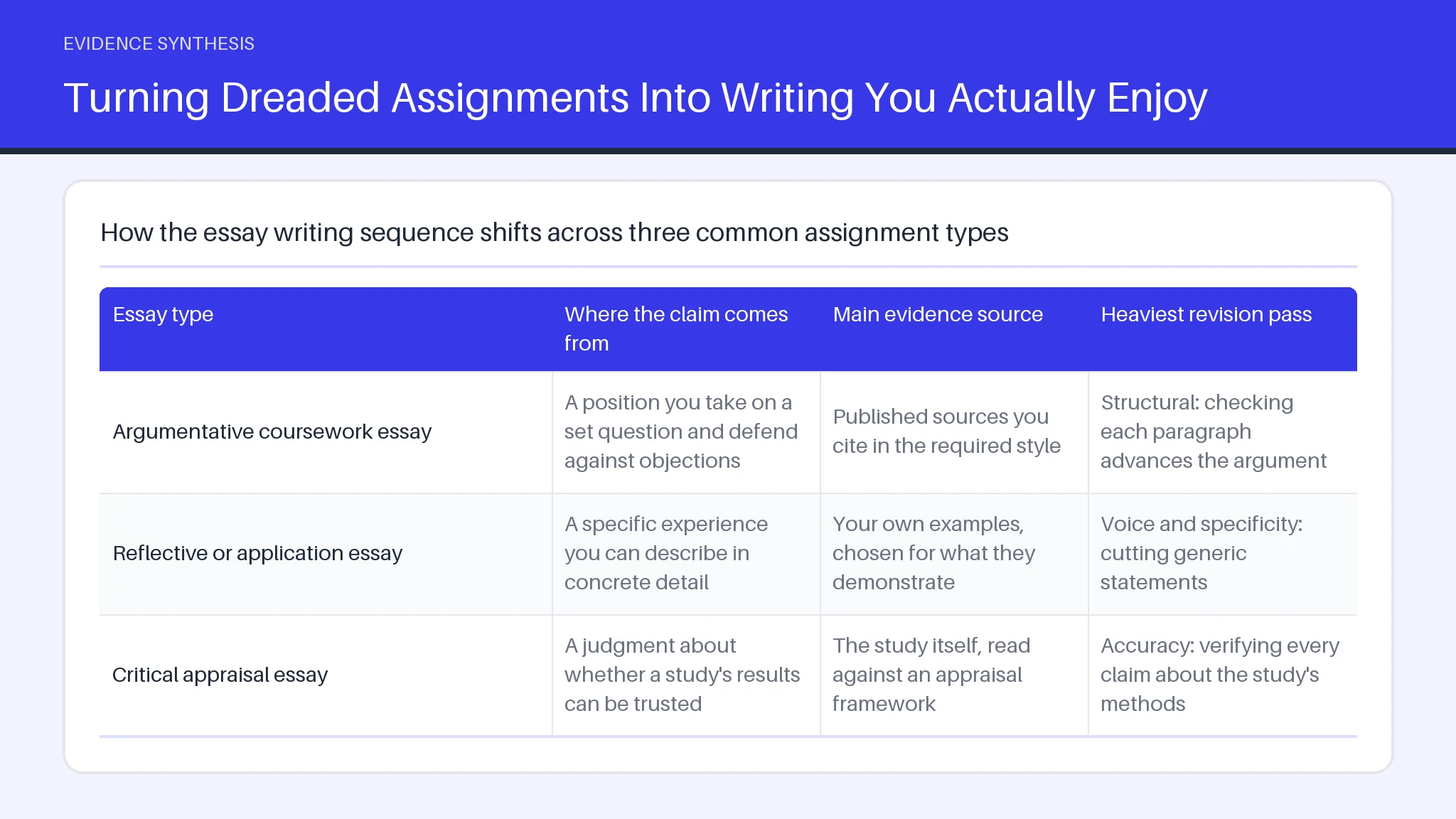
The table below shows how that same sequence shifts across three common essay types, because the proportions change even though the steps do not.
| Essay type | Where the claim comes from | Main evidence source | Heaviest revision pass |
|---|---|---|---|
| Argumentative coursework essay | A position you take on a set question and defend against objections | Published sources you cite in the required style | Structural: checking each paragraph advances the argument |
| Reflective or application essay | A specific experience you can describe in concrete detail | Your own examples, chosen for what they demonstrate | Voice and specificity: cutting generic statements |
| Critical appraisal essay | A judgment about whether a study's results can be trusted | The study itself, read against an appraisal framework | Accuracy: verifying every claim about the study's methods |
The reason to write step four fast is mechanical. Editing uses a different mode of attention than generating, and switching between them repeatedly is what produces the feeling of working hard while producing nothing. Give yourself permission to write an ugly first draft in one sitting, then treat revision as the real craft. Writers who work this way typically finish earlier and revise more, which is the combination that raises quality.
One practical guardrail: before you write paragraph one, write the last line of your outline. Knowing where the argument lands stops you from discovering your real thesis in the final paragraph, which is the most common structural flaw in otherwise competent drafts.
How to Make Essay Writing Feel Less Like a Chore
Essay writing stops feeling like a chore when you shrink the unit of work from the whole assignment to one answerable question. Dread attaches to vague, enormous tasks. It does not attach to a task like "write the 120 words explaining why this study's sample size matters." The trick is not motivation. It is task definition.
Three concrete changes help more than any productivity system. First, choose an angle inside the topic that you have an actual opinion about. A topic you find inert produces prose the reader also finds inert, and where the brief allows any latitude, spending ten minutes narrowing toward something you want to settle pays for itself across the whole draft. Second, write the middle first. The introduction is the hardest paragraph to write and the easiest to write badly, because you cannot summarize an argument you have not made yet. Start with the body paragraph you feel most confident about. Third, work in timed blocks with a stated output, not a stated duration. "Twenty-five minutes" invites drifting. "The paragraph on counterevidence" does not.
It also helps to separate reading from drafting on the calendar. Reading feels productive and has no natural end point, so it expands to fill whatever time you have. Set a cutoff: once you have enough to defend your claim, stop reading and start writing, and return to the sources only when a specific gap appears.
On software, be honest about what it does. Reference managers, note systems, and screening tools genuinely reduce the clerical load, and AI tools marketed for writing essays with citations can draft quickly, but they also invent plausible-looking references, so every citation still needs opening and checking against the original source. The useful division of labor is to let tools handle retrieval, formatting, and organization while you keep the judgment. Following the citation instruction in your brief to the letter is your responsibility as the writer, not the software's, and a fabricated reference is treated as a serious academic failure regardless of how it entered the document.
Giving Your Essay a Storyline Readers Can Follow
An essay needs a storyline because readers hold arguments in memory the same way they hold narratives: as a sequence where each step follows from the last. Your essay is, in a structural sense, just a story about how you arrived at a conclusion. It has a situation, a complication, a series of moves, and a resolution. Treating it that way is not a style flourish. It is what makes a grader able to follow you without rereading.
The mechanical test is simple. Copy the first sentence of every paragraph into a separate document and read them in order. If those sentences alone form a coherent argument that moves forward, your structure works. If they read as a list of loosely related observations about the topic, you have a sequencing problem no amount of sentence polishing will fix. This is the single most useful revision skill to build, and it takes about five minutes per draft.
Paragraph order should follow the logic of persuasion rather than the order in which you did the reading. Put the point that establishes your foundation first, the point that does the most argumentative work second, and the strongest objection to your case before your conclusion rather than after it. Addressing a counterargument late makes you look like you anticipated it. Ignoring it makes the reader supply it for you.
Transitions carry the storyline, and the best ones name the logical relationship instead of decorating it. "Because," "however," "which means," and "the weaker version of this claim" all tell the reader what kind of step is coming. Writers who ask which AI tool is best for writing essays are usually asking the wrong question at this stage, because the ordering decision depends on what you are arguing and who is reading it, and no tool can make that judgment for you. Build the spine first, then fill it.
Balancing Your Own Voice With What Graders Expect
Your voice and your grader's expectations conflict far less often than students assume. What rubrics penalize is not personality but imprecision: hedged claims, unsupported generalization, and sentences whose meaning shifts depending on how you read them. A distinctive voice that is also precise almost always scores better than anonymous prose, because it demonstrates that a person is thinking rather than assembling phrases.
Start by reading the rubric as a specification. Most grading rubrics reward four things: a clear position, evidence that actually supports it, engagement with alternative views, and control of the conventions. None of those require you to write stiffly. They require you to be answerable for every sentence. Where the assignment allows first person, using it is usually clearer than the contortions people invent to avoid it, though some disciplines still prefer impersonal construction, so check the brief for the stated requirement.
What to cut is more specific than "be concise." Remove sentences that restate the question, sentences that announce what you are about to do, and adjectives that assert significance without demonstrating it. Words like "crucial," "vital," and "fascinating" describe your reaction to the topic rather than the topic itself, and a grader reads them as filler. Replace them with the reason the point matters.
Register also shifts with format. A report-essay hybrid, such as a policy brief or a lab-style write-up, expects flatter and more functional prose, while a seminar essay rewards analytical argument in your own register. Knowing which one you are producing prevents a mismatch that costs points for reasons the writer never sees. Students who ask which AI tool is best for essay writing often want a voice problem solved by software, but generated prose tends toward a smooth, unplaceable register that graders now recognize quickly, and it flattens exactly the specificity that earns credit. The more durable skill is reading your own paragraphs aloud: anything you would not say to a colleague in conversation is usually a sentence worth rewriting.
Turning Dreaded Assignments Into Writing You Actually Enjoy
A dreaded assignment usually becomes bearable the moment you find the genuine disagreement inside it. Boredom in an essay is almost always a symptom of a question you have framed as settled. If there is nothing to resolve, there is nothing to write, and you end up summarizing instead of arguing. Look for the point where credible sources actually contradict each other, and write toward that.
Practical moves that change the experience: pick the case study that is closest to something you know, argue the position you find less comfortable to see whether it holds, and set yourself a small constraint such as making the whole case in five paragraphs. Constraints reduce the decision load, and reduced decision load is most of what people mean when they say a task felt easy.
The other shift is to stop treating the first attempt as the performance. Almost nobody produces a good essay on the first pass, and expecting to is what makes the blank page punishing. Give the first draft one job: get the reasoning out where you can see it. A paragraph that is clumsy but correct is worth more than an elegant sentence pointing in the wrong direction, because the clumsiness is a two-minute fix and the wrong direction is a rebuild.
Assignment type affects how much latitude you have. Writing a critical appraisal essay leaves less room for personal angle, since the framework dictates what you examine, though you still choose which weaknesses matter most and why. A report-style essay constrains you further, because the sections are prescribed. Essays with open prompts give you the most freedom and therefore the most responsibility for making them interesting. Asking which AI tool is best for essay writing tends to be a way of avoiding that choice, and outsourcing it removes the part of the process most likely to be satisfying. A writer who has decided what they think finds drafting far less painful than one still hoping the argument will appear on its own.
Why Students Find Essays So Hard to Write
Students find essays hard because an essay tests three separate capacities at once and gives one grade for all of them. You have to understand the material, form a defensible position on it, and render that position in prose a stranger can follow. A weakness in any one of the three looks like a writing problem on the page, which is why generic advice to "write more clearly" so often fails to help.
The most common underlying cause is starting to write before deciding what to argue. Without a claim, every paragraph has to justify its own existence, so the draft becomes a sequence of summaries and the writer feels the resistance as a lack of ideas. It is actually a lack of direction. Deciding the claim first converts an open-ended task into a series of closed ones.
The second cause is the mismatch between reading comprehension and production. You can follow a sophisticated argument long before you can construct one, and that gap is uncomfortable. It closes with practice at a specific skill: restating someone else's argument in two sentences, then stating your objection in one. Do that ten times and structuring your own case becomes noticeably easier.
Third, students rarely get feedback at the point where it would help. Comments arrive on the finished essay write-up, weeks after the decisions that shaped it. The fix is to get someone to read your one-sentence claim and your outline before you draft, because thirty seconds of feedback there prevents hours of misdirected writing.
Fourth, time pressure pushes people into the worst possible order of operations. When a deadline is close, writers skip planning and try to compose polished sentences from the start, which is the slowest way to produce text. If you have four hours, spend the first thirty minutes on a claim and an outline anyway. It feels like a luxury and functions as insurance.
Finally, longer formats introduce structural demands that shorter essays never teach. A dissertation chapter or an extended argument requires managing signposting across thousands of words, and the habits that carry a 1,200-word piece do not automatically scale. Our guide to thesis writing from statement to finished draft covers that longer arc, but the underlying principle holds at every length: know the claim, then write to prove it.
How to Keep a Reader Reading to the Last Line
A reader keeps reading when every paragraph pays off the expectation the previous one created. Attention in prose is a contract: you raise a question, you answer it, and in answering it you raise the next one. Essays lose readers when a paragraph closes a loop and opens nothing, because at that moment there is no reason to continue.
The opening sentence does most of the work. Begin with the specific rather than the general. A named case, a number, a contradiction, or a direct statement of your position all pull a reader forward, while a sentence about how important the topic is pushes them away, because it is the sentence they expected. Graders read dozens of essays on the same topic, and the ones they remember start somewhere unexpected and concrete.
Vary sentence length deliberately. Long sentences carry qualification and relationship; short ones land conclusions. A paragraph of uniformly long sentences reads as fog, and a paragraph of uniformly short ones reads as a list. Alternating them creates the rhythm that makes dense material feel readable.
Endings deserve more attention than they usually get. A conclusion that restates the introduction tells the reader their time in the middle was wasted. A better close states what follows from the argument: what it changes, what it rules out, or what the remaining uncertainty is. Among the more useful tips on writing an argumentative essay is to end with the strongest consequence of your position rather than a summary of the steps you took to reach it.
Whatever tools you use for drafting, the judgment about pacing belongs to the writer. Asking which AI tool is best for writing essays misses the point that engagement depends on choices about emphasis and order that only someone who understands the intended reader can make. Read your draft in one pass, marking the exact line where your own attention drifts. That line, not the paragraph around it, is where the problem sits, and fixing it is usually a matter of cutting rather than adding.
Practical Habits That Sharpen Your Essay Writing Fast
Six habits improve essays faster than anything else, and all of them are mechanical enough to adopt this week.
The first habit is the six-step sequence, applied every time. Decode the prompt, plan the claim, outline the paragraph order, write a complete rough draft, revise the structure, then fix the sentences and citations. Those are the six steps to writing an essay, and their value comes from keeping them separate. Drafting while editing is what makes writing slow.
The second habit is the five C's check, run on the finished draft. Clear means a reader understands each sentence on first pass. Concise means no sentence restates another. Coherent means paragraph order matches the logic of the argument. Credible means every factual claim has a source a grader could follow. Compelling means the reader has a reason to reach the end. Those five criteria map closely onto most grading rubrics, and running them as five separate reads catches problems a single review misses.
The third habit is reverse outlining. After drafting, write one line per paragraph describing what that paragraph does, not what it is about. If two lines say the same thing, merge the paragraphs. If a line says "provides background," ask whether the background is earning its word count. This is the fastest structural diagnostic available, and it takes ten minutes.
The fourth habit is reading aloud. Your ear catches tangled syntax, accidental repetition, and missing logical steps that your eye skips. Read the whole draft out loud once, pen in hand, and mark every place you stumble. Stumbles are almost always genuine defects rather than performance errors.
The fifth habit is writing the introduction last. Once the body exists, the introduction becomes a short factual task: state the question, state your answer, indicate the route. Written first, it is guesswork you will have to redo.
The sixth habit is keeping a personal error list. After each piece of feedback, add the recurring problems: comma splices, unsupported generalizations, paragraphs that end without a point. Before submitting anything, check the draft against your own list. Most writers repeat four or five errors, and eliminating them raises grades more reliably than learning new techniques.
Two further points make essay writing genuinely more enjoyable rather than merely faster. Remember your essay is just a story about how you reached a conclusion, so if a section bores you to write, it will bore someone to read, and that is useful information about the argument rather than about your discipline. And build a habit of reading good essays in your field with attention to structure rather than content: mark where the writer states their claim, where they concede, and where they turn. Copying the moves is legitimate craft learning in a way that copying the words is not.
Finally, timing. A draft you have not slept on is a draft you cannot see. Finish the rough version at least a day before the deadline, do the structural pass with fresh eyes, and leave the sentence-level work for last. That single scheduling change does more for quality than any amount of additional research, because it is the only way to read your own work the way a stranger will.
Where to Get Help With Your Application Essay
Help with an application essay is most useful at two specific points: before you draft, when you are choosing what to write about, and after the first draft, when you need to know whether the story lands. Feedback in the middle tends to produce revision churn, because the piece is not yet stable enough to judge.
University writing centers and school counselors are the highest-value option for most applicants, because they read large numbers of statements and can tell you quickly whether your angle is distinctive or one an admissions reader sees weekly. Subject teachers are better at judging whether your claims about your own achievements are specific enough to be believed. A trusted adult who does not work in education is useful for one question only: does this sound like me? That question catches over-coached prose better than any expert review.
Paid editing services exist across a wide quality range, and the key distinction is between feedback and rewriting. Feedback on structure, specificity, and clarity is legitimate and often valuable. Having someone else produce the prose misrepresents authorship and, in the case of application essays, may breach the terms you agree to when submitting. Ask directly what a service will and will not write for you before paying, and keep your own drafts so the development of the piece is documented.
Choose your topic on the basis of what it lets you demonstrate rather than how impressive the event sounds. A small, precisely observed experience usually reveals more than a dramatic one described generically, and admissions readers are explicit about valuing reflection over incident. The topic also needs room for change: a story where you learned nothing has nowhere to go in the closing paragraphs.
Application essays sit at the opposite end of the spectrum from academic argument, so advice transfers only partly. The tips on writing an argumentative essay that concern evidence and objections matter less here, while specificity and voice matter more. A writer moving from coursework to a personal statement usually over-formalizes at first. If your next assignment is analytical instead, our guide to critical appraisal covers the evidence judgments involved in writing a critical appraisal essay, and the Systematicly journal collects the longer research writing formats.
Frequently asked questions
How do I write an essay?
Writing an essay means answering a set question with one arguable claim and proving it in ordered paragraphs. The working sequence is: read the brief and identify the command verb, state your answer in a single sentence, list the points that support it in the order a reader needs them, draft each point as a paragraph that opens by naming the point, then revise in two separate passes for structure and then for sentences and citations. Keep planning short and revision long. Most writers spend too much time producing the first version and too little improving it, which is the reverse of what raises quality.
What are the 5 steps to writing an essay?
The common five-step version is planning, outlining, drafting, structural revision, and final editing, with decoding the prompt folded into planning; this guide makes decoding its own first step, which gives six. Planning fixes your claim and confirms you have enough evidence. Outlining sets paragraph order, one line per paragraph. Drafting produces a complete rough version without stopping to polish. Structural revision moves, merges, and deletes paragraphs so the argument advances in a straight line. Final editing handles sentence clarity, citation accuracy, formatting, and proofreading. The steps work because they stay separate; combining drafting with editing is the most common cause of a stalled essay.
What are the 5 C's of essay writing?
The five C's are clear, concise, coherent, credible, and compelling. Clear means a reader understands each sentence the first time. Concise means nothing is repeated or announced rather than done. Coherent means the paragraph sequence matches the logic of the argument, which you can test by reading only your opening sentences. Credible means each factual claim is sourced and each source is real and checkable. Compelling means the reader has a reason to continue past the first paragraph. Used as five separate review passes rather than a slogan, they catch most of what graders penalize.
What are the five main types of essays?
The five main types are argumentative, expository, analytical, narrative, and descriptive. An argumentative essay defends a position against alternatives and needs sourced evidence. An expository essay explains a subject without taking sides. An analytical essay breaks a text, dataset, or event into parts and interprets how they work together. A narrative essay tells a sequenced story, which is the form most personal statements take. A descriptive essay builds a detailed impression of a subject through concrete sensory and factual detail. Identifying the type before drafting matters, because each one treats evidence and the writer's own presence differently.
How do I start an essay?
Start an essay with a specific sentence that puts the reader inside the subject: a case, a number, a contradiction, or your position stated outright. Avoid a dictionary definition or a claim about how important the subject is, because graders read those openings constantly. A reliable method is to write the introduction last and keep it to three functions: the question, your answer, and your route.
What words can I use in an essay?
Use words that name a logical relationship rather than pad the sentence. In the body, the workhorse connectives are because, whereas, which means, by contrast, and although. Phrases such as "two claims are usually conflated here" or "the evidence points the other way" tell a grader exactly what kind of step is coming next.
What are some words to end an essay?
The best closing words in an essay state consequence rather than announce summary: what follows, what this rules out, what remains uncertain, what a reader should do differently. Some writers still reach for "in conclusion" or "as we have seen"; both are permitted, but neither does any work, so spend the line on the implication instead.
What are some good descriptive words to use in an essay?
Some of the most effective descriptive words in an essay are not adjectives at all but concrete nouns and precise verbs. Good description names the thing: the figure, the date, the mechanism. Replacing "very significant increase" with the actual percentage improves both the sentence and its credibility, while intensifiers such as crucial, vital, and fascinating add nothing.
Can you give me an example of an essay?
A short worked example makes the pattern visible. Suppose the question is whether remote work reduces team productivity. The claim sentence might be: "Remote work does not reduce productivity on its own, but it exposes weak coordination practices that co-location had been hiding." The paragraph plan then runs: define what the productivity measures actually capture; present the studies showing no aggregate decline; present the studies showing decline in roles requiring rapid iteration; explain what distinguishes the two groups; concede that long-run effects on training and mentoring remain poorly measured; close with what this implies for how organizations should decide. That is six paragraphs, each with one job, and the argument can be followed from the opening sentences alone. Note that the concession comes before the conclusion, not after it.
What does a good essay look like?
A good essay answers the question asked, takes a position you can identify within the first paragraph, and supports it with evidence a reader can verify. Its paragraphs each make one point, open by naming that point, and follow an order that would collapse if you shuffled them. It engages the strongest objection rather than the easiest one. Its citations are accurate and formatted consistently. It contains no sentence that only restates another, and it ends by stating what follows from the argument rather than repeating the introduction. Length is not a quality signal: a tight piece under the word limit that does all of this reads better than a longer one that does most of it.