Research Question: How to Write One That Works
A research question is the precise, answerable question that your study exists to answer. It names the population or setting you care about, the factor or experience you are examining, the outcome you will measure or describe, and often the time frame involved. Everything downstream depends on it: the databases you search, the inclusion criteria you apply, the data you extract, and the claims you are entitled to make at the end.
This guide is for graduate students, clinicians, librarians, and applied researchers who have a topic and need to turn it into a defensible research question. It covers the main question types, how to narrow a broad interest, how to stress test a draft with FINER, PICO, and SPIDER, what weak and strong versions look like side by side, and how to score your own wording before you commit to a method.
The practical value is time saved. A question that looks reasonable on a title page can collapse once you start screening records, because the concepts are too loose to sort papers consistently. Fixing that wording early is cheap. Fixing it after you have screened two thousand abstracts is not. The sections below work through the decision points that generic advice usually skips, including feasibility limits, data availability, and how question type constrains your analysis plan.
Key takeaways
- A research question is the single sentence that names what you want to find out, and it sets the boundaries for your search, your sample, and your analysis.
- Choose the question type before the method: descriptive, comparative, relational, evaluative, and exploratory questions each commit you to a different type of study.
- Structured frameworks help you test a draft rather than write it. PICO suits comparative clinical questions, SPIDER suits qualitative work, and FINER checks feasibility and relevance.
- Most weak questions fail for one of three reasons: they are too broad to answer, they smuggle in the answer you expect, or nobody has produced the data needed to answer them.
- Score your draft against a short checklist before you write a protocol, because a vague question costs the most when it is discovered during screening or data extraction.
What Is a Research Question and What Does It Do?
A research question does four jobs at once. It defines scope, so you know which literature belongs and which does not. It implies a method, because a question about prevalence and a question about causation cannot be answered by the same design. It sets the unit of analysis, which determines what you extract from each study. And it fixes the outcome, which is what turns a vague interest into a testable claim. A researcher who can state the question in one sentence can usually defend the whole protocol; one who cannot will find the study drifting.
A hypothesis is not the same thing. The question asks what is true; the hypothesis states what you expect to find and can be wrong. Exploratory work often has no hypothesis at all, which is legitimate as long as you say so. A doctoral question example shows the difference in scale: "How do first generation undergraduates interpret academic feedback during their first semester?" is an exploratory question suited to interviews, while "Does structured feedback training reduce first year attrition?" commits you to comparison and measurement. Both add knowledge; they demand different evidence. Framework based wording, including examples of PICOT research questions, adds a time element so the outcome window is explicit.
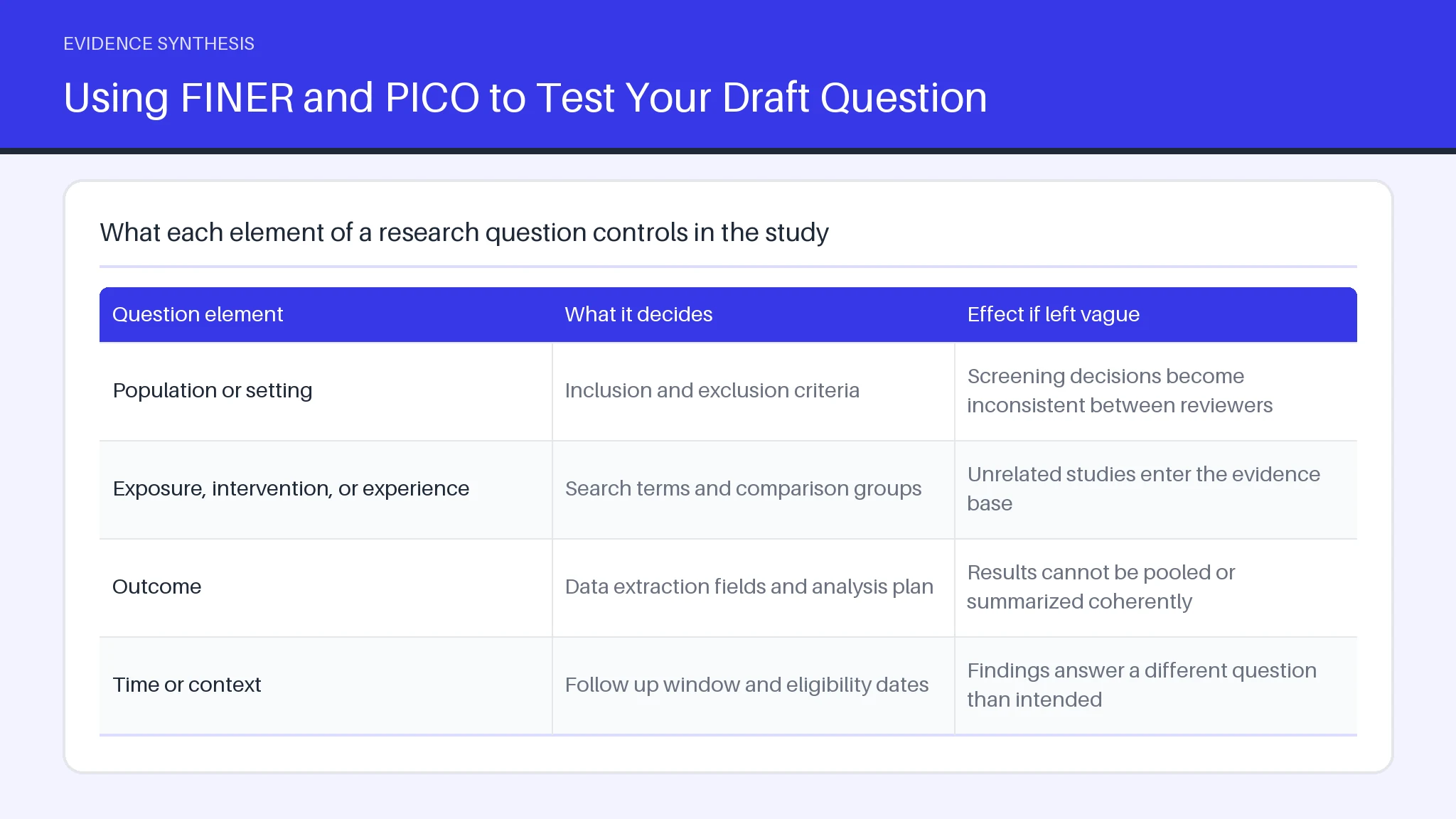
| Question element | What it decides | Effect if left vague |
|---|---|---|
| Population or setting | Inclusion and exclusion criteria | Screening decisions become inconsistent between reviewers |
| Exposure, intervention, or experience | Search terms and comparison groups | Unrelated studies enter the evidence base |
| Outcome | Data extraction fields and analysis plan | Results cannot be pooled or summarized coherently |
| Time or context | Follow up window and eligibility dates | Findings answer a different question than intended |
Which Type of Research Question Fits Your Study?
The type of research question you write determines the design you must use, so pick the question type first and let the method follow. Five families cover most work. Descriptive questions ask how much or how often, and suit surveys and registry data. Comparative questions ask whether one group or condition differs from another, and need a controlled or matched design. Relational questions ask how two variables move together, and require enough cases for meaningful statistics. Evaluative questions ask whether something works, which pushes you toward trials or quasi experimental designs. Interpretive questions ask how people understand an experience, which calls for interviews or observation.
A worked example helps. Suppose you want to investigate remote consultations. "How satisfied are patients with remote consultations?" is descriptive and needs a measurement instrument. "Do remote consultations produce comparable follow up rates to in person visits for type 2 diabetes?" is comparative and needs two groups with similar baseline risk. The second version tells you what type of study to run and what to record in every case.
Base the choice on the literature rather than on preference. If several trials already exist, a synthesis question adds more than another small study, and the systematic review methodology guide sets out the phases involved. If published work is thin and descriptive, a primary study is the honest next step. Moving from question to research process means writing the question, checking what has already been answered, then selecting the design; reversing that order in the research process is how a study ends up with data that cannot address its own aim. Common queries about research questions almost always trace back to this sequencing.
Common Mistakes to Avoid When Framing Your Question
Most failed questions share a small set of faults. The first is the two in one question, which joins separate concerns with "and" and then needs two designs to resolve. The second is the loaded question, which assumes its own conclusion and biases the search. The third is the unanswerable question, where no dataset exists and no ethics committee would approve collecting one. A researcher who plans to write a research question around a broad social problem often hits this wall late.
Watch for concept drift too. If the wording says "better outcomes" without naming the outcome, every reviewer will interpret it differently and the methodology cannot support a single answer. Framework templates such as nursing research PICO questions reduce this by forcing each element to be named explicitly.
- Avoid yes or no wording when you actually want to investigate a mechanism or process.
- Do not include the intervention you already prefer inside the question itself.
- Check that the outcome is measurable with instruments that exist today.
- Confirm that the population is defined tightly enough for one study to recruit it.
Good research practice means testing the wording against these faults before drafting a protocol, not after.
How to Narrow a Broad Topic Into a Focused Enquiry
Narrowing works best as a series of deliberate cuts rather than one leap. Start from the broad problem, then reduce it along four axes in order: population, setting, outcome, and time. "Burnout in healthcare" becomes "burnout in emergency department nurses," then "burnout in emergency department nurses working rotating night shifts," then "changes in burnout scores over twelve months among those nurses." Each cut makes the work more feasible and the results more interpretable.
Read before you narrow. A scan of recent reviews shows which slices are already saturated and where an honest gap sits, and it tells you whether measurement tools exist for the outcome you want to study. That reading is also where a researcher finds the validated instrument that makes a hypothesis testable rather than rhetorical.
Templates speed this up. PICO research question examples and nursing research PICO questions give you a ready structure for comparative clinical work, and reviewing several before you write a research question shows how tight the wording needs to be. Where you plan to investigate experiences instead of effects, keep the population narrow and let the outcome stay open. Good research usually comes from a modest question answered well, not a large one answered loosely.
Using FINER and PICO to Test Your Draft Question
FINER and PICO serve different purposes, and using both in sequence catches problems neither finds alone. PICO structures the content of a comparative question by naming population, intervention, comparator, and outcome. FINER then audits the draft: is it Feasible with your time and access, Interesting to the field, Novel against existing work, Ethical, and Relevant to practice or policy. Structure without feasibility produces a tidy question nobody can complete.
Apply FINER concretely. Feasibility means counting eligible cases at your site and checking whether recruitment math works. Novelty means running a quick search rather than trusting memory. Ethics means asking whether the comparator withholds effective care. A question that clears all five is usually strong research territory; one that fails feasibility should be rescoped, not abandoned.
For content structure, work through several PICO research question examples and examples of PICO questions for nursing research to see how each element is named. PICO also indicates the type of study you need and the analysis that follows, since a stated comparator implies a control group and an effect estimate. If your draft has no comparator, you are likely asking a descriptive or interpretive question, and forcing PICO onto it will distort the aim. Our PICO templates cover the mechanics; a hypothesis follows once the four elements are fixed.
How Specific and Focused Should Your Question Be?
A research question should be specific and focused enough that two competent reviewers would sort the same set of papers the same way, and no more specific than your data can support. That is the practical test. If a colleague reads your question and cannot predict which studies you would include, the wording is too loose. If the question is so narrow that fewer than a handful of eligible cases exist, you have over specified it and the analysis will be underpowered.
Balance matters. Over narrowing is a real failure mode: restricting to one hospital, one year, and one age band can leave you with an answer that holds nowhere else. The purpose of specificity is replicable judgment, not minimal scope. A useful middle setting names the population and outcome precisely while leaving the setting broad enough to recruit.
Practically, write the question, then write the inclusion criteria straight from it. Any criterion you cannot trace to a word in the question shows a gap you should close. Examples of PICOT questions for nursing research demonstrate this well, because the added time element removes ambiguity about the follow up window. Comparing a PICO and SPIDER research question on the same topic also shows how much precision each framework expects. Strong research questions leave the hypothesis obvious and the analysis already half planned before you ask anyone for data.
Weak Versus Strong Question Examples Side by Side
Comparing drafts side by side is the fastest way to see what precision buys you. Each weak version below fails on a specific point, and the revision fixes it without changing the underlying research topic.
- Weak: "Does social media affect teenagers?" Strong: "Is daily time on image based social media associated with body dissatisfaction scores among US girls aged 13 to 17?" The revision names population, exposure, and outcome.
- Weak: "Is telehealth good?" Strong: "Do telehealth follow ups reduce 30 day readmissions after heart failure discharge compared with clinic visits?" The revision adds a comparator so the investigation can produce an effect estimate.
- Weak: "What are the problems with nurse staffing?" Strong: "How do ward nurses describe rationing care during understaffed night shifts?" The revision turns a vague issue into an answerable interpretive question example.
Apply the same discipline to a thesis. Compare a PICO and SPIDER research question version of your topic, or review examples of PICOT questions for nursing research, then ask which wording a reader could act on without further explanation. Good research questions survive that test; weak ones need a paragraph of clarification before anyone can answer them.
Self Assessment Checklist for Scoring Your Question
Score your draft on seven points, one mark each, before you write anything else. A draft scoring five or below needs another pass.
- Clarity: a reader outside your field can state what you will find out without asking a follow up question.
- Single focus: the wording contains one specific question, not two joined by "and."
- Researchable: the data either exists or can be collected within your timeline and budget.
- Measurable outcome: you can name the instrument, scale, or coding approach.
- Neutral framing: the wording does not presuppose the answer.
- Contribution: the question adds knowledge rather than repeating a settled issue.
- Traceability: every inclusion criterion maps to a word in the question.
Two extra checks pay off in review work. First, pilot screen twenty records against your criteria; disagreement above roughly one in five usually means the question, not the reviewers, is at fault. Second, read examples of PICO questions for nursing research and examples of PICOT research questions alongside your draft to confirm each element is explicit. Good research questions, whether for a thesis or a synthesis, pass all seven points before a protocol is written.
Why a Sharp Question Decides the Success of Your Project
The question determines what a project can produce, and no later effort compensates for a weak one. A sharp question tells you when to stop searching, which records to keep, and which numbers to report. A loose one leaves every decision negotiable, which is why vague projects expand: without a boundary, each new paper looks arguably relevant. Teams that fix the wording first tend to finish; teams that leave it open tend to rescope halfway through.
There is a cost curve worth knowing. Rewriting a question during planning costs hours. Rewriting it after screening means redoing the search and the eligibility log. Rewriting it after data extraction usually means restarting the project. That asymmetry is the strongest practical argument for spending a week on wording before you write a research protocol.
A researchable question also protects the write up. Your methodology section becomes a direct account of how you answered one stated aim, your results answer that aim in the same terms, and each reference in the discussion connects to it. Exploratory projects still need this discipline; they simply state the aim as territory to map rather than an effect to estimate. Tools such as Systematicly can keep the question, criteria, and extraction fields aligned across a project, but the knowledge gain comes from the question itself.
Frequently asked questions
What are examples of research questions?
Examples of research questions span every discipline, and the pattern is consistent: name a population, a factor, and an outcome. "Do standing desks reduce lower back pain reports among office workers over six months?" is comparative. "How do community pharmacists describe deprescribing conversations with older adults?" is interpretive. "What proportion of high school teachers use generative AI for lesson planning?" is descriptive. Each one could be screened consistently by two people working separately.
What are the 5 good research questions?
Five strong questions share the same five properties rather than the same subject matter: they are clear, single focused, feasible, measurable, and neutral. Applied to one topic, they might read: what is the prevalence of sleep deprivation among night shift nurses; do 12 hour shifts increase medication error rates compared with 8 hour shifts; how do night nurses describe managing fatigue; does a scheduled nap protocol reduce error rates over three months; and how do fatigue scores change across a six month rotation.
What is in a research question?
A complete question contains a defined population, a factor or experience, a measurable outcome, and usually a context or time frame. It is essential to the research process because it selects the design, the search strategy, and the analysis, so every method choice afterward either serves it or wastes effort.
What are 5 good research topics?
Five workable research topics with room for new work include digital mental health support for adolescents, antimicrobial stewardship in primary care, teacher retention in rural schools, food insecurity among college students, and evidence reporting quality in published reviews.
What are the 10 examples of research titles?
Ten example research titles follow directly from the writing steps: read widely, pick a gap, choose a question type, name the population, name the outcome, add a time frame, check feasibility, check the ethics, pilot the wording, then finalize. Applied titles include remote monitoring and heart failure readmissions; PICO framing in published nursing reviews; sleep and academic performance; peer mentoring and first year retention; telehealth uptake in rural clinics; nurse staffing and care rationing; screening reliability in evidence synthesis; deprescribing in community pharmacy; standing desks and back pain; and generative AI in lesson planning.
What are 10 topics?
Ten broad topic areas worth exploring are public health, education policy, clinical nursing, mental health, environmental science, labor economics, nutrition, digital technology use, health equity, and research methods, and our research methods guide covers how to design studies within them.
What are the top 10 research topics for high school students?
Ten workable topics for high school students, chosen because the data is accessible, are screen time and sleep, part time work and grades, school start times, cafeteria food waste, local air quality, recycling behavior, exercise and mood, study technique effectiveness, water usage at home, and social media use and test anxiety.