Measuring presence in virtual environments means quantifying how strongly a person responds to a mediated environment as if it were real, and the research literature does this with three families of tools: self-report questionnaires, behavioral and performance measures, and physiological recordings. A systematic review of that literature does not ask whether virtual reality works. It asks a narrower and harder question: which instruments have been used, under what conditions, with what psychometric support, and whether their results can be compared across studies at all. If you are planning measuring presence in virtual environments: a systematic review, that distinction decides almost every design choice you will make later.
This article is written for the person actually running the review: a postgraduate researcher, a human factors or HCI scientist, a psychologist working with immersive display technology, or a librarian supporting a team that has been asked to map measurement practice in this field. It assumes you already know the general machinery of evidence synthesis and want the field-specific decisions that generic guidance skips. For the underlying process, from question formulation through to reporting, the complete guide to systematic reviews covers the seven phases in full, and this article stays focused on what changes when your outcome is a construct rather than a clinical endpoint.
The first thing that changes is the definition problem. Presence and immersion are used interchangeably in a great deal of published work, and the confusion is not merely sloppy writing. One common position treats immersion as a describable property of the system, the objective level of sensory fidelity, tracking accuracy, field of view and latency that a display can deliver, while presence is the psychological response that a given level of immersion may or may not produce. Another position treats immersion as a subjective state of absorption in the experience, which puts it squarely inside the territory that presence questionnaires already occupy. Neither usage is wrong in itself, but a review that does not declare which one it is using will pull in studies measuring incompatible things and then report the mixture as if it were a single body of evidence.
The second thing that changes is the unit of extraction. In an effectiveness review you extract an effect estimate, its variance and the risk of bias in the study that produced it. In a measurement review you extract the instrument name and version, the number and naming of its subscales, the item count, the response anchors, the language and translation status, the point in the session at which it was administered, and any reliability or validity evidence reported in that specific paper rather than inherited by citation from the original validation study. That last point is where most reviews in this area lose information. A paper that says it used a well-known presence questionnaire and cites a reliability figure from 1998 has not given you reliability evidence for its own sample, and the difference matters when you are trying to say something about measurement quality.
The third thing that changes is what synthesis can legitimately do. Pooling presence scores across studies is usually indefensible because the scales differ in length, structure and anchoring, and because presence is manipulated rather than merely observed in most experiments. The more useful synthesis products are a structured map of instruments against study characteristics, a narrative account of how measurement families are combined, and a candid statement of where the evidence base is too thin to support pooling. Where a subset of studies does use the same instrument, the same manipulation logic and comparable populations, a small quantitative synthesis may be possible, and the meta-analysis guide sets out the conditions that have to hold first.
Beyond those three shifts, there are practical decisions that the highly cited primary studies and existing reviews in this space tend to leave implicit. Four are worth settling in writing before you screen a single record.
- Eligibility by display class, not by the word "virtual". Head-mounted displays, CAVE-style projection rooms, desktop three-dimensional environments, 360-degree video on a phone holder and augmented overlays all appear in this literature under the same label. They deliver very different sensory conditions. Decide which classes are in scope and record the class for every included study so that your reader can see what the pooled picture is actually made of.
- Eligibility by measurement family. A review restricted to validated questionnaires will look nothing like a review that also admits physiological and behavioral indicators. Both are defensible; only one can be your review. State which, and state why.
- Timing of measurement. Presence reported during an experience, immediately after removing the headset, and a day later are three different measurements. Extract timing as a variable, because it explains a meaningful share of the disagreement between studies.
- Handling of adapted instruments. Many studies shorten, translate or reword an existing scale without revalidating it. Treat adaptation as an extraction field and, ideally, as an appraisal item, rather than silently counting the study as having used the original instrument.
There is also a reporting asymmetry worth planning for. Studies in virtual reality research frequently report presence as a manipulation check rather than as a primary outcome, which means the presence data sit in a single sentence or a table footnote while the paper's real subject is task performance, learning gain, anxiety reduction or motion sickness. Those studies are often eligible for a measurement review and often impossible to extract fully without contacting authors. Decide your policy on incomplete reporting early, say how many records it affects, and report the proportion. It is one of the most informative numbers you can give a reader, and it is almost always missing from published reviews of this literature.
The sections that follow work through the substance in the order a review team meets it: how studies combine dimensions of presence, how presence relates to emotional response, which statistical methods appear in the analysis stage, the place illusion and plausibility framing that underpins much of the theory, the instrument landscape itself, the boundary question of what counts as a virtual environment, physiological indicators as objective measures, the specific difficulties of social presence, and a worked example of scale validation in an educational virtual world. Each section is written to be usable as a protocol decision rather than a literature summary, which is the main thing a working review team needs and the main thing measuring presence in virtual environments: a systematic review has to deliver.
Suggested visual 1: a three-column diagram mapping the measurement families (self-report, behavioral, physiological) to the extraction fields each one requires. Alt text: "Diagram mapping three presence measurement families to their required data extraction fields."
Key takeaways
- A review of presence measurement is a methods review, not an effects review: the outcome you are synthesizing is the instrument itself, so screening, extraction and appraisal all have to be rebuilt around measurement properties rather than effect sizes.
- Presence is measured through three broad channels that rarely agree: self-report questionnaires, behavioral and performance indicators, and physiological signals such as heart rate, skin conductance and postural response.
- Questionnaire heterogeneity is the main barrier to pooling. Different instruments use different subscale structures, anchors and timing, so raw scores are almost never comparable without standardization.
- Plan for small samples. Many studies in this literature recruit fewer than 40 participants, which limits correlational and factor-analytic claims and shapes what any synthesis can responsibly conclude.
- Before drafting measuring presence in virtual environments: a systematic review, settle four definitions in the protocol: presence, immersion, what counts as a virtual environment, and which measurement families are eligible.
How Studies Combine Dimensions of Presence in Virtual Environments
Studies combine dimensions of presence by treating the construct as multidimensional and then reporting either a total score, a set of subscale scores, or both. The dimensions that recur across instruments are spatial presence, the feeling of being located in the mediated place; involvement or attentional engagement, the degree to which attention is allocated to the virtual content rather than the physical room; realism or naturalness, the judgment that events behave as they would outside the headset; and, where other people or agents are present, social presence. A review has to decide how to handle studies that collapse these into one number, because a single composite conceals exactly the variation a measurement review exists to describe.
Three combination patterns dominate the published literature, and each creates a different extraction problem.
The first pattern is a summed total score. The authors administer a multidimensional instrument and report one mean. This is the easiest to extract and the least informative, because two studies with identical totals can differ completely in profile: one high on spatial presence and low on realism, the other the reverse. If your review reports only totals, it will overstate agreement in the field.
The second pattern is subscale reporting without a total. This is the most useful for synthesis and the hardest to align, because subscale names are not standardized. Involvement in one instrument overlaps substantially with attention in another and with engagement in a third. Building a crosswalk table that maps each included study's subscale labels onto a small set of review-level dimensions is tedious but it is the single most valuable analytic product a review of this kind can produce.
The third pattern is composite indexing, where authors combine questionnaire scores with behavioral or physiological data into a derived index. These composites are rarely replicated, weightings are often chosen without justification, and the resulting values cannot be compared with anything outside the original paper. Extract them, describe them, and keep them out of any pooled estimate.
A fourth pattern appears in applied work, particularly virtual reality training studies in surgery, aviation, industrial safety and clinical skills. There, presence is measured as one covariate among several and the analysis asks whether the sense of presence predicts learning transfer. The measurement is often abbreviated to save participant time. These studies are valuable for external validity and weak for psychometric evidence, which is a trade-off worth stating plainly rather than resolving by exclusion.
The decision factors below are the ones that most change what your review can conclude. They are also the ones most often omitted from published methods sections in this area, which makes them worth reporting explicitly in your own.
- Display class. Immersive virtual reality delivered through a head-mounted display with six-degree-of-freedom tracking is not interchangeable with desktop three-dimensional content, even when the same questionnaire is used. Record the class and report subscale profiles by class.
- Content duration. Short exposures of two to five minutes produce different involvement scores than sessions of twenty minutes or more, partly through novelty and partly through fatigue. Duration is usually reported and almost never analyzed.
- Task demand. A passive viewing condition and an active manipulation task load attention differently, so involvement subscales are not comparable between them.
- Presence of other agents. Once avatars or agents appear, social dimensions activate and total scores shift for reasons unrelated to spatial fidelity.
- Prior experience. Participants familiar with the hardware report lower novelty-driven engagement, which is a plausible source of cohort differences between studies conducted years apart.
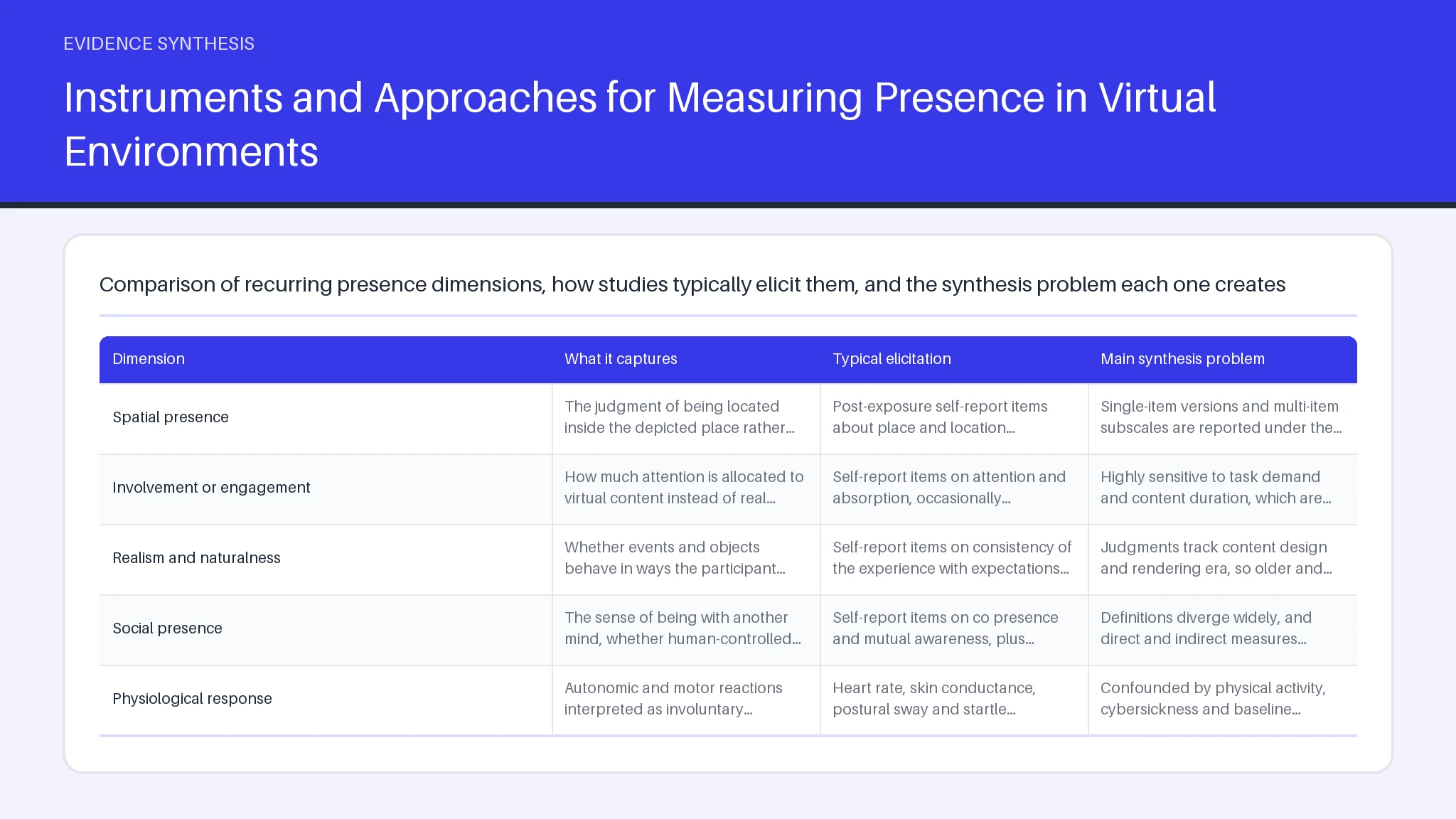
The table below sets out how the recurring dimensions differ in what they capture, how they are usually elicited, and where they create synthesis problems. It is grounded in the combination patterns described above and is intended as a template for the crosswalk you will need to build during extraction.
| Dimension | What it captures | Typical elicitation | Main synthesis problem |
|---|---|---|---|
| Spatial presence | The judgment of being located inside the depicted place rather than in the physical room | Post-exposure self-report items about place and location, sometimes a single-item "being there" rating | Single-item versions and multi-item subscales are reported under the same label, so score ranges differ |
| Involvement or engagement | How much attention is allocated to virtual content instead of real surroundings | Self-report items on attention and absorption, occasionally supported by reaction-time distraction tasks | Highly sensitive to task demand and content duration, which are rarely matched across studies |
| Realism and naturalness | Whether events and objects behave in ways the participant finds credible | Self-report items on consistency of the experience with expectations of the real world | Judgments track content design and rendering era, so older and newer studies are not comparable |
| Social presence | The sense of being with another mind, whether human-controlled or agent-controlled | Self-report items on co presence and mutual awareness, plus interaction behavior such as gaze and interpersonal distance | Definitions diverge widely, and direct and indirect measures often disagree within the same study |
| Physiological response | Autonomic and motor reactions interpreted as involuntary correlates of the experience | Heart rate, skin conductance, postural sway and startle response recorded during exposure | Confounded by physical activity, cybersickness and baseline arousal, so it indexes reaction as much as presence |
Two practical consequences follow. First, report dimension coverage as a descriptive result in its own right. Stating how many included studies measured spatial presence, how many measured social dimensions, and how many measured only a total is a finding, and it tells readers which parts of the construct the field has actually studied. Second, resist the temptation to harmonize scores arithmetically. Converting a seven-point scale to a percentage of maximum does not make two different instruments equivalent; it only makes the incompatibility invisible.
Finally, note where user experience research and presence research pull apart. Usability and satisfaction measures answer whether the system was pleasant and efficient to use. Presence measures answer whether the person responded to the depicted world as a place. Studies that treat the two as one construct will inflate correlations, and a careful review flags that conflation rather than absorbing it. Keeping presence and immersion conceptually separate at extraction, and being explicit about display class and task demand, is what allows measuring presence in virtual environments: a systematic review to describe the field accurately instead of averaging away its most interesting variation.
How Presence Shapes Emotion and Affect in VR Users
Presence shapes emotion by changing how seriously the nervous system treats what the display shows. When a participant reports a strong sense of presence, emotionally loaded content produces larger self-reported affect and larger autonomic responses than the same content viewed with lower presence. The relationship runs in both directions, which is the point most often missed: emotionally engaging content also raises reported presence, so studies that use affective stimuli to manipulate presence and then correlate the two are partly measuring the same thing twice.
For a review team this matters because emotion is the most common reason presence gets measured at all. Clinical applications of virtual reality in exposure therapy for phobias, post-traumatic stress and social anxiety depend on the environment provoking a genuine emotional response. If the participant does not respond to the virtual height, the virtual crowd or the virtual spider as if it mattered, the therapeutic mechanism has nothing to work with. Presence therefore functions as a mediator in these designs rather than as an outcome, and extracting it correctly means recording its position in the causal model the authors specified.
Three patterns recur in how emotion and presence are linked in immersive virtual studies, and each carries a distinct appraisal risk.
Presence as a manipulation check. The authors vary something about the system, typically field of view, stereoscopy, tracking or sound, then verify that the high-immersion condition produced higher reported presence, and proceed to test emotional outcomes. The appraisal risk is that the manipulation altered emotional content as well as sensory fidelity. Adding spatialized audio, for example, changes both immersion and the startle potential of the scene.
Presence as a mediator. The analysis tests whether the effect of the environment on anxiety, empathy or enjoyment runs through reported presence. The appraisal risk is measurement timing. Presence is typically measured once, after exposure, while emotion fluctuates throughout, so a single post-hoc rating is being asked to mediate a time-varying process.
Presence as a moderator. The analysis asks whether emotional responses are stronger in participants who report higher presence. The appraisal risk is individual differences masquerading as an effect of the technology. Trait absorption, immersive tendencies, prior gaming experience and anxiety sensitivity all predict both higher presence reports and stronger emotional reactivity.
The emotional connectivity strand of this literature pushes further, arguing that the core of presence is a sense of being rather than a judgment about display quality. On that reading, what the participant reports is not an estimate of rendering fidelity but a felt sense that they are somewhere and that what happens there involves them. This framing explains a result that puzzles people new to the field: low-fidelity content can generate very strong presence when it is emotionally meaningful, while photorealistic content can leave participants flat. A narrative about loss delivered through simple geometry will often outperform a technically superior architectural walkthrough. Any review that treats sensory fidelity as the sole driver of presence will find its own included studies contradicting it.
Emotional valence also interacts with measurement channel in ways worth extracting separately. Negative, threatening content produces clear autonomic signatures such as elevated heart rate and increased skin conductance, which makes physiological measurement viable. Positive or calm content, the kind used in relaxation and pain-distraction applications, produces much smaller autonomic change, so physiological indicators lose sensitivity precisely where self-report still works. A review that pools physiological validity evidence across valence conditions will report an artificially mixed picture. Stratifying by valence is a small analytic decision with a large effect on interpretation.
There are two practical extraction recommendations that follow from all of this and that the prominent reviews in this space do not make.
- Record whether emotional content was part of the presence manipulation. If it was, flag the study as having confounded affect with sensory fidelity. This single field lets you separate clean sensory manipulations from mixed ones at analysis time rather than arguing about it in the discussion.
- Record cybersickness measurement alongside emotion. Nausea, eye strain and disorientation depress presence reports and raise autonomic arousal at the same time, which is the worst possible combination for interpreting physiological data. Studies that measured sickness and studies that ignored it should not be treated as equally informative.
Population characteristics deserve the same attention. Clinical samples recruited for anxiety treatment respond differently from undergraduate convenience samples, and children, older adults and people with vestibular conditions differ again in both presence reports and tolerance of VR technology. Reporting the distribution of populations across your included studies is a straightforward descriptive result that helps readers judge how far the evidence generalizes.
One limitation is worth stating in any review of this area. Because emotion is so often the dependent variable, presence measurement in these studies is usually abbreviated. Researchers who need thirty minutes for an anxiety protocol will not spend ten on a full presence instrument, so they use a short form, a subscale or a single item. That produces a literature with wide coverage and thin measurement, which is why the strongest psychometric evidence and the strongest applied evidence tend to sit in different papers. Saying so clearly is more useful than pretending the two bodies of work are one, and it is a distinction measuring presence in virtual environments: a systematic review is well placed to draw. Where the underlying appraisal logic gets technical, the guidance on judging whether results can be trusted covers the general principles this section applies to a specific literature. Keeping spatial presence, affect and user experience separable at extraction is what makes the resulting synthesis interpretable.
Statistical Methods Used to Analyse Presence Data Across Studies
Statistical methods in presence research cluster into four groups: group comparison tests on questionnaire scores, correlation and regression linking presence to other variables, factor-analytic work on instrument structure, and time-series or signal analysis of physiological recordings. Each group answers a different question, and knowing which group a study belongs to tells you immediately what kind of evidence it can contribute to a measurement review.
Group comparison is the default. A study assigns participants to two or more display conditions, administers a presence instrument, and runs a t-test or analysis of variance on the totals or subscales. Effect sizes are frequently omitted, sample sizes are often small, and multiple subscales are tested without adjustment, which inflates the apparent number of significant findings. When you extract from these studies, record the number of comparisons performed as well as the number reported as significant. The ratio is informative and it is rarely visible in abstracts.
Correlation and regression analyses ask whether the sense of presence relates to performance, learning, emotion or sickness. The recurring problem is range restriction. Experiments designed to produce high presence generate scores bunched near the top of the scale, which suppresses correlations and makes null findings hard to interpret. Extract the observed mean and standard deviation, not just the correlation coefficient, so you can see whether restriction is a plausible explanation for a weak association.
Factor analysis and structural equation modeling appear in instrument development work. Exploratory factor analysis is used to derive subscales, confirmatory factor analysis to test a proposed structure, and measurement invariance testing, much more rarely, to check that the structure holds across languages, age groups or display types. Invariance testing is the most important and least common analysis in this literature. Without it, comparing spatial presence scores between a study run in one country and a study run in another rests on an untested assumption. A review that reports how many included validation studies tested invariance is adding something the field genuinely lacks.
Sample size is the binding constraint on all of this. Factor-analytic work requires participant counts that presence studies seldom reach, and conventional guidance on ratios of participants to items would disqualify a substantial share of published validation attempts. Report the sample size distribution across your included studies and state the implication: many structural claims in this field rest on samples too small to support them, which is a limitation of the evidence rather than a flaw in your review.
Physiological methods used to assess presence form the fourth group and require an entirely different analytic vocabulary. Studies that use physiological signals to assess presence typically record one or more of the following:
- Electrocardiography and heart rate variability. Analysis focuses on mean heart rate change from baseline and on frequency-domain or time-domain variability indices interpreted as autonomic balance. These require clean baselines and are corrupted by movement, which is a real problem in room-scale conditions.
- Electrodermal activity. Skin conductance level and the count or amplitude of phasic responses are used as arousal indices. Analysis requires decomposition into tonic and phasic components, and results depend heavily on the decomposition method chosen, which is often unreported.
- Electroencephalography. Band power in alpha and theta ranges and event-related potentials are used to index attentional engagement. Analysis pipelines involve many preprocessing choices, and head-mounted displays introduce mechanical and electrical artifacts that constrain electrode placement.
- Postural and motor response. Center-of-pressure displacement, body sway and avoidance movements are analyzed as involuntary responses to virtual events such as a simulated drop or an approaching object. These are among the most face-valid indicators because the participant cannot easily fake them.
- Respiration and facial electromyography. Breathing rate and corrugator or zygomatic activity provide affective information that complements arousal indices and helps separate valence from intensity.
The analytic problem common to all of these is that autonomic arousal is not specific to presence. A raised heart rate during a virtual height exposure is consistent with high presence, with physical exertion, with cybersickness and with anticipatory anxiety about the experiment itself. Statistical approaches that address this include difference-from-baseline designs, within-subject comparison of matched high and low presence conditions, and multivariate models that enter self-reported presence, sickness and physical activity together. Extract which of these strategies each study used, because it is the clearest marker of analytic quality in this subliterature.
Synchronization is the other technical detail worth extracting. Linking a physiological signal to a specific virtual event requires accurate event markers from the rendering engine, and many studies report only session-level averages because they lacked that synchronization. Session averages cannot support event-locked claims, so the distinction changes what a study is evidence for. Recording sampling rate and whether event markers were logged takes seconds per study and separates studies that can support fine-grained inference from those that cannot.
On whether to pool, the honest answer for most reviews of this field is no. A meaningful quantitative synthesis needs comparable instruments, comparable manipulations and comparable populations, and this literature supplies those conditions only in narrow pockets. Where it does, standardized mean differences on a single named instrument across similar display classes can be combined, with heterogeneity examined by display class, exposure duration and content type. Where it does not, structured tabulation with direction-of-effect reporting is the defensible alternative. The general decision rules are set out in the meta-analysis guide, and the distinction between synthesis types is covered in systematic review versus meta analysis.
Two further analytic points are worth carrying into your protocol. First, studies that use virtual reality alongside augmented reality or partially overlaid content need separate handling, because perceived realism in an overlaid scene is judged against the actual room rather than against a fully synthetic world, and the comparison logic differs. Second, how participants perceive realism is frequently analyzed as a predictor of presence rather than as a component of it, and the two treatments are not interchangeable; record which one each study adopted. Since a systematic review is only as informative as its extraction sheet, building these analytic distinctions into the form at protocol stage is what allows measuring presence in virtual environments: a systematic review to report the state of statistical practice rather than just the state of the findings.
Place Illusion and Plausibility: The Illusions Behind Presence
Place illusion and plausibility illusion are two separable perceptual illusions that together account for most of what people describe as presence. Place illusion is the sensation of being in the depicted location despite knowing you are not, and it depends chiefly on the sensorimotor contingencies the system supports: whether turning your head, leaning, reaching and walking produce the perceptual consequences your body expects. Plausibility illusion is the sensation that the depicted events are actually happening, and it depends on whether the world responds to you, whether events are credible given the context, and whether other characters appear to notice you.
Separating the two is analytically useful because they have different determinants and different failure modes. Place illusion breaks with tracking latency, mismatched field of view or a frame rate that lags head motion. Plausibility breaks when a character walks through a wall, an object floats when it should fall, or the environment ignores an action you just performed. A system can deliver near-perfect place illusion and almost no plausibility, which is exactly what happens in a high-fidelity but entirely non-responsive environment. It can also deliver strong plausibility with modest sensory fidelity, which is why simple but responsive virtual reality experiences often outperform expensive passive ones.
For measurement, this framing has a consequence that most presence questionnaires do not accommodate. Instruments built around spatial presence and involvement capture place illusion reasonably well and capture plausibility poorly. Items about feeling located in a place, about the environment seeming real to look at, and about losing awareness of the physical room all speak to the first illusion. Plausibility needs different items: whether events seemed to be really happening, whether the participant felt acted upon, whether characters appeared aware of them. A review that maps included instruments against the two illusions will usually find coverage badly skewed toward place. Reporting that imbalance is a substantive finding about the state of measurement, not a footnote.
The immersion side of the distinction is also cleaner under this framing. If immersion is defined as the set of sensorimotor contingencies a system affords, then it becomes a describable, comparable property: tracked degrees of freedom, latency in milliseconds, field of view in degrees, spatial audio rendering, haptic channels. Those can be extracted from methods sections when authors report them, and the fact that many do not is itself worth counting. A review that reports what proportion of included studies specified latency and field of view gives readers a concrete picture of reporting quality in the field, and that number is more actionable than another discussion of definitions.
Behavioral evidence sits naturally alongside this framing, and it is where the strongest validity arguments in the field come from. If a participant genuinely holds the place illusion, they behave as if the place were real: they duck under a virtual beam, step back from a virtual edge, avoid walking through a virtual table, and show postural adjustment when the floor appears to drop. If they hold the plausibility illusion, they respond socially to virtual characters, maintain interpersonal distance, break eye contact, and answer when addressed. These behaviors are hard to produce deliberately and they do not depend on the participant understanding a questionnaire item, which makes them valuable convergent evidence. Extract them as a distinct measurement family and record whether behavior was coded by blinded raters, because unblinded coding of avoidance behavior is a known weak point.
Applying the framing to mixed reality and augmented reality changes the analysis in a specific way. When virtual content is overlaid on the real room, place illusion is largely unnecessary because the participant is already in a real place. What matters is whether the overlaid content is plausibly part of that place: whether it is occluded correctly by real objects, lit consistently, stable relative to surfaces, and responsive to the user. Presence instruments designed for fully synthetic environments ask questions that make little sense under these conditions, and studies that apply them anyway generate scores that are hard to interpret. If overlaid-content studies are eligible for your review, either restrict instruments to those designed or adapted for the condition, or analyze them separately and say why.
Two practical uses for the place and plausibility distinction are worth building into a protocol.
- As an extraction dimension. Code every instrument and every item set as addressing place illusion, plausibility, both or neither. This produces a coverage map that is immediately useful to anyone choosing an instrument for a new study.
- As an appraisal lens for manipulation checks. When a study claims to have manipulated presence, ask which illusion the manipulation targeted. A manipulation that changed environmental responsiveness but was verified with a spatial presence subscale has a measurement mismatch, and that mismatch belongs in your risk assessment rather than in a general note about heterogeneity.
Used this way, the two illusions stop being a theoretical preference and become an organizing device for the whole extraction sheet. They explain why immersion metrics and subjective reports diverge, why some manipulations fail their own checks, and why spatial presence dominates the instrument landscape while plausibility remains under-measured. That is the kind of structural observation measuring presence in virtual environments: a systematic review is well positioned to make, and it gives readers something more durable than a ranking of questionnaires. Where these choices need to be locked down before screening begins, the guidance on writing and registering a protocol covers how to document them.
Suggested visual 2: a two-axis matrix plotting place illusion against plausibility illusion, with quadrant labels for high-fidelity non-responsive, responsive low-fidelity, both high and both low conditions. Alt text: "Matrix plotting place illusion against plausibility illusion across four virtual reality system conditions."
Instruments and Approaches for Measuring Presence in Virtual Environments
Instruments for measuring presence fall into four approaches: multi-item post-exposure questionnaires, single-item or continuous subjective ratings collected during exposure, behavioral and break-in-presence methods, and physiological recording. Questionnaires dominate the published record by a wide margin, and a review that wants to describe practice accurately has to document not just which instruments were used but how much of each instrument was used, in what language, and at what point in the session.
Multi-item questionnaires. The standard approach administers ten to forty items on a five to seven point scale immediately after exposure, producing subscale scores for dimensions such as spatial presence, involvement, realism and sometimes ease of interaction or examination of the environment. The strengths are practicality, familiarity to reviewers and a reasonable amount of accumulated reliability evidence. The weaknesses are equally clear. Retrospective report depends on memory of a state that has already ended, items about realism invite judgments about graphics rather than about experience, and asking participants to reflect on whether they felt present can itself break the state being measured.
Continuous and single-item ratings. Some studies ask for a presence rating at intervals during the experience, either verbally or with a handheld dial. This captures fluctuation that a single post-exposure score averages away, and it allows presence to be linked to specific events. The cost is interruption: each probe pulls attention back toward the measurement task and toward the physical room. Whether that cost outweighs the temporal resolution gained is a genuine trade-off, and a review should report how many studies chose each side of it rather than treating continuous measurement as straightforwardly better.
Behavioral and break-in-presence methods. Rather than asking participants how present they felt, these methods count observable responses or count moments when presence visibly lapses. Break-in-presence protocols ask participants to report transitions from the virtual to the real world, on the reasoning that counting breaks is cognitively easier and less abstract than rating a continuous psychological state. Behavioral coding counts ducking, flinching, avoidance and social responses. Both approaches sidestep the introspection problem and both require careful operational definitions and, ideally, blinded coding.
Physiological recording. Autonomic and neural signals provide continuous data that participants cannot consciously shape. They are covered in detail in the section on objective indicators; for instrument selection, the key point is that physiological data need a self-report or behavioral anchor to be interpretable, because arousal alone does not distinguish presence from sickness or exertion.
The psychological side of the concept of presence is what questionnaire items are ultimately probing, and it is worth being precise about the content of that probing. Items in this literature ask about four things: location, meaning where the participant felt they were; attention, meaning what they were aware of and what faded; reality judgment, meaning how convincing events seemed; and involvement, meaning how much the experience mattered to them. The fourth is the emotional connectivity component, the sense of being somewhere and being involved in what happens there, and it is the dimension that most often explains why a technically modest environment produces strong presence. Instruments weight these four very differently, which is why two studies using different questionnaires on the same system can report meaningfully different scores. Building a crosswalk of item content, not just subscale names, is the only reliable way to see that.
Assessing presence well in a primary study, and therefore judging whether a study assessed it well in a review, comes down to a short list of concrete checks.
- Instrument fit to condition. A questionnaire developed for desktop environments applied to a head-mounted display, or one developed for solitary exploration applied to a multi-user setting with co presence, will produce scores of uncertain meaning.
- Administration medium. Answering inside the headset keeps the participant in the environment but constrains item presentation; answering outside introduces a transition that may color recall. Both are defensible; neither is neutral.
- Timing and delay. Record the interval between exposure end and questionnaire completion. Even a few minutes of debriefing changes what is being recalled.
- Completeness of use. Note whether the full instrument, a subscale or a handful of items was administered, and whether scores were rescaled. Partial administration is common and often undisclosed in abstracts.
- Translation and adaptation status. Translated instruments need their own validation. Record whether any was performed or whether the original psychometrics were assumed to transfer.
- Convergent evidence. Studies that combine self-report with behavioral or physiological data support stronger validity claims than studies relying on one channel.
There is a selection question that published reviews tend to answer implicitly and that deserves an explicit answer. Choosing an instrument for a new study involves trading psychometric pedigree against fit to the specific condition. An older, heavily cited questionnaire brings comparability with a large body of prior work and a known factor structure, but its items may reference display technology that no longer exists and may ignore social dimensions entirely. A newer, condition-specific instrument fits the setup better and produces cleaner data, but isolates the study from the comparative literature. Neither choice is wrong, and a review that lays out this trade-off with evidence from its own included studies is more useful than one that ranks instruments.
The same trade-off appears in review design. A review restricted to a small number of named, validated instruments will produce a tighter, more comparable evidence base and may support a limited meta analysis. A review admitting any self-report measure of presence will describe practice more completely and will almost certainly have to rely on narrative synthesis. State which you chose and what it cost you.
One last reporting recommendation, and it is the sort of detail that separates a useful methods review from a catalog. Record the participant time cost of each measurement approach. A full questionnaire takes five to ten minutes, physiological setup can take twenty or more before the session starts, and behavioral coding costs researcher time after it ends. Because participant time is the scarcest resource in this kind of experiment, these costs explain a great deal about why measurement practice looks the way it does, and surfacing them helps the next research team plan realistically. Since a systematic review is a description of practice as much as of findings, that practical layer belongs in the results. The screening decisions that produce a clean included set are covered in the guidance on screening studies for a systematic review, and for teams comparing workflow options the review software comparison sets out how extraction forms of this complexity are typically handled.
What Counts as a Virtual Environment in Presence Research?
A virtual environment in presence research is any computer-generated setting that a person can perceive and, usually, act within, from a fully enclosing head-mounted display to a desktop three-dimensional scene navigated with a mouse. The breadth of that definition is the central eligibility problem for a review of this literature, because studies using radically different setups all describe their apparatus with the same two words, and pooling them without recording the difference produces a synthesis that averages incompatible conditions.
The setups that appear in this literature sort into six classes worth distinguishing at extraction.
- Head-mounted displays with positional tracking. Stereoscopic, head-tracked, often with hand controllers and spatial audio. This is the immersive virtual environment that most current research means by virtual reality, and it supports the widest range of sensorimotor contingencies.
- Projection-based rooms. CAVE-style installations surround the participant with projected walls and floor. They preserve the participant's view of their own body, which changes embodiment and social interaction compared with a headset.
- Desktop three-dimensional environments. A monitor, keyboard and mouse. Presence is reported and measured here, often at lower levels, and the historical instruments in this field were largely developed in this condition.
- 360-degree video. Rotational tracking with no positional movement and no interaction. Visual fidelity can be photographic while agency is near zero, which separates realism from interactivity cleanly.
- Multi-user platforms. A shared, persistent virtual world where several participants are represented by avatars. Social dimensions and co presence become primary, and the collaborative virtual setting introduces measurement issues that solitary designs never face.
- Overlaid and partially synthetic settings. Content placed in the real room. As discussed earlier, standard presence items often do not apply cleanly here.
Recording class is not bureaucratic tidiness. It changes interpretation directly. An interactive virtual scene with full positional tracking affords ducking, leaning and reaching, so behavioral measures of presence are available. A 360-degree video affords none of those, so the same behavioral protocol would record nothing and a review that reports behavioral measurement rates without stratifying by class will misdescribe the field. Similarly, involvement and attention subscales behave differently when the participant can see their own hands.
Content type is the second axis and it is independent of hardware class. The same headset can present an architectural walkthrough, a clinical exposure scenario, a training simulation, a game, a social meeting space or an abstract psychophysics stimulus. Emotional loading, task demand, narrative structure and social content all vary across those, and all affect reported presence and immersion. Extract content type separately from display class, because their combination, not either alone, determines what a given presence score means.
Exposure duration is the third axis. Presence in this literature is measured after exposures ranging from under a minute to over an hour. Short exposures carry novelty effects and leave little time for the environment to demonstrate responsiveness; long exposures introduce fatigue, sickness and habituation. Duration is nearly always reported and nearly never used as a moderator, which makes it low-hanging fruit for a review that wants to add something.
Two eligibility edge cases cause the most disagreement in screening, and deciding them in the protocol saves substantial time later.
Non-visual and minimally visual environments. Audio-only environments, haptic-only setups and text-based shared spaces have all been studied as presence-inducing. They can generate strong reported presence despite minimal visual fidelity, which is theoretically important and practically awkward, since most instruments assume a visual scene. Decide whether they are in scope and be explicit.
Second, screen-based games and simulations not described as virtual reality. A large body of media psychology work measures spatial presence in conventional video games and film using instruments built for that purpose. Excluding it keeps the review focused; including it roughly doubles the instrument landscape and brings in measurement development work that headset-focused reviews miss entirely. Either choice is defensible and the choice should be recorded with its rationale rather than left to screener judgment.
There is a practical consequence for search strategy design. Terminology in this field has shifted repeatedly, and papers from different eras use different labels for the same apparatus. A search restricted to current terminology will miss the desktop-era validation studies where several widely used instruments originated, and a search that is too broad will bury screeners in unrelated work about online communities and telepresence in remote collaboration. Piloting the search on a known set of ten to fifteen instrument development papers, then checking which ones your string retrieves, is the fastest way to calibrate that balance. The general framework sits in the systematic review guide, and the specific question of scope breadth against depth is handled in what a scoping review is and when to use one, which may be the better format if your aim is to map the whole terminological landscape rather than answer a focused measurement question.
Reporting the class distribution of your included studies is a finding in its own right. If most included studies used head-mounted displays but most instrument validation studies used desktop environments, then the field is applying desktop-validated tools to immersive conditions without revalidation, and stating that plainly is more valuable than any pooled estimate a meta analysis of presence questionnaire scores could produce. It also tells the next team exactly where the gap in the evidence sits, which is the most useful thing a methods review can do.
Physiological Indicators as Objective Measures of Presence in VR
Physiological indicators measure presence indirectly, by recording involuntary bodily responses to virtual events and treating the magnitude of those responses as evidence that the participant is treating the environment as real. The appeal is obvious: heart rate, skin conductance, respiration, muscle activity, postural sway and cortical activity cannot be adjusted to please an experimenter, and they produce continuous data rather than a single retrospective rating. The limitation is equally clear: none of these signals is specific to presence, so every physiological claim depends on a design that rules out competing explanations.
The objective of surveying this subliterature is to establish which signals have actually been used, how they were paired with subjective measures, and whether their reported relationships with presence hold up across studies. That is a narrower and more answerable aim than asking whether physiological measurement works, and it produces something usable: a map of sensor choices, pairing patterns, sample sizes and analytic strategies that a research team can consult when designing a study. A survey with that objective should report the frequency of each sensor type, the proportion of studies that combined channels, the proportion that reported synchronization with virtual events, and the direction and strength of associations with self-reported presence where both were measured.
The signals in use divide by what they index.
- Arousal. Heart rate, heart rate variability and electrodermal activity respond to threat, surprise and effort. They work well with negative or startling content and poorly with calm content.
- Attention and cortical engagement. Electroencephalographic band power and event-related potentials index attentional allocation, which maps onto the involvement dimension of presence more directly than arousal does.
- Motor and postural response. Center-of-pressure displacement, body sway, flinch and avoidance movement respond to virtual spatial threats such as a simulated drop, a looming object or a narrow ledge. These are the closest thing to a direct behavioral test of spatial presence.
- Affective expression. Facial electromyography and respiration pattern add valence information, helping distinguish a pleasant high-arousal state from an unpleasant one.
- Ocular measures. Pupil diameter, blink rate and gaze distribution index arousal and attention, and gaze in particular supports co presence research by showing whether participants treat virtual characters as social partners.
The interpretive problem deserves stating precisely, because it is where most physiological presence claims are weakest. Suppose skin conductance rises when a participant steps onto a virtual plank over a drop. That rise is consistent with the participant responding to the height as real. It is also consistent with cybersickness, with physical exertion from standing and balancing, with anticipatory anxiety about the experimental procedure, and with the simple novelty of wearing unfamiliar hardware. Designs that handle this well share three features: a stable pre-exposure baseline, a within-subject contrast between conditions matched on physical demand, and concurrent measurement of sickness. Designs that lack all three can report arousal but cannot attribute it.
Three further constraints shape what this measurement family can deliver, and they are practical rather than theoretical.
Artifact from the hardware itself. Head-mounted displays press on the face and restrict electrode placement, controllers require hand movement that corrupts electrodermal recording from the palm, and room-scale movement introduces motion artifact into cardiac and cortical signals. Studies that used seated, stationary designs produce cleaner data and less ecologically valid presence and immersion conditions, which is a real trade-off rather than a flaw.
Event synchronization. Attributing a response to a specific virtual event requires timestamped markers from the rendering engine aligned to the physiological stream. Without them, only session-level averages are available, and session averages cannot support event-locked inference. Extract whether synchronization was implemented, because it determines what the data can show.
Cost and sample size. Physiological setup, calibration and cleaning add substantial time per participant, so these studies typically recruit fewer people than questionnaire-only studies. Smaller samples mean wider confidence intervals on the very correlations the subliterature exists to establish, which partly explains why associations between physiological measures and self-reported presence are reported inconsistently across the field.
Where physiological measurement earns its cost is in three specific situations, and saying so gives readers a decision rule rather than a survey. First, when the research question concerns moment-to-moment change, since questionnaires cannot resolve time. Second, when self-report is unreliable or unavailable, as with young children or populations where demand characteristics are a serious concern. Third, when the study needs convergent validity evidence for a new instrument, where agreement between an involuntary signal and a self-report score is a meaningful validity argument in a way that agreement between two questionnaires is not.
Where it does not earn its cost is in simple condition-comparison studies with emotionally neutral content and no time-resolved question. There, a well-chosen questionnaire answers the question more cheaply and with a larger sample. Reviews of this literature rarely state that plainly, and it is one of the more useful conclusions a careful synthesis of immersive virtual reality measurement practice can offer.
For extraction, record sensor type, sampling rate, electrode or site placement, baseline protocol, artifact handling, synchronization method, the subjective instrument paired with it, and the reported association with that instrument. Those nine fields turn a scattered subliterature into a table that a study designer can actually use, and they let your review report the state of measurement practice in reality VR research rather than only the state of its conclusions.
Building and Validating Social Presence Measures in VR Psychology
Social presence measures capture the sense of being with another mind in a mediated environment, and building them is harder than building spatial presence measures because the construct itself is contested, the direct measures depend on introspection about a social feeling, and the indirect measures are open to multiple explanations. A review of this area has to confront all three problems, and being explicit about them is more useful than adopting one definition and proceeding as if the matter were settled.
The definition problem. Social presence has been defined at least four distinct ways in the published literature, and the definitions are not nested. One treats it as the salience of another person in an interaction, a property of the medium's capacity to convey social cues. A second treats it as the subjective sense of being together with another, sometimes labeled co presence. A third treats it as mutual awareness, requiring that each party senses being sensed by the other, which raises the bar considerably and rules out interaction with non-responsive agents. A fourth treats it as the degree to which a virtual other is perceived as a real, intentional being with a mind. These definitions imply different item content, different eligible conditions and different validity criteria. A scale built on the medium-capacity definition will correlate with bandwidth and cue richness; a scale built on the attribution-of-mind definition will correlate with behavioral realism of the agent. Reporting which definition each included study adopted is the single most clarifying thing a systematic literature review of this area can do, and it is usually missing.
The definitional split also determines what counts as a valid comparison. Studies of human-to-human interaction through avatars, studies of human interaction with computer-controlled agents, and studies of participants who merely know that others are present in a shared environment are all reported as social presence research. Under the mutual-awareness definition only the first qualifies. Under the attribution-of-mind definition the second is central. Grouping them without recording the distinction produces scores that are numerically similar and conceptually unrelated.
The problem of direct measures. Direct measures ask participants how much they felt they were with another person, whether the other seemed aware of them, and whether the interaction felt like a real social encounter. Four difficulties recur. First, these items require participants to introspect on a social feeling they have no everyday vocabulary for, which produces noisy responses and heavy reliance on how the item is worded. Second, the items are transparent about what the experimenter wants, so demand characteristics are a serious concern, particularly when participants know the study concerns avatars or agents. Third, social desirability pushes responses toward reporting engagement with a partner, since admitting you ignored someone feels impolite even when the someone is rendered. Fourth, ceiling effects are common: when the partner is a real human represented by a tracked avatar, almost everyone reports high social presence, which leaves too little variance to detect condition differences.
The practical consequences for appraisal are specific. Studies that used a single global item are more vulnerable to all four problems than studies using multi-item scales with mixed-direction wording. Studies that told participants in advance whether their partner was human or computer-controlled introduce expectancy effects that the measure cannot separate from experience. Recording partner type, disclosure of partner type, and item count gives a review the raw material to distinguish these designs.
The problem of indirect measures. Indirect measures infer social presence from behavior rather than asking about it: interpersonal distance maintained from a virtual other, mutual gaze duration and gaze aversion, mimicry of posture and gesture, turn-taking timing in conversation, politeness in language, and physiological responses such as arousal during a virtual social evaluation. These avoid introspection and demand characteristics, and they are the strongest evidence available that participants are treating a rendered figure as a social partner. They carry their own interpretive burden.
Interpersonal distance, for example, is affected by collision avoidance in a navigable space, by the tracking volume available, by whether the participant is seated or standing, and by cultural norms that vary across samples. Gaze behavior depends on whether the agent's eyes were animated at all and on whether eye tracking was accurate enough to detect fixation on a face. Mimicry depends on the fidelity of the avatar's own movement. Physiological arousal during a virtual social task indexes evaluation anxiety, which correlates with social presence but is not identical to it. None of these invalidates indirect measurement; all of them mean an indirect measure needs a stated causal argument linking the behavior to the construct, and reviews should record whether the study offered one.
The most defensible validation work in this area combines channels: a multi-item direct scale, at least one behavioral indicator, and a manipulation that plausibly varies social presence while holding sensory immersion constant. Holding immersion constant is the part most often skipped. If the high social presence condition also has better graphics, higher frame rate or spatially rendered audio, then the manipulation changed immersion too, and any difference in scores has two candidate explanations. Extracting whether display parameters were matched across social conditions is therefore an appraisal item, not a descriptive one.
Two further recommendations follow for anyone building or reviewing these measures in virtual reality psychology.
- Report the agency manipulation explicitly. Whether the virtual other was human-controlled, scripted, or autonomous and reactive changes what the measure is measuring. Studies frequently describe the avatar's appearance in detail and its control architecture in a single clause.
- Test invariance across partner types before comparing. A scale validated on human-controlled avatars may not have the same factor structure when applied to autonomous agents. Comparing means across partner types without checking structure assumes equivalence that has usually not been tested.
For a review team, the deliverable that adds most value here is a structured table of included social presence instruments coded by underlying definition, item count, partner types validated on, whether behavioral convergent evidence was collected, and whether display parameters were matched across conditions. That gives a reader a defensible basis for choosing a measure, which is a more honest contribution than declaring one instrument best. The general appraisal logic behind those judgments is set out in the guidance on critical appraisal, and the broader distinction between a structured methods review and a looser survey of the same ground is covered in systematic review versus literature review.
Validating a Presence Scale for Virtual World Teacher Education
Validating a presence scale for teacher education in a shared virtual world means building and testing an instrument that measures whether trainee teachers experience a simulated classroom as a real place with real students, and doing it under conditions that differ in several important ways from laboratory presence research. Teacher preparation programs use avatar-based classroom simulations so that trainees can practice classroom management, questioning technique and responses to disruptive behavior before facing thirty actual children. Whether the simulation produces transferable practice depends heavily on whether trainees respond to it as a genuine social and spatial situation, which is precisely what a presence scale is supposed to detect.
The validation task in this setting has four features that standard instruments handle poorly.
The environment is social first and spatial second. What matters is whether the trainee responds to student avatars as students: whether they address them by name, scan the room, notice off-task behavior and adjust their instruction. A questionnaire weighted toward spatial presence and visual realism will report middling scores for a simulation that is working extremely well pedagogically. Items about being addressed by students, about students appearing to attend to the trainee, and about the sense of being responsible for the room capture more of what matters.
The participants are not naive volunteers. Trainees have professional goals, are often assessed on the activity, and know their performance is observed. That changes the demand structure of every self-report item. A trainee who found the simulation unconvincing may still rate it positively if they believe the program values it, so validation needs anonymous administration and, where possible, behavioral convergent evidence from session recordings.
The delivery platform is often not a headset. Teacher education simulations frequently run on desktop platforms in computer labs, sometimes with a single operator puppeteering several student avatars. That means the instrument must work in low-immersion conditions, where items written for an immersive virtual environment will have restricted range and awkward wording. If the same program also runs immersive virtual reality sessions, the scale needs testing in both conditions rather than assumed to transfer.
The outcome of interest is professional learning. Presence here is instrumental. Nobody cares about presence for its own sake; they care whether it predicts practice quality, reflective depth and transfer to real classrooms. Predictive validity against supervisor ratings or later classroom performance is therefore the most valuable evidence, and the most rarely collected.
A defensible validation sequence for this setting runs through six steps.
- Content definition with practitioners. Draft items from interviews with teacher educators and trainees about what makes a simulated classroom feel real, rather than adapting items written for architectural walkthroughs.
- Expert content review. Have teacher educators and presence researchers rate each item for relevance and clarity, and drop items that only one group endorses.
- Cognitive interviewing. Ask a small group of trainees to think aloud while answering, which reliably surfaces items read in unintended ways. This step is cheap and skipped far too often.
- Pilot and structure testing. Administer to a sample large enough for exploratory factor analysis, recognizing that single-cohort teacher education samples are frequently too small, which usually means pooling cohorts and reporting the pooling.
- Confirmatory testing in a new cohort. Test the proposed structure on an independent sample, and test measurement invariance across delivery conditions if more than one is used.
- Validity evidence against outcomes. Correlate scores with observed behavior in the simulation and, ideally, with subsequent supervised teaching performance.
Two trade-offs are worth making explicit for anyone running this kind of validation. The first concerns comparability. Writing a setting-specific scale produces items trainees understand and scores that relate to teaching practice, but it cuts the instrument off from the wider literature, so results cannot be placed alongside general virtual reality findings. Adding a short general subscale alongside the setting-specific items is a workable compromise and costs perhaps two minutes of participant time. The second concerns who the referent is. Items can ask about the trainee's own sense of being in the classroom, about the students seeming present, or about mutual awareness between them. These generate different factor structures, and mixing them without a clear rationale produces a scale that loads messily.
The reporting gap in published work on educational virtual world presence measurement is consistent enough to name. Papers typically report internal consistency and an exploratory factor structure, and stop there. They rarely report test-retest reliability across sessions, rarely test invariance across cohorts or delivery conditions, and rarely relate presence scores to any external measure of teaching quality. A review that counts how many validation studies reached each of those levels gives program directors a realistic picture of how much confidence the available instruments support, which is far more actionable than a list of available scales.
There is also a design point that applies well beyond teacher education and that the general presence literature underuses. Where an environment exists to develop professional skill, presence measurement should be paired with a behavioral record of what the participant actually did, since the pairing of subjective report and observed action provides validity evidence that neither channel supplies alone. That combination, applied consistently, is what would let this corner of the field move from describing user experience toward demonstrating that spatial presence and social engagement in a simulation predict competence outside it.
Frequently asked questions
What types of sensors were used to assess presence in virtual reality studies?
A small set of sensor types were used to assess presence in immersive virtual reality studies. Cardiac sensors dominate, followed by electrodermal electrodes for skin conductance, respiration bands, facial electromyography, reduced-channel electroencephalography caps, force platforms for postural sway, and eye trackers now integrated into the display itself.
Sensor placement is constrained by the hardware: a headset occupies the forehead, and hand controllers corrupt palmar recordings. Record sensor grade and sampling rate at extraction, because research amplifiers and consumer wristbands do not support the same analyses in virtual reality research.
How were physiological methods combined to assess presence?
Physiological methods were combined in four ways to assess presence: autonomic arousal paired with a questionnaire; multichannel autonomic recording; autonomic plus electroencephalographic measurement; and event-locked multimodal recording synchronized to virtual events. Interpretable combinations share a pre-exposure baseline, a condition matched on physical demand, and concurrent cybersickness measurement.
Why does the number of participants per study matter?
Sample sizes shape what any synthesis can claim. Laboratory studies here commonly recruit twenty to sixty participants, with many under forty; physiological work sits lowest because of setup and immersion-related artifact cleaning, while online validation studies occasionally reach several hundred.
The number of participants per study is the binding constraint on inference. Samples of thirty leave correlations between physiological signals and self-report too imprecise to interpret, and factor structures from such samples often fail to replicate. Report the median and range as a result, use size as an appraisal dimension rather than an exclusion rule, and record whether the design was within-subject.
What should a summary and discussion of presence research include?
A summary and discussion for this field should state four confident conclusions and their limits. Presence is multidimensional, with spatial and attentional dimensions captured most reliably by existing instruments; plausibility and social dimensions are measured less often, so coverage of the construct is uneven.
A summary and discussion should carry three conclusions. Measurement channels converge weakly in immersive research, so no single channel is a gold standard. Instrument heterogeneity blocks pooling, making structured mapping the defensible output. Reporting quality constrains synthesis more than study quality: latency, field of view, timing and sensor specifications are often missing, and counting those omissions gives the field a fixable target. Limitations include small convenience samples, fast hardware change that dates findings about immersion, and shifting terminology. Process scaffolding sits in the systematic review guide and reporting rules in the PRISMA 2020 guide; platforms such as Systematicly help manage extraction forms of this complexity, but the analytic decisions remain the reviewer's.