PICO Question Examples, Templates and How to Write One
A PICO question is a structured clinical or research query built from four elements: the population or problem, the intervention or exposure, the comparison, and the outcome. You write one so that a broad concern such as "how do we stop so many patients falling overnight?" becomes something a database can actually answer: in hospitalized adults over 65, do hourly nursing rounds compared with standard two-hourly checks reduce inpatient falls? That single sentence tells you which studies count, which search terms to use, and what result would change your practice.
This guide is for nurses, allied health clinicians, students, and early-career researchers who need to formulate a searchable question before they touch a database. It covers free templates and worksheets, a diagnostic example taken apart element by element, where the question sits within evidence based practice, and how nursing projects usually go wrong at the outcome stage. Everything here is practical: what to write in each box, what to do when the comparison does not exist, and how to tell the difference between a question that will return usable evidence and one that will return 40,000 irrelevant records.
Two things worth knowing before you start. First, PICO was designed for therapy and intervention questions. If you are asking about diagnostic accuracy, prognosis, etiology, or lived experience, you will need to bend the framework or swap it for another one, and this guide shows how. Second, the elements do double duty. The same four parts you use to define your question become your search concepts and later your inclusion and exclusion criteria, which is why a sloppy question costs you time twice. If your question is heading toward a full evidence synthesis, the structure you set here carries straight into the protocol and screening stages described in our complete guide to systematic reviews.
What you need before you start: a real clinical problem you have observed rather than a topic you find interesting; access to at least one bibliographic database through your institution or a public source such as PubMed; a rough sense of the population you serve, including age band and care setting; and a defensible outcome that someone already measures in your unit or in the literature.
Key takeaways
- A well-built pico question turns a vague clinical worry into four searchable parts: population, intervention, comparison, and outcome. PICOT adds time, and PICOTS adds setting or study design.
- The four parts are not just a writing exercise. Each one maps directly to a search concept, a set of synonyms, and an eligibility rule you will reuse when you screen studies.
- Different question types need different frameworks. Therapy questions fit PICO well, while diagnostic, prognostic, and etiology questions often need a reworked comparison element or a different mnemonic such as PEO or SPIDER.
- Nursing projects usually fail on the outcome, not the intervention. If the outcome is not measurable with data you can actually collect, the question will not survive the search or the appraisal stage.
- Write the question before the search, not after. A question drafted to match papers you already found bakes selection bias into the whole project.
PICO Question Templates and Worksheets You Can Use Free
Most university libraries publish a free worksheet for this framework, and they are all variations on the same four-box grid: one row per element, one column for your plain-English description, and one column for the synonyms and controlled vocabulary terms you will feed into the database. The second column is the one people skip and the one that matters. Writing "older adults" in box one is fine; writing "older adults, elderly, geriatric, aged 65+, MeSH: Aged" is what makes the worksheet useful when you run the search.
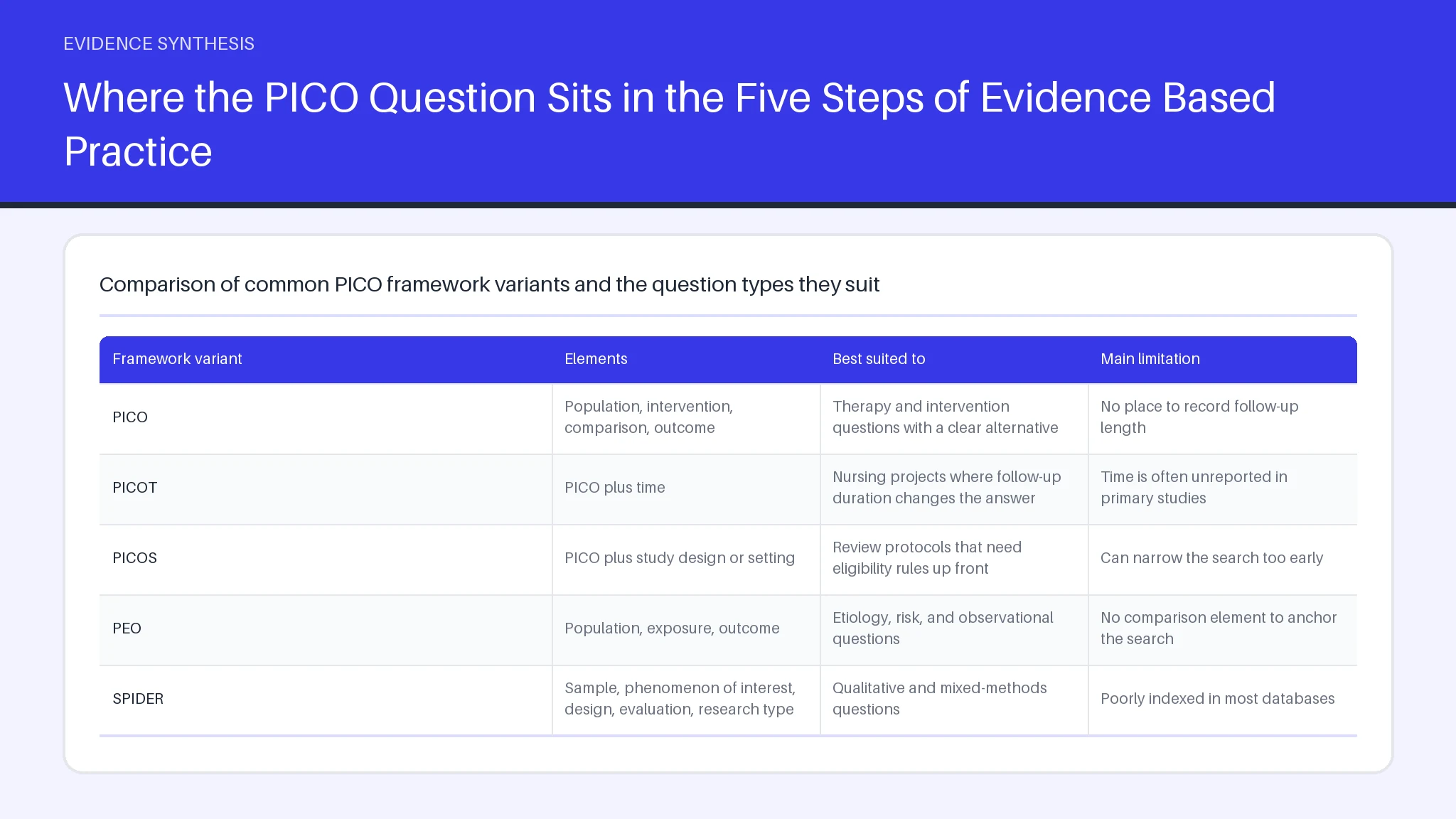
Which template you pick depends on the question type rather than the discipline. The table below compares the common variants so you can choose before you start drafting. Collections of pico question examples and sample pico questions circulate widely through library guides, and they are useful as calibration, but copy the structure rather than the content: a borrowed question rarely matches your population or your unit's outcome data.
| Framework variant | Elements | Best suited to | Main limitation |
|---|---|---|---|
| PICO | Population, intervention, comparison, outcome | Therapy and intervention questions with a clear alternative | No place to record follow-up length |
| PICOT | PICO plus time | Nursing projects where follow-up duration changes the answer | Time is often unreported in primary studies |
| PICOS | PICO plus study design or setting | Review protocols that need eligibility rules up front | Can narrow the search too early |
| PEO | Population, exposure, outcome | Etiology, risk, and observational questions | No comparison element to anchor the search |
| SPIDER | Sample, phenomenon of interest, design, evaluation, research type | Qualitative and mixed-methods questions | Poorly indexed in most databases |
Sets of pico nursing sample questions are widely shared for teaching, and they work best as a diagnostic tool: if you cannot fill all four boxes of your own question without hedging, the problem is upstream in how you framed the clinical issue.
PICO Question Example for a Diagnostic Case, Broken Down Part by Part
Diagnostic questions are where the standard pico question starts to strain, because the "intervention" is a test and the "comparison" is usually a reference standard rather than a rival treatment. Take a concrete case: in adults presenting to the emergency department with suspected deep vein thrombosis, how accurate is point-of-care ultrasound compared with contrast venography for identifying proximal clots?
Population: adults presenting to an emergency department with clinically suspected DVT. Note what this excludes. Asymptomatic screening populations have a much lower disease prevalence, and accuracy figures do not transfer across prevalence bands.
Intervention (index test): point-of-care compression ultrasound performed by the treating clinician. Specify who performs the test and with what training, because operator dependence is the main driver of variation in the results.
Comparison (reference standard): contrast venography. In diagnostic questions the comparator is what you measure the test against, not an alternative care pathway. If no accepted reference standard exists, say so, because that limitation will dominate your appraisal.
Outcome: sensitivity and specificity for proximal DVT, ideally with predictive values calculated at the prevalence you actually see. This is the practical detail library guides omit: a test with 95 percent sensitivity behaves very differently in a population with 30 percent prevalence than in one with 3 percent.
Any drafting tool, whether a library form or an AI assistant, will produce a grammatically tidy sentence from these inputs. What no tool decides for you is whether the reference standard is defensible or whether the outcome is the one your unit can act on. For pico question nursing work in particular, that judgment is the actual task.
Where the PICO Question Sits in the Five Steps of Evidence Based Practice
Evidence based practice is conventionally taught as five steps: ask, acquire, appraise, apply, and assess. The pico question format supplies the first of those steps. Your structured question belongs to step one, and everything downstream inherits its quality. A well-formed question gives you the search concepts for step two, the eligibility rules that make step three manageable, and the outcome you will re-measure in step five to see whether the change worked.
The sequence matters more than it looks. If you acquire evidence first and write the question afterward to fit what you found, you have quietly let availability decide your clinical priority. A defensible pico question is drafted from the problem on your unit, then tested against the literature, then revised once for scope if the search returns nothing or everything.
Step two is where the elements earn their keep. Each element becomes a search block that joins synonyms with OR, and the blocks are then combined with AND. Most clinicians search the population and the intervention, leaving the outcome out of the search string because outcomes are inconsistently indexed. That is a deliberate trade-off, not an error.
Step three, judging whether the results hold up, is a separate skill covered in our guide to critical appraisal. A pico question generator can speed up drafting for nursing coursework, but no tool can tell you whether the outcome you chose is the one that matters to patients.
How Nurses Write PICO Questions for Clinical and Research Projects
Nurses write these questions for two different purposes, and the purposes pull in opposite directions. A clinical question needs to be narrow enough to answer this week; a capstone or research question needs to be broad enough to sustain a search, a synthesis, and a discussion. The population element is usually where you resolve the tension: keep the intervention and outcome fixed and widen or narrow the population until the search volume is workable.
Five research questions that hold up as project topics, all built on the same four elements:
- In adult medical-surgical inpatients, does a structured hourly rounding protocol compared with standard checks reduce fall rates over 90 days?
- In nurses working 12-hour shifts, does a scheduled break policy compared with informal breaks reduce measured emotional exhaustion over six months?
- In adults with central venous catheters, does chlorhexidine-impregnated dressing compared with standard transparent dressing reduce bloodstream infections?
- In postoperative adults, does nurse-led early mobilization compared with usual care shorten length of stay?
- In patients with type 2 diabetes, does telephone follow-up compared with clinic-only follow-up improve medication adherence at 12 months?
Notice the pattern in those question examples: every outcome is something a unit already counts. That is the practical filter. If nobody records your outcome, you cannot measure a change after implementation, and step five of evidence based practice collapses.
Tips and common mistakes. Do not stack two outcomes into one question; split it. Do not write "usual care" without describing what usual care is on your unit. Do not add a time frame you cannot follow up. Published sets of sample pico questions and pico nursing sample questions are useful for structure, but the intervention has to be something your team can actually deliver.
Frequently asked questions
What is a PICO question example?
A worked example: in hospitalized adults aged 65 and over (population), does hourly nursing rounding (intervention) compared with standard two-hourly checks (comparison) reduce the rate of inpatient falls (outcome) over a 90-day period (time)? Each element is doing a specific job. The population sets your eligibility criteria, the intervention and comparison define what you are contrasting, the outcome tells you what counts as success, and the time frame keeps follow-up honest. If you can read your question back and identify all four parts without guessing, it is well formed.
What is a PICO used for?
PICO is used to turn a clinical uncertainty into a searchable question and then to structure the search itself. In practice it does three jobs: it forces you to name the patient group precisely, it makes the comparison explicit rather than asking only whether something works, and it commits you to an outcome before you see the results. Beyond the bedside, the same elements become the inclusion and exclusion criteria in a review protocol, which is why the framework appears throughout evidence synthesis and in reporting standards such as those described in our PRISMA 2020 guide.
What are some good Picot questions?
Good PICOT questions share three features: a population defined by more than diagnosis alone, an intervention that a real team could deliver, and an outcome someone already measures. Examples that meet that bar include whether early mobilization shortens length of stay in postoperative adults over 30 days, whether chlorhexidine dressings reduce catheter-related bloodstream infections in ICU patients over 12 months, and whether structured discharge teaching reduces 30-day readmission in patients with heart failure. Questions that fail tend to have vague outcomes such as "better care" or interventions like "improved communication" that nobody can operationalize.
How do I generate a PICOT question?
Start from the clinical problem, not the framework. Write one sentence describing what you observed and why it concerns you. Then split that sentence into the four elements and add a time frame if follow-up duration would change the answer. Run a quick scoping search to check that studies exist, and revise the scope once: widen the population if you find nothing, narrow it if you find thousands of records. Library worksheets and drafting tools can format the sentence for you, but the judgment about which outcome matters stays with you and your team.
What is picot example?
A PICOT example with the time element carrying real weight: in adults with type 2 diabetes attending a primary care clinic, does nurse-led telephone follow-up compared with clinic-only follow-up improve medication adherence at 12 months? Twelve months is not decoration here. Adherence interventions often show an effect at three months that fades, so the time frame is the difference between a finding you can act on and one that misleads you.
What is a good picot question for nurse burnout?
For burnout, the usual failure is a fuzzy outcome. A workable version: in registered nurses working 12-hour shifts on inpatient units, does a mandated uninterrupted break policy compared with informal break practice reduce emotional exhaustion scores over six months? The outcome names a measurable construct rather than "burnout" in general, and the comparison describes what currently happens instead of calling it usual care.
How to write a picot question in nursing?
Draft the population, intervention, comparison, outcome, and time in that order, writing each element as a phrase rather than a full sentence. Add two or three synonyms beside each element for the search. Then stitch them into a single question and check three things: can you collect the outcome data, can your unit deliver the intervention, and does the comparison describe current practice accurately? If your question is the starting point for a full synthesis rather than a single clinical decision, the same elements should be locked into a registered protocol before screening begins, and platforms such as Systematicly are built around that workflow.