Literature Review: How to Plan, Judge and Write One
A literature review is a structured account of what published work already says about a defined question, how that work was produced, and where it falls short. You will finish this guide able to choose a review format, narrow a topic to something searchable, judge which sources carry weight, and write a body organized by themes rather than by the order you happened to read things. It is written for graduate students, early career academics, and analysts who have to produce a defensible review under a deadline.
Most guidance stops at "summarize the field." The harder work sits in the decisions around the summary: how wide to cast the search, when to stop searching, which weak studies still deserve a mention, and how much of your process a reader needs to see. Those choices change depending on whether the review supports a dissertation chapter, a policy brief, or a regulated technical file.
Treat the review as an argument built from other people's research. Every source you include should earn its place by supporting, complicating, or contradicting a claim you are making. If a paper does none of those three things, it belongs in your notes rather than your text. That single test does more to improve a literature review than any template.
Key takeaways
- A literature review maps what is already known on a question, shows where the evidence disagrees, and justifies why your own study is worth doing.
- Choose the format before you search: narrative, scoping, and theoretical formats answer different questions and demand different levels of documentation.
- Narrowing works best as a funnel: broad field, then population, then outcome, then date and language limits you can defend in writing.
- Synthesis means grouping sources by theme or finding, not describing them one at a time in the order you read them.
- Keep a written record of each database, search string, and inclusion decision; regulated and graded reviews are both judged on that audit trail.
What Is Literature Review?
A review of the literature is a written synthesis of existing scholarship on a defined question, organized by idea rather than by source. It can be a chapter inside a thesis, a section that sets up an empirical paper, or a standalone publication in its own right. The purpose is not to prove you read widely. It is to show a reader the current state of knowledge, the methods that produced it, and the gaps your work addresses.
Every review makes three decisions: how far the search reaches, how strictly sources are appraised, and how much of the process is reported. A narrative literature review sets a flexible scope and interprets the field with expert judgment. A protocol-driven review fixes the scope in advance and documents each step so someone else could repeat it. Both are legitimate; they answer different questions.
The funnel model of literature review describes the shape of a good chapter: start with the broad field, move to the specific debate, then to the precise question you will answer. Whatever the approach, you must critically evaluate each book, article, and dataset rather than simply summarize it, and you should note the publication venue and date because both affect how much weight a finding carries.
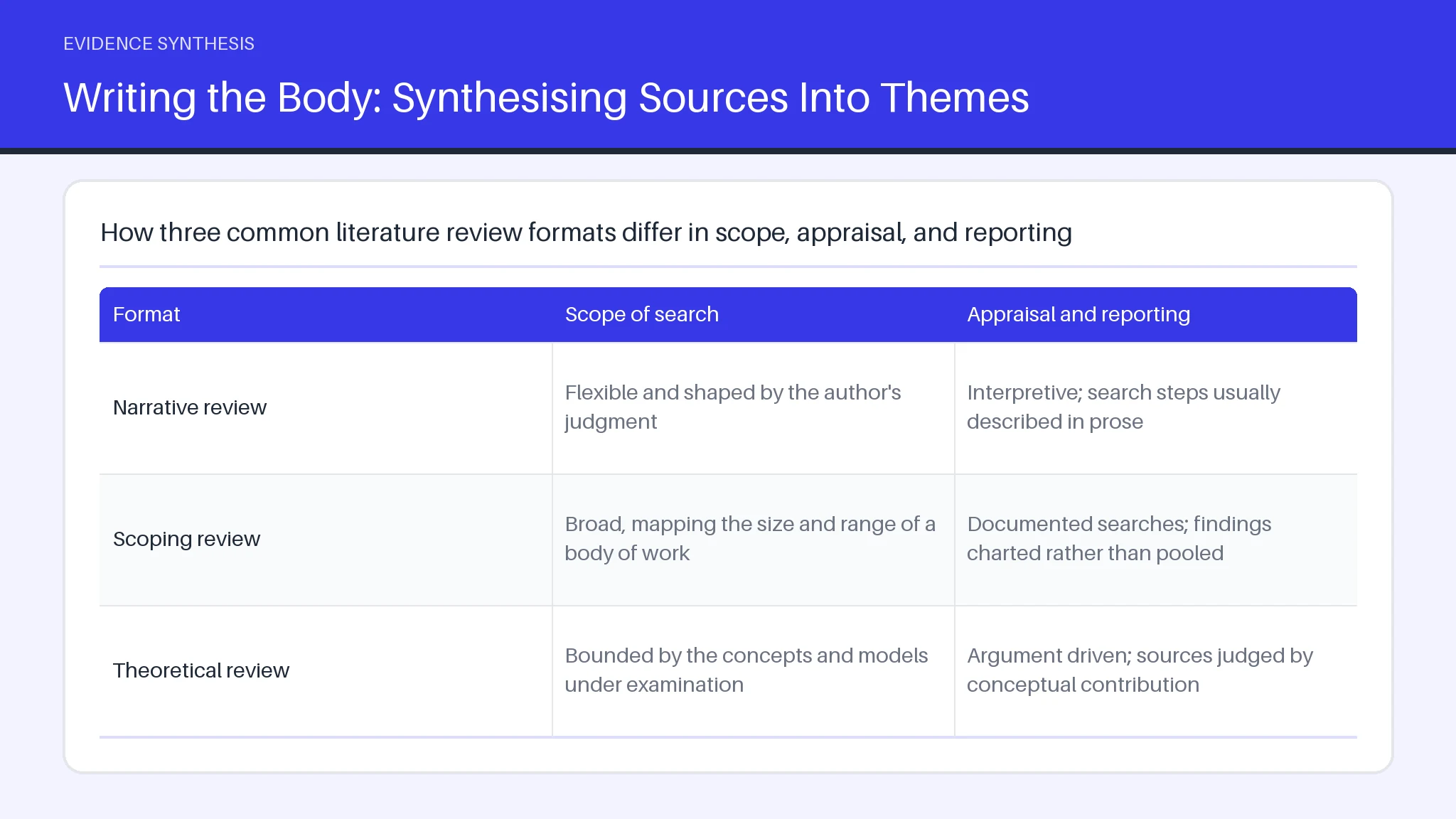
| Format | Scope of search | Appraisal and reporting |
|---|---|---|
| Narrative review | Flexible and shaped by the author's judgment | Interpretive; search steps usually described in prose |
| Scoping review | Broad, mapping the size and range of a body of work | Documented searches; findings charted rather than pooled |
| Theoretical review | Bounded by the concepts and models under examination | Argument driven; sources judged by conceptual contribution |
How to Judge the Significance of Sources You Find
Judging a source starts with finding a focus, because significance is relative to the question you asked. Once your question is fixed, ask four things about every item: what claim does it make, what evidence supports that claim, how well does the method fit the question, and does anything here change what I would write without it. A paper with a modest sample can matter more than a large one if it is the only work testing your exact concept.
Three practical signals help. First, look at whether the finding has been replicated; a single quantitative result that no one has repeated is a hypothesis, not a conclusion. Second, read the methods section before the discussion, since authors often summarize their own work more confidently than their data allow. Third, treat citation count as a measure of attention rather than of quality, and check who is citing the work and whether they agree with it. Our guide to judging whether results can be trusted goes deeper on appraisal tools.
Field context matters too. In a narrative literature review you can evaluate relevance loosely, while medical device literature reviews for EU MDR require a documented appraisal approach for every included record.
Narrative, Systematic, Scoping and Theoretical Review Formats Compared
Format choice should follow the question, not habit. A narrative format suits a broad interpretive question and lets a scholar argue about how a field has developed. A protocol-driven format suits a narrow effect question where a reader needs to know exactly which studies were considered and why. A scoping format suits an emerging area where you do not yet know how much research exists or what shape it takes. A theoretical format suits a question about how a concept has been defined and used across a body of work.
The trade-off is coverage against transparency. Broad, comprehensive searching costs weeks of screening, so a review that must be finished in a month will usually narrow its question rather than loosen its standards. Which route you pick will also depend on the audience: a dissertation committee, a grant panel, and a regulator do not want the same evidence. See our systematic review guide for the protocol-driven end of that spectrum.
Software helps with the mechanical parts of the work: deduplicating results, tracking screening decisions, storing full texts, and keeping citation records consistent. Reference managers, screening tools, and platforms such as Systematicly reduce the bookkeeping, but they cannot decide whether a qualitative study is relevant to your question. Critical analysis is still yours, and a good review is valuable precisely because someone competent read the sources closely enough to analyze what they actually show. Medical device literature reviews for EU MDR make that expectation explicit by requiring written justification for each judgment.
Writing the Body: Synthesising Sources Into Themes
Organize the body around findings and arguments, then place sources inside them. Write down the three to six claims that your reading supports, and make each one a subsection. Under each claim, group the studies that agree, the studies that disagree, and the reason they differ, which is usually a difference in population, measurement, or design. That grouping is synthesis; a list of paragraphs each opening with an author name is a summary of individual sources instead.
Two habits make the writing faster. Keep a single spreadsheet or table with one row per source, columns for design, sample, key finding, and which theme it feeds, and record the database where you found it. Then define your terms once, early, and use them consistently so a reader can follow the argument without re-reading. Where a book or older paper introduced a term that later research uses differently, say so plainly.
Close each theme by naming what remains unresolved. Those gaps are where your thesis earns its place, and any scholar reviewing your work will look for them. Keep every citation attached to the specific claim it supports, not to the paragraph in general, so a reader can analyze your reasoning source by source.
How to Narrow Your Topic and Set Search Boundaries
Narrow your topic by adding constraints one at a time until the result set becomes readable. Start with the broad field, then fix the population, then the intervention or concept, then the outcome you care about, and only then apply date and language limits. "Remote work and productivity" returns tens of thousands of records; "remote work and self-reported productivity among software engineers since 2015" returns a set you can actually analyze. Before you write a literature chapter, put those limits in a short paragraph you can defend.
What you need before you start is small but non-negotiable: a written question, a list of the databases you will search, a first set of search terms with synonyms, somewhere to store records and full texts, and a rule for what gets excluded. Add one reference management habit, which is to capture every record at the moment you find it rather than reconstructing it later.
Boundaries also come from purpose. A regulatory literature review inherits its scope from the device or product under assessment, and a medical device literature review must cover state of the art as well as the specific product, so the search cannot be narrowed purely for convenience. In academic work, any scholar reading your summary should be able to see why each limit exists.
Where the Review Sits in a Social Science Paper
In a social science paper the review sits after the introduction and before the methodology, where it does two jobs: it establishes the theory and prior findings your study builds on, and it defines the gap your research question fills. In a dissertation it usually becomes its own chapter with a stated scope, while in a journal article the same material is compressed into a few pages of scholarly framing before the design section.
A workable example of an outline for a review runs: field and why it matters, the main theoretical positions, what empirical work has tested, where results conflict, and what remains unexamined. Keep the sequence pointing forward. Every paragraph should make the reader more prepared for your methods, and you should analyze prior work rather than only summarize it.
Placement conventions differ elsewhere. A medical device review or regulatory review sits inside a technical file rather than a scholarly publication, with an appraisal plan and a search log attached. Our research methods guide covers how the review connects to the design choices that follow it.
Frequently asked questions
Can I use ChatGPT for literature review?
Large language models can help with early scaffolding tasks: suggesting synonyms for a search string, drafting a summary of a paper you have already read, or reorganizing your own notes into themes. They should not be used to generate citations, because fabricated or mismatched references are a documented failure mode, and they cannot verify what a study actually reports. Use them for structure and language, then check every factual claim against the source and record which parts of the research process were assisted.
Is the literature review the hardest part of a dissertation?
The review is often the longest part of a dissertation but rarely the hardest technically; the difficulty is judgment rather than skill. Most people stall because the question is too broad, so screening never ends, or because they write source-by-source and then cannot connect the paragraphs. Fixing the question early and writing to claims instead of to sources removes most of that pain.
What are some tips for writing a good it?
Good reviews share a few practical habits. Write the outline before the prose, keep one row of notes per source, cap the search when new results stop changing your conclusions, and read your draft asking whether a stranger could follow the argument without the sources in front of them. Rewrite any paragraph that begins with an author's name.
What should you know about step 4: Critically analyze the literature?
Critical analysis of the literature means testing each study against the question you asked rather than accepting the authors' conclusions. Check whether the design can support the claim, whether the sample matches your population, whether outcomes were measured in a comparable way, and whether limitations are acknowledged. Record your verdict in a note so the reasoning is available when you write.
What should you know about ask yourself questions like these:?
Useful screening questions are simple and repeatable: What is the main claim? What evidence supports it? Is the method appropriate? Who funded it? Does it agree or conflict with what I have already read, and why? Applying the same list to every record keeps your decisions consistent.
What should you know about ask yourself questions like these about each book or article you include:?
For each book or article, ask what it contributes that nothing else does, how current it is, whether it defines key terms as you do, and where it belongs in your outline. If you cannot name the theme it feeds, it probably does not belong in the draft.
What should you know about summarize and synthesize?
Summarizing captures what one source says; synthesizing explains what several sources say together, including where they disagree. Aim for paragraphs that open with a finding and then cite the studies behind it, which is the clearest signal that you have synthesized rather than catalogued.