Research and observation come together whenever a study answers its question by watching what people, groups, or settings actually do and recording it against a plan. Observation in this sense is not casual looking. Marshall and Rossman define it as the systematic description of events, behaviors, and artifacts in the social setting chosen for study, as summarized in a review of observation in institutional ethnography. In an observational study, researchers measure what happens without assigning anyone to a treatment. That is why the design underpins so much evidence in health, education, and social science.
This guide is for students, clinicians, and evidence reviewers. It will help you choose an observation design, run one well, or judge the observational studies you find in the literature. You will see how the main types differ, when structured observation beats a survey, why being watched changes behavior, and what to record so your findings hold up in peer review. If you later pool this kind of evidence in a systematic review, the same distinctions shape how you search, screen, and appraise studies.
The central tension in research and observation is control versus realism. In structured observation, investigators unobtrusively record participants' physical and verbal actions from afar, yet people who know they are being watched may still behave differently, a reactivity effect documented in studies of handwashing behavior.
Key takeaways
- An observational study records what people already do. Researchers do not assign anyone to an exposure or treatment.
- Structured observation fits questions where you already know what information you need. Unstructured and participant observation suit exploratory questions.
- Being watched can change behavior, and handwashing studies show that self-report overestimates it. Plan for both biases.
- Smoking research shows that observational evidence can support strong public health judgments when findings agree across designs. A single association still does not prove cause.
- Record metadata for every session (observer, date, time, location, participant description) and describe the observation protocol in your methods section.
Research and Observation: What Is Observational Research?
An observational study is a design in which researchers record exposures, behavior, and outcomes as they happen, without stepping in to change them. Within research and observation, that label covers two traditions. Qualitative observation, which includes participant observation, ethnography, and field work, aims at rich description and interpretation of a setting (qualitative interviewing and observation review). Quantitative observational designs in epidemiology, such as cohort and case-control studies, count exposures and outcomes to estimate associations.
Direct watching allows researchers to capture expressions of feelings, interactions between people, and the time spent on different activities (observation in health care research). Reviewers should also watch the spelling: British and Commonwealth journals write behaviour, so database searches should include both spellings.
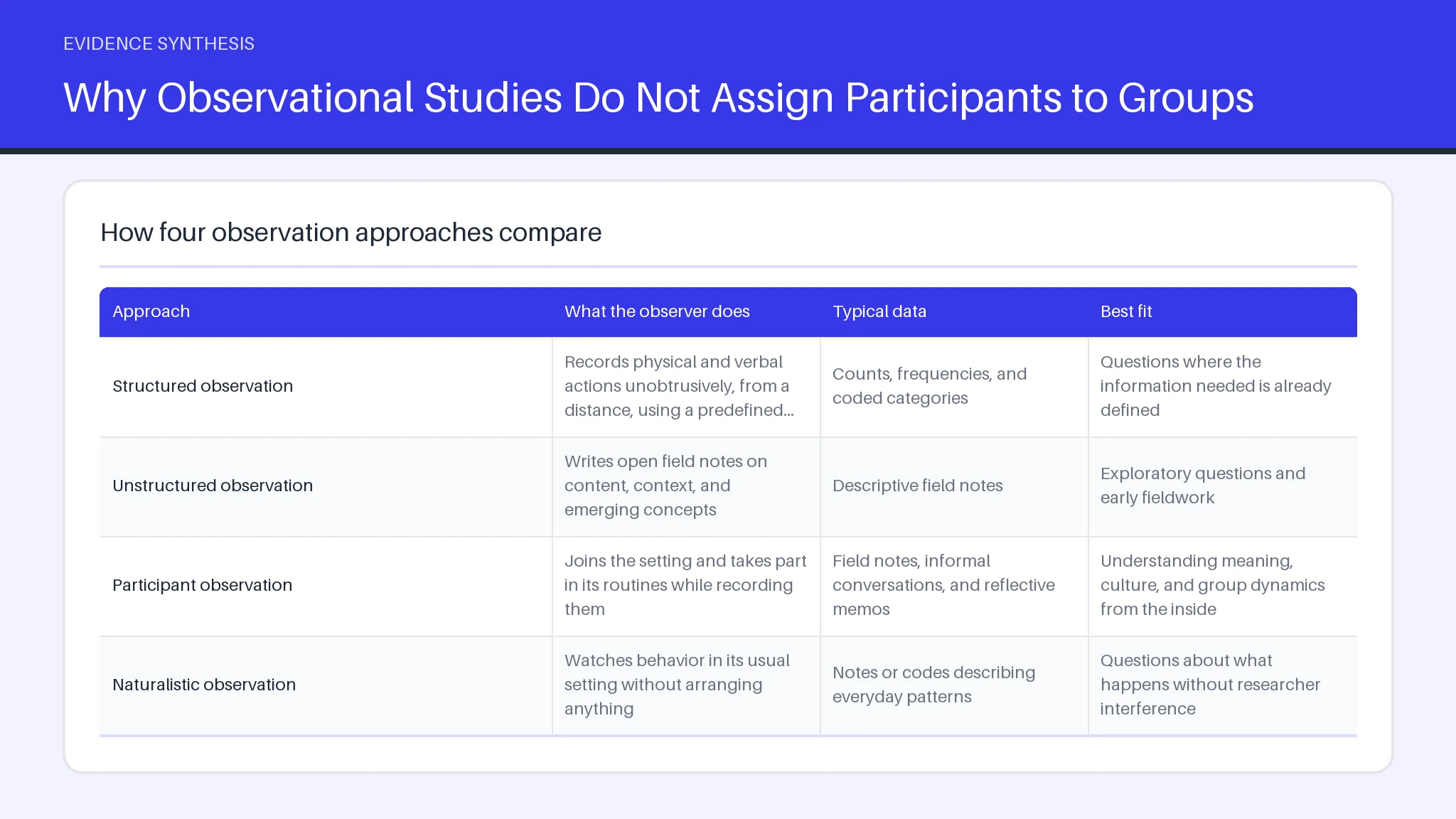
| Approach | What the observer does | Typical data | Best fit |
|---|---|---|---|
| Structured observation | Records physical and verbal actions unobtrusively, from a distance, using a predefined coding scheme | Counts, frequencies, and coded categories | Questions where the information needed is already defined |
| Unstructured observation | Writes open field notes on content, context, and emerging concepts | Descriptive field notes | Exploratory questions and early fieldwork |
| Participant observation | Joins the setting and takes part in its routines while recording them | Field notes, informal conversations, and reflective memos | Understanding meaning, culture, and group dynamics from the inside |
| Naturalistic observation | Watches behavior in its usual setting without arranging anything | Notes or codes describing everyday patterns | Questions about what happens without researcher interference |
Most research methods textbooks treat these approaches as points on a continuum, and many studies mix them. Our guide to study design places observation alongside the other designs.
Overt observation is observation in which participants know they are being studied and the researcher's role is stated openly. Overt observation allows people to know who is watching and why. The trade-off is reactivity: people may change what they do once they know they are being watched.
Handwashing research shows the problem. One study put acceleration sensors inside bars of soap to measure reactivity to structured observation. The authors linked the effect to social expectations, since people may act differently when others see their public behavior as positive (handwashing reactivity study). The same paper notes that studies have consistently found self-report overestimates handwashing, so asking people about their habits does not solve the problem either.
No observer is fully objective, so careful records matter. Guidance on field notes recommends logging metadata for each session: who recorded it, the date and time, the location, and a participant description (3 Cs field observation guide). That record helps researchers trace how a particular session or setting may have shaped group dynamics. Observation also lets researchers record expressions of feelings, interactions between people, and time spent on activities (observation and institutional ethnography).
When researchers observe a setting, the write-up should describe the observation protocol in the methods section. The results should report descriptors such as actors, site number, or setting (direct observation methods guide). With that detail, readers can judge the insights drawn from the field notes.
How Smoking Studies Became the Classic Observational Research Example
Smoking studies became the classic observational research example because they showed that careful study of exposures and outcomes could support a public health judgment that no ethical experiment could test. Observational research is any study in which investigators measure exposures and outcomes without controlling who is exposed. Observational studies of this kind include cohort studies, case-control studies, cross-sectional surveys, and qualitative field studies.
Nobody can randomly assign people to smoke for decades, so investigators used two complementary designs:
- Case-control studies compared people who had lung cancer with similar people who did not, then looked back at their smoking histories. These studies relied on participants' responses about how much they had smoked, which opens the door to recall bias.
- Cohort studies followed large groups of smokers and nonsmokers forward in time to see who developed disease. This avoided the recall problem and showed that the exposure came before the outcome.
Both types of observational research pointed the same way, and heavier smoking went with higher risk. Careful observation allows investigators to study harms they could never impose. Still, the smoking case convinced people because results were consistent across designs, populations, and research teams, not because of any single study.
That is the practical lesson for anyone reading observational research today. One association is a signal, while consistent findings from independent designs make a much stronger case. Systematic reviews formalize that judgment, and a meta-analysis can measure how consistent the effect is across studies.
How Observational Studies Differ From Controlled Experiments
Observational studies differ from controlled experiments in one decisive way: investigators measure exposures but do not assign them. In an experiment, researchers randomize participants, manipulate one or more variables, and hold other conditions constant. A difference in outcomes can then be credited to the intervention. Observation involves recording behavior and outcomes as they already occur, so a difference between groups might reflect the exposure or something that travels with it.
- Causal strength. Randomization balances known and unknown confounders on average. Observational designs must measure and adjust for the confounders they can name.
- Realism. Experiments can alter behavior by placing it in artificial conditions, while observation shows what people do in ordinary settings.
- Ethics and scope. Observation can study harmful or long-term exposures that no trial could assign.
- Measurement. In observation, the observer's coding judgment is part of the instrument, so checks between raters matter as much as sample size.
Researchers often combine the two. A trial tests whether an intervention works, and observation of routine practice shows whether it holds up outside the trial. Those insights only count if each study is appraised with a tool built for its design, which our guide to critical appraisal covers.
When to Use Direct Observation Instead of a Survey
Direct observation beats a survey when you need to know what people actually do, not what they report, especially for routine or socially desirable behavior. Handwashing research shows the gap: studies have consistently found that self-report overestimates handwashing behavior (handwashing reactivity study). Naturalistic observation of a clinic also captures sequences that respondents forget. Surveys remain stronger for attitudes, beliefs, and past events that no one can watch. Many research methods texts favor using both, since observational data can serve as auxiliary or confirmatory evidence (qualitative interviewing and observation review).
What you need before you start
- A defined question that names the events and variables to record.
- A budget and timeline for staffing, tool design, and pilot testing.
- An analysis plan settled early, because it shapes what you record (direct observation methods guide).
- A metadata template covering observer, date, time, location, and participant description.
Tips and common mistakes
- Pilot the coding scheme. Vague categories lead two researchers to observe the same event and code it differently.
- Do not treat naturalistic observation as proof of cause. Plan the analysis early so your conclusions follow from the research questions and the study's epistemological tradition, and keep the results focused on what was actually observed.
- Search for both behavior and behaviour when you look for earlier studies.
- Researchers should describe the observation protocol in the methods section and report setting and actors with the results.
Why Observational Studies Do Not Assign Participants to Groups
Observational studies do not assign participants to groups for one of two reasons: the exposure is already happening, or imposing it would be unethical or impossible. Researchers instead study the groups that people sort themselves into.
Three reasons usually drive that choice:
- Ethics. You cannot ask people to take up a harmful exposure to see what happens.
- Feasibility. Exposures such as occupation, neighborhood, or diet over decades cannot be handed out at random.
- Realism. The question concerns behavior in ordinary settings, not under trial conditions.
The cost is confounding. Because people choose their own exposures, the groups may differ in age, income, health, or habits that also affect the outcome. Good design in research and observation therefore measures those differences so analysts can adjust for them. Leaving groups intact also allows researchers to see patterns and social dynamics that a controlled setting would erase. For that reason, research methods courses usually pair observational designs with experiments instead of ranking one above the other.
Types of Observational Research: Naturalistic, Controlled and Participant
The main types of observational research differ on four choices. These are how much structure the recording follows, whether the observer takes part, whether participants know they are being watched, and where the watching happens.
- Structured or unstructured. Structured observation uses a checklist or coding scheme. Unstructured observation relies on field notes, and one published approach organizes those notes by content, context, and concepts (the 3 Cs method for field notes).
- Participant or non-participant. In participant observation, the researcher joins the activity. In non-participant observation, the researcher watches from outside it.
- Overt or covert. In overt work, the group knows who the observers are. Covert work hides the researcher's role and raises serious questions about informed consent.
- Natural or controlled setting. Fieldwork happens where behavior normally occurs. Controlled observation takes place in a lab or simulation.
In research and observation practice, these choices combine. A study of nurses' hand hygiene habits might use overt, non-participant, structured coding on a ward. A study of interactions in a peer support group might use overt participant observation with open notes. Each combination produces different insights, so let the question decide, not what you have done before.
Advantages and Disadvantages of Observation as a Research Method
Observation as a research method trades control for authenticity. It captures what people actually do, but it takes time, depends on the skill of whoever does the recording, and can change the behavior it records. In research, observation means recording events and actions in a chosen setting against a plan set by the research question. Watching and remembering later does not count.
The structured observation method fixes three things in advance: what counts as an event, how each event is coded, and how long each observation window lasts. Drawing on Mulhall, health care researchers note that structured observation is most suitable for positivistic research. It works best when the research question and the information needed are already defined (observation in health care research).
Participant observation places the researcher inside the group, taking part in its routines while recording them. Choosing between participant and non-participant observation is a trade-off between access and distance. Participant observation offers insider understanding of meaning and context. Non-participant observation keeps the researcher's influence on the group lower and avoids conflicts between roles.
Advantages
- Records what people do, not what they say they do.
- Captures context, nonverbal cues, and sequences of events that interviews miss.
- Naturalistic observation keeps activity in its ordinary setting.
- Participant observation can reach groups and meanings that are closed to outsiders.
Disadvantages
- Reactivity: people may act differently when they know they are being watched.
- Observer bias and fatigue, which call for a second coder on a sample of sessions.
- Cost, since budgets and timelines must cover staffing, tool design, and pilot testing (direct observation methods guide).
- Participant observation risks over-identifying with the group and blurring consent boundaries.
- Observation alone cannot establish cause.
The strongest research and observation designs match each strength with a plan for its weakness. A short pilot will show whether you can observe the target events reliably before full data collection begins.
Overt Observation: When Participants Know They Are Being Watched
In overt observation, the people being studied know a researcher is present and understand, at least broadly, why. Ethics committees usually treat this as the default because it supports informed consent and lets participants decline or withdraw. Overt participant observation is common in ethnography, clinical settings, and classrooms, where the researcher joins daily routines openly instead of posing as an insider.
The main trade-off is reactivity. People who know they are being watched may change what they do, an effect often called the Hawthorne effect. Researchers reduce it in practical ways: they allow time for people to get used to them before recording data, keep note-taking low-key, and compare early and late field notes for changes in how participants act.
Openness also shapes the data. Participants can explain their reasoning, correct the observer's misreadings, and point out events the observer would otherwise miss. That access makes overt participant observation strong on context, but it is never fully objective, because the observer's presence affects what happens. When appraising participant observation studies for a review, check whether the authors report how long they observed, how they disclosed their role, and how they handled reactivity. Without those details, readers cannot judge how trustworthy the participant observation is.
Frequently asked questions
What is an observational experiment?
People who say "observational experiment" usually mean a study that collects data by watching what people do. Marshall and Rossman define observation as "the systematic description of events, behaviors, and artifacts in the social setting chosen for study." In structured observation, for example, investigators unobtrusively record participants' physical and verbal actions. When you read one of these studies, check that the methods section describes the observation protocol. Also look at how the authors handle reactivity, because people may behave differently when they know someone is watching them.
Is observation considered research?
Yes. Marshall and Rossman define observation as "the systematic description of events, behaviors, and artifacts in the social setting chosen for study." It is frequently used in qualitative research and can be structured or unstructured. Structured observation fits best when the research question and the information needed are already defined. Several researchers argue that observation is underused in qualitative health care research and less favored than interviews (observation in health care research).
What are the five types of observation?
The health research guidance covered here does not name five fixed types. A review of observation in health care research says observation is either structured or unstructured (Mulhall, 2003). In structured observation, researchers record participants' physical and verbal actions unobtrusively, from afar. It suits studies where the research question and the information needed are already defined. Unstructured observation is more open. Institutional ethnographers use it to start learning about people's everyday activities. A practical guide for health researchers also gives examples of reporting semi-structured, qualitative observation data alongside structured, quantitative data.
What is the structured observation research method?
Structured observation means unobtrusively recording participants' physical and verbal actions from afar. It is most suitable for positivistic research and useful when the research question and the information you need are already defined. In health care, Duxbury and colleagues used it to code nurse-patient behaviors during medication administration, and researchers can report its results as structured, quantitative data. Reactivity is a known concern: a handwashing study used acceleration sensors embedded in soap to assess it, noting that people may behave differently when their behavior is seen in public.
What are the four main types of observation methods?
The health research sources reviewed here do not give one fixed list of four. One article on observation in health care research describes observation as either structured or unstructured. In structured observation, researchers unobtrusively record participants' physical and verbal actions from a distance. It suits positivist research and is useful when the research question and needed information are already defined. Unstructured observation helps researchers begin to learn about people's everyday activities. A practical guide for health researchers also describes semi-structured qualitative observation alongside structured quantitative observation. If your course or journal names four types, check how it defines them.
What are observational studies?
Here, observational studies are studies that gather data by watching people rather than only asking them. Marshall and Rossman define observation as "the systematic description of events, behaviors, and artifacts in the social setting chosen for study." It can be structured, with researchers unobtrusively recording physical and verbal actions when the question is already defined, or unstructured. It helps where self-report misleads; self-report has consistently overestimated handwashing. People may act differently when watched, so check that each study's methods section describes its observation protocol (systematic review guide).
What are some examples of observational studies?
Published health studies show several kinds of observation in practice. In one study, researchers used structured observation to code nurse-patient behaviors and interactions during medication administration (observation and institutional ethnography). Studies of health behavior also use structured observation widely. Handwashing is a good example, because studies have consistently shown that people overreport handwashing when asked about it. One study put acceleration sensors inside bars of soap to test whether being watched changed how people washed (handwashing reactivity study). Less structured studies exist too. Institutional ethnographers use unstructured observation to learn about people's everyday activities, including how they interact and how they spend their time.