The main types of evidence in writing are statistics and other numerical data, expert testimony, testimonial and anecdotal accounts, documentary evidence such as official records and published texts, and textual evidence drawn from close reading of a source. Each type proves something different. Numbers show scale and frequency. Experts offer qualified judgment. Personal accounts show what an experience is like, and documents establish what was actually recorded, decided or published. Arguments usually hold up best when they combine at least two of these, because one type can cover for the weakness of another.
This guide is for students, early career researchers and professionals who need to support claims in essays, reports, theses and evidence-based papers. It covers how to match each claim to the kind of support that can carry it, when a personal story is enough, how to cite records and written sources properly, and how to spot evidence that only looks convincing. It also explains how to introduce each piece of evidence so readers can follow your reasoning.
Before you search for support, read your own claim closely. That is the most useful step you can take, because the wording of a claim tells you what kind of proof it needs:
- Claims about how often or how much ("most first-year students," "rates have risen") need data and statistics, with the source and the denominator stated.
- Claims about cause and effect ("the program reduced absences") need findings from a study design that can test causes, ideally from more than one study.
- Claims about what a rule, policy or text says need the original document, quoted or paraphrased accurately.
- Claims about experience or meaning ("patients describe the wait as isolating") need testimonial evidence or qualitative research.
- Claims about uncertain or disputed questions need expert testimony that shows where qualified people agree and where they disagree.
You need three things in place before you start. First, you need a working claim that you could defend and that someone else could reasonably dispute. If you are still shaping it, Essay Writing: Step by Step From Question to Claim covers that stage. Second, you need a clear picture of your reader and what they will accept as proof. A lab report marker, a hiring panel and a policy audience will weigh the same anecdote very differently. Third, keep a simple log that records the author, date, location and page or table number for every piece of evidence as you collect it. That way, every source in your draft can be traced back to where it came from.
In research writing, the strength of evidence also depends on how it was gathered and combined. A single study, a narrative review and a systematic review are not interchangeable. A primer for early career researchers published in PubMed Central says narrative reviews are not considered an evidence synthesis method, because they can be biased and they lack transparency and reproducibility (PMC primer on review types). Understanding the types of evidence in writing therefore means watching two things at once: the form the evidence takes, such as a number, a quotation or a record, and the method that produced it. Our guide to systematic reviews explains how structured methods change what a body of research can support.
Key takeaways
- Most academic and persuasive arguments draw on six kinds of support: statistics and data, expert testimony, testimonial accounts, anecdotes, documentary records and textual evidence.
- Read your claim first. Its wording tells you what proof it needs: a claim about frequency needs data, and a claim about what a policy says needs the original document.
- A personal anecdote can illustrate a point or disprove an "always" claim. It cannot show that something is common or typical.
- A narrative review is not treated as an evidence synthesis method, and a scoping review maps evidence without judging its quality. Cite each one for what it actually shows.
- Introduce each piece of evidence by naming its source, then explain in your own words how it supports your claim.
When Personal Anecdotes Count as Evidence in Your Writing
A personal anecdote counts as evidence when your claim is about possibility, experience or a specific case, and when you are a credible witness to what you describe. It does not count as evidence for how common, typical or effective something is. Among the types of evidence in writing, the anecdote is the easiest to collect and the easiest to overuse. A vivid story feels more convincing than it logically is.
Four questions help you decide whether an anecdote belongs in a draft:
- Does the genre invite it? Personal statements, reflective essays and opinion pieces expect first-person material. Lab reports, systematic reviews and most research papers do not accept it as support for findings.
- Is the claim universal? A single well-documented case can disprove an "always" or "never" claim. It cannot prove a "usually" claim.
- Is the pattern already established? An anecdote works well as an illustration placed after data that shows the pattern, giving the reader a concrete picture of the numbers.
- Can the reader check it? Readers can only check your own experience by trusting you, so state your role plainly (for example, "as a ward nurse") and avoid exaggeration.
Testimonial evidence is close to anecdote but comes from other people: interview quotes, survey comments or published first-hand accounts. It carries more weight when gathered systematically. Report how many people you asked and how many said something similar, rather than picking the most striking quotation.
Research follows the same principle. According to a PMC primer on review types, qualitative evidence synthesis explores lived experiences and contextual factors, so first-hand accounts become evidence when they are gathered and combined with a stated method. The same primer warns that a narrative review does not count as an evidence synthesis method because of its potential for bias and its lack of transparency and reproducibility. A single anecdote has those same weaknesses.
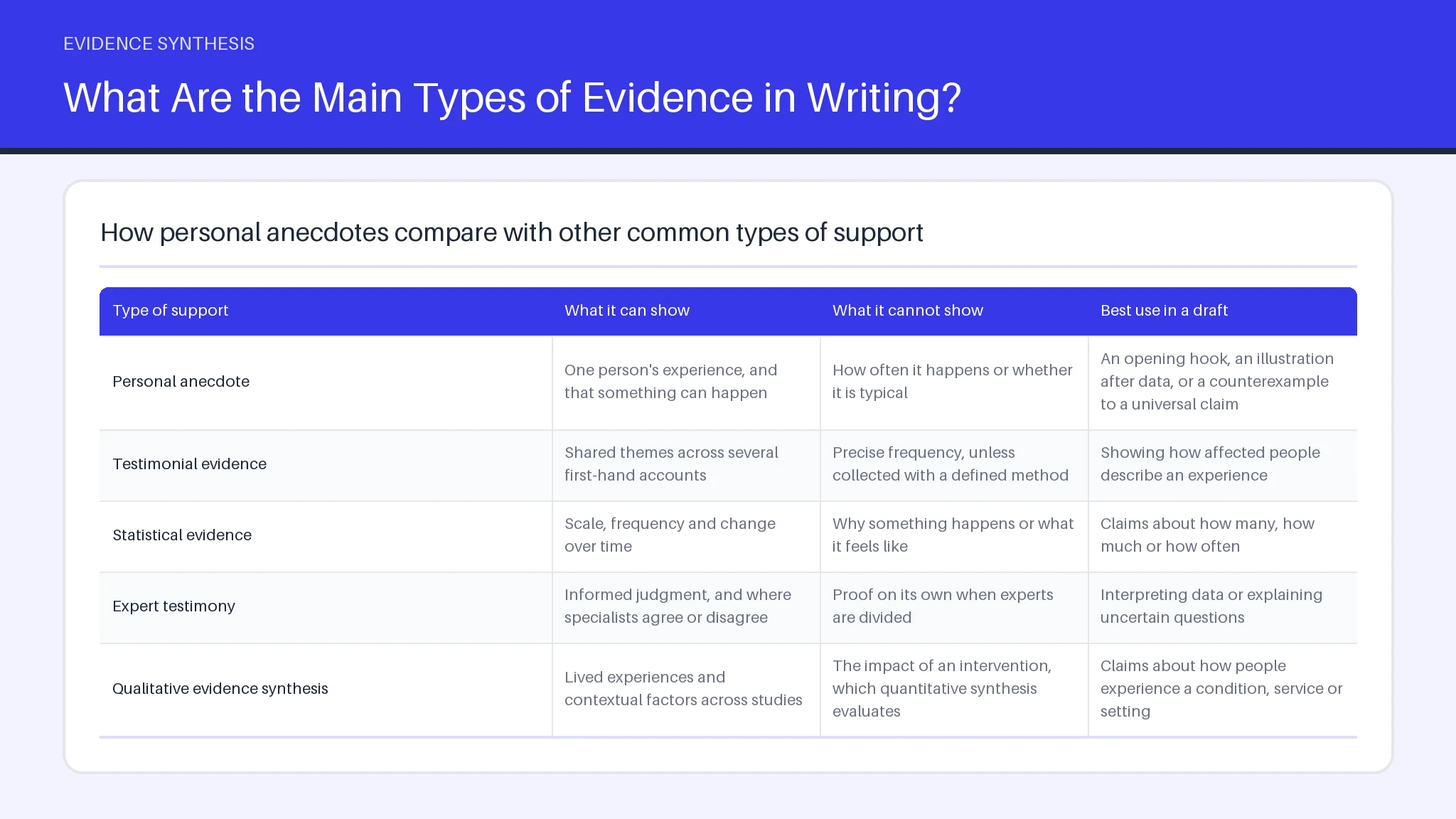
| Type of support | What it can show | What it cannot show | Best use in a draft |
|---|---|---|---|
| Personal anecdote | One person's experience, and that something can happen | How often it happens or whether it is typical | An opening hook, an illustration after data, or a counterexample to a universal claim |
| Testimonial evidence | Shared themes across several first-hand accounts | Precise frequency, unless collected with a defined method | Showing how affected people describe an experience |
| Statistical evidence | Scale, frequency and change over time | Why something happens or what it feels like | Claims about how many, how much or how often |
| Expert testimony | Informed judgment, and where specialists agree or disagree | Proof on its own when experts are divided | Interpreting data or explaining uncertain questions |
| Qualitative evidence synthesis | Lived experiences and contextual factors across studies | The impact of an intervention, which quantitative synthesis evaluates | Claims about how people experience a condition, service or setting |
What Are the Main Types of Evidence in Writing?
The main types of evidence fall into six groups, and most strong arguments draw on two or three of them. Knowing the full set helps you notice when a draft leans too heavily on one kind of support.
- Research evidence. Results from published studies and reviews. Name the authors, the year and the study design, because a single study and a review that pools many studies support different claims.
- Expert testimony. Statements from people whose training or role qualifies them to judge the question, given with their credentials.
- Testimonial evidence. First-hand accounts from people affected by an issue, including interview and survey responses.
- Anecdotal evidence. Individual stories, including the writer's own, that illustrate a point.
- Documentary evidence. Official records, legal texts, reports and archives that establish what was recorded.
- Textual evidence. Quotations and close readings from a primary text, which are central to essays in literature, history and philosophy.
The types of evidence in writing that a reader expects vary by discipline. A history essay rests on documents and textual evidence, and a public health report rests on study findings. A reflective nursing assignment links structured personal experience to research. Check your assignment brief or the journal's author guidelines for the standard of proof they expect.
In research writing, published reviews are themselves a form of evidence. The PMC primer groups evidence synthesis into five broad types: quantitative, qualitative, mixed methods, mapping and meta-evidence synthesis. The last type combines existing reviews, such as systematic reviews and scoping reviews (PMC primer). Not every review carries the same weight. The primer warns that a narrative review is not considered a method for evidence synthesis because of its potential for bias and its lack of transparency and reproducibility. It also reports that industry-sponsored meta-analyses are more likely to report favorable outcomes than independent ones (PMC primer). Before you cite a meta-analysis, check its funding and author affiliations, and word your claim to match the strength of the review.
Whatever the type, introduce each piece of evidence with a signal phrase that names the source. Present it accurately, then explain how it supports the claim. If you drop evidence in without that explanation, the reader has to do the reasoning for you.
Documentary Evidence: Citing Official Records and Written Sources
Documentary evidence is any written or recorded source that shows what was officially stated, decided or published. Examples include legislation and regulations, court records, government and agency reports, meeting minutes, organizational policies, archival letters, registered study protocols and published datasets. Before you lean on a written source, check who wrote and funded it, because a primer for early career researchers published on PMC notes that author affiliations and funding are often not disclosed and that industry-sponsored meta-analyses are more likely than independent ones to report favorable outcomes. Of all the types of evidence in writing, it is often the most precise, because a record either says something or it does not.
To cite a document well, go to the original rather than a news article or blog post that summarizes it. Name the issuing body, give the date and version, and point to the section, page or table you rely on. Documents change. Regulations are amended, reports are revised and web pages are replaced, so note the date you accessed any online version. If you are working from material that someone else compiled, our page on secondary research explains the difference between original and secondhand sources.
Some evidence looks authoritative but does not hold up. Watch for these other examples of dubious evidence:
- Orphan statistics. These are numbers repeated across websites with no traceable original source, survey method or date.
- Undisclosed interests. These are findings from a sponsor that benefits from the result. The PMC primer reports that industry-sponsored meta-analyses are more likely to report favorable outcomes than independent ones. It also notes that leaving unfavorable results unpublished adds bias to the evidence base (PMC primer).
- Mislabeled reviews. These are narrative overviews presented as if they were systematic reviews. Check for a stated search strategy, inclusion criteria and a quality assessment. PRISMA 2020 describes what a full systematic review should report.
- Maps used as verdicts. Scoping reviews chart key concepts, types of evidence and research gaps without regard to the quality of the studies they include. Citing one as proof that an intervention works overstates what it found.
- Citations you have not opened. References copied from another paper or generated by a tool may be misquoted or may not exist. Open and read every source you cite.
Tips and common mistakes: the problems that come up most often with documents are quoting an outdated version, citing a press release as if it were the full report, and relying on one document for a claim that needs confirmation from another source. When a source matters to your argument, judge how reliable it is before you build on it. Our guide to critical appraisal walks through that process for research studies.
Frequently asked questions
What are all the types of evidences?
The types of evidence in writing depend on what you are writing and why. For research reviews, a primer published in PMC sorts evidence synthesis into five broad types. Quantitative synthesis evaluates interventions or combines prognostic, diagnostic and observational studies. Qualitative synthesis explores lived experiences and context, and mixed methods synthesis integrates both kinds of findings. Mapping synthesis charts the extent of evidence without combining results. Meta-evidence synthesis draws together existing reviews, such as systematic or scoping reviews.
Where can i find evidence?
Start with published evidence syntheses, which have already gathered and organized studies on a question. Scoping reviews map the key concepts, available evidence and research gaps on a topic. Umbrella reviews summarize findings across existing systematic reviews and meta-analyses. Systematic reviews use a structured protocol and a systematic search, so their methods are reproducible. Check author affiliations and funding, because studies show industry-sponsored meta-analyses are more likely to report favorable outcomes. Our systematic review guide explains how these reviews are built.
How to introduce evidence?
The clearest way to introduce evidence takes three moves: name the source, present the evidence and explain how it connects to your claim. Start with a signal phrase that names the source and shows why it is credible, such as "According to the agency's annual report." Then give the evidence accurately as a quotation, paraphrase or figure. Finish by explaining how it supports your point. When you introduce statistics, state the year and what the number is a share of.
Do i need more evidence?
It depends on how your current evidence was gathered. The PMC primer on review types warns that a narrative review, built on a nonsystematic search, is prone to bias and not reproducible, while a systematic review uses a structured protocol, a systematic search and quality assessment. The primer also notes that industry-sponsored meta-analyses are more likely to report favorable outcomes than independent ones. To show how and why something works, not only whether it does, combine quantitative and qualitative findings.