A Spanish AI detector estimates how likely it is that a Spanish text came from a large language model rather than a person. It measures statistical patterns in word choice and sentence structure. It does not find a hidden signature or match the text to a source, so what you get back is a probability that you still have to interpret.
This guide is for educators, editors, peer reviewers and research teams who handle Spanish-language essays, theses, manuscripts or open-ended survey responses. It's also for writers who worry that their own careful Spanish might get flagged. You'll learn what these tools measure, why Spanish causes specific problems for them, how to read a score without overreacting, and how to run a check you could defend if the author challenges it.
In a study of oncology abstracts, human-written abstracts translated to Spanish and back to English with translation software were flagged as AI content 33% of the time by one detector at its chosen threshold, 3% of the time by a second and never by a third, so the tool, its threshold and the text's translation history can all change the result. A study of oncology scientific abstracts, published in PubMed Central, machine-translated human-written abstracts into Spanish and back into English. One commercial detector then labeled a third of them as AI content, and another labeled none. The same texts produced opposite conclusions. No Spanish AI detector can tell you who wrote something. It can only tell you how closely the text resembles what its model learned to treat as machine output.
What you need before you start
- The original text. Check the version the author actually submitted, not a copy you translated, reformatted or summarized.
- A known-human comparison sample. Collect a few Spanish texts of the same genre and length that were written before chatbots were widely available. They show you how your tool behaves on writing you trust.
- Context on how the text was produced. Ask whether the author used grammar correction, translation software or a template. Each one changes the statistical profile a detector reads.
- A clear policy. Decide in advance what a high score triggers, such as a conversation or a request for drafts, and what it never triggers on its own.
For related reading on research methods and writing tools, see the Systematicly journal.
Key takeaways
- AI detectors estimate likelihood from statistical patterns in the text. A score is evidence to weigh. It does not prove who wrote something.
- Results on the same text can vary widely by tool. In one published study, human-written abstracts translated into Spanish and back were flagged as AI at rates from 0% to 33%, depending on the detector.
- Polished formal Spanish, templated writing and machine-translated text cause most false positives.
- Paraphrasing and heavy human editing make detection less reliable. In one study of oncology abstracts, researchers set a separate detection threshold for telling human-written text apart from mixed AI and human text, instead of relying only on the threshold chosen for fully AI-generated text.
- Test any tool on Spanish writing you know is human before you trust its scores on work that matters.
What a Spanish AI Detector Checks in Your Text
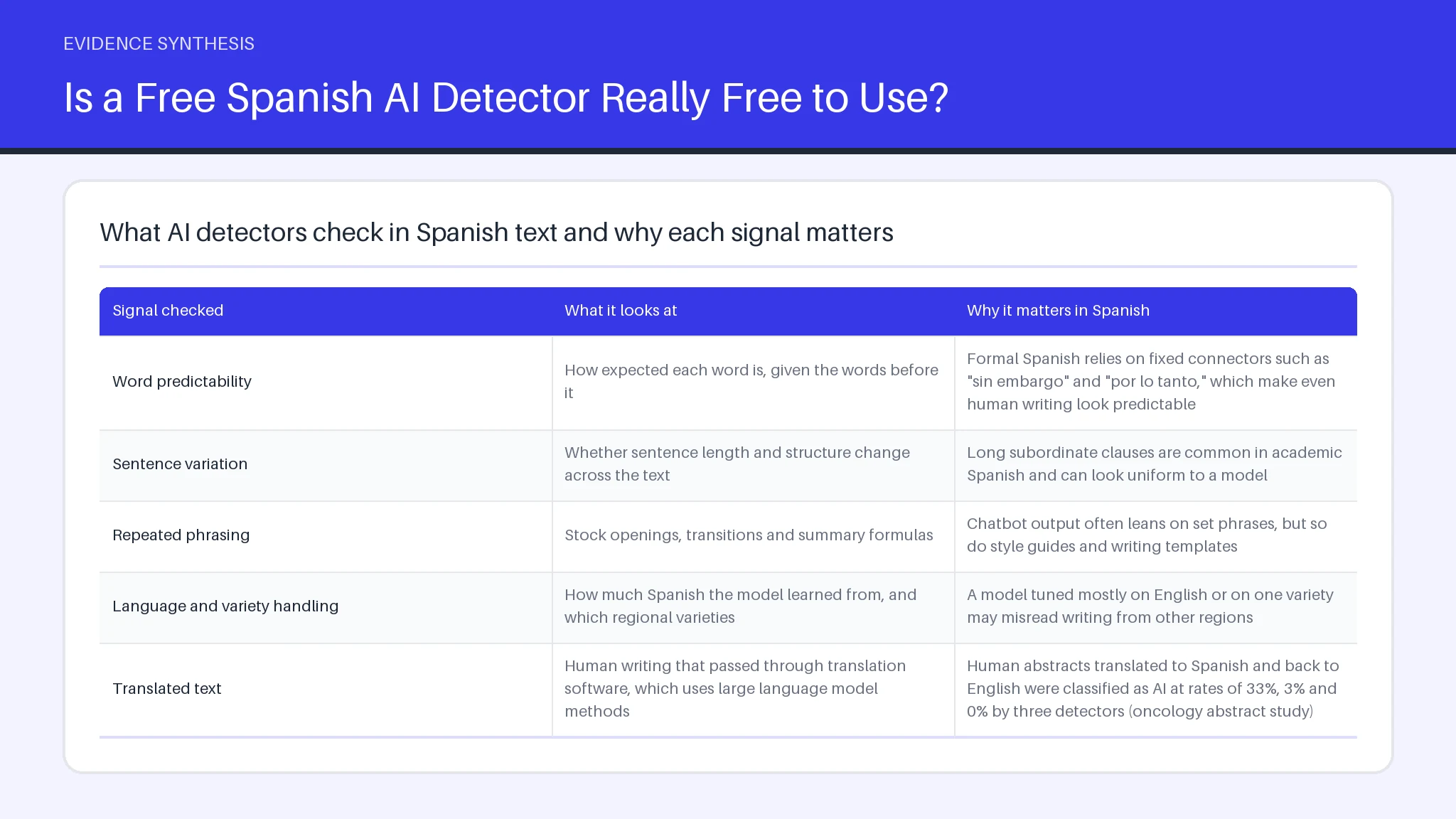
A Spanish AI detector checks three things: how predictable your words are to a language model, how much your sentences vary in length and structure, and whether repeated phrases match patterns common in machine output. It combines those signals into a score and applies a cutoff that turns the score into a label such as "likely human" or "likely AI."
Each signal behaves differently in Spanish, so a tool that works well on English can misjudge Spanish prose.
| Signal checked | What it looks at | Why it matters in Spanish |
|---|---|---|
| Word predictability | How expected each word is, given the words before it | Formal Spanish relies on fixed connectors such as "sin embargo" and "por lo tanto," which make even human writing look predictable |
| Sentence variation | Whether sentence length and structure change across the text | Long subordinate clauses are common in academic Spanish and can look uniform to a model |
| Repeated phrasing | Stock openings, transitions and summary formulas | Chatbot output often leans on set phrases, but so do style guides and writing templates |
| Language and variety handling | How much Spanish the model learned from, and which regional varieties | A model tuned mostly on English or on one variety may misread writing from other regions |
| Translated text | Human writing that passed through translation software, which uses large language model methods | Human abstracts translated to Spanish and back to English were classified as AI at rates of 33%, 3% and 0% by three detectors (oncology abstract study) |
The same study shows how the cutoff shapes results. Researchers chose the threshold that best separated human-written abstracts from fully AI-generated ones, then set a separate threshold for mixed human and AI text. At those optimal thresholds, the three detectors identified 96% to 99.5% of GPT-3 and GPT-4 abstracts and flagged at most one abstract from 2018 to 2019 (oncology abstract study). The translation test is the warning sign: the same human text scored very differently across tools.
Before you rely on a tool, ask whether its cutoff is fixed or adjustable and whether it highlights individual sentences you can review with the author.
Can AI Detection Catch Paraphrased or Reworded Text?
AI detection can sometimes catch paraphrased or reworded text, but it gets less reliable with each round of rewriting, because the text moves further from the raw patterns a language model produces. Light rewording often keeps the original sentence rhythm, so a detector may still flag it. Thorough human editing adds the irregular phrasing, local references and uneven sentence lengths that detectors read as human.
Automated paraphrasing tools fall in between. Many are language models themselves, so they may swap one machine-like pattern for another instead of removing it. The effect is unpredictable: some passages score higher after paraphrasing and some score lower.
For Spanish, the rewording that matters most is translation. A text drafted in English by a chatbot and then translated into Spanish has been processed by machines twice. A human text translated the same way picks up machine-like regularity it never had. The abstract study showed this second effect directly. After round-trip translation through Spanish, one detector flagged a third of the human-written abstracts. A Spanish AI detector can't tell whether regular phrasing came from a chatbot or from translation software.
Mixed documents, where a person wrote some paragraphs and a chatbot wrote others, are a separate problem. The oncology abstract study did not simply reuse its main cutoff for mixed text; it ran a separate analysis to find the best threshold for telling human-written abstracts apart from mixed AI/human abstracts. If you suspect partial AI use, read the sentence-level highlights rather than the overall percentage, and ask the author about the specific passages.
How Spanish Grammar and Vocabulary Shape AI Text Analysis
Spanish grammar and vocabulary shape AI text analysis because they change how predictable a sentence looks to a detector. The main features are gender and number agreement, rich verb conjugation, flexible word order and dropped subject pronouns. A model has to learn these patterns from Spanish training data, and many detection tools are built and tuned mainly on English.
Several features affect the score in practice:
- Inflection. A single Spanish verb can take dozens of forms. Models split these words into smaller pieces, so a detector trained on little Spanish may treat correct but less common forms as unusual.
- Long subordinate clauses. Academic and legal Spanish often builds sentences from several linked clauses. That steady structure can look like the low variation detectors associate with machine text.
- Fixed connectors. Schools teach phrases such as "sin embargo," "por lo tanto" and "cabe destacar" as standard formal Spanish, and chatbot output uses them heavily too.
- Regional variety. Vocabulary and grammar differ across Mexico, the Caribbean, the Southern Cone, Spain and US Spanish-speaking communities. Examples range from "computadora" versus "ordenador" to "vos" and "vosotros." Chatbots tend to default to a neutral, standardized register.
Regional variety explains a common complaint. Writers who deliberately use neutral international Spanish, for example when submitting to a journal with a broad readership, can sound closer to chatbot defaults than writers who keep their regional voice.
What a Dedicated Spanish-Language AI Checker Offers
A dedicated Spanish-language AI checker offers a model trained and calibrated on Spanish text. That matters far more than a translated interface. A tool that presents its AI detector in Spanish may still run an English-tuned model underneath, so the language of the buttons tells you nothing about accuracy.
When you evaluate a Spanish-focused tool, look for evidence, not claims:
- Training and validation data. Does the provider say whether it trained on native Spanish writing, and which regional varieties it included?
- Behavior on translated text. Modern translation software uses large language model methods, and detectors can mistake its output for AI writing. In a study of oncology abstracts, researchers translated human-written abstracts into Spanish and back into English. At its chosen threshold, one detector then labeled 33% of them as AI content. A second labeled 3%, and a third labeled none (PMC). Ask how a tool handles translated or machine-assisted drafts.
- Sentence-level output. Highlights let you check specific passages and discuss them with the author.
- Mixed-language handling. Spanish manuscripts often include English titles, quotations and references. The tool should handle this mix without distorting the score.
- Data handling. Look for clear terms on storage and deletion, and on whether the provider uses submitted text to train models.
The trade-off is scope. A tool tuned for one language may get updates less often when new chatbot models appear. Any vendor's accuracy statement stays a product claim until independent testing backs it up. The same study shows why. All three detectors caught 96% to 99.5% of fully AI-generated abstracts, but they split sharply on translated human text. That test used English text after a round trip through Spanish, not native Spanish writing, so it doesn't settle how detectors handle original Spanish prose. To compare tools fairly, run the same set of known-human, known-AI and translated Spanish samples through each one.
Is a Free Spanish AI Detector Really Free to Use?
A free Spanish-language detector may cost nothing to run, but the price tells you nothing about how well it handles Spanish or translated text. Before you rely on any score, check how the tool behaves on writing you already understand.
Published testing shows why that check matters. A study of oncology scientific abstracts found that three commercial detectors identified 96% to 99.5% of GPT-3 and GPT-4 generated abstracts when each used its optimal threshold. They flagged almost none of the human-written abstracts from 2018 to 2019. The researchers also ran human-written abstracts through machine translation into Spanish and back into English, because modern translation software uses large language model methods. One detector then classified 33% of those human abstracts as AI content, another flagged 3%, and the third flagged none.
This tells you two things. First, detectors that agree on clean English text can disagree sharply once translation enters the workflow. Second, the study's results depended on thresholds the researchers chose for best performance, so a free tool's default setting may behave differently. Keep one limit in mind: the study scored English text after a round trip through Spanish. It did not score original Spanish writing.
Before you trust any free AI Spanish detector, run it on two or three Spanish texts you know are human, including one that went through translation. Read the terms before you paste in an unpublished manuscript, a peer review assignment or participant data.
A detector works best as a screening step when three things are true:
- You can follow up with the author.
- The text is long enough to give the tool something to measure.
- There's room for a conversation before anyone makes a decision.
Be especially careful with text you know was translated. A detector score should never be the only evidence behind a grade, a rejection or a misconduct finding.
Does Institutional Plagiarism Software Detect AI in Spanish Documents?
Institutional plagiarism software can include AI detection. Whether it scores Spanish documents depends on the product, the languages it officially supports and how your institution has set it up. Similarity checking and AI detection are separate functions, even though they often share one dashboard.
Similarity checking compares a submission against a database of published work, web pages and earlier submissions, then reports overlapping passages. It works on Spanish when the database contains the Spanish sources the writer drew on. It says nothing about whether a chatbot wrote the text. AI detection uses a statistical model instead, and an institution may turn it on for some languages and not others. A Spanish submission may come back with no AI score, with a score marked as unsupported, or with a score from a model nobody validated on Spanish.
Put three questions to your administrator, or look for the answers in the product documentation:
- Which languages does the AI detection feature support, and was it tested on each one?
- Ask which threshold triggers a flag, because in a study of oncology abstracts, human-written abstracts that were translated into Spanish and back into English were classified as AI content 33% of the time by one detector at its chosen threshold, compared with 3% by a second detector and none by a third.
- Who sees the result, and is the submitted text stored in a shared repository?
If your institution runs checks through its learning platform, our guide to the Canvas AI detector explains what that layer checks. For Spanish work, treat an institutional AI score the same way you'd treat a score from a standalone tool: as a reason to look more closely, not as a verdict.
Detection Rates for AI-Written Spanish Across Tool Types
A peer-reviewed study of oncology scientific abstracts, published in PubMed Central, is one of the few sources with data involving Spanish. The authors chose thresholds that best separated human-written abstracts from purely AI-generated ones. They then ran a similar analysis for human-written versus mixed AI and human abstracts. Modern translation software uses large language model methods, so they also tested human-written abstracts that were translated into Spanish and then back into English.
Here is what they found when they compared three detectors:
- At each tool's optimal threshold, the detectors identified 99.5%, 96% and 97% of the AI-generated abstracts.
- Two detectors classified none of the sampled 2018 to 2019 abstracts as AI-generated. The third flagged a single abstract.
- After the round trip through Spanish, one detector classified 33% of the human-written abstracts as AI content at the chosen threshold. Another flagged 3%, and the third flagged none.
In that last test, all three tools saw the same human-written text. Only the detector changed, yet the share wrongly flagged as AI ranged from 0% to 33%. The test used text that went through translation, not text written in Spanish from the start. Treat it as evidence about translated text only.
The researchers compared detectors using area under the receiver operating curve, area under the precision recall curve and Brier score, not a single accuracy figure. When you evaluate an AI detector for Spanish, ask which of these measures the vendor reports. Also ask what threshold produced the results and whether the test text was translated, mixed or fully AI-generated.
False Positives: When Human Writing Gets Flagged as AI
A false positive happens when a detector labels human writing as AI. In Spanish, false positives cluster around text that is formal, heavily edited, templated or machine-translated, which describes how many researchers and students write.
The clearest warning in the published evidence comes from translation. After human-written abstracts were translated into Spanish and back, one detector flagged 33% of them as AI content. The same detector had flagged none of the sampled abstracts written before modern chatbots existed.
These writers face a higher risk:
- Non-native writers who rely on grammar correction or translation software
- Authors who draft in one language and then translate their own work
- Writers following rigid structures, such as structured abstracts or reporting checklists like PRISMA
- Anyone submitting short texts, where a few predictable sentences can dominate the score
Tips and common mistakes
- Find out what your tool's percentage means. Many tools report the model's confidence, not the share of the text a chatbot wrote.
- Don't keep re-running a text until you get the result you expected.
- Keep drafts and version history if you write in formal Spanish, so you can show how you worked.
- Read the flagged sentences yourself before you raise a concern with anyone.
Can Chatbot-Generated Spanish Content Be Identified as AI?
Chatbot-generated Spanish can often be identified as AI when it's raw, unedited and long enough to measure. Identification gets weaker as the text is edited, translated, shortened or mixed with human writing. The abstract study supports the first part: at optimal thresholds, detectors caught nearly all fully AI-generated abstracts. Those texts were in English, though.
Unedited chatbot Spanish tends to share some recognizable habits. It uses a neutral register with no regional vocabulary, evenly balanced lists, generic examples and tidy closing summaries that open with phrases like "En resumen." None of these habits proves AI use, because careful human writers do the same things.
Stronger evidence usually comes from outside the detector:
- Process records. Drafts, notes and document version history
- Source checks. Confirmation that every cited reference exists and says what the text claims
- Knowledge checks. A short conversation in which the author explains the choices in the text
- Consistency. A comparison with the author's earlier Spanish writing
The same logic applies to research teams bringing Spanish-language studies and manuscripts into an evidence synthesis project. Standard study appraisal doesn't include a detection score. Checking the data, methods and references protects a review far more than an AI label does. In evidence synthesis work like the kind Systematicly supports, that checking belongs in the screening and data extraction stages, where reviewers already record their decisions.
Frequently asked questions
How does AI detection work differently in Spanish?
There is little published evidence on how detectors handle Spanish text itself. The closest data comes from a study of oncology abstracts published in PMC. Researchers used machine translation to turn human-written abstracts into Spanish and then back into English, because modern translation software uses LLM methods. Three detectors gave very different results: one flagged 33% of these human texts as AI content, another flagged 3%, and the third flagged none. This means translation alone can trigger false positives, and how often depends on which detector you use.
How do AI-detection algorithms work?
Detection tools give a text a score, and a threshold turns that score into a human or AI label. In a study of oncology abstracts, researchers chose the thresholds that best separated human-written from AI-generated abstracts. They then measured performance with the area under the receiver operating curve (AUROC), the area under the precision recall curve, and the Brier score. Results varied by tool. When human-written abstracts were translated to Spanish and back to English, one detector labeled 33% as AI at its chosen threshold, another labeled 3%, and a third labeled none.
How to use an AI detector effectively?
Treat the threshold as a setting you check, not a fixed rule. A study of oncology abstracts, published on PubMed Central, used abstracts from 2018 to 2019 as a human baseline. With tuned thresholds, three detectors caught 96% to 99.5% of fully AI-generated abstracts and flagged almost none of the human ones. Mixed human and AI text needed its own threshold. Translation can cause false flags: after human abstracts went into Spanish and back to English, the share flagged as AI ranged from 0% to 33%, depending on the detector.