
Systematic Review vs Literature Review: Key Differences
If you are weighing systematic review vs literature review, the short answer is that they solve different problems. A systematic review sets out to answer one focused question using a documented, repeatable method, so another researcher could follow your steps and reach the same body of evidence. A traditional literature review surveys a topic more broadly, drawing on the author's judgement to summarise themes, debates, and gaps.
This guide is for postgraduate students, clinicians, and applied researchers deciding which method fits their question, timeline, and audience. We explain how each type defines its scope, how the searches differ, and where transparency, reproducibility, and bias diverge in practice. You will also find a comparison table, best-practice steps, and answers to common questions. By the end you should know which review to run, what you need before you start, and the trade-offs that ranking pages tend to skip when they compare systematic review vs literature review.
Key takeaways
- A systematic review answers a tightly defined question using a written protocol, pre-set inclusion rules, and a search you can reproduce; a literature review summarises what is known with far more author discretion.
- The core distinction in systematic review vs literature review is method transparency: systematic methods can be repeated by another team, while narrative reviews rarely document every choice.
- Systematic reviews often feed a meta analysis; traditional literature reviews describe and interpret evidence without pooling results statistically.
- Choose a literature review to map a broad field quickly, and a systematic review when the answer must withstand scrutiny and bias checks.
- Both approaches are legitimate. The right choice depends on your question, timeline, and how much rigour your audience expects.
Systematic Review vs Literature Review: What Is the Difference?
The clearest way to grasp systematic review vs literature review is to look at how each is built. A systematic review works from a fixed question, an explicit inclusion criterion for every study, and a search you can audit. A literature review leans on author selection and narrative synthesis. Note that a tool's logo or brand badge on a database means nothing for review quality; method does.
| Feature | Systematic review | Literature review |
|---|---|---|
| Question | Single, pre-defined and focused | Broad and often exploratory |
| Study selection | Explicit inclusion criterion, applied by two screeners | Author discretion, rarely documented |
| Reproducibility | High; steps are recorded | Low; hard to repeat |
How Each Review Defines Its Research Question and Scope
A systematic review sets its scope before searching, while a literature review lets scope emerge as the author reads. The systematic approach states the question first, usually with a framework such as PICO, and locks the scope into a written protocol that lists eligibility and outcomes in advance, which is how you define defensible boundaries. That discipline is what lets a later meta analysis pool comparable studies with confidence.
A literature review usually starts wider and narrows as the author reads, so the scope evolves rather than being fixed up front. That flexibility is useful for mapping an unfamiliar field, but it makes the boundaries harder to justify. If you expect to synthesise numbers or defend your selection, a pre-registered protocol is the safer route. If you want a readable overview of debates and gaps, the broader question serves you well.
Comparing Search Strategies and Source Selection Methods
Search strategy is where the two methods separate most visibly. A systematic review runs a comprehensive search across multiple databases using documented terms and Boolean logic, then applies its inclusion rules through a two-person screening process recorded against the review protocol. The aim is to find every eligible study, not just convenient ones. Our practical screening guide walks through that stage.
A literature review typically uses a narrower, less formal search. The author selects sources that illustrate the argument, which is faster but risks missing counter-evidence. The trade-off is coverage versus speed: a comprehensive search costs weeks and detailed record-keeping, while a targeted read can be finished in days but cannot claim completeness. Match the effort to how defensible your conclusions need to be.
How Transparency and Reproducibility Differ Between the Two
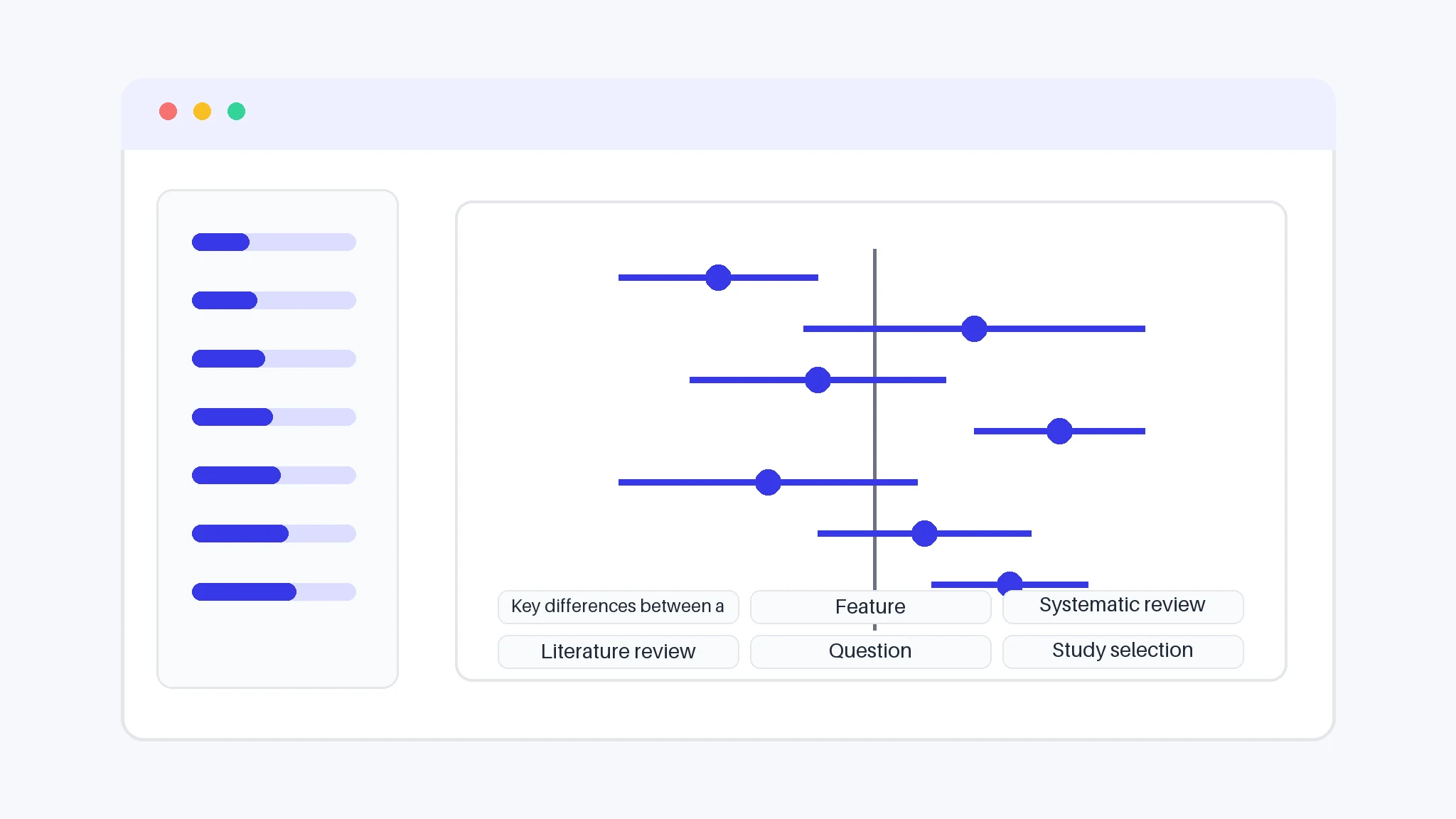
Transparency is the practical dividing line. A systematic review documents each decision so another team can repeat it: the protocol, the search strings, the screening log, and a PRISMA flow diagram showing records found, screened, and excluded with reasons. That paper trail is what makes the comprehensive search meta-level auditable rather than a matter of trust.
A literature review rarely records this detail. Readers see the conclusions but not the choices behind them, so the work cannot be reproduced and a brand or publisher logo offers no substitute for method. If your findings will inform a guideline, a policy, or a later meta-analysis, prioritise the reproducible approach. If you are scoping ideas for a proposal, a lighter narrative record is acceptable, provided you are honest about its limits.
Best Practices for Conducting a Traditional Literature Review
A good literature review is still disciplined, even without a formal protocol. Set a working criterion for what you will include so your selection is not purely convenient, and note which databases you searched and when. Group sources by theme rather than listing them one by one, and separate established findings from contested ones so the reader can weigh the evidence.
Be explicit about limits: state that the review is not exhaustive and that you did not screen at systematic-review scale. If you later expand toward a meta analysis, keep your notes structured so the transition is easier. A useful habit for any researcher is to record search dates and terms as you go, so the review can grow into something more rigorous. Judge sources on method, not on the meta-badge or logo of the platform hosting them.
Comparing Bias and Rigour in Each Review Approach
Rigour is really about how each method controls bias. A systematic review reduces selection bias through a pre-set inclusion criterion, dual screening, and a fixed protocol, and it assesses risk of bias within each included study using validated tools. When results are combined, a meta analysis can also test for publication bias across the pooled set at a meta level.
A literature review carries more room for confirmation bias, because the author chooses what to include and how to frame it. That is not a flaw when the goal is interpretation, but it does limit how strongly you can generalise. For a fuller comparison of synthesis stages, see our note on systematic review vs meta-analysis. The practical rule: the higher the stakes, the more you should favour documented, bias-checked methods.
Frequently asked questions
What's the difference between a systematic review and a literature review?
A systematic review answers one focused question using a written protocol, a comprehensive search, explicit inclusion rules, and a reproducible process. A literature review surveys a topic more broadly and relies on the author's judgement, so it is faster but cannot be repeated in the same way.
What are the 4 types of literature review?
Common categories include the narrative review, which summarises a field; the scoping review, which maps the breadth of evidence and gaps; the rapid review, which streamlines systematic methods to save time; and the integrative review, which combines diverse study types. Each suits a different question and level of rigour.
Does a systematic review count as a literature review?
Not usually. A systematic review reviews literature, but the term describes a specific, protocol-driven method with documented searching and screening. A general literature review lacks that structure, so the two are not interchangeable even though both examine published studies.
How to tell if an article is a systematic review?
Look for a stated research question, a written protocol or registration, named databases and search terms, an inclusion criterion applied by more than one screener, a PRISMA flow diagram, and a risk-of-bias assessment. If those elements are missing, you are most likely reading a narrative literature review.