Thesis Writing: From Statement to Finished Draft
A thesis is an extended, original piece of written work that defends a single arguable claim with evidence you collected, appraised, and reported under supervision. The document exists to show that you can pose a question worth asking, choose a defensible method, handle disagreement in the evidence honestly, and reach a conclusion a committee can check. Length varies by field and institution; the underlying test does not.
This guide is written for master's and doctoral candidates who have been admitted to a program, have a supervisor, and now have to turn a rough interest into a finished submission. It covers the practical decisions that determine whether the work finishes on time: how a project based format differs from a conventional written thesis, the order in which research and writing actually happen, how to phrase a claim that can be argued rather than merely described, how to build a milestone schedule with review time built in, and why the proposal stage stalls so many people.
What you need before you start is short but non-negotiable: a supervisor who has agreed to the general direction, a topic narrow enough that you can name the evidence you would need to answer it, access to the databases or participants that evidence lives in, a reference manager set up before you read your fiftieth paper, and a written copy of your program's formatting and submission rules. If any of those are missing, fix them first. Every week spent drafting without them tends to be rewritten later, and rewriting is the most expensive activity in graduate work. Our research methods guide covers design choices in more depth.
Key takeaways
- A thesis is a sustained, evidence-based argument submitted for a degree, and its defining feature is a claim a committee can dispute, test, and accept.
- Project based work swaps part of the written argument for a built artifact, so the deliverable changes but the review standard does not.
- Scope decisions made in the first month control your workload more than writing speed does, because search breadth, inclusion rules, and data volume are all fixed early.
- Working backward from the submission date, and reserving a protected block for review and editing, prevents the most common failure: a complete draft that arrives too late to revise.
- Faculty feedback cycles are the slowest step in most schedules, so book them as calendar events rather than treating them as informal favors.
What Is a Project Based Thesis and How Does It Differ?
A project based thesis replaces part of the traditional written argument with a built deliverable: software, a clinical pathway, a policy toolkit, a dataset, a design, or a public exhibition, accompanied by a shorter critical commentary that explains the method and evaluates the result. The degree is still awarded for the argument, not the artifact. The commentary has to explain why the project was the right way to answer the question and what the evidence says about whether it worked.
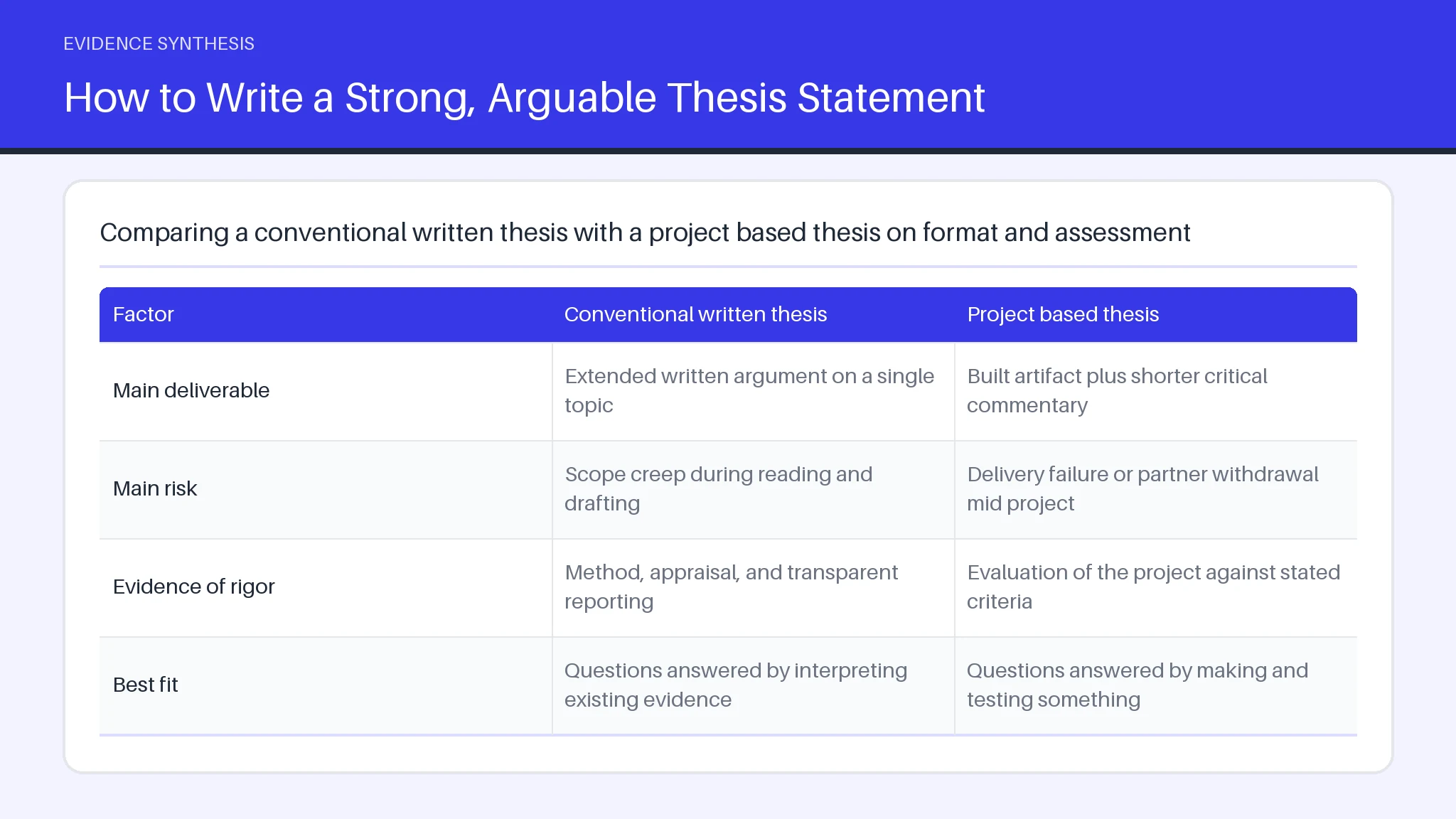
The practical differences are about risk and sequencing. A conventional thesis front-loads reading; a project front-loads building, which means technical failure, ethics delays, or a partner organization withdrawing can cost you months with nothing written. Choose the project route when the contribution genuinely is an artifact and when you have a named evaluation plan. Choose the written route when the contribution is an interpretation of existing evidence.
| Factor | Conventional written thesis | Project based thesis |
|---|---|---|
| Main deliverable | Extended written argument on a single topic | Built artifact plus shorter critical commentary |
| Main risk | Scope creep during reading and drafting | Delivery failure or partner withdrawal mid project |
| Evidence of rigor | Method, appraisal, and transparent reporting | Evaluation of the project against stated criteria |
| Best fit | Questions answered by interpreting existing evidence | Questions answered by making and testing something |
How to Research and Write a Thesis Step by Step
Research and writing overlap from week one; treating them as separate phases is what produces unreadable first drafts. Work in this order, and write short summaries as you go.
- Define the question. Write it in one sentence and name the evidence that would change your mind. A vague question makes every later step ambiguous.
- Map the field. Run structured searches, record the database, date, and search string, and save the results. This research record is what lets you justify your coverage later.
- Set inclusion rules before screening. Deciding relevance while reading invites bias; deciding first makes your screening defensible.
- Extract into a table, not margin notes. One row per study, columns for design, sample, outcome, and limitation. This becomes your results section.
- Collect or analyze your own data. Pre-register or at least pre-write the analysis plan so the research does not drift toward whatever looks significant.
- Draft the middle first. Methods and results are the most factual chapters and the easiest to finish. Write the introduction once you know what you found.
- Reconcile the argument. Check that every claim in the discussion traces to evidence in your own research, and cut the ones that do not.
For structured evidence work, our systematic reviews guide sets out the methodology in detail.
How to Write a Strong, Arguable Thesis Statement
A strong thesis statement makes a specific claim that an informed reader could reasonably reject. If nobody in your field would disagree, you have written a topic description rather than an argument. Test every draft statement by writing the strongest counterclaim beneath it. If the counterclaim is coherent and someone credible holds it, the statement is arguable.
Practical tips for writing your statement:
- Name the subject, the claim, and the basis for the claim in one sentence. "Remote monitoring reduces readmissions in heart failure patients because it shortens the interval between deterioration and intervention" states all three.
- Remove hedges that carry no information. "May somewhat influence" cannot be tested; "reduces" can.
- Keep the scope inside what your evidence covers. Overreaching is the flaw faculty readers spot fastest.
- Include the mechanism or condition. Claims that explain why tend to survive questioning better than claims that only assert what.
- Rewrite it after your results are in. The statement you pursue at the proposal stage rarely matches what the evidence supports.
Circulate two or three candidate statements to your supervisor and one other faculty member before you commit. A five-minute reaction from someone who has examined dozens of submissions will surface an unsupportable claim faster than another month of reading.
Timeline and Milestones for Finishing a Dissertation on Schedule
Build the schedule backward from the submission deadline and place review and editing before drafting in your planning, not after. A workable pattern for a twelve-month dissertation reserves roughly the first fifth for question definition and the proposal, the next two fifths for evidence collection and analysis, one fifth for drafting, and the final fifth entirely for revision, formatting, and administrative checks. That last block is what most candidates cut when they slip, and it is the block that determines whether a reader can follow the argument.
Save time for review and editing by writing to a fixed chapter template, keeping a running list of unresolved claims instead of stopping to fix each one, and scheduling a full read-through of the whole thesis in one sitting. Reading it end to end is the only reliable way to catch a topic that drifts between chapters or a conclusion that answers a different question than the introduction posed.
Treat feedback as a dependency with a lead time. Ask each faculty reader how long they need, then put the return date in your plan and work on something else meanwhile. Two supervisors reviewing sequentially can add six weeks that no writing speed will recover. Add milestone dates for ethics approval, data access, and any faculty progress review, since those are externally controlled and cannot be compressed.
Why Drafting a Thesis Proposal Feels So Hard for Graduate Students
The proposal is hard because it asks you to commit to answers you do not have yet. Every other stage of graduate work rewards accumulating information; the proposal rewards closing options. You have to fix a question, a method, and a scope while your reading is still expanding, and that mismatch, rather than any lack of writing ability, is what stalls most graduate students for weeks.
Study the map before you start driving. Read three or four recently accepted proposals from your own department, not exemplars from elsewhere, and note their length, how they justify method choice, how much literature they cite, and how they state limitations. Local expectations vary far more than published advice suggests, and a faculty committee assesses against local norms.
Then draft in the order the committee reads: question, why it matters, what is already known, what you will do, what could go wrong. Write each section to a hard word limit on the first pass so no single part expands to fill the gap left by an unresolved decision. Accept that the proposal is a plan under uncertainty, and say which parts are provisional. A proposal that names its own weak points is easier to approve than one that pretends none exist, and it gives graduate candidates a defensible record of why the design changed later.
Frequently asked questions
What is a thesis?
A thesis is a long-form academic document that presents and defends one central argument using evidence the author gathered and appraised. It is submitted for a degree and assessed by examiners who judge whether the question was worth asking, whether the method could answer it, and whether the conclusions follow from the results.
What is dissertation vs thesis?
A dissertation and a thesis are both supervised, argument-driven documents, and which word applies depends on where you study. In the United States, a thesis is usually the master's submission and a dissertation the doctoral one. In much of the United Kingdom and Europe the labels are reversed, with the dissertation completed at master's level. Length, originality expectations, and defense format matter far more than the label, so always check your own program's regulations rather than assuming.
Is thesis for masters or PhD?
A thesis can be required at master's level, doctoral level, or both, depending on the institution and program design. Many master's degrees offer a thesis track and a coursework or capstone track; doctoral programs almost always require an extended original submission. The doctoral version differs in scale and in the demand for a contribution that is new to the field, not simply new to you.
What does thesis mean in Greek?
In Greek, thesis means a placing, setting down, or proposition, from the verb tithenai, to put or place. The sense of a position being set down for argument carried into Latin and then into academic English, which is why the word still describes a claim you are prepared to defend.
What is another word for "thesis"?
Depending on the sense you need, alternatives include dissertation, treatise, monograph, argument, proposition, contention, or claim. For the document itself, dissertation and treatise are closest. For the central argument inside it, proposition or contention works better, and using the precise word avoids the common confusion between the paper and the claim it defends.
What was Albert Einstein's PhD thesis?
Albert Einstein's 1905 doctoral dissertation at the University of Zurich was titled "A New Determination of Molecular Dimensions," and it derived a method for estimating molecular size and Avogadro's number from the viscosity of dilute solutions. It was separate from his famous 1905 papers on relativity, the photoelectric effect, and Brownian motion, and it remains one of his most cited pieces of research.
Who had a higher IQ, Einstein or Newton?
No verified IQ score exists for either Albert Einstein or Isaac Newton, so the comparison cannot be settled. Both men died before or outside the era of standardized testing, and the figures circulated online are retrospective estimates rather than measurements. Comparative rankings of historical intelligence are not research findings, and they say more about biographers than about either scientist.