Methodology vs Methods: How to Justify Your Design
Methodology is the justified logic of a study: which design you chose, why that design can answer your question, and how the resulting evidence should be interpreted. Methods sit inside it as the concrete procedures, from sampling and instruments to statistical tests. Readers looking up methodology usually need two things at once, a clear definition and a way to write the section without hand waving.
This page is written for graduate students, clinicians and applied researchers preparing a protocol, thesis chapter or journal submission. It covers the method and methodology distinction, how the main research approaches compare, a step by step drafting sequence, what you need before you start, and the mistakes reviewers catch most often. Related design detail sits in our research methods guide.
Key takeaways
- Methodology is the reasoning behind your research design; methods are the specific procedures you run. Reviewers expect both, in that order.
- Qualitative, quantitative and mixed designs answer different question types, so the question shape decides the design rather than personal preference.
- A defensible methodology section names the design, the sampling frame, the data sources, the analysis plan and the limitations you accepted knowingly.
- Write and date the plan before data collection so later deviations can be reported as deviations, not presented as original intent.
- Cite the standards and handbooks you followed, not just the topic literature, so readers can audit each choice.
What Is Methodology?
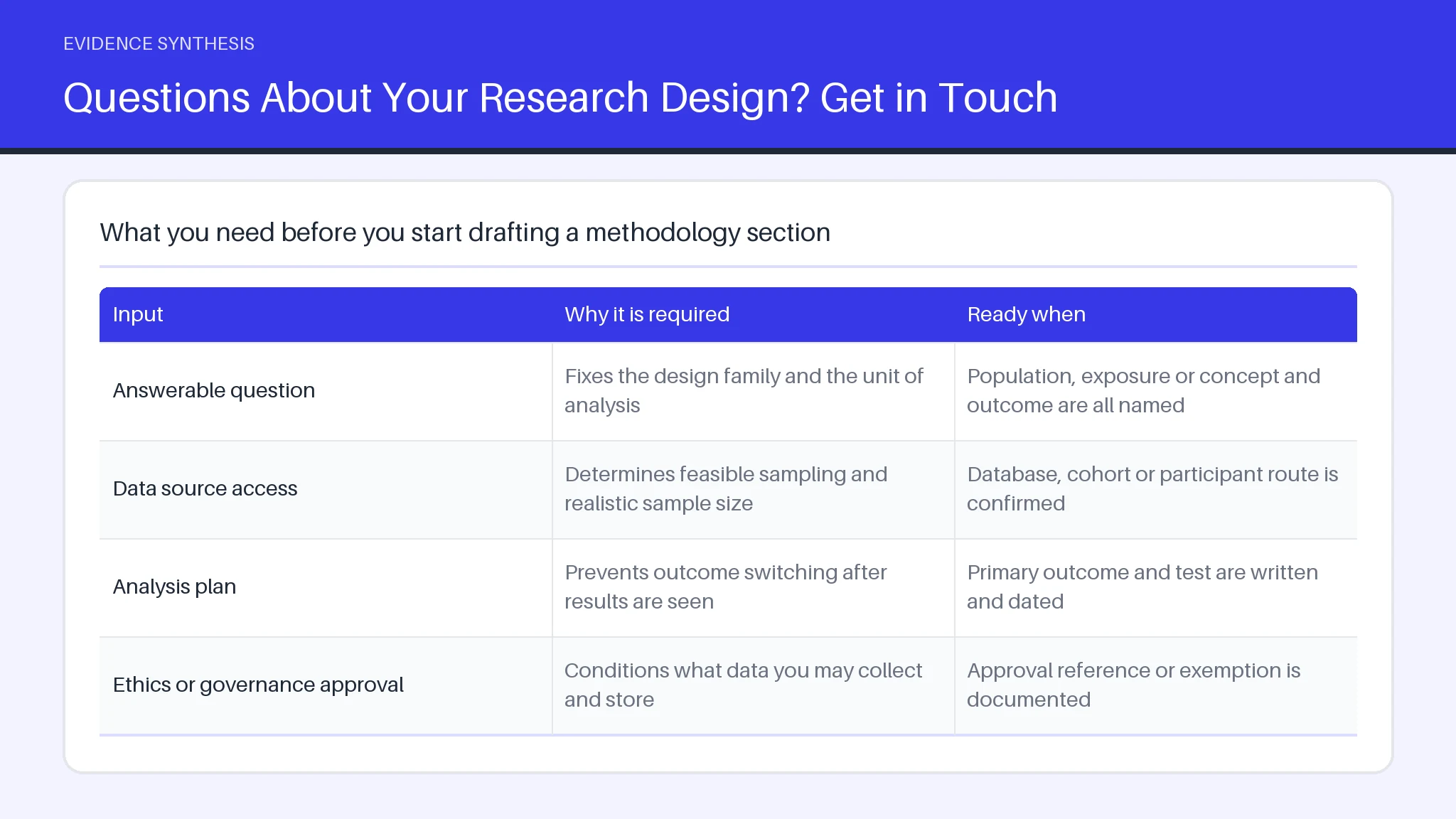
Methodology is the framework that connects your question, your assumptions about evidence and your chosen procedures into one defensible argument. A method is a single tool inside that framework, such as a survey instrument or a regression model. The table below sets out what you need in place before drafting, because most weak sections fail on missing inputs rather than poor writing. Recognized research methodologies all demand the same groundwork.
| Input | Why it is required | Ready when |
|---|---|---|
| Answerable question | Fixes the design family and the unit of analysis | Population, exposure or concept and outcome are all named |
| Data source access | Determines feasible sampling and realistic sample size | Database, cohort or participant route is confirmed |
| Analysis plan | Prevents outcome switching after results are seen | Primary outcome and test are written and dated |
| Ethics or governance approval | Conditions what data you may collect and store | Approval reference or exemption is documented |
Qualitative, Quantitative, and Mixed Methods Approaches Compared
Quantitative work measures how much, how often and how strongly, using numeric data and predefined hypotheses. Qualitative work explains how and why, using interviews, observation or documents to build interpretation from the data. A mixed approach sequences both, typically numbers to establish a pattern and narrative data to explain it. The choice follows the question: prevalence and effect size call for one method, meaning and mechanism call for another, and your methodology must say which claim you intend to make.
Methods vs Methodology: What Is the Difference?
Methods are what you did; methodology is why doing it that way produces trustworthy answers. The practical test is the verb. If a sentence describes an action you performed, such as recruiting 200 patients, coding transcripts or running a mixed effects model, it belongs in methods. If it defends a decision, such as choosing thematic analysis because you wanted to keep participant language intact, it belongs in methodology.
Use the words accordingly. Write "the method was semi-structured interviewing" when naming the procedure, and "the qualitative research methodology was interpretive phenomenology" when naming the framework that governs sampling, saturation and how far findings may be generalized. Journals reject drafts that list procedures with no justification far more often than they reject unusual designs.
How to Write a Methodology Section Step by Step
A good methodology section moves in five ordered steps. First, restate the question and name the design family. Second, justify that design against at least one rejected alternative. Third, describe the population, sampling frame and recruitment or search process in enough detail to be repeated. Fourth, specify each data collection method, instrument and validation status. Fifth, set out the analysis plan, software, handling of missing data and limitations you accepted.
Write in past tense for completed work and present the same five elements in a protocol. When reporting a qualitative research methodology, add reflexivity: who collected the data and how their position shaped interpretation.
Questions About Your Research Design? Get in Touch
Design questions are easiest to resolve before recruitment starts, when changing course costs nothing but time. Useful checkpoints include a librarian for search and sampling frames, a statistician for the analysis plan, and your ethics committee for consent and data handling. Explore the design handbooks for your study type first, then explore comparable published studies to see how similar teams reported their choices and what reviewers asked them to add.
Planning Your Research Approach Before You Collect Data
Fix your approach in writing and date it before the first data point arrives. A prespecified plan converts later changes into reportable deviations rather than invisible revisions, which is what protects credibility. Record the primary outcome, the sample size assumption, the inclusion rules and the analysis approach. Feasibility checks belong here too: a pilot of five interviews or a test extraction of ten records usually reveals whether the approach survives contact with real data.
Why Your Study Needs Both Methods and Justification
Procedures without reasoning cannot be evaluated. A reader who knows you used a cross-sectional survey still cannot judge the work unless you explain why that method suited the question, what it cannot show about causation, and which alternative you ruled out. Justification is also what makes replication meaningful, because another researcher copying the steps needs to know the constraints you were working within. Each method should carry one sentence of purpose and one of limitation.
Choosing Methods and Defending Them to Reviewers
Reviewers test three things: fit between question and design, transparency of procedures, and honesty about limits. Defend each method by naming the trade-off you accepted. Administrative data buys scale and loses measurement precision. Purposive sampling buys depth and loses breadth. Blinded duplicate screening buys reliability and costs time. A researcher who states the trade-off first is rarely asked to justify it twice, whereas silence invites the assumption that the method was chosen for convenience.
How to Cite Sources That Support Your Methodological Choices
Cite the source that governs the procedure, not a general textbook. When you follow a reporting standard such as PRISMA 2020, cite the statement itself and say which items you addressed. For an analysis method, cite the paper that introduced or validated it. For established research methodologies, cite the handbook edition you actually used, since guidance changes between editions. Attach citations to the specific methodological sentence they support rather than grouping them at the end of the paragraph.
Frequently asked questions
What does methodology mean?
Methodology means the justified system of principles behind a study. For example, a team asking whether a nurse-led clinic reduces readmissions might adopt a quantitative observational methodology, using linked hospital records, a prespecified 30-day outcome and regression adjustment for case mix.
What is methodology and an example?
Quantitative research measures variables numerically to estimate frequency, difference or association, while qualitative research collects textual or observational data to interpret meaning and process. The first generalizes from samples; the second explains depth within context.
What is another word for methodology?
Close alternatives include research design, research strategy, inquiry framework and analytical approach. None is an exact synonym, so name the design rather than relying on a substitute word.
What are the four types of methodology?
The four commonly taught types are quantitative, qualitative, mixed methods and evidence synthesis, the last covering reviews such as a systematic review or a meta-analysis.
What are the 5 steps of methodology?
The five steps are: define the question, select and justify the design, specify sampling and data sources, detail collection procedures, then set the analysis plan and limitations.
What are the three methodologies?
The three broad methodologies are quantitative, qualitative and mixed. Everything else is a variant within one of them.
What are the four qualitative methods?
Four widely used qualitative methods are interviews, focus groups, participant observation and document or content analysis.