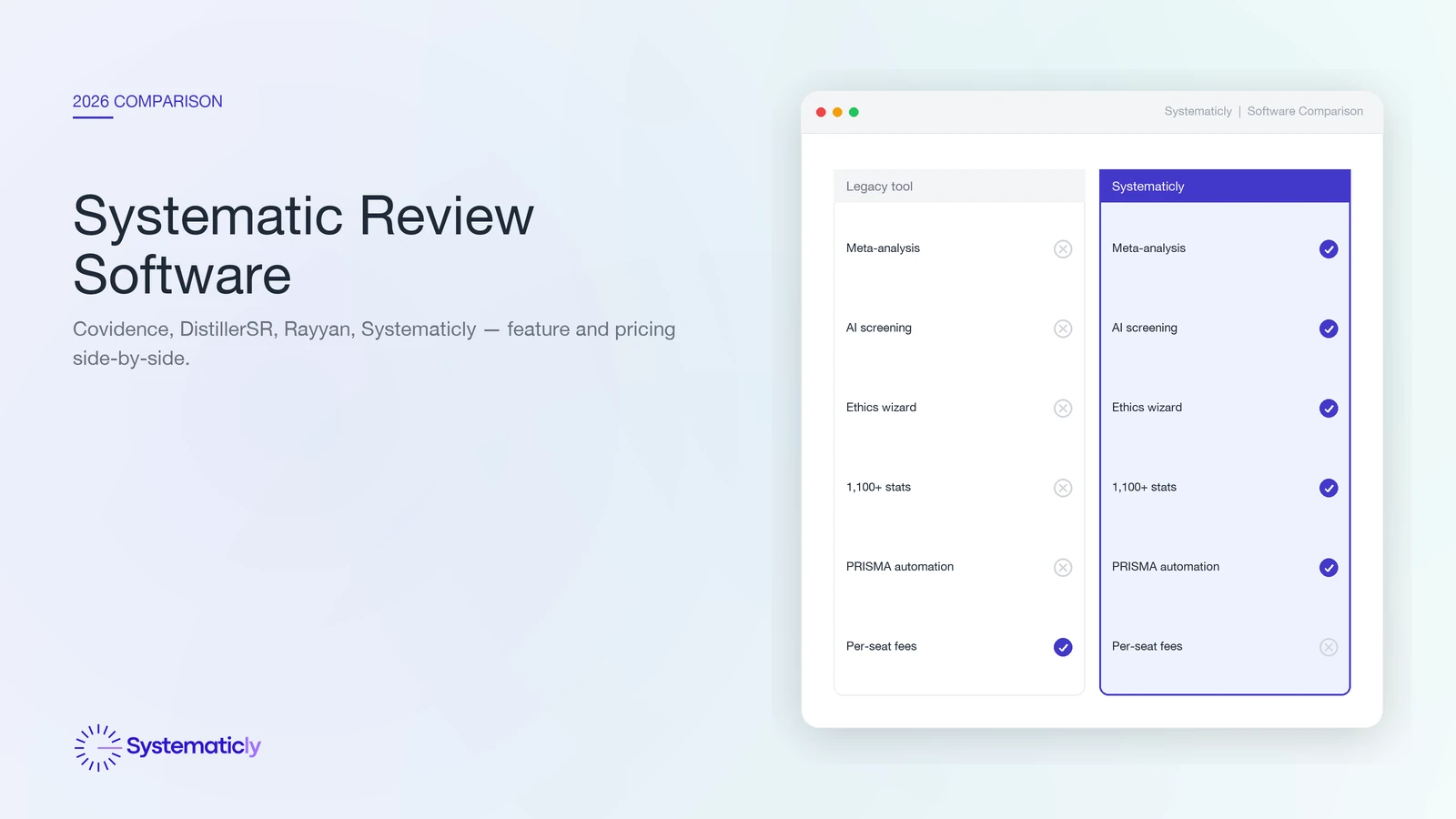
Choosing systematic review software is a practical decision with consequences that show up months later in the form of saved hours, avoided re-work, and smoother submission to journals. The four platforms most research teams evaluate in 2026 are Covidence, the long-standing market leader; DistillerSR, the enterprise and regulatory-focused option; Rayyan, the free screening-first tool; and Systematicly, the newer end-to-end AI-assisted platform.
This guide compares them by feature category, by head-to-head use case, and by how each tool handles the phases where systematic reviews actually get slow (screening and extraction). The feature lists below reflect each vendor's published capabilities as of 2026 and are linked to source pages for verification.
Key takeaways
- Covidence, DistillerSR, Rayyan, and Systematicly each fit different team profiles. None is universally the right choice.
- Covidence suits teams already on an institutional licence and reviewers who want a clean Cochrane-aligned workflow.
- DistillerSR suits enterprise and regulatory teams that need configurable workflows, audit trails, and per-seat licensing.
- Rayyan suits solo researchers and students doing screening-only work within a free tier.
- Systematicly suits teams wanting end-to-end AI assistance across search, screening, extraction, analysis, and PRISMA reporting in one platform.
- For most teams the bottleneck is screening and extraction. Tools with stronger AI automation in those phases save the most time.
- Verify feature availability and pricing directly with each vendor; product capabilities change frequently.
Why your systematic review software choice matters
Systematic review software determines how much of the review is manual and how much is automated, how well the team collaborates across time zones and institutions, and how much re-work is required at submission time. A well-fitted tool saves hundreds of researcher hours; a poorly fitted one buries the team in export-and-re-import cycles between screening, extraction, and analysis.
How much time a tool saves depends on which phases it automates, which is what the category-by-category feature comparison below makes explicit.
Systematic review software feature comparison
The feature list spans more than 80 capabilities across planning, reference management, screening, full-text collection, extraction, quality and analysis, output and publishing, AI writing integrity, beyond-SR workflows, and infrastructure and collaboration. Select a category below to see the head-to-head comparison.
| Feature | Systematicly | Covidence | DistillerSR | Rayyan |
|---|---|---|---|---|
| AI PICO / PECO / SPIDER framework analysis | ||||
| Multi-database search strategy builder | ||||
| Feasibility assessment with AI narrative | ||||
| Protocol generation (PROSPERO, Cochrane, JBI, PRISMA-P templates) | ||||
| Research proposal generator (8 templates incl. NIH, NHMRC, Cochrane and JBI) | ||||
| Auto methodology documentation (PRISMA trail) |
AI PICO / PECO / SPIDER framework analysis
- Systematicly
- Covidence
- DistillerSR
- Rayyan
Multi-database search strategy builder
- Systematicly
- Covidence
- DistillerSR
- Rayyan
Feasibility assessment with AI narrative
- Systematicly
- Covidence
- DistillerSR
- Rayyan
Protocol generation (PROSPERO, Cochrane, JBI, PRISMA-P templates)
- Systematicly
- Covidence
- DistillerSR
- Rayyan
Research proposal generator (8 templates incl. NIH, NHMRC, Cochrane and JBI)
- Systematicly
- Covidence
- DistillerSR
- Rayyan
Auto methodology documentation (PRISMA trail)
- Systematicly
- Covidence
- DistillerSR
- Rayyan
Feature availability based on each vendor's published product information as of 2026. Refer to vendor sites for current capabilities.
Some capabilities exist in all four platforms (standard reference import, title and abstract screening, dual screening, PRISMA flow diagrams). The differentiation sits in the AI automation layer (priority screening, data extraction, cross-validation), beyond-screening features (meta-analysis, GRADE, manuscript generation), and workflow coverage (feasibility analysis, pre-submission review, living reviews).
Covidence vs Systematicly
Covidence is the most widely adopted systematic-review platform in academia, with strong Cochrane integration and a reputation for a clean, task-focused interface. Teams already on an institutional Covidence licence have low switching costs and a familiar workflow, which is the single strongest reason to stay with it.
- Covidence's strengths. Mature screening workflow; widely used by Cochrane teams; institutional licensing common in academic settings; strong reference-management import.
- Where Systematicly differs. Broader automation across extraction, meta-analysis, and PRISMA reporting; plain-English statistical-test selection; end-to-end workflow in one project rather than export to separate tools for analysis.
- When Covidence is the right choice. Institutional licence already paid for; team already trained; Cochrane-aligned workflow required; no need for integrated meta-analysis.
- When Systematicly is the right choice. Team needs end-to-end coverage beyond screening; AI extraction and meta-analysis required; living-review or update workflow needed.
DistillerSR vs Systematicly
DistillerSR positions itself for enterprise and regulatory users, with configurable workflows, strong audit trails, and a form-builder approach to data extraction. For pharmaceutical submissions and health-technology assessments, DistillerSR is a long-established option.
- DistillerSR's strengths. Highly configurable workflows; strong audit trail support; per-seat licensing that fits organisational procurement; experienced enterprise-support team.
- Where Systematicly differs. AI-assisted screening, extraction, and analysis built in by default rather than configured per project; plain-English statistical analysis; living-review and update-extension support; the audit trail is cryptographically signed rather than log-based.
- When DistillerSR is the right choice. Regulatory submission; existing DistillerSR workflows and trained team; per-seat procurement required; deeply configurable forms needed.
- When Systematicly is the right choice. Team wants AI acceleration without per-seat enterprise licensing; integrated analysis and reporting required; living-review or ongoing-update workflow.
Rayyan vs Systematicly
Rayyan is free for basic title and abstract screening, which is why it is popular with students, solo researchers, and small teams starting out. Its paid tiers add team features and some AI assistance, but Rayyan remains focused on screening rather than covering the full review lifecycle.
- Rayyan's strengths. Free tier for screening; low barrier to entry; popular with students; simple dual-reviewer support.
- Where Systematicly differs. Covers search, extraction, analysis, and reporting alongside screening; removes the need to export to a second tool for data extraction; integrated meta-analysis and PRISMA reporting.
- When Rayyan is the right choice. Student project with screening-only scope; budget constraints ruling out paid platforms; team familiar with the Rayyan workflow.
- When Systematicly is the right choice. Full-lifecycle review planned; extraction and analysis beyond screening needed; team wants AI assistance past the title-and-abstract stage.
Pricing and access models
Pricing models vary significantly across the four platforms. Figures below are indicative; each vendor's pricing page is the authoritative source and is linked at the end of this guide.
- Covidence. Institutional licences common in universities; individual subscriptions available; free 15-day trial; some users access through Cochrane institutional agreements.
- DistillerSR. Per-seat enterprise licensing; quote-based; typically targeted at organisations rather than individual researchers.
- Rayyan. Free tier for basic screening; paid tiers for teams and extended features; team pricing quoted on their site.
- Systematicly. Explorer is free for browsing and manual drafting, while AI-assisted workflows use published fixed-price project packs from $79 to $699. There are no personal subscriptions; organisation pricing for shared workspaces, dual screening, audit logs, and PO billing is set by separate agreement.
The total cost of a review is dominated by researcher time, not platform fees. A tool that costs more per month but saves 200 hours of screening pays for itself within weeks. Weigh licence cost against expected time savings for your project volume.
AI capability breakdown
All four platforms now ship some form of AI-assisted screening. The differentiation is in which other phases are AI-automated and in how integrity mechanisms (dual verification, human-in-the-loop checkpoints, audit trails) are handled.
- Priority screening (active learning). Supported by Covidence, DistillerSR, Rayyan, and Systematicly in their current versions. Model strength and classifier architecture differ.
- AI data extraction from PDFs. All four platforms now offer some form of AI-assisted extraction. Systematicly additionally supports multi-method extraction with accuracy scoring, cross-validation between text and table sources, and auto-re-runs on detected discrepancies.
- AI-assisted search strategy. Systematicly offers PICO/PECO/SPIDER analysis, multi-database search-string building, and citation chasing as native capabilities.
- Statistical analysis. Systematicly provides 1,033 statistical functions with plain-English selection and automated forest, funnel, and sensitivity plots. The other platforms typically stop at screening and extraction, leaving analysis to separate tools.
- AI writing integrity. Systematicly includes detectability scoring, citation-hallucination detection, and journal-ready AI-use disclosure statements. Not standard on the other platforms.
When to choose which
A short decision guide by team profile. No platform is universally the right choice. The honest answer is usually a combination of institutional access, budget, and the phases your team actually wants to automate.
- Solo researcher, screening-only. Rayyan for screening-only work, or Systematicly Explorer to browse the full pipeline and keep up to three active personal drafts.
- Solo researcher, full review. Systematicly; per-project pricing with the planning step free so you can validate the AI on your topic before committing to a full review.
- Academic team with existing Covidence licence. Stay on Covidence unless meta-analysis and integrated reporting are blocking bottlenecks. Consider Systematicly when moving to a new review cycle.
- Regulatory or pharmaceutical team. DistillerSR remains a default choice; Systematicly is a credible alternative where audit integrity and AI acceleration are both priorities.
- Cochrane-aligned team. Covidence integrates directly with Cochrane workflows. Systematicly outputs Cochrane-compatible formats (RevMan export, PRISMA 2020 flow diagrams).
- Living systematic review team. Systematicly; built-in scheduled re-search and living-update diagram support.
- Student on tight budget. Rayyan (free, screening only). Systematicly's per-project pricing keeps the planning step free, but the full review is paid per project.
Migration and switching
Switching tools mid-review is more disruptive than it looks. The references usually port cleanly, but screening decisions, risk-of-bias judgements, and extracted data require more care.
- References and search results. Export as RIS, BibTeX, or NBIB from the source tool and import into the destination. Deduplication runs cleanly on the destination side; no decisions are lost.
- Screening decisions. Export screening decisions as a CSV where the source tool supports it. Some tools require manual re-application of include/exclude decisions after import; check vendor documentation before starting.
- Extracted data. Most platforms export to CSV or Excel. Re-importing into a new extraction form typically requires field mapping; pilot on a handful of studies before bulk migration.
- Risk-of-bias judgements. Rarely transfer cleanly between tools due to different RoB 2.0 and ROBINS-I implementations. Plan to re-enter judgements in the new tool.
- PRISMA diagram. Better regenerated from the destination tool's actual screening data than copied across, per PRISMA 2020 best practice.
Frequently asked questions
Is there a free tier?
Systematicly Explorer is free for browsing and manual drafting, with three active personal drafts, one lifetime feasibility preview, and three lifetime Evidence Answers. AI-assisted workflows use fixed-price, once-off project packs rather than a personal subscription. Rayyan is free for basic screening with paid tiers for teams and advanced features. Covidence offers a 15-day free trial and free access through some Cochrane institutional agreements. DistillerSR is paid-only and quotes per seat. Refer to each vendor's pricing page for the most current terms.
Can I import an existing review from another tool?
Most platforms support standard reference-management formats (RIS, BibTeX, NBIB, PubMed XML) for importing records. Systematicly, Covidence, DistillerSR, and Rayyan all accept these formats. Transferring screening decisions, risk-of-bias judgements, or extracted data is typically more involved and may require manual export-and-re-enter or vendor support.
Which tool has the strongest AI capabilities?
All four platforms now include some form of AI-assisted screening through active-learning classifiers. Systematicly additionally offers AI-assisted search-strategy building, data extraction with dual-AI cross-verification, risk-of-bias support, statistical-test selection in plain language, and PRISMA diagram auto-generation. Covidence, DistillerSR, and Rayyan have narrower AI feature sets focused primarily on screening.
What about data privacy and regulatory compliance?
All four vendors publish data-handling policies; check each for current positions on GDPR, HIPAA, zero data retention, and whether your data is used to train models. Systematicly publishes its security and privacy commitments at systematicly.com/security. For regulated or multi-site work, request the vendor's most recent security documentation directly.
Is Systematicly suitable for enterprise or regulatory teams?
Systematicly supports audit trails with cryptographic integrity chains, collaborator permissions, and dual-AI verification checkpoints that are relevant for regulatory work. DistillerSR is the long-standing choice in regulatory-submission contexts and remains strong for organisations with established DistillerSR workflows. Which fits best depends on specific regulatory requirements and existing team processes.
Which tool is fastest for solo researchers or students?
For solo researchers, the bottleneck is typically screening and extraction rather than project management. Platforms with stronger AI automation in those phases have a practical advantage. Systematicly and Rayyan are commonly used by students and solo researchers; Covidence is common where institutional access is already paid for.
If you are weighing a switch, or starting a new review and picking your first tool, Systematicly Explorer is the easiest way to see how the end-to-end workflow feels on your own data. Start a free project at research.systematicly.com, or watch the demo first to see a full review from protocol to publication.
Summary
Covidence, DistillerSR, Rayyan, and Systematicly each fit different team profiles. Covidence for Cochrane-aligned academic teams already on licence; DistillerSR for regulatory and enterprise workflows; Rayyan for free screening-only work; Systematicly for end-to-end AI-assisted reviews covering search, screening, extraction, analysis, and PRISMA reporting in one project. Verify feature availability and pricing with each vendor before committing; product capabilities change frequently.
For deeper coverage of the methodology these tools support, see our systematic review guide, meta-analysis guide, PRISMA 2020 checklist and flow diagram guide, and research methods guide.
Ready to see Systematicly in action?
Try the full end-to-end workflow on your own data, or walk through a worked example review from protocol to publication.
Sources
Feature availability and pricing below reflect each vendor's published information as of 2026. Capabilities change frequently; use each vendor's official site as the authoritative source.
- Covidence. Official product site. covidence.org
- DistillerSR. Official product site. distillersr.com
- Rayyan. Official product site. rayyan.ai
- Systematicly. Official product site. systematicly.com
- Equator Network. Reporting guidelines catalogue. equator-network.org