An argumentative research paper outline is a one- or two-page plan of your paper in the order a reader will meet it. It lists your thesis, the claims that support it, the evidence and citation behind each claim, the strongest counterargument with your response, and the conclusion. This guide is for college and university students who have a research question, a set of sources and a position to defend. It shows you how to turn those into a plan you can draft from with confidence.
The outline matters because an argument depends on order. An informative report can present findings in almost any sequence, but a paper that takes a side only persuades when each point earns the next one. If you map that chain first, you can see the gaps while they are still easy to fix: a claim with no source, a source that supports nothing, or an objection you have not answered. Fixing those problems in a plan takes minutes. Fixing them in a finished ten-page draft can take days.
Research papers also ask more of you than a short opinion essay does. You need to draw on published evidence, cite it accurately, and respond to what other researchers have argued. For the full picture of how sections fit together in any academic paper, start with our hub on research paper structure, sections and writing steps. If your question still feels loose, our guide to writing a research question that works will help you narrow it first.
This page covers one job: building an argumentative research paper outline that holds up under scrutiny. It explains where the counterargument belongs, how to connect evidence to claims, how the writing process works, and how to sharpen your central claim. It also includes an introduction checklist, a university-level sample, the habits of strong writers, a persuasive outline method and a template you can copy into any document.
Key takeaways
- An outline for an argumentative paper maps one debatable position to a chain of claims. Each claim gets its own evidence and a line that explains how the evidence supports it.
- Give the counterargument a planned slot. Use a dedicated section before the conclusion when one objection threatens your whole case, or short rebuttals inside each section when each claim faces its own challenge.
- A thesis is ready when an informed reader could reasonably reject it and it is narrow enough to defend within your page limit.
- Writing the outline in full sentences shows weak links, missing sources and unanswered objections before you start drafting.
- The introduction has to give background, explain why the question matters and state your position, so outline it as carefully as the body.
Where Counterarguments Belong in an Argumentative Research Paper Outline
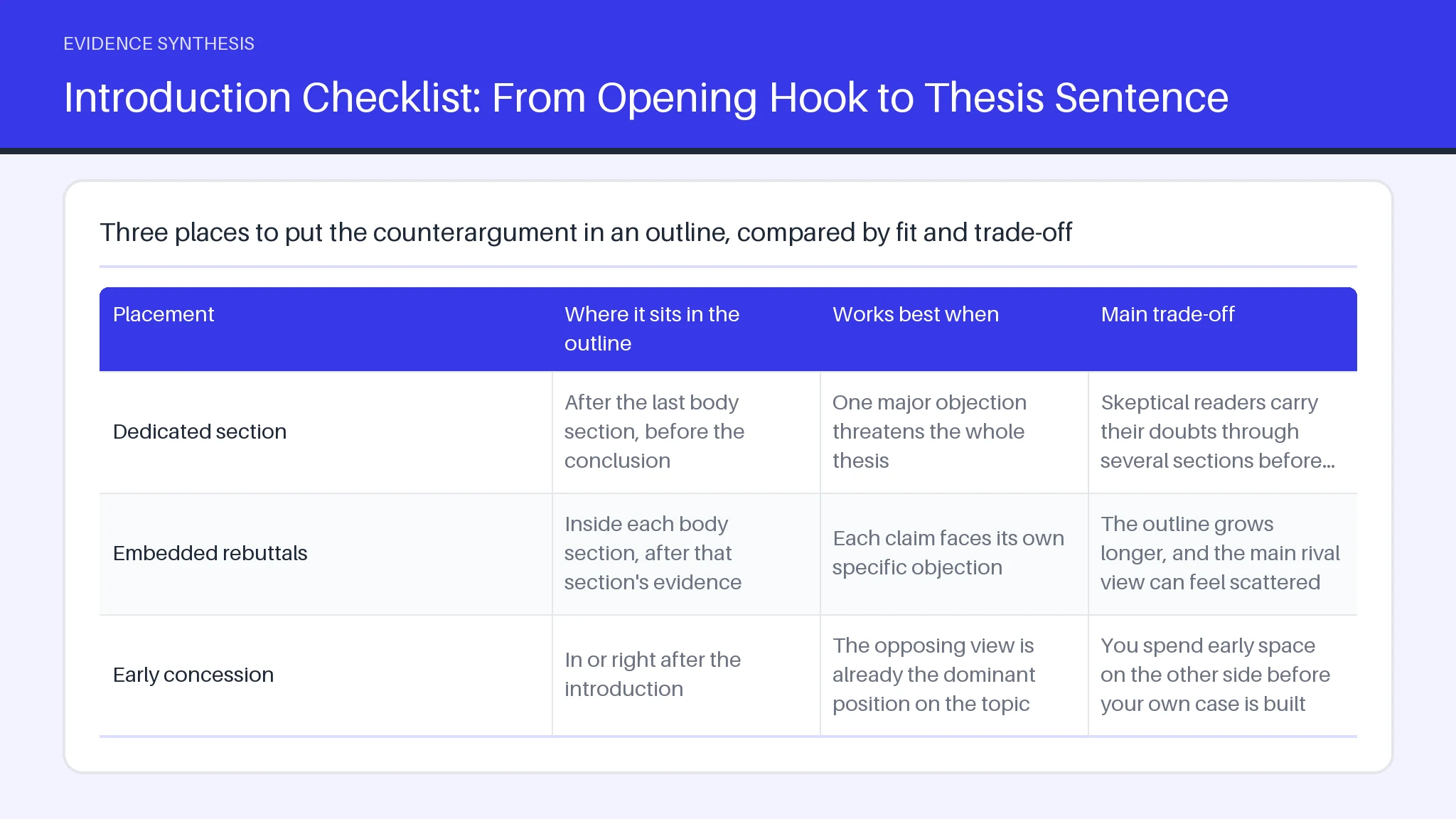
The counterargument needs its own planned, labeled place in your outline. Most writers put it in one of three places: a dedicated section just before the conclusion, a short rebuttal inside each body section, or an early concession near the introduction. If you choose the place before you draft, the objection won't end up squeezed into one apologetic sentence at the end.
Every argumentative essay outline has the same key components, whether it plans a five-page essay or a twenty-page paper. It needs an introduction that ends in a thesis, body sections that each make one claim, evidence for every claim, a counterargument with a rebuttal, and a closing section that states what the argument has shown. An argumentative research paper outline adds a citation to each evidence line and usually gives the opposing literature more space.
Here is an argumentative research paper example. Suppose a paper argues that U.S. universities should require one data literacy course of every undergraduate.
- The thesis.
- Claim one: graduates regularly face numeric claims in health, money and civic decisions.
- Claim two: a single course can build the skill of reading those claims. The writer must support this with published studies.
- Claim three: the cost fits within existing general education credits.
- The objection that curricula are already crowded, then the rebuttal and the close.
| Placement | Where it sits in the outline | Works best when | Main trade-off |
|---|---|---|---|
| Dedicated section | After the last body section, before the conclusion | One major objection threatens the whole thesis | Skeptical readers carry their doubts through several sections before you answer them |
| Embedded rebuttals | Inside each body section, after that section's evidence | Each claim faces its own specific objection | The outline grows longer, and the main rival view can feel scattered |
| Early concession | In or right after the introduction | The opposing view is already the dominant position on the topic | You spend early space on the other side before your own case is built |
A quick test helps you choose. Write the opposing claim in one sentence, then ask which part of your case it attacks. If it attacks your main position, give it a dedicated section. If it attacks a single claim, put the rebuttal in that claim's paragraph, right after the evidence. Either way, keep the logical order: claim, evidence, objection, response.
How Reasoning Connects Your Evidence to Each Claim
Reasoning is the sentence or two that explains why a piece of evidence supports a claim. Without it, a reader sees facts but not an argument. A statistic showing that tuition rose does not prove that a funding policy failed. You have to state the link, such as the comparison the number implies or the cause it points to. Classical rhetoric calls this appeal to evidence and logic logos, and it does most of the work in academic writing.
In your outline, give each claim three lines: the claim, the evidence with its citation, and a "because" line that explains the connection. If you cannot write the "because" line, the evidence may belong under a different claim, or the claim needs a stronger source. Deciding whether a study can carry that weight is a separate skill. Our guide to judging whether research results can be trusted covers it.
Two logical gaps often show up in student outlines:
- Treating correlation as cause. Two trends that move together do not show that one drives the other, unless your source tests that.
- Citing an expert outside their field. An expert's opinion counts as evidence only within the expert's own area.
Also check that your reasoning follows your introduction, which should set "the roadmap for the remainder of the manuscript."
End each body section with a one-line conclusion that says what the evidence has shown about your topic. Your final conclusion can then pull those small verdicts into one answer instead of adding new material.
How to Write an Argumentative Essay Step by Step
Writing an argumentative essay or research paper works best as a series of separate passes: prepare, outline, draft, revise and proofread. When you mix those jobs, for example by polishing sentences before you know what you think, drafts tend to stall.
What you need before you start:
- The prompt, with its length and citation style.
- A focused research question.
- A set of sources you have actually read, with notes on what each one shows.
If you are writing for a journal rather than a course, pick the target journal first. A back-to-basics guide to research manuscripts published in PMC reports that editors reject about 20% of papers before peer review. The reason is that they judge the scope a poor fit for the journal or the quality low. Choosing the journal early also lets you follow its formatting requirements from the first draft (How to Write a Successful Research Manuscript).
- Take a stance after reading, not before. Let the evidence shape your position, so you are not hunting for sources to fit a conclusion you already chose.
- Build the argumentative research paper outline. Write down the thesis, each claim with its evidence, the counterargument and the closing point.
- Draft the body first. Introduce each claim in the first sentence of its section, then give the evidence and the explanation.
- Write the introduction and conclusion last. They are easier to frame once you know what the body actually proves.
- Revise the argument, then the style. Check every claim against your central position before you change any wording.
- Proofread and check your citations. Match every in-text citation to an entry in your reference list.
Tips for Writing a Debatable, Specific Thesis
A strong thesis for an argumentative paper makes a claim that an informed, reasonable reader could reject. It is also narrow enough to defend within your page limit. Run these tests before you lock it into your outline:
- The disagreement test. If no one could argue against it, you have a fact or a summary, not an argument. "Social media affects teenagers" fails. "High schools should ban phones during class time because they pull attention away from instruction" invites debate.
- The scope test. Name the population, place or time period. A thesis about "schools" is harder to support than one about U.S. public high schools.
- The "because" test. A thesis that includes its main reasons gives you the skeleton of the body, because each reason becomes one claim.
- The vague-word test. Replace words such as "bad," "important" or "better" with the specific outcome you mean.
- The revision test. Treat your first thesis as a working draft. If the evidence pushes back, change the claim. Don't bend the evidence.
Every claim in the outline should answer "why?" about that one sentence. For more on drafting and refining it, see our guide to thesis writing from statement to finished draft.
Introduction Checklist: From Opening Hook to Thesis Sentence
An effective introduction takes the reader from a concrete opening to your thesis. For a short paper that usually happens in a single paragraph. A longer research paper may need two or three paragraphs. Writing researchers describe the introduction as possibly the hardest section of a manuscript. It has to condense the background, show why the work matters and lay out the route for the rest of the paper, while still giving readers a reason to keep going (Writing Manuscript "Bookends"). An argumentative paper adds one more job: it must state a position plainly.
- Hook: a specific fact, case or tension that the reader can check and that your thesis will resolve. Skip dictionary definitions and sweeping claims about all of history.
- Context: two to four sentences of background the reader needs to follow the debate.
- Stakes: who is affected, and why the question matters now.
- Conflict: a brief, fair sketch of where informed people disagree.
- Thesis sentence: your position plus its main reasons, usually as the last sentence of the introduction.
- Roadmap (optional): one sentence that previews the order of your claims. It helps most in longer papers.
Finish with one check. Cover everything after the introduction and read only its last line. If a reader who stopped there could not say exactly what you will defend, your thesis statement is too vague, or it is buried in the middle of the paragraph. Move the thesis to the end and make its verb more precise.
Sample University-Level Argumentative Research Paper Outline
A university-level argumentative essay outline fits a thesis, three claims, a counterargument and a closing section onto one page. The sample below plans a paper on required data literacy courses. Treat this essay outline as a model of structure. The notes in parentheses show where your own cited evidence goes.
- Introduction
- Hook: a documented public case in which a misread chart shaped a policy debate (cite the case).
- Context: how general education requirements work at U.S. universities, and where quantitative courses fit in them.
- Thesis: U.S. universities should require every undergraduate to pass one data literacy course. Graduates must interpret numeric claims, one course can build that skill, and the cost fits within existing credits.
- Claim 1: Graduates face numeric claims in work, health and civic life.
- Evidence: employer and survey research on data skills (cite).
- Link: if the need is broad, the preparation should reach every student.
- Claim 2: A single course improves how students read data.
- Evidence: published evaluations of introductory data courses (cite).
- Link: students get the benefit without a full minor.
- Claim 3: The cost fits within current requirements.
- Evidence: credit structures from sample institutions (cite).
- Link: the course can replace an elective rather than add a credit.
- Counterargument and rebuttal
- Opposing view: curricula in demanding majors are already full.
- Rebuttal: versions built for each discipline can count toward the major.
- Concession: some programs may need a phased start.
- Conclusion: restate the position in new words, sum up what each claim showed, and name a practical next step for universities.
Notice the logical thread. Each body paragraph or section opens with a claim that answers "why?" about the central position.
Habits That Make an Argumentative Essay Exceptional
An argumentative essay is a piece of academic writing that takes a clear position on a debatable question and defends it with evidence, while answering the strongest objections. Its basic structure has four elements: an introduction that ends in a thesis statement, body paragraphs that each develop one claim, a section that deals with the other side, and a conclusion. Short assignments often fit this into five paragraphs. Writers who produce exceptional work tend to share a few habits.
- They argue against the best version of the opposing view. If you only take on a weak objection, the whole paper looks less honest.
- They keep one claim per paragraph. When a paragraph carries two claims, they split it and give each claim its own evidence.
- They cite while outlining. Noting the source next to each evidence line saves a late search for references.
- They choose specific evidence over volume. One well-chosen study with a clear link does more than five loosely related quotations.
- They keep a measured voice. Confident, precise language reads as more credible to academic readers than intensity does.
Tips and common mistakes. The errors that weaken argument papers are predictable:
- Choosing a topic with no real debate.
- Summarizing sources instead of using them to prove claims.
- Hiding the thesis in the middle of the introduction.
- Adding new evidence in the conclusion.
Read your outline once looking only for these four problems before you start drafting. For beginner errors in every section of a paper, see the mistakes list in our research paper structure guide.
Steps to Build a Persuasive Essay Outline
A persuasive essay outline has four main parts:
- A hook and thesis.
- Body paragraphs that each pair one reason with evidence and an appeal to the reader.
- A response to objections.
- A closing call to judgment or action.
Persuasive and argumentative writing overlap heavily, and the main difference is emphasis. A persuasive piece may lean more on the audience's values. An argumentative research paper rests on published evidence and gives the other side a fair hearing.
You can build either kind of plan in four steps:
- Pick your position and your audience. Reread the assignment, confirm that the topic is open to debate, and decide who you need to win over: a skeptical expert, a general reader or a policymaker.
- List your reasons and rank them. Write down every reason you can defend, then keep the two to four strongest. Drop any reason you cannot support with a source.
- Attach evidence and an appeal to each reason. Under each reason, note the source, the key fact or finding, and the value it speaks to, such as fairness, safety or cost.
- Set the order and plan your response. Many writers open with a solid reason and save the strongest for last. Put the response to objections where it does the most work.
The same four steps produce an argumentative essay outline, with two changes. Step three relies more on cited research, and step four gives the counterargument a full section. Write each entry as a complete sentence rather than a fragment. That way, every paragraph in the draft starts from a clear claim instead of a vague label.
Free Argumentative Research Paper Outline Template in PDF
This free template is an outline you can copy into any word processor or document app, fill in, and save as a PDF with the app's export or print-to-PDF option. Keep it as an editable document at first, so you can reorder claims as your evidence changes.
- Working title and research question.
- Topic and audience: what the debate is about and who you are writing for.
- Hook: one specific, cited detail.
- Background: the context and foundation the reader needs to understand the issue and see why it matters.
- Thesis statement: your position plus its main reasons.
- Body paragraphs or sections 1 to 3: for each one, the claim, the evidence with its citation, the link sentence and a one-line takeaway.
- Counterargument: the strongest objection in one fair sentence, with its source.
- Rebuttal: your response, plus any concession.
- Conclusion: your position restated, what the claims showed, and why it matters.
- Sources: full references in the required citation style.
Fill in the source lines before you draft. Credible, accurately cited sources build ethos, the reader's trust in you as a writer, and that trust makes each paragraph more convincing. For a refresher on the wider process of essay writing, from question to claim, see our step-by-step guide.
Frequently asked questions
What is a sentence outline?
A sentence outline is an outline in which every entry is a complete sentence rather than a word or short phrase. In an argumentative paper, a line reads "One required course can build data interpretation skills" instead of a label like "course benefits." In the introduction part of the outline, you can write full sentences for each job that a PMC article on manuscript "bookends" gives an introduction: provide the background, establish the need for and importance of the research, and set the roadmap for the rest of the paper.
What is an argumentative paragraph?
In a research paper, an argumentative paragraph is one that works to persuade the reader, not only to report. The introduction shows this most clearly. Guidance published in PMC contrasts it with the "more objective and technical methods and results sections" and says it must establish the need for and importance of the research, provide background, and set the stage for the methods chosen, all while enticing the reader to care about the topic. In your outline, give each such paragraph one of those jobs.
What are the 5 main parts of an argumentative essay?
The number and names of the parts depend on your assignment, so follow the structure your instructor or style guide sets. The opening is the part that guidance describes most clearly. A guide to framing scientific manuscripts, published in PMC, says the introduction should give background, show why the research matters, and set the stage for the methods. It should also make readers care enough to read the whole paper. Treat that introduction as the roadmap for every section after it.
What are the 7 parts of an argumentative essay?
The sources behind this guide do not describe a fixed seven-part model, so treat any seven-part list as a teaching aid rather than a standard. They do describe what the opening of a paper has to do. It should provide background, explain why the question matters, set up the approach you chose, and give the reader a reason to keep going. Build your outline so each later part follows that roadmap.
What are the 5 elements of a good argument?
No official list sets out five elements of a good argument, so any fixed count is a teaching aid and not a standard. Published guidance on framing science manuscripts describes what a research paper's introduction should do. It should establish the need for and importance of the research, set the stage for the research methods chosen for the study, and entice the reader to care about the topic and read the entire paper. Use those jobs as a checklist when you draft the opening of an argumentative paper.
What is a good hook for an argumentative essay?
A good hook does the first part of your introduction's job. Guidance on framing scientific manuscripts, published in PMC, says a strong introduction distills extensive and complex information in a creative, compelling and succinct way. It also establishes why the research matters and entices the reader to care about the topic and read the entire paper. Open with the point that shows why your question needs an answer, then use it to set the roadmap for your argument.
How to write a good argumentative research paper?
Start by reviewing the research related to your topic. If you plan to submit to a journal, choose that journal before you write. A PMC article on manuscript writing reports that about 20% of papers are rejected before peer review because editors judge the scope a poor fit or the quality low. Choosing early also lets you format the paper to the journal's requirements. In your argumentative research paper outline, plan an introduction that gives background, shows why the question matters, sets up the methods you chose, and lays out a roadmap for the rest of the paper. If your argument draws on many studies, our systematic review guide explains a structured way to gather them.