Cochrane Explained: The Library, Reviews and Mission
Cochrane is an independent, international non-profit organization, established in 1993 and previously known as the Cochrane Collaboration, that produces structured summaries of health research and publishes them through the Cochrane Library. If you searched for it because a lecturer, clinical guideline, or reviewer pointed you there, the practical answer is this: it is both an organization and a set of searchable databases, and knowing which part you need saves a lot of wasted searching.
This page is written for students, clinicians, librarians, and early-career researchers who need to use the resource properly rather than admire it from a distance. By the end you should be able to say what sits inside each database, how to get access when you are not on campus, how to read a review's certainty ratings instead of just its conclusion, and where the limits of the resource start.
Two distinctions matter before you start clicking. First, a full evidence synthesis is a completed piece of research with a protocol, a search strategy, screening decisions, and graded findings. A trial record is a single study reference, indexed for retrieval, with no judgement attached. Second, being published in a well-known collection does not automatically make a finding strong. Every synthesis grades its own evidence, and plenty of conclusions land on "low certainty" or "we do not know yet." Reading those ratings is the skill that separates useful evidence from a headline.
What you need before you start is short: a clearly framed clinical or policy question, ideally in PICO format; institutional or national access credentials; a rough sense of whether you want a finished synthesis or raw trial records; and a place to record what you searched and when. If you are planning your own evidence synthesis, treat this resource as one source among several rather than the whole search. Tools such as Systematicly are used to manage the screening and extraction that follows, but the search planning still belongs to you.
Key takeaways
- Cochrane is an international non-profit, founded in 1993, that produces and maintains health evidence syntheses; the Cochrane Library is the collection of databases where that output is published.
- The two databases most people actually use are CDSR (full reviews and protocols) and CENTRAL (a very large index of controlled trial records), and they answer different questions.
- Access is usually institutional or national rather than personal: most readers get in through a university health sciences library, a hospital knowledge service, or a country-wide licence.
- A published review is a starting point, not a verdict. Check the assessed-as-up-to-date date, the certainty ratings for each outcome, and whether the comparison matches your patient or policy question.
- CENTRAL is a search resource, not a finished answer, so trial records still need screening, appraisal, and often a fresh search of other databases.
What Is the Cochrane Library and What Databases Does It Contain?
The Cochrane Library is an online collection of databases that holds the organization's published evidence syntheses alongside a large index of controlled trial records. The two components most readers need are the Cochrane Database of Systematic Reviews (CDSR), which contains completed reviews and the protocols that describe reviews still in progress, and the Cochrane Central Register of Controlled Trials (CENTRAL), which gathers records of randomized and quasi-randomized trials drawn from bibliographic databases, trial registers, and hand searching.
The practical decision is which one to open first. If you want a graded answer to a well-defined intervention question, start with the reviews. If you are building your own search and need trial records to screen, start with the register. Using the register as if it were an answer, or the review database as if it were a comprehensive trial search, is the most common wasted afternoon in evidence work.
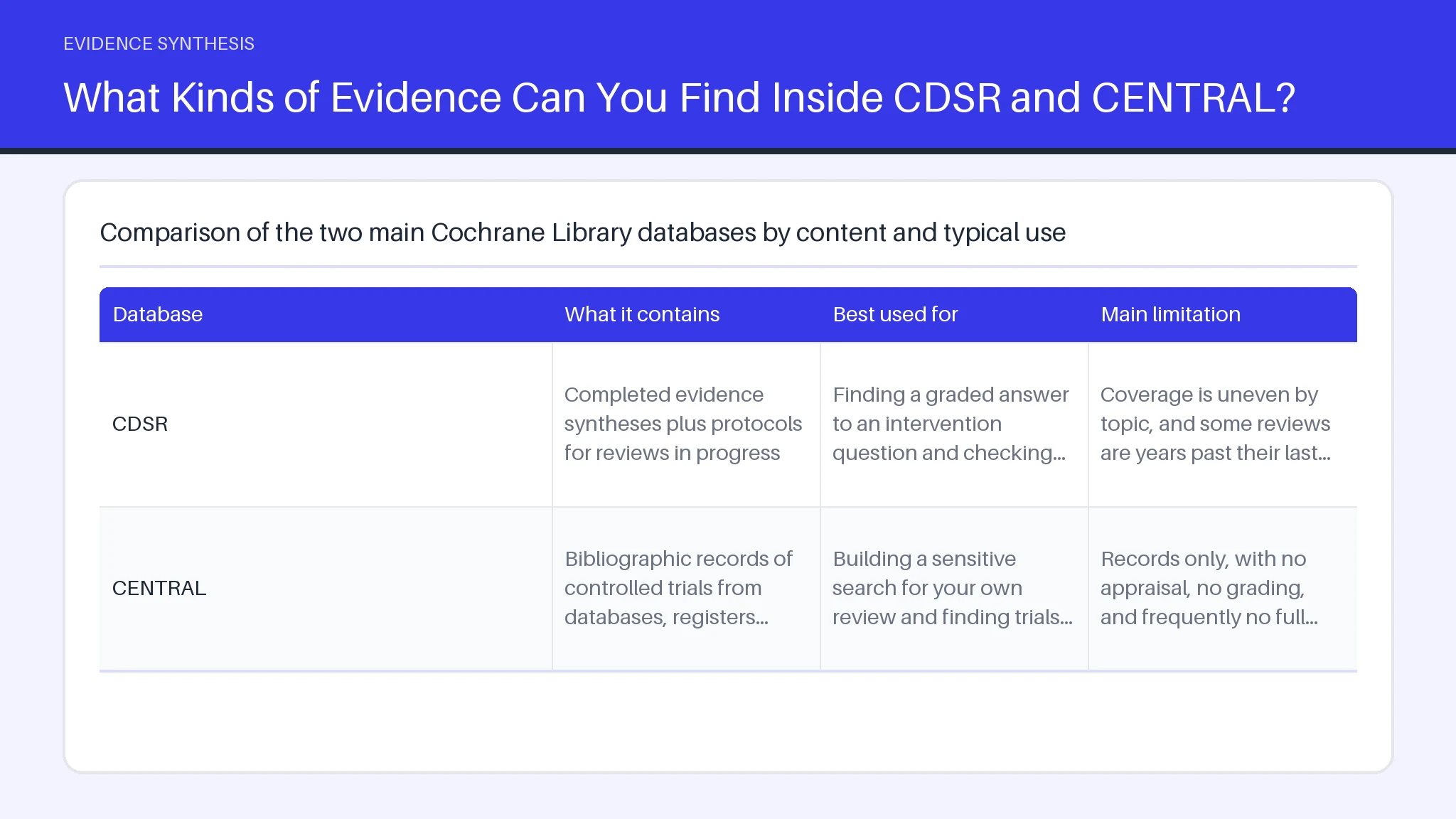
| Database | What it contains | Best used for | Main limitation |
|---|---|---|---|
| CDSR | Completed evidence syntheses plus protocols for reviews in progress | Finding a graded answer to an intervention question and checking whether a review already exists | Coverage is uneven by topic, and some reviews are years past their last update |
| CENTRAL | Bibliographic records of controlled trials from databases, registers, and hand searching | Building a sensitive search for your own review and finding trials other databases index poorly | Records only, with no appraisal, no grading, and frequently no full text |
Protocols are worth a second look. If a protocol covers your exact question, a synthesis is already underway, which changes whether you should start your own.
How to Access and Learn the Cochrane Library Through a University Health Sciences Library
Access to the Cochrane Library normally arrives through an institution rather than a personal subscription. Universities with health sciences programs license it centrally, hospital knowledge services provide it to clinical staff, and several countries fund national provisions that give every resident access. The result is that the same page can look completely different depending on how you arrived at it, which is why students often see abstracts only when they search from a search engine and full text when they route through the library.
Three steps solve most access problems. First, sign in through your library's database list or proxy link rather than typing the address directly, so your entitlement is recognized. Second, set up off-campus access before you need it, whether that is a VPN, a proxy bookmarklet, or an institutional login, because troubleshooting at 11pm the night before a deadline is a poor use of time. Third, if your institution has no license, check whether your country has a national provision or whether your professional body offers membership access.
Learning the interface is a separate task from getting in. Health sciences librarians run scheduled sessions on search construction, and those sessions are usually where people learn the parts that matter: combining free-text terms with controlled vocabulary, using the advanced search to build line-by-line strategies, saving and rerunning searches, and exporting records into a reference manager or screening tool. Book a one-to-one consultation if your question is a review question rather than a quick lookup. A librarian who co-designs the search is often named in the methods section, and that is a fair reflection of the contribution.
What Kinds of Evidence Can You Find Inside CDSR and CENTRAL?
CDSR holds finished syntheses of intervention effects, and increasingly of diagnostic test accuracy, prognosis, and qualitative evidence. A typical Cochrane review states an explicit question, describes an exhaustive search, lists the included and excluded studies with reasons, assesses risk of bias in each trial, and reports pooled results where pooling is defensible. The most useful part for a busy reader is the summary of findings table, which gives an effect estimate per outcome alongside a certainty rating derived from risk of bias, inconsistency, indirectness, imprecision, and publication bias.
CENTRAL holds something different: bibliographic records for controlled trials, including many conference abstracts and registry entries that never became journal articles. That breadth is exactly why review teams search it. It surfaces studies that a single database search would miss, and it reduces the pull of published, positive results. What it does not give you is judgement. Every record still needs screening against your eligibility criteria and then appraisal once you have the full text.
One limitation deserves naming. Absence of a review on your topic is not evidence that the intervention is ineffective; it usually means nobody has synthesized it yet. Empty reviews, where a rigorous search finds no eligible trials, are published for the same reason and are genuinely informative.
The Cochrane Mission: Turning Trusted Evidence Into Better Health Decisions
The organization's stated purpose is to make high-quality health evidence available so that patients, clinicians, and policymakers can make better-informed decisions. It pursues that through standardized methods, an editorial process with peer review, plain language summaries written for non-specialists, and a policy of declaring and managing conflicts of interest, including restrictions on commercial sponsorship of the reviews themselves.
The practical consequence for you is consistency. Because every Cochrane review follows the same reporting structure, you can find the comparison, the outcomes, and the certainty rating in the same place each time, which makes scanning several reviews on a single afternoon realistic. Guideline developers rely on that consistency when they build recommendations, and it is one reason these syntheses appear so often in national guidance.
Consistency is not the same as certainty, and this is where careless reading causes trouble. Check three things before you act on a conclusion. Look at the assessed-as-up-to-date date, since a review published years ago may predate the trials that changed practice. Look at whether the comparator matches current care, because a comparison against placebo tells you little when the real question is whether one active treatment beats another. Look at the certainty rating for the specific outcome you care about, not the overall tone of the abstract, since one review often reports high certainty for one outcome and very low certainty for another. Tips worth keeping: read the summary of findings table first, and treat the plain language summary as an orientation rather than the evidence.
Frequently asked questions
What is a Cochrane used for?
A Cochrane review is used to answer a focused health question by gathering, appraising, and combining the relevant studies into a single graded conclusion. Clinicians use them to check whether a treatment works and how confident the evidence allows them to be. Guideline panels use them as the evidence base behind recommendations. Students and researchers use them to see whether a question has already been answered, to identify evidence gaps worth studying, and as worked examples of transparent methodology. Patients and carers use the plain language summaries to understand options before an appointment. The register of trials, by contrast, is used mainly as a search resource when building a new review rather than as a source of answers.
What does Cochrane mean?
The name comes from Archie Cochrane, a British physician and epidemiologist whose 1972 book argued that healthcare decisions should rest on evidence from randomized controlled trials rather than habit or authority. When the organization was founded in Oxford in 1993, it took his name as an acknowledgment of that argument. In everyday research conversation the word is used loosely to mean either the organization, the library of databases, or a specific review, so it is worth asking which sense a colleague intends.
What does Cochrane do?
The Cochrane Collaboration, now known simply as Cochrane, coordinates a global network of researchers, clinicians, librarians, methodologists, statisticians, and patient contributors who produce and maintain evidence syntheses. Its work includes setting methodological standards, running editorial and peer review processes, publishing reviews and protocols, translating summaries into multiple languages, and training new review authors. It also manages conflict-of-interest policy for its own output, which is part of why its reviews are treated as an independent evidence source rather than a promotional one.
What ethnicity is Cochrane?
Cochrane is a surname, not an ethnicity. It is a family name of Scottish origin, and people who carry it today come from many backgrounds across the world. The organization itself is international and independent, with contributors in more than a hundred countries, so nothing about the name says anything about who does the work.
Is Cochrane Scottish or Irish?
The surname is Scottish. It derives from lands near Paisley in Renfrewshire, in the west of Scotland, and the family later became associated with the Earls of Dundonald. Because of migration between Scotland and Ireland over several centuries, the name also appears in Irish records, and spelling variants such as Cochran and Corcoran occasionally cause confusion, but the origin usually cited is Scottish.
What is the history of the Cochrane family?
The family traces back to landholdings in Renfrewshire recorded from the medieval period. Its best-known line produced Thomas Cochrane, 10th Earl of Dundonald, a naval commander of the Napoleonic era who later served in the South American independence navies. Branches of the family emigrated widely to North America, Australia, and elsewhere, which is why the name is common well beyond Scotland today.
Why is Cochrane famous?
In research and healthcare, the name is famous for two connected reasons. Archie Cochrane is remembered as one of the founders of evidence-based medicine, and the organization named after him became the most widely recognized producer of health evidence syntheses in the world. Its reviews are cited in national guidelines, taught in health sciences curricula, and used as the reference standard for how a transparent synthesis should be reported, which is why the name appears so often in methodology guides and reading lists.