PubMed Search: Build Queries That Find the Evidence
A pubmed search is a structured query against the National Library of Medicine's biomedical citation index, and the quality of the results depends almost entirely on how you build the query rather than on which buttons you click. PubMed covers more than 40 million citations drawn from MEDLINE, additional life science journals, and online books, with links out to full text in PubMed Central and on publisher sites. The search box accepts plain keywords, but it also accepts field tags, Boolean operators, phrase quoting, and controlled medical subject headings. Learning that second layer is the difference between 12,000 unsorted hits and a defensible set of records you can screen.
This guide is written for clinicians, graduate students, librarians, public health analysts, and anyone assembling evidence for a review, a guideline, a thesis chapter, or a grant background section. By the end you will be able to translate a clinical question into search terms, find the right MeSH term in the MeSH database, combine search lines in advanced search, narrow results by date, language, and article type without discarding eligible studies, save a search for later reruns, and export citations into whatever tool you use for screening.
Two habits separate a search you can publish from a search you cannot. The first is recording the exact query string and the date you ran it, because PubMed's index changes daily and an unrecorded query cannot be reproduced. The second is treating sensitivity and precision as a deliberate choice: a scoping question tolerates noise, while a targeted clinical question does not. Everything below assumes you are building a search someone else might need to rerun, including your future self. If your search feeds a formal evidence synthesis, our complete guide to systematic reviews covers the wider process that a good search plugs into.
Key takeaways
- PubMed is the free public interface to MEDLINE and related biomedical citations, maintained by the National Center for Biotechnology Information (NCBI) at the U.S. National Library of Medicine, and it indexes more than 40 million citations for biomedical literature.
- A reliable pubmed search combines two layers: MeSH medical subject headings for indexed concepts and free-text keywords for new terminology, brand names, and wording the indexers have not caught up with yet.
- Anyone can reach the PubMed website without a login; institutional access matters only for full text, so route through your library link resolver when you need the PDF rather than the citation.
- Advanced search, search history numbering, the search builder, and saved searches let you combine search lines with AND, OR, and NOT and document the exact query you ran.
- Filters for date, language, and publication type speed up scanning but can silently remove eligible studies, so apply them after you know how many records the unfiltered query returns.
Why Use PubMed for Biomedical Literature Searching?
PubMed earns its place as the default starting point for biomedical literature searching because it is free, indexed by trained human curators, updated daily, and openly citable. Use this database when your question concerns human health, clinical medicine, nursing, dentistry, veterinary medicine, public health, or the preclinical science that supports them. It is the strongest single choice for clinical and biomedical questions. It is a weaker choice for psychology and social science theory, education interventions, health economics modeling, and gray literature such as government reports, conference abstracts, and trial registry entries, all of which sit largely outside its scope. For a question with a social or behavioral core, PubMed should be one database among several rather than the only one.
The practical trade-off is coverage against control. A broad web search surfaces something readable in seconds; a PubMed search rewards a few extra minutes with reproducibility, field-level precision, and a citation trail. When you need to prove what you searched, PubMed wins. Understanding how to search in pubmed properly also transfers: Boolean logic, controlled vocabulary, and field tags behave similarly in other bibliographic databases.
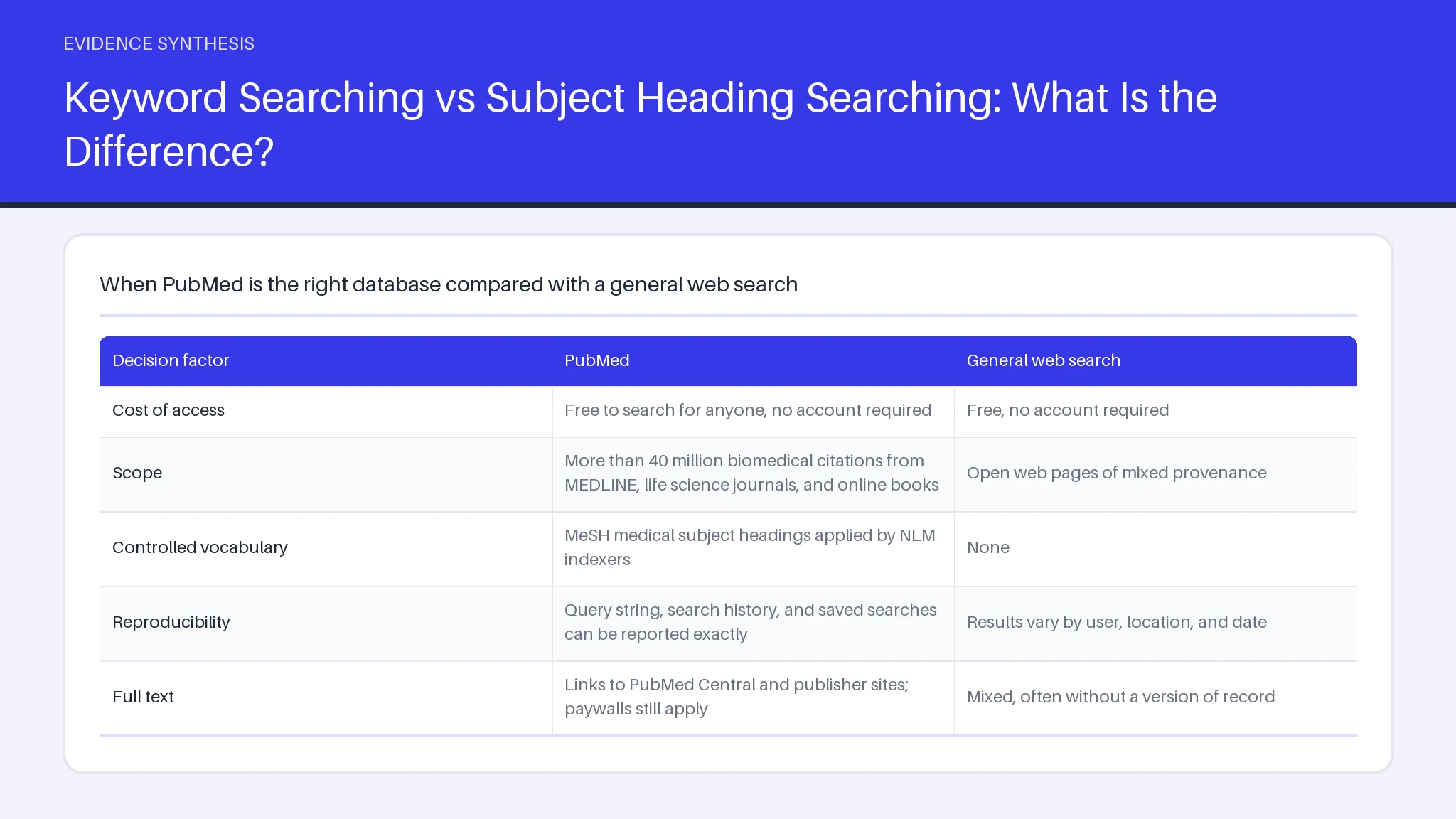
| Decision factor | PubMed | General web search |
|---|---|---|
| Cost of access | Free to search for anyone, no account required | Free, no account required |
| Scope | More than 40 million biomedical citations from MEDLINE, life science journals, and online books | Open web pages of mixed provenance |
| Controlled vocabulary | MeSH medical subject headings applied by NLM indexers | None |
| Reproducibility | Query string, search history, and saved searches can be reported exactly | Results vary by user, location, and date |
| Full text | Links to PubMed Central and publisher sites; paywalls still apply | Mixed, often without a version of record |
What Changed in PubMed Publication Type Filters
Publication type filters in PubMed are index tags, not quality judgments, and NLM has adjusted both the tag set and the sidebar defaults over successive releases of the site. The current interface shows a short list of article types in the left sidebar, with the full set available behind the additional filters option. Newer tags such as those distinguishing preprints and retracted publications sit alongside long-standing ones for randomized controlled trials, meta-analyses, reviews, case reports, and practice guidelines.
Two behaviors catch people out during a pubmed search. First, publication type is assigned during indexing, so very recent records that are still ahead of print may carry no type tag at all and will drop out the moment you tick a box. Second, a filter for a study design captures how the article was labeled, not how it was conducted, so a paper described as a trial report may be an analysis of trial data. Check what a filter does by clicking the Advanced link and reading the generated query: a sidebar tick becomes a visible term such as randomized controlled trial[pt]. If the label matters to your conclusions, verify it in the record rather than trusting the tag.
How to Narrow Results by Date, Language, and Article Type
Narrow a result set by adding limits in a specific order: run the concept query first, note the total, then apply one limit at a time and record how many records each one removes. That sequence tells you whether a filter is trimming noise or deleting evidence. Date limits accept a custom range as well as the sidebar presets, and you can restrict to publication date or to the date a record entered the database, which matters when you rerun a saved search and want only new additions.
Language limits are the riskiest of the three. Restricting to English removes non-English reports that may be perfectly eligible, and in some clinical areas that loss is substantial. If you must limit by language for practical reasons, state it as a limitation. Article type limits work best for narrowing an already large set rather than for defining the set itself.
A cleaner alternative in any pubmed search is to express limits as query text rather than sidebar clicks, for example adding AND 2015:2025[dp]. The query string then carries the full record of what you did, which you can paste into a methods section or a screening log without reconstructing it from memory.
Video: Reaching PubMed Through Your Institution's Library Access
Everyone can use PubMed for free. The database itself has no paywall and no login requirement: type pubmed.ncbi.nlm.nih.gov into a browser anywhere in the world and you can search the full index, read abstracts, and export citations. What institutional access changes is the step after the citation, namely whether you can open the full article. Students and staff at a university such as the University of Delaware reach PubMed through the library's database list precisely so that their subscription entitlements travel with them into the results page.
The mechanism is a link resolver. When you arrive from a library link or sign in through your institution's proxy, PubMed records display an extra button pointing to your library's holdings, so a record that otherwise dead-ends at a publisher paywall opens in one click. If you started at the public site and hit a paywall, do not pay: go back through the library catalog, look for the article in PubMed Central, check for an author manuscript deposited under a funder mandate, or request it through interlibrary loan, which is usually free to affiliated users.
Three points are worth knowing before you set up your routine. Off-campus access needs either the proxy link or single sign-on, so a bookmark saved on campus may fail at home. An individual NCBI account is separate from institutional access and exists to store your work, including saved searches, collections, and search history beyond the session. And pubmed advanced search behaves identically on the public and library-routed versions of the site, so you can build and test a query anywhere and only route through the library when you need the PDF. Unaffiliated readers still have real options: PubMed Central hosts millions of free full-text articles, and many public libraries and hospital libraries provide document delivery.
Keyword Searching vs Subject Heading Searching: What Is the Difference?
Keyword searching matches the characters you type against text in the record; subject heading searching matches the concept an NLM indexer assigned to the article. The difference has concrete consequences. A keyword for heart attack finds records where an author used that phrase and misses those written as myocardial infarction. The MeSH heading Myocardial Infarction finds all indexed records on the concept regardless of the author's wording, but misses articles too new to be indexed and articles in journals PubMed does not index for MEDLINE.
Neither layer is sufficient alone, which is why a competent pubmed database search runs both and combines them with OR. A short pubmed search strategy example shows the pattern for a question about exercise and depression in older adults:
- Concept 1: "Depression"[Mesh] OR depression[tiab] OR depressive[tiab]
- Concept 2: "Exercise"[Mesh] OR exercise[tiab] OR "physical activity"[tiab]
- Combine: #1 AND #2
The [tiab] tag restricts free text to title and abstract, which is far more precise than an untagged word that also matches affiliations and journal names. Use OR inside a concept, AND between concepts, and keep NOT for rare, well-justified exclusions, because it removes records that mention a term for any reason.
How to Search With MeSH Terms Using the MeSH Database
MeSH terms are the controlled vocabulary of Medical Subject Headings that NLM staff assign to each indexed article, arranged in a hierarchy that runs from broad categories down to narrow concepts. Because they describe content rather than wording, they are the backbone of a precise pubmed database search.
Work through the MeSH database instead of typing a term you assume exists. From the PubMed homepage, open the MeSH Database link, type your concept, and open the matching heading. The record shows the scope note defining exactly what the term covers, the entry terms that are mapped to it, the subheadings available, and the tree position showing narrower headings underneath. Use the Add to Search Builder control, choose your Boolean operator, add your remaining concepts, then send the assembled query to PubMed.
Two choices on that page change your results materially. Selecting a subheading such as drug therapy or diagnosis narrows the retrieval to that aspect, which improves precision and risks losing relevant papers indexed under a different aspect. Ticking the option to exclude narrower terms turns off automatic explosion, so the search no longer picks up the headings below yours in the tree; leave explosion on unless you have a specific reason. A working pubmed search strategy example of a single MeSH line looks like "Hypertension/drug therapy"[Mesh], which you would still pair with title and abstract keywords to catch unindexed records.
Getting Started With a PubMed Search for Medical Research
Search PubMed when you need evidence you can cite, verify, and retrieve again. It is the most widely used database for medical research because it is free, comprehensively indexed, and linked to full text, which makes it the reference point clinicians and reviewers expect to see in a methods section.
Before you start, gather four things: a question broken into its component concepts, two or three known relevant articles to test against, a place to record queries and dates, and your library access route if you will need full text. The known-relevant articles matter more than people expect. If your finished query does not retrieve them, the query is wrong, and opening one of those records to read its assigned MeSH terms is the fastest way to find vocabulary you missed.
From there the sequence is short. Enter one concept at a time so search history numbers each line, combine the lines in advanced search, scan the first fifty titles for terminology you have not used, add it, and rerun. Useful pubmed search tips include quoting multi-word phrases, using the Similar Articles list on a strong record to expand coverage, and checking the Cited By links to move forward in time from a key paper. A pubmed author search deserves its own habit: use the [au] tag or the author's linked name in a record to gather the work of a prolific group, and be aware that common surnames and name changes make author retrieval incomplete unless an ORCID identifier is attached.
How This Guide Supports Public Health Evidence Searching
Public health questions stretch a biomedical index in ways clinical questions do not, and the searching techniques here are built with that strain in mind. Population-level interventions, policy evaluations, and implementation studies often appear in journals outside MEDLINE's core, use inconsistent terminology, and produce evidence in reports rather than indexed articles. The practical response is to lean harder on free-text synonyms than on MeSH, to search more than one database, and to plan for a separate gray literature step covering agency and government sources.
Documentation matters more here too, because public health reviews are frequently updated as programs evolve. Save each query in your NCBI account, note the run date and record count, and keep the numbered search history so a colleague can rebuild the strategy. Among the pubmed search tips that pay off most in this field: build a reusable population block for the group you study repeatedly, and keep a separate line of outcome terms you can swap in and out. A pubmed author search across the handful of research teams working on a niche program can surface eligible studies that concept searching misses entirely. If you plan to pool results, the meta-analysis guide explains what your search needs to deliver.
How to Choose Effective Keywords for Your Search Strategy
Effective keywords come from the literature, not from your own vocabulary. Start with the terms in your question, then harvest more from three sources: the MeSH entry terms listed under each heading you use, the titles and abstracts of known relevant articles, and the keyword lists authors supply with their papers. Write the harvested terms into concept blocks so you can see coverage gaps.
Four decisions shape a keyword block. Include spelling variants, since British and American forms differ and truncation with an asterisk does not handle internal differences such as an extra letter in the middle of a word. Include abbreviations alongside full forms, but check them: short abbreviations retrieve unrelated records. Use truncation cautiously, because PubMed switches off automatic term mapping for a truncated word, so therap* loses the MeSH expansion you would otherwise get. And quote phrases you need held together, then confirm in the Advanced search Details view that PubMed kept the phrase intact rather than splitting it.
Knowing how to search in pubmed well means testing each decision. Build the query in pubmed advanced search, inspect the translation PubMed generated, and compare hit counts as you add each synonym. A term that changes the total by nothing is dead weight; a term that adds thousands of irrelevant records needs a field tag.
Frequently asked questions
How do I search in PubMed?
Searching in PubMed works best as a three-step loop. Break your question into concepts, enter each concept separately so it gets its own numbered line in search history, then combine the lines with AND in advanced search. Within each concept, join synonyms with OR and pair the MeSH heading with title and abstract keywords. Check the generated query in the Details view to confirm PubMed interpreted your terms as you intended, scan the first page of results for missing vocabulary, and rerun. When the retrieval looks right, save the search to your NCBI account and record the query string and date.
Can you access PubMed for free?
PubMed is free for everyone, with no subscription, login, or institutional affiliation required to search the index and read abstracts. The limit is full text: some articles sit behind publisher paywalls. PubMed Central provides millions of free full-text articles, funder mandates place many author manuscripts in the open, and library routing or interlibrary loan covers most of the rest. An optional free NCBI account adds saved searches, collections, and email alerts, but nothing about searching requires one.
Is PubMed a trustworthy source?
PubMed is a trustworthy index rather than a guarantee of trustworthy findings. The citations are curated by the National Library of Medicine, journals are selected for indexing against defined criteria, and retractions and corrections are linked to the original records. That makes the database itself dependable. It does not make every indexed study reliable, because PubMed indexes small, flawed, and contradicted research alongside rigorous work. Judging an individual paper is a separate task, and our note on critical appraisal covers how to do it.
What is the PubMed website?
The PubMed website is the free search interface at pubmed.ncbi.nlm.nih.gov, developed and maintained by the National Center for Biotechnology Information at the U.S. National Library of Medicine, part of the National Institutes of Health. It provides access to more than 40 million citations for biomedical literature drawn from MEDLINE, additional life science journals, and online books, plus tools including advanced search, the search builder, the MeSH database, search history, saved searches, and citation export.
What is better than PubMed?
No single database is better than PubMed for biomedical questions; the right answer is usually PubMed plus something else. Subscription indexes add journals PubMed does not cover and offer richer citation tracking. Region-specific and discipline-specific indexes improve coverage for nursing, psychology, and non-English literature. Trial registries capture studies that never reached publication. For a thorough evidence search, plan on at least two or three bibliographic sources plus a gray literature step, rather than looking for one perfect database.
What does PubMed stand for?
PubMed is not a formal acronym expanded by NLM, though the name combines PubMed Central's public access model with MEDLINE, the National Library of Medicine's flagship bibliographic database of biomedical journal citations. MEDLINE forms the largest component of PubMed, so the distinction matters in practice: MEDLINE records carry full MeSH indexing, while PubMed also contains in-process records awaiting indexing, PubMed Central deposits, and citations from journals outside MEDLINE's selected set. A MeSH-only search therefore misses part of what PubMed holds.
Who owns PubMed?
PubMed is owned and operated by the U.S. federal government. It is developed and maintained by the National Center for Biotechnology Information within the National Library of Medicine, which is part of the National Institutes of Health under the Department of Health and Human Services. That public ownership is why the database carries no advertising, charges no search fees, and publishes its indexing policies and data openly.