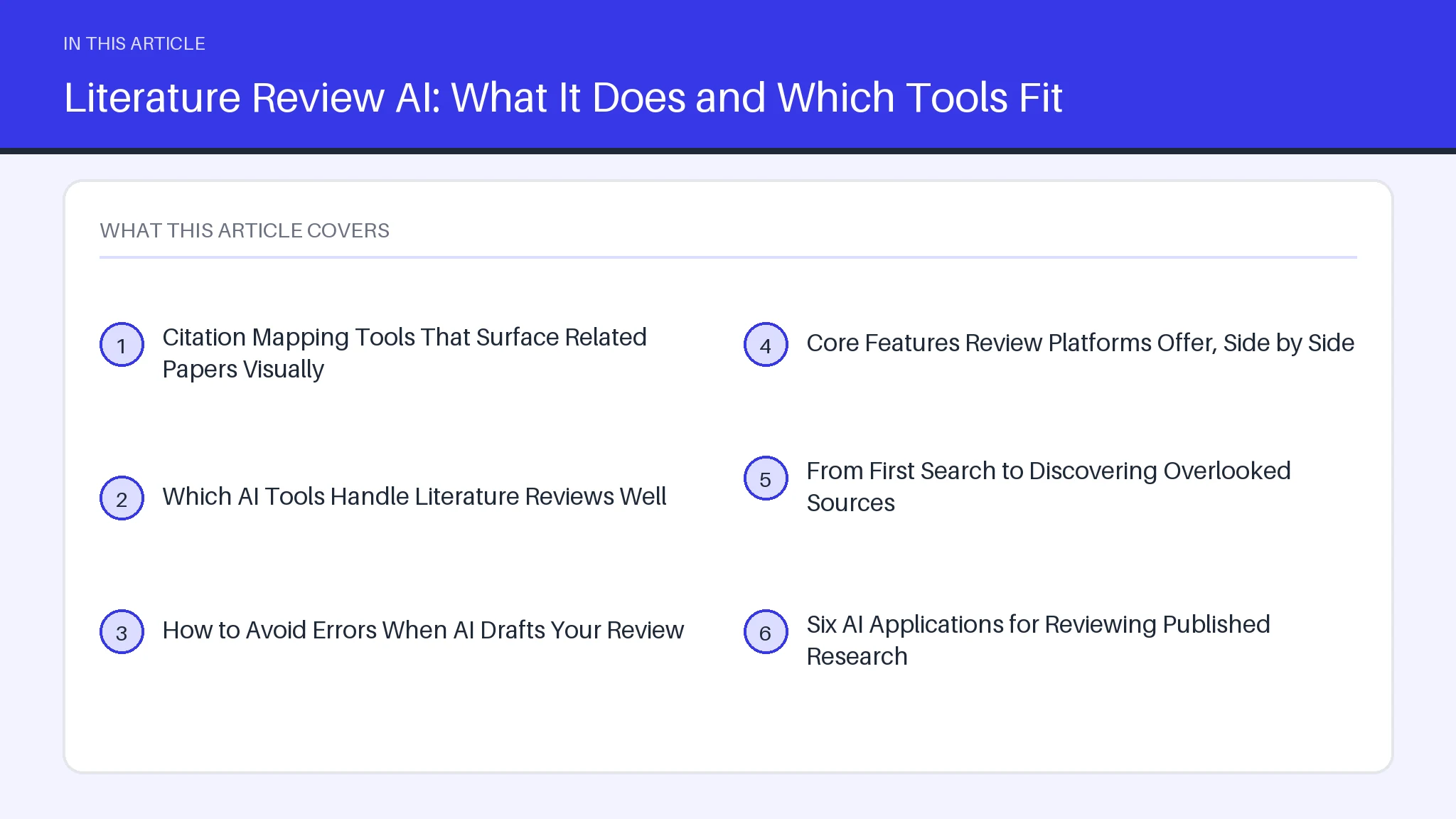
Literature review AI refers to software that applies language models and semantic matching to the mechanical parts of reviewing published research: finding candidate papers, ranking them by relevance, grouping them by theme, pulling out structured details, and surfacing papers you would not have found through keyword search alone. It does not replace the analytical work of deciding what the evidence means. Used with that boundary in mind, it reliably compresses the weeks normally spent on searching and screening.
This article is for graduate students, research librarians, clinicians, and evidence synthesis teams who already know how to run a review and want a realistic account of where automation helps. If you need the underlying method first, start with the pillar guide on how to plan, judge and write a literature review, then come back here for the tooling layer.
What follows covers the categories of literature review AI available today, what each one genuinely does at each stage, where errors enter, and how to keep your process reproducible when the underlying ranking is probabilistic. The emphasis throughout is on decision factors that the usual tool round-ups skip: how semantic retrieval changes your search audit trail, what extraction accuracy means in practice, and which outputs a reviewer or journal editor will accept without a human check. Treat the tools as instruments with known error profiles, not as shortcuts past the thinking.
Suggested visual 1: a stage-by-stage diagram of the review workflow with automation confidence marked at each step. Suggested visual 2: a schematic of a citation network showing seed papers, forward citations, and backward references.
Key takeaways
- Literature review AI is strongest at narrow, checkable jobs: expanding search vocabulary, mapping citation networks, clustering records by theme, and flagging duplicates. It is weakest at judging whether a study answers your question.
- Tool categories matter more than brand names. Semantic search engines, citation mapping interfaces, extraction assistants, and general chat models fail in different ways, so pick by the stage of work you are stuck on.
- Every claim an AI tool produces needs a verifiable link back to a specific paper. If a tool cannot show you the sentence it drew from, treat its output as a hypothesis, not a finding.
- Reproducibility is the real constraint. Semantic ranking changes between runs, so record your queries, dates, filters, and exported record counts if the review needs to be defensible.
- Expect time savings in screening and organization rather than in synthesis. The reading and judgment that make a review worth citing still belong to you.
Citation Mapping Tools That Surface Related Papers Visually
Citation mapping tools build a visual graph from a seed paper, drawing edges to the works it cites and the later works that cite it. Instead of reading a results list, you see clusters: a dense knot of methods papers here, an isolated branch of applied studies there. That shape tells researchers something a ranked list hides, which is how a field has split and which papers act as bridges between subfields.
These interfaces assist discovery rather than appraisal. A paper sitting at the center of a dense cluster is well connected, not necessarily well conducted, and citation counts reward age and controversy as much as quality. The practical use is coverage checking: after you finish a literature search in a bibliographic database, run two or three known key papers through a citation map and see whether anything in the graph is missing from your export. Anything new is either a genuine gap in your query or a record indexed under vocabulary you did not anticipate.
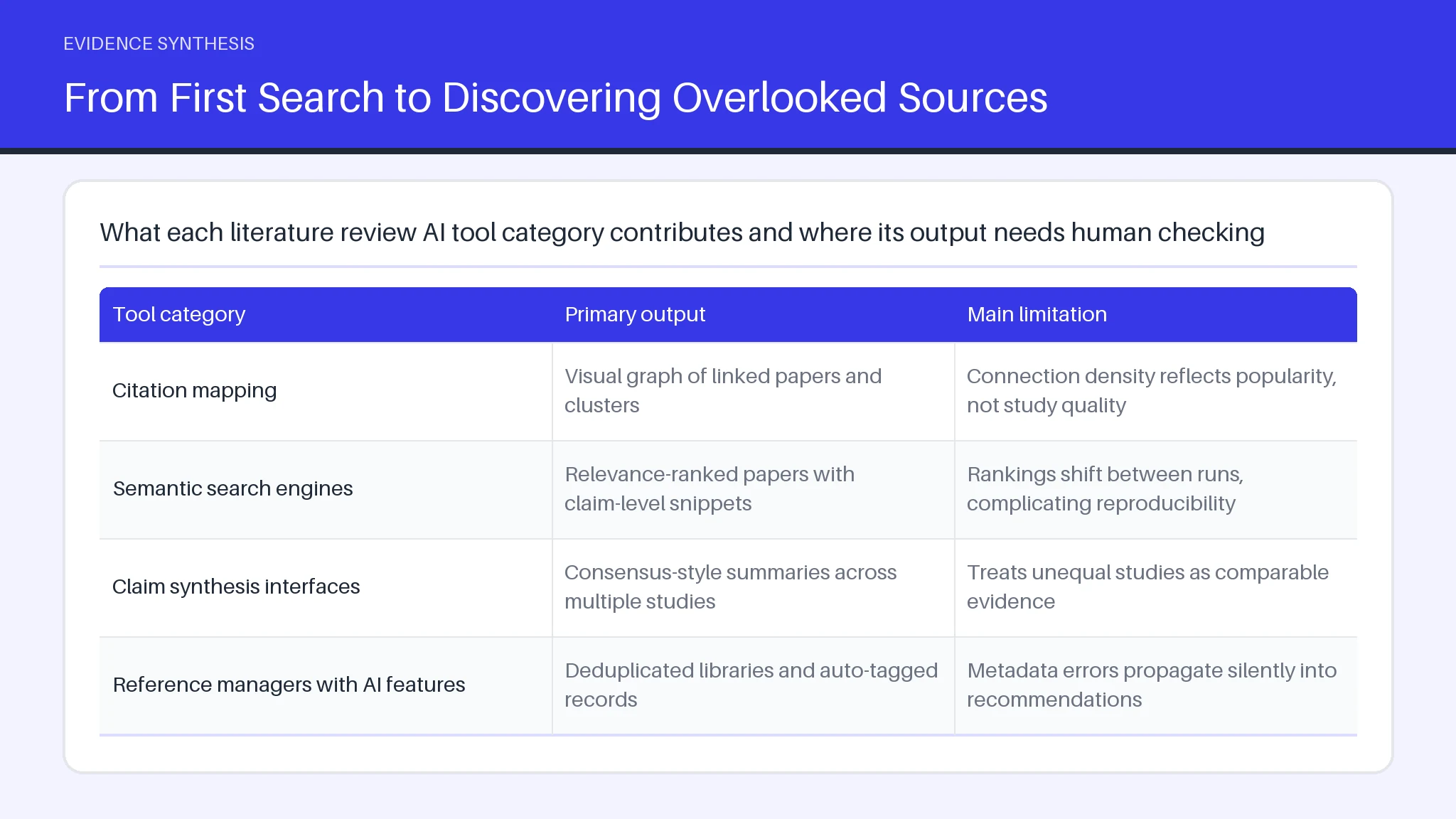
| Tool category | Primary output | Main limitation |
|---|---|---|
| Citation mapping | Visual graph of linked papers and clusters | Connection density reflects popularity, not study quality |
| Semantic search engines | Relevance-ranked papers with claim-level snippets | Rankings shift between runs, complicating reproducibility |
| Claim synthesis interfaces | Consensus-style summaries across multiple studies | Treats unequal studies as comparable evidence |
| Reference managers with AI features | Deduplicated libraries and auto-tagged records | Metadata errors propagate silently into recommendations |
Which AI Tools Handle Literature Reviews Well
The AI tools that perform well on literature reviews share one trait: every output traces back to a specific source document you can open. Tools that generate prose without that link are useful for brainstorming and nothing else. This distinction matters more than feature counts, because the cost of an unverifiable claim in a review is a correction notice, not a wasted afternoon.
Six categories cover almost all serious use. Semantic search engines retrieve papers by meaning rather than exact terms, which catches studies that use different vocabulary for the same construct. Claim-level answer engines return a Consensus-style summary of what multiple papers found on a narrow question, with each sentence tied to a citation. Screening assistants rank titles and abstracts by predicted relevance so reviewers read the likely includes first. Data extraction tools pull populations, sample sizes, and outcome measures into a structured grid. Citation mapping interfaces handle discovery. Reference managers handle deduplication and library hygiene.
Why these AI tools matter for literature reviews comes down to volume. A comprehensive search on a broad clinical question routinely returns several thousand records, and the proportion worth reading is usually under five percent. Automated relevance ranking does not change what you include, but it changes the order you encounter records in, which means researchers reach saturation on their inclusion decisions sooner.
Where AI tools still underperform is nuance: distinguishing a pilot from a definitive trial, noticing that two papers report the same cohort, or recognizing that an outcome was measured differently. Those recommendations require reading. For a broader comparison of platform options, see our guide to picking the right literature review software.
How to Avoid Errors When AI Drafts Your Review
Errors in AI-assisted reviews cluster in three places: fabricated or mismatched citation details, overstated certainty about what the evidence shows, and silent omission of studies that contradict the drafted narrative. Each has a specific countermeasure.
For citation integrity, resolve every reference against its DOI before it enters your manuscript. A plausible author, year, and journal combination that resolves to nothing is the classic failure mode, and it survives a casual read. Keeping your library in a reference manager with Zotero-style DOI lookup makes this a mechanical check rather than a judgment call.
For overstated certainty, compare the drafted sentence against the abstract and results of each cited paper. A tool summarizing across a Semantic Scholar index or similar corpus will often flatten a hedged finding into a declarative one. Where a Consensus-style interface reports agreement across studies, check whether those studies share a design, a population, and an outcome definition before accepting the agreement as meaningful.
For omissions, run a deliberate disconfirming search. Query the opposite of your drafted conclusion and see what returns. Analyzing the papers that do not fit is the fastest way to catch a narrative the model built from whatever happened to rank highest.
Finally, keep tool integration shallow enough that you can audit it. Literature review AI that writes directly into your draft removes the checkpoint where you would otherwise notice a problem.
Core Features Review Platforms Offer, Side by Side
Review platforms converge on a similar feature list, but the implementations differ in ways that matter once you are three thousand records deep. Judge them on five things: search reach, screening support, extraction structure, export fidelity, and reference manager integration.
Search reach means which indexes a platform queries and whether it uses keyword logic, semantic matching, or both. Pure semantic retrieval finds conceptually related work that Boolean strings miss, but it cannot reproduce an exact query on demand, so protocol-driven reviews usually need both. Screening support ranges from simple dual-reviewer blinding to active learning that reorders the queue as you decide. Extraction structure determines whether findings arrive as free text you must retype or as fields you can analyze.
Export fidelity is the quietly decisive one. If a platform cannot export full records with abstracts and your decision history intact, you have locked your project inside it. Zotero and comparable managers remain the practical safety net, because a RIS or BibTeX export that round-trips cleanly protects you from any single tool's roadmap.
Integration with claim-level sources such as a Semantic Scholar index or a Consensus-style answer layer adds discovery breadth, though it also means two tools now disagree about which studies are central. Reconcile those lists manually; the disagreement often marks exactly the concepts your search strategy underweighted.
Literature review AI features age quickly, so weight data portability above any single capability.
From First Search to Discovering Overlooked Sources
Overlooked sources hide in predictable places: older papers using retired terminology, work published in adjacent disciplines, non-English studies, gray literature, and papers whose abstracts omit the outcome you care about. A keyword query built from current vocabulary finds none of them reliably.
A workable sequence starts with a structured database search to establish your defensible core, then adds three discovery passes. First, citation chasing in both directions from your five most relevant papers, which is where a Research Rabbit style graph interface earns its place. Second, a semantic query written as a sentence rather than a string, phrased as the claim you expect to find; this surfaces studies that describe the same construct differently. Third, a Consensus-style question put to a claim-indexed corpus, which returns papers grouped by what they concluded rather than by what they are about.
Each pass should end with the same discipline: export the new references, deduplicate against your existing library in Zotero or an equivalent manager, and log how many unique records the pass added. If a pass adds nothing, your original query was strong. If it adds twenty papers, your query had a blind spot worth documenting.
Research gaps become visible through this process too. When researchers find a cluster of studies that all cite the same single trial, the gap is replication rather than coverage. The best AI assistance here is the kind that shows you structure, not the kind that hands you a paragraph.
Six AI Applications for Reviewing Published Research
Six applications account for most of the value researchers get from AI-powered research tools, and they map cleanly onto stages of work rather than onto products.
- Query expansion. Generating synonyms, spelling variants, and controlled vocabulary candidates before you build a formal search string. ChatGPT and similar general models are genuinely good at this, because a wrong suggestion costs nothing and a right one widens your net.
- Semantic retrieval. Finding papers by described meaning, which catches work indexed under vocabulary you did not think of.
- Citation graph traversal. Following references forward and backward, the job a Research Rabbit style interface does visually.
- Relevance ranking for screening. Reordering thousands of abstracts so likely includes arrive first, cutting the time to a stable decision set.
- Structured extraction. Pulling sample sizes, settings, and outcome measures into a grid you can sort and check.
- Cross-study comparison. Consensus-style views that show how many papers reached similar findings on a narrow question.
These AI-powered tasks share a property worth noting: each produces an intermediate artifact you can inspect, not a finished conclusion. That is the design signal to look for. The moment a tool jumps from records to prose without showing its working, you have lost the ability to audit it, and an unauditable review is one you cannot defend in peer review.
How Tool Categories Differ at Academic Search
Academic search tools differ mainly in what they treat as the unit of retrieval. Traditional bibliographic databases retrieve records matched to indexed terms. Semantic engines retrieve papers matched to meaning vectors. Claim-level engines retrieve individual statements extracted from papers. General chat models retrieve nothing at all unless connected to a live index, which is why ChatGPT alone is unsuitable for search and perfectly suitable for drafting a query.
That difference shapes what researchers get back. Term-matched retrieval is reproducible and auditable, so it anchors the formal literature review process. Meaning-matched retrieval is broader and better at crossing disciplinary vocabulary, but two identical searches a month apart can return different sets. Claim-level retrieval answers narrow empirical questions quickly and misses context that lives in a paper's limitations section.
Summarization sits on top of all three and inherits whatever the retrieval layer got wrong. A clean summary of a biased sample of papers reads exactly like a clean summary of a representative one, which is the central risk.
The best AI strategy for search is layered: build the auditable query first, document it, then use semantic and claim-level tools to test whether that query missed anything. Reporting your findings in that order also satisfies reviewers who want to see a reproducible strategy rather than a tool list.
Where Literature Review AI Technology Is Headed Next
A literature review is a structured account of what has already been published on a question, organized by theme or argument rather than by paper, and written to show where current knowledge stands and where it runs out. The pillar guide covers how to plan, judge and write one in full; what concerns us here is which parts of that work automation is moving toward.
The five C's offer a useful test for any claimed advance. A strong review cites the relevant work, compares studies against each other, contrasts where they disagree, critiques the methodologies behind the disagreement, and connects the whole to the question at hand. Current AI tools handle citing and comparing competently. Contrasting is partial. Critiquing study design and connecting findings to a specific research question remain human work, and nothing in the near-term roadmap changes that.
Three shifts are visible. First, retrieval is moving from document level to claim level, so a database query returns statements with their evidence context rather than whole papers. Second, summarization is becoming grounded by default, with each generated sentence carrying a span reference into the source. Third, screening models are being trained on review-specific decision histories rather than generic text, which improves ranking on the kinds of borderline records that cost reviewers the most time.
For researchers using AI in research and literature review work today, the practical implication is to adopt tools that expose their intermediate steps. Semantic retrieval and automated ranking will keep improving; the obligation to show how you reached your included set will not relax. The best AI investment is the one whose outputs you can still explain in a methods section two years from now. Platforms built for evidence synthesis, including systematic review software, increasingly treat that audit trail as a core requirement rather than an add-on.
What AI Genuinely Does at Each Review Stage
Automation earns its place unevenly across the literature review process, and knowing where it helps prevents both over-trust and wasted setup time.
At protocol and question definition, AI contributes little beyond wording suggestions; the research question drives everything downstream and needs domain judgment. At searching, semantic expansion genuinely widens reach. At deduplication, automated matching is reliable and should always be used. At title and abstract screening, relevance ranking helps researchers front-load the obvious includes, while the inclusion and exclusion criteria themselves still require two human reviewers on anything that will be published.
At full-text review, literature review tools assist with locating specific data points inside long PDFs, which is tedious manual work with a high error rate when done by hand. At extraction, structured field population saves real time and still needs verification against the source. At appraisal, automation is not dependable; judging risk of bias means reading methods sections closely, as our guide to critical appraisal sets out. At synthesis, tools can group studies by theme, but the recommendations you draw from that grouping are yours to defend.
Note the pattern: automation is strongest where the task is matching and weakest where it is judging.
Frequently asked questions
How to do a literature review with AI?
Running a literature review with AI works best as a layered process. Define your question and inclusion rules first, build an auditable database query and record it, then use semantic search and citation mapping to test that query for blind spots. Import everything into a reference manager, deduplicate, and use relevance ranking to order your screening queue rather than to make decisions for you. Extract data into structured fields, verify each against the source PDF, and write the synthesis yourself. The value of a good AI literature review tool lies in traceability, active learning on your own screening decisions, clean export formats, and the ability to show which sentence in which paper supports each output.
What is a literature review?
A literature review is a structured synthesis of published work on a defined question, organized by theme or argument rather than paper by paper, showing what is known, where studies disagree, and what remains unanswered. Our pillar guide on planning, judging and writing a literature review covers the full method, including how it differs from an annotated bibliography.
What are the 5 C's of a literature review?
The five C's are cite, compare, contrast, critique, and connect. You cite the relevant literature accurately, compare studies on method and finding, contrast where results diverge, critique the design choices that explain the divergence, and connect the whole body of work back to your own question. Using them as a checklist against a draft reveals summary passages that never progress into analysis.
Which AI is good for literature review?
Tools built on indexed scholarly corpora suit literature review work best, because every statement they produce can be traced to a specific paper. The main types are semantic search engines, claim-level answer interfaces, citation mapping graphs, screening and extraction platforms, and reference managers with AI tagging. General-purpose chat models belong in the drafting and query-brainstorming stages only. Choose by the stage you are stuck on rather than by overall capability claims.
Can you tell if an article has been written by AI?
Detection of AI-written text is unreliable at the level of an individual article. Statistical detectors flag unusually even sentence rhythm and low word-choice variability, but they misclassify careful human academic prose and miss lightly edited machine output. Fabricated or unresolvable citations are a far stronger signal than any detector score. Our piece on what Canvas AI detection actually checks explains the mechanics.
Which AI is better than ChatGPT for writing?
No general writing model is categorically better than another for academic work, because the limiting factor is grounding rather than fluency. For review writing, a model connected to a verified corpus of papers will outperform a stronger but ungrounded model every time, since the failure that matters is a confident sentence with no source behind it.
What happens if you get caught using AI in college essay?
Consequences for undeclared AI use in coursework depend entirely on your institution's academic integrity policy. Outcomes commonly range from a required resubmission to a failing grade for the assessment, and repeated or contested cases can escalate to formal misconduct proceedings. Many universities now permit disclosed AI assistance for specific tasks such as proofreading or search term generation, so read your course's stated policy and declare your use in the submission.