Research questionnaires in quantitative studies are structured instruments. They ask every participant the same questions, in the same order, with answer options fixed in advance. That lets you count the results, compare groups and test them statistically. This guide is for graduate students, clinicians, educators and market research teams who need numbers rather than narratives: how many people do something, how strongly they agree with a statement, or whether one group differs from another.
The reasons to use them are practical. A methods paper on questionnaire design notes that questionnaires are a low-cost way to collect large amounts of data quickly, even from a wide sample. They can also be standardized, which allows comparison between groups and locations (Designing and validating a research questionnaire, Part 1). The same paper warns that a questionnaire is not always the best way to get the knowledge a study needs. Your first decision is whether your question calls for measurement at all.
This guide shows you how to:
- choose the right question format for each thing you measure
- write survey questions that produce clean data
- decide when an open-ended item is worth including
- check validity and reliability before launch
You can adapt the example wordings for a thesis survey, a course or patient evaluation, or a customer study.
Before you start, you need three things: a clearly stated research objective, a list of the variables you plan to measure, and a plan for how you will analyze each one. If your topic is still taking shape, work on your research question first. Strong research questionnaires in quantitative projects start from that analysis plan and work backward. They do not start from a list of things it would be nice to know. Without that plan, you end up with a long form full of data nobody can use.
Key takeaways
- A quantitative questionnaire turns answers into numbers because it fixes the answer options, units and timeframe before anyone responds.
- Decide how you will analyze each item before you write it. An exact age supports a mean. Age bands do not.
- Plan for nonresponse. If you expect many people not to respond, recruit roughly 20% to 30% more participants than your calculated minimum sample.
- Open-ended items still have a place, mostly as an "other" option, a numeric entry box or a short comment box that explains the numbers.
- Check the questionnaire before launch: have experts review every item, run a pilot, then test reliability on any multi-item scale.
How Quantitative Survey Questions Turn Answers Into Measurable Data
Quantitative survey questions are closed questions with answers fixed before data collection begins. Each reply becomes a code, a count or a value you can summarize and compare. A well-built questionnaire asks participants specific questions about their perspectives, experiences or attitudes to provide "valuable insights and data" (Crafting an effective questionnaire). Questionnaires are popular in quantitative studies for several reasons. They cost little and collect large amounts of data quickly from a wide sample. They can also be standardized, and they allow comparison between groups and locations (Designing and validating a research questionnaire).
This structured approach works best when your research question is precise and tied to measurable variables. Quantitative research questions can describe the characteristics of variables, look for differences between groups on an outcome, or examine relationships among variables (A Practical Guide to Writing Quantitative and Qualitative Research Questions). Relationship-based survey questions handle that last aim by measuring both variables in the same participants, such as weekly study hours and exam score.
Published guidance points to a few habits to follow when you write each item:
- Plan the analysis first. One guide uses age as its example. If you want the mean age of participants, capture exact age (Designing A Questionnaire). A form that records only age bands lets you count people in each band, but you cannot calculate a true mean afterward.
- Use clear, concise language. Avoid complex sentences, jargon and ambiguous terms (Crafting an effective questionnaire).
- Order items logically. Start with demographics and then move to specific questions. Use skip questions so respondents can bypass sections that do not apply to them.
- Test before launch. Do not skip pilot testing. Expert reviewers can rate each item for relevance and clarity and add free-text comments (AMEE Guide No. 87).
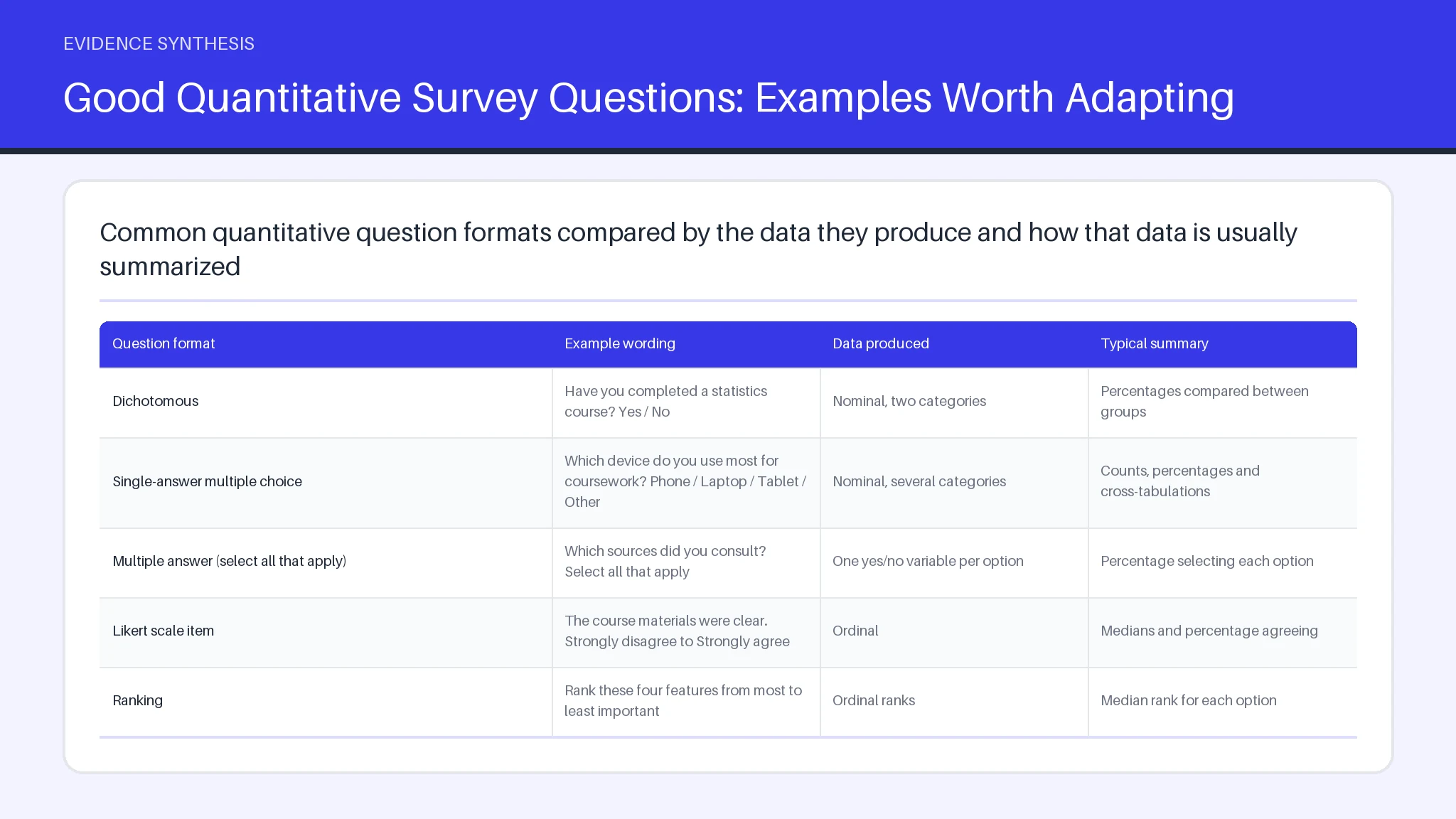
Most research questionnaires in quantitative designs combine several of the formats below. Systematicly also keeps a fuller set of samples organized by question type.
| Question format | Example wording | Data produced | Typical summary |
|---|---|---|---|
| Dichotomous | Have you completed a statistics course? Yes / No | Nominal, two categories | Percentages compared between groups |
| Single-answer multiple choice | Which device do you use most for coursework? Phone / Laptop / Tablet / Other | Nominal, several categories | Counts, percentages and cross-tabulations |
| Multiple answer (select all that apply) | Which sources did you consult? Select all that apply | One yes/no variable per option | Percentage selecting each option |
| Likert scale item | The course materials were clear. Strongly disagree to Strongly agree | Ordinal | Medians and percentage agreeing |
| Ranking | Rank these four features from most to least important | Ordinal ranks | Median rank for each option |
No fixed number of questions suits every questionnaire. Each item should serve the research objectives, and you should leave out any question that does not (Crafting an effective questionnaire). Length also affects recruitment. The same source says a well-crafted design encourages complete responses. If you expect a high nonresponse rate, it advises recruiting 20% to 30% more participants than your calculated sample size.
Main Categories of Quantitative Research Questionnaires
Research questionnaires in quantitative studies fall into three main types by purpose: descriptive, comparative and relationship-based. A practical guide to writing questions and hypotheses for scholarly articles uses the same split:
- Descriptive questions describe a population or the characteristics of what is measured.
- Comparative questions look for differences between groups on an outcome.
- Relationship questions examine trends and interactions among variables.
Each purpose shapes the questionnaire differently:
- Descriptive questionnaires estimate how common a behavior, belief or characteristic is. Careful sampling matters more here than clever items. Typical outputs are percentages and numerical summaries such as means.
- Comparative questionnaires must capture a grouping variable, such as year of study or clinic site, with clean categories. Without it, you cannot make the comparison.
- Relationship questionnaires measure at least two things in the same respondents, such as opinions alongside a behavior. Both need dependable measures.
You can also group questionnaires by content: behavior and experience, attitudes and opinions, knowledge, and demographics. Medical education offers familiar examples, such as student course evaluations, patient satisfaction surveys and student self-assessments. A review of original research in the journal Medical Teacher found that 37 articles (24%) published in 2011 and 2012 used surveys as part of their study design (AMEE Guide No. 87). Market research uses the same structured types in usage, awareness and preference studies. Whatever the type, responses only become useful insights when each item maps clearly to one of these purposes.
Quantitative vs Qualitative Survey Questions: How They Differ
The main difference between quantitative and qualitative survey questions is who controls the answer. Quantitative items fix the options in advance. Qualitative items let people respond in their own words. That one difference shapes everything else, from how you word the question to how you handle the data afterward.
In qualitative studies, questions usually ask "what" or "how." They are open-ended to draw out description rather than to link measures or compare groups, and researchers often revise them as the study goes on (the same practical guide). Quantitative questions are precise. You write them at the start and keep them fixed, so every participant answers the same questionnaire.
- Asking quantitative questions: specify the unit, the timeframe and every allowed answer. Example: if you plan to report participants' mean age, ask for their exact age. 0, 1 to 5, 6 to 10, more than 10."
- Asking qualitative questions: use one open prompt per question that does not push people toward an answer. Example: "What, if anything, made coursework harder this week?"
Use quantitative items when you know the likely answers and need to count, compare or test. Use qualitative items in two situations: when you are exploring a topic where you cannot yet write the answer options, and when you need to explain a pattern the numbers reveal.
The two types often work in sequence. A methods paper on questionnaire validation recommends building a conceptual framework first. That may involve a scoping review of published literature, a look at similar questionnaires, or focus groups to identify common themes (Designing and validating a research questionnaire, Part 1). Those open-ended findings then supply the answer options for the structured questionnaire.
Many research questionnaires in quantitative designs also keep a small open section, such as a final comment box. The closed responses tell you how many people answered each way. The comments provide insights into why.
Single-Answer Multiple Choice Questions in Quantitative Surveys
Single-answer multiple choice questions ask respondents to choose exactly one option from a fixed list. Each person lands in one category, so the answers are easy to count, cross-tabulate and compare between groups. That fits the standardized, group-to-group comparison that makes questionnaires popular in quantitative studies (Designing and validating a research questionnaire, Part 1).
The format only works if you build the list carefully:
- Choose categories or exact values before you write options. Plan the analysis first. If the objective of asking age is to report the mean age, you need to record exact age, not an age band (Designing A Questionnaire). You cannot calculate a mean from answers to a list of age bands.
- Use clear, unambiguous wording. Published guidance on questionnaire design advises plain, concise language and warns against jargon and ambiguous terms (Crafting an effective questionnaire).
- Ask about one thing. "How satisfied are you with the price and quality?" forces one answer to cover two separate judgments. Ask about each one separately, with a satisfaction scale running from "Very dissatisfied" to "Very satisfied."
- Test the list before launch. The same guidance warns against skipping pilot testing. Expert reviewers can also rate each item for relevance and clarity (AMEE Guide No. 87). If you catch a confusing option early, it is less likely to bias the results.
Link every item to a stated objective before you write the options. When you design research questionnaires in quantitative health or education studies, that link determines the categories. If you need to compare first-year and final-year students, the year-of-study item must produce exactly those groups. Well-built single-answer items yield nominal or ordinal data that is ready for statistical comparison between groups. When you already know the categories, a structured list in a quantitative survey is faster to code than free text.
Good Quantitative Survey Questions: Examples Worth Adapting
Good quantitative survey questions cover one idea, one timeframe and one answer format, so every respondent reads them the same way. Published guidance on questionnaire design recommends clear, concise language that respondents can easily understand, and it warns against complex sentences, jargon and ambiguous terms (Crafting an effective questionnaire, PMC). The pairs below put weak wordings next to stronger versions you can adapt.
- Leading. Weak: "Don't you agree the new clinic hours are better?" Stronger: "The new clinic hours suit my schedule," answered from Strongly disagree to Strongly agree.
- No unit. Weak: "How much do you spend on textbooks?" Stronger: "In the current semester, how much have you spent on required textbooks, in US dollars?"
- Scale with no labeled ends. Weak: "How would you score the app?" Stronger: "On a 0 to 10 rating, where 0 is not at all likely and 10 is extremely likely, how likely are you to recommend this app to a colleague?"
- Format that does not fit the analysis. Decide how you will analyze each item before you write it. If you want the mean age of participants, ask for exact age in years instead of age bands (Designing a questionnaire, PMC).
Each stronger version produces responses that line up neatly in a spreadsheet, with no recoding or guessing what people meant. The same rules apply to everyday instruments such as course evaluations and patient satisfaction surveys, which AMEE Guide No. 87 describes as common in medical education (AMEE Guide No. 87, PMC). Before fielding, pilot test the items and ask experts to judge each one for relevance and clarity. When you adapt these survey questions, keep the wording the same across groups and rounds of data collection so your comparisons stay valid. If you plan to measure the same people more than once, see longitudinal versus cross-sectional studies for the trade-offs between one-time and repeated designs.
Can Open-Ended Questions Belong in a Quantitative Survey?
Open-ended questions can belong in a quantitative survey if you keep them few, place them on purpose, and either ask for a number or plan how to code the answers. They add context the closed items cannot. The cost is time: someone has to read every free-text answer and sort it into categories before it can feed any statistical analysis.
Three placements are usually worth it:
- Numeric open entry. "How old are you, in years?" and "What is the most you would pay per month for this service, in US dollars?" are technically open, yet the answers are numbers. For pricing questions, open numeric entry keeps the full spread of values, while preset bands collapse it. This is the same logic that applies to recording exact age (Designing A Questionnaire).
- "Other, please specify." This catches answers your list missed and shows which options to add in the next version.
- A follow-up after a score. A short "What is the main reason for your score?" placed after rating scales helps explain unexpected results.
The AMEE guide to developing questionnaires recommends giving expert reviewers space for free-text comments alongside the quantitative data they provide. Combining the two improves content validity (AMEE Guide No. 87). The same idea applies to respondents: the numbers show how big a pattern is, and a few comments provide the insights that explain it. Make open items optional and put them near the end. That way, a skipped comment box never costs you the closed answers you need most.
Example Wordings That Show a Quantitative Question Type in Action
Example wordings make a question type concrete because they show how a study aim becomes an item that produces quantitative data. In quantitative studies, research questions can describe a population, compare groups on an outcome, or examine relationships among variables, as a practical guide to writing quantitative questions and hypotheses explains. The illustrative wordings below show each type, and researchers can adapt them to their own topic.
- Descriptive. Aim: find out how many nursing students use a study app each week. Item: "In a typical week this term, on how many days do you use a study app? 0 to 7."
- Comparative. Aim: find out whether first-year and final-year students differ in weekly study time. Items: a year-of-study question plus "About how many hours did you spend on independent study last week?"
- Relationship. Aim: find out whether sleep is linked to daytime pain. Items: "On average over the past week, how many hours did you sleep per night?" and a 0 to 10 rating of average daytime pain.
- Dichotomous screening question. Aim: send people past sections that do not apply to them. Item: a single Yes / No question with skip logic. Questionnaire design guidance recommends proper skip questions to bypass irrelevant sections. See dichotomous question formats for more patterns.
Plan the analysis before you settle the wording. If you want to report the mean age of participants, the item should capture exact age, because an age band cannot give you a mean later.
Whether you use a Likert scale or a numeric 0 to 10 item:
- label every point on the scale
- keep the scale running in the same direction across items
- use identical scales for items you plan to combine
- decide in advance whether a neutral option is a meaningful answer for your aims
- pilot the items and use clear, concise language that respondents can easily understand
That way, the insights you report come from what you meant to measure, not from changes in layout.
Key Design Choices for Quantitative Research Questionnaires
The main design choices in a questionnaire are mode, answer format, question order, answer options and sample size. Each one trades convenience against data quality. Settle them before you write the final wording, because changing one later often means changing the others too.
- Mode. Online forms are cheap and fast. Paper and interviewer-led versions reach people with limited internet access but cost more for each completed response. You can mix modes, but keep the wording the same in each.
- Answer format. Exact counts let you calculate means and correlations. Frequency labels such as "rarely" or "often" are quicker to answer, but they mean different things to different respondents. Choose based on the analysis you need.
- Order. One methods review recommends a logical flow that starts with demographics and moves on to specific questions, with skip questions that let people bypass sections that do not apply to them (Crafting an effective questionnaire). Some researchers move sensitive demographic items, such as income, to the end so they do not put people off early. Whichever order you choose, test it in the pilot.
- Answer options. If you cannot write the options yet, earlier qualitative research such as interviews or focus groups can supply them. This step is common in both academic and market research.
- Sample size and nonresponse. First calculate the minimum sample you need to detect your effect statistically. Then increase it to allow for people who will not respond. The same review advises that when you expect a high nonresponse rate, you should recruit additional participants in line with that rate, typically 20% to 30% on top of the calculated sample (Crafting an effective questionnaire). For example, if your calculation calls for 300 completed questionnaires, plan to recruit roughly 360 to 390 people.
Record each choice and the reason for it in your protocol. Readers should be able to trace each of the variables you measure from your objective to a specific item. That traceability gives them confidence in the insights you report.
Step-by-Step Questionnaire Design With Validity and Reliability Checks
A sound questionnaire is built in six steps, in order. You check validity before launch and confirm reliability with real data. Following the steps in sequence catches most problems while they are still cheap to fix.
- Define your objectives and variables. Build a conceptual framework of everything you need to measure. Draw on the literature, existing questionnaires on similar topics, and qualitative research where the topic is new (Designing and validating a research questionnaire, Part 1). Reuse validated scales where they exist.
- Draft structured items. Match each item to the analysis you plan. Use clear, concise language, and avoid jargon, complex sentences and ambiguous terms (Crafting an effective questionnaire).
- Have experts check the content. Ask reviewers to score every item, and each group of items, for relevance and clarity. Give them space for free-text comments (AMEE Guide No. 87).
- Pretest with a few people from your target group. Ask them to think aloud as they answer, so you can catch items they read in unexpected ways.
- Pilot the full questionnaire. Run it with a small sample under real conditions and time it. Review the numerical results for missing answers, lopsided items and broken skip logic. Do not skip this step.
- Test reliability. For multi-item rating scales that measure attitudes, check internal consistency, meaning whether the items in a scale give consistent results. For traits that should stay stable, give the same questions twice and compare the answers to see whether they hold over time.
Common mistakes to avoid:
- arranging questions randomly instead of in a logical order
- including questions that serve no stated objective
- skipping the pilot
- changing the wording partway through data collection
The same discipline applies whether the study is academic or a market research project. If your results may later be pooled with other studies, consistent measures make that much easier. See the meta-analysis guide for how comparable outcomes are combined.
Frequently asked questions
Does quantitative research have surveys?
Yes. Quantitative research uses surveys widely, and the questionnaire is one of its most common tools for collecting data. Questionnaires suit quantitative studies because they gather large amounts of standardized data quickly and at low cost, which allows comparison between groups (Designing and validating a research questionnaire, Part 1). A survey is quantitative when its survey questions have fixed answer options that produce counts, scores or measurements. A survey made up mostly of open prompts is closer to qualitative work.
How do you create a questionnaire?
You create a questionnaire by starting from your research objective, working back to individual items, and testing those items before launch. In practice:
- List what you need to measure and how you will analyze each item.
- Draft clear items that each cover one idea and include every possible answer option.
- Have experts review the items for relevance and clarity.
- Pilot the questionnaire with a small group of respondents and revise it.
- Check reliability for any multi-item scale, then launch with a larger sample to allow for nonresponse.
What is the difference between multiple choice and multiple answer questions?
A multiple choice question asks respondents to pick one option. A multiple answer question lets them pick every option that applies. The format you choose decides what kind of data you collect, so treat it as an analysis decision as well as a wording decision. The PMC article "Designing A Questionnaire" advises deciding how you will analyze each item before you write it. Choose the format your planned analysis needs. Put the rule in plain words, such as "select one" or "select all that apply," and test the item in a pilot before launch.