Secondary research means analyzing information that someone else already collected, usually for a different purpose, to answer a new question. Instead of recruiting participants and collecting fresh responses, you work from published studies, government statistics, industry reports, clinical registries and administrative records. You get speed and scale. The cost is that you inherit every decision the original collectors made about whom to sample and what to measure.
This guide is for students, analysts, product teams and evidence reviewers who need a solid answer from existing data before commissioning primary research, or in place of it. It shows you how to tell internal sources from external ones, how to judge whether a dataset can actually answer your question, how to decide when original data collection is worth the cost, and how to combine both approaches in one plan. The same logic applies whether you are sizing a market research opportunity or preparing the background for a clinical study.
You need three things before you start. First, a written research question narrow enough to test. Second, a list of the variables you must have to answer it. Third, a simple log for recording where each figure came from. Secondary research rewards this preparation, because most wasted hours come from searching before you know what a usable dataset looks like.
Key takeaways
- Desk research reuses data collected for another purpose, such as published reports, registries, claims records and surveys, to answer a new question.
- Primary research collects new data designed around your question. It costs more time and money, but you control the measures and the sample.
- Before you rely on an existing dataset, check that it fits your question, has enough observations, includes the key variables and follows people for long enough.
- Strong projects often start with existing data to map what is already known, then use targeted fieldwork to close the remaining gaps.
What Is Secondary Research?
Desk research, also called secondary analysis, means answering a new question with data that someone else collected. The NCBI Bookshelf user's guide on protocols for observational comparative effectiveness research draws the line clearly. Primary data are collected specifically for research. Secondary data were collected for other purposes and are reused to answer a research question. A PMC review of systematic reviews and meta-analysis describes the field the same way, as two fundamental categories of research: primary and secondary.
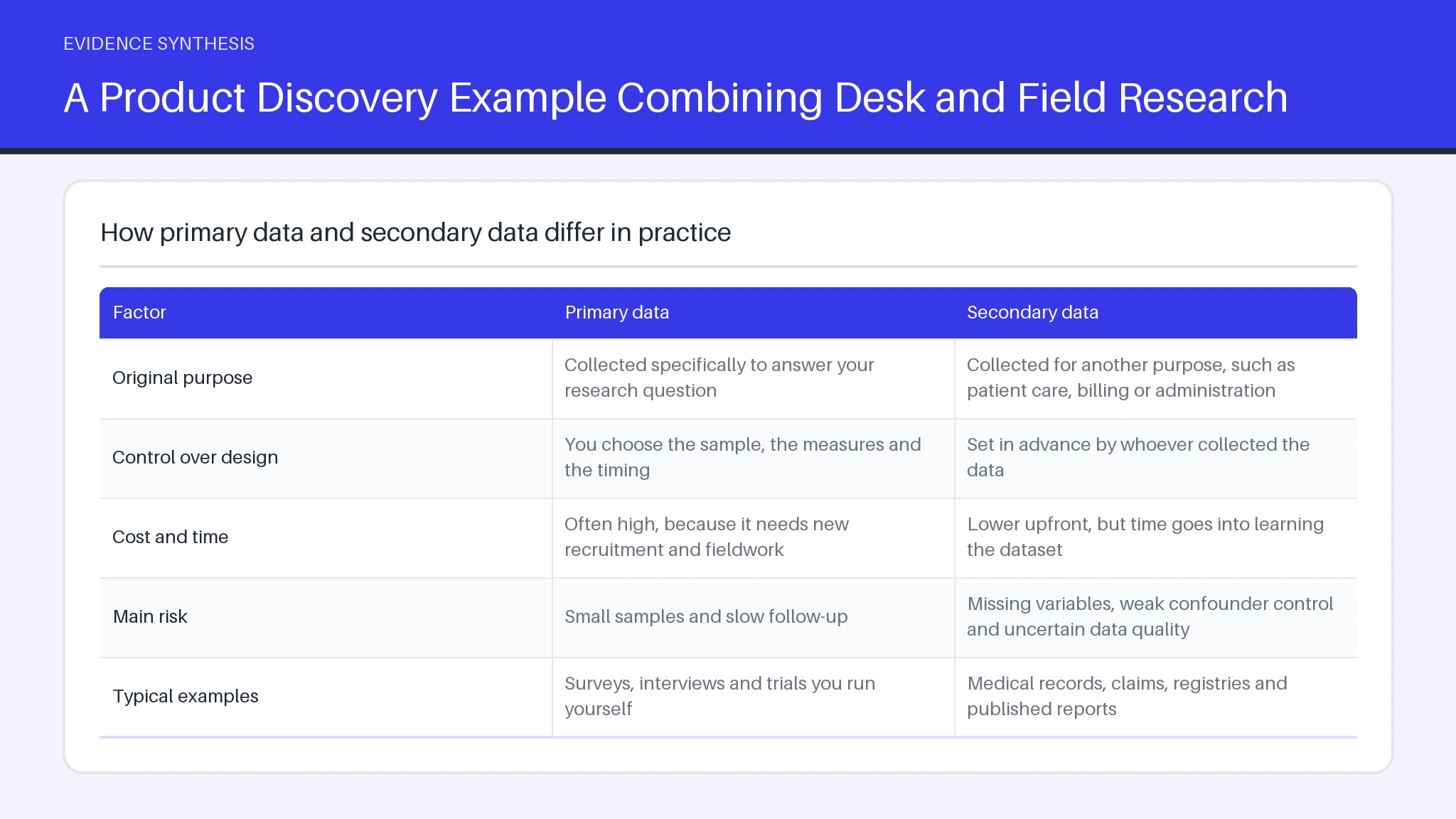
In practice, conducting this kind of work involves three steps. You locate the sources, you judge whether they fit your question, and you extract the findings or raw information you can analyze. The table below sets out the trade-offs that decide which kind of data suits a project.
| Factor | Primary data | Secondary data |
|---|---|---|
| Original purpose | Collected specifically to answer your research question | Collected for another purpose, such as patient care, billing or administration |
| Control over design | You choose the sample, the measures and the timing | Set in advance by whoever collected the data |
| Cost and time | Often high, because it needs new recruitment and fieldwork | Lower upfront, but time goes into learning the dataset |
| Main risk | Small samples and slow follow-up | Missing variables, weak confounder control and uncertain data quality |
| Typical examples | Surveys, interviews and trials you run yourself | Medical records, claims, registries and published reports |
Secondary Research Categories: Internal and External Sources
Existing data sources fall into two groups. Internal sources are records your own organization already holds. External sources come from governments, research teams, registries, publishers and industry bodies. The split matters because it changes how much you know about how the data were made. With internal records, you can usually ask the person who built the system. With external data, you depend on the documentation.
Data that began as primary data for one team often ends up as secondary material for another. Registries for Evaluating Patient Outcomes, a user's guide on NCBI Bookshelf, gives health examples. Demographic details from a hospital admission and discharge system, medication use from pharmacy records and procedure details from a catheterization laboratory system can all be transferred into a registry and sit alongside primary data collected for the registry itself. The NCBI protocol guide traces this to the "record generation process": records are created during patient care, claims are created so providers get paid, and dispensing records are created at the pharmacy.
- Internal sources: sales and billing records, customer support logs, product analytics, past survey files, earlier project reports and electronic health records.
- Government and program data: national statistics and program records such as Medicare claims. These often suit longitudinal work, because people enrolled in Medicare usually stay enrolled for the rest of their lives.
- Clinical and disease registries: datasets built around one condition, such as the Surveillance, Epidemiology and End Results (SEER) Program, and already-linked resources such as SEER-Medicare.
- Published literature: peer-reviewed articles, systematic reviews and meta-analyses that summarize findings across many trials.
- Industry and trade material: association surveys, regulatory filings and company annual reports, which reward a deliberate search strategy.
Bookmark these four sources first: your national statistics agency, the main registry in your field, one bibliographic search platform, and the documentation pages for any dataset you plan to reuse. Documentation is the resource people most often skip and later regret skipping.
Advantages of Working With Existing Data
Existing data offers a scale, history and reach that a single team could rarely build. A PMC introductory guide to secondary dataset analysis gives an example. To compare racial and ethnic differences in health services use over the last 10 years of life, you could enroll a diverse group of people with chronic illness and wait a decade or longer. Or you could find a dataset that already includes a diverse sample of people who have died. Primary data collection on that scale takes time and money, and junior researchers in particular rarely have either.
- Large samples and long follow-up: established datasets can provide large samples, relevant measures and longitudinal records with no new recruitment.
- Population baselines: census and national survey figures let you check whether a small primary sample resembles the wider population.
- Timeliness: the NCBI protocol guide notes that electronic records and computer-aided collection can produce detailed data, sometimes in real or near-real time, which helps you spot trends.
- A predictable academic timeline: the PMC guide calls two years from start to publication typical for large database research.
The trade-off is a different kind of effort. Instead of gathering data, you spend your time learning someone else's.
Secondary Research vs Primary Research: The Practical Differences
Primary research produces new data designed for your question, while secondary research reuses data that already exists. The practical difference is who controlled the design. In primary research, you choose the sample, the wording of every question and the follow-up schedule. With existing data, you accept someone else's choices and work around them.
When to use existing data: to map what is already known, size a population, benchmark against national figures, test a hypothesis that needs thousands of records, or follow outcomes that take years to appear. Existing data is also the sensible first step before any primary research, because it shows you which questions already have answers.
When to use primary research: when no adequate existing data can test your hypothesis, which the NCBI protocol guide gives as the reason observational work must collect new data. Primary research also makes sense when the variable you need was never recorded, when the population is too new or too small to appear in published data, or when you need people to explain their reasons in their own words.
The key differences:
- Control: primary research sets the measures in advance. With existing data, someone else has already set them.
- Cost: primary research spends money on recruitment and fieldwork. Reusing data spends time on reading documentation and cleaning records.
- Fit: primary research can match the question exactly. Existing data rarely does, so you may need proxies such as diagnosis codes.
- Validation: with primary research you know how every value was captured. With reused data, you may have to look for published evidence that the measures are accurate.
How to combine them: do the desk phase first, write down what it could not answer, and design primary research only for those gaps. Then use the existing figures to check whether your new sample resembles the wider population. A combined plan keeps primary research small and focused, because it only has to answer what the existing record could not.
A Product Discovery Example Combining Desk and Field Research
A hypothetical product team planning a medication reminder app for older adults shows how the two approaches fit together. The desk phase came first. The team reviewed published trials of reminder interventions, read national survey information on smartphone use by age, and gathered industry reports on the existing app market. Conducting secondary analysis of public survey files gave them a rough size for the target group without recruiting anyone.
That work answered the sizing questions but left two unknowns: why people skip doses, and which reminder formats they find intrusive. No reliable dataset recorded either one. So the primary research stayed narrow: a short round of interviews and a usability test with a prototype. The team then compared the field findings with the desk figures to see whether their small primary sample resembled the wider population of older smartphone users.
This sequence is common in early-stage work. Our guide to exploratory research covers that wider approach.
Tips to Speed Up Finding and Reviewing Existing Data
Desk work goes faster when you prepare well and refuse to trust any figure you cannot trace. These habits save the most time.
- Read the documentation first. The PMC guide to secondary dataset analysis recommends reading the online documentation and technical manuals, searching PubMed for validation studies and reading previous studies that used the same dataset. Start by asking who collected the data, and why.
- Search with a plan. Decide your terms, sources and inclusion rules before you open a search box. For health evidence, the steps in our systematic review guide keep searches reproducible.
- Keep a provenance log. For each number, record the source, the table or page, the date you accessed it and the definition it uses.
- Go back to the original. Trace headline statistics in news coverage or industry reports back to the primary sources behind them before you treat them as reliable.
Common mistakes to avoid:
- Treating a billing code as a confirmed diagnosis. The NCBI protocol guide advises citing evidence for data quality when a condition such as obesity is predicted from ICD-9 codes.
- Linking datasets without enough identifiers. The registry guide warns that mismatch errors and duplicate records must be managed.
- Starting primary research before checking whether published information already answers the question.
When Collecting Original Data Is the Better Choice
Collecting original data is the better choice when existing records cannot answer your question. The NCBI protocol guide warns that using secondary data may be impossible or unwise in some situations, and its data selection checklist shows where reuse breaks down.
- The key variable was never recorded. Claims show what was billed, not why a patient stopped taking a drug.
- There are too few observations. A rare condition or a niche customer segment may not have enough cases for a stable estimate.
- Confounders are missing. If you cannot measure the other factors that drive the outcome, comparisons may mislead.
- Follow-up is too short. The dataset ends before the outcome you care about appears.
- Quality is unknown. Records made for patient care or payment may not be reliable enough for research without validation.
- The topic is too new. Journals, published studies and trade reports lag behind new products and emerging populations.
In these cases, primary data collection gives you control. Plan for its obligations as well: the registry guide notes that collecting and handling personal identifiers brings duties around informed consent, privacy and confidentiality. A focused primary study that targets only the missing pieces keeps both cost and the burden on participants down.
Useful Databases, Websites and Publications for Existing Data
A short, well-chosen bookmark list covers most needs for secondary data. Group it by type so you know where to look first.
- Bibliographic databases: PubMed indexes biomedical literature. Our guide to building PubMed queries explains the search syntax.
- Evidence summaries: the Cochrane Library publishes systematic reviews. See how Cochrane works.
- Government statistics: the U.S. Census Bureau and federal health agencies publish population and survey data with technical documentation.
- Health program and registry data: Medicare claims, the SEER cancer registry and the VA health system. Researchers value VA data for its relatively stable patient population and the detailed clinical information in its electronic records.
- Methods publications: NCBI Bookshelf hosts federal user's guides on choosing data sources and running patient registries.
As you work through each one, note the gaps it leaves. Those notes become the brief for any primary data collection.
Key Points on Using Existing Data for Market Research
Desk research is fast when it is disciplined. These are the points to keep in mind.
- Write down the question and the variables you need before gathering anything. That list is the test you apply to every dataset.
- Judge fit with the NCBI checklist: the data should address the question and have enough observations, the key variables, adequate confounder control and long enough follow-up.
- Expect a lot of material. The PMC review on evidence in healthcare cites nearly 20,000 journals publishing 2 million articles a year, so a careful summary of many reports often tells you more than any single paper.
- In market research, use desk figures to size and segment the market, then pay for fieldwork only on what the existing data leaves unanswered.
- Record where every number came from. Whether the result is an academic paper or a product decision, someone will ask where a figure came from and what information it rests on.
- If the desk phase grows into a formal review, report it transparently using PRISMA and combine comparable results through meta-analysis where appropriate. Our software comparison covers tools for that stage.
Frequently asked questions
What are the methods used in secondary research?
Common methods fall into two kinds of work. A systematic review and meta-analysis summarize published research reports so that no single study is read in isolation. Secondary data analysis reuses data collected for other purposes, such as claims records, clinical registries, population-based surveys and longitudinal datasets. Researchers sometimes link these datasets, as SEER-Medicare does. Dataset analysis follows the same core steps as a primary study: a clear question, a defined sample, appropriate measures and a thoughtful analytic approach.
What is secondary data and its example?
Secondary data is information collected for one purpose and reused to answer a different research question. Medicare claims are a standard example. Claims are created so that providers get paid, but researchers reuse them to study treatment patterns and outcomes over time. Other examples include national survey tables, cancer registry records and a company's past customer survey results.