Research paper writing tools or websites are software products and web services that take over a specific, repeatable task in producing a paper: finding studies, storing and formatting references, checking language, restructuring prose, tracking versions, or assembling a long manuscript. None of them produce a finished, defensible paper on their own. They remove friction from the parts of the job that reward consistency rather than judgment, which leaves you more attention for the parts that need judgment.
This guide is written for graduate students, early-career researchers, and anyone assembling a first journal submission who has more software options than time to test them. It covers what each category of research paper writing tools or websites genuinely does, where the categories overlap, what the free tiers hold back, and how to keep a tool-assisted draft inside your institution's academic integrity rules. You will finish with a short, defensible toolkit instead of eleven half-configured accounts.
The structure of the paper itself sits outside this article. If you are still deciding what belongs in your methods section or how your abstract should open, start with the companion guide to research paper structure, sections, and writing steps and come back once you know what you are drafting. The sections below assume you have an outline and a question and now need to pick the software that will carry a draft from scattered notes to a submitted manuscript.
One habit matters more than any individual product. Decide in advance which task a tool is allowed to touch, then verify its output against the primary source. That single rule separates researchers who save weeks from researchers who spend those weeks correcting fabricated references.
Key takeaways
- Research paper writing tools or websites fall into six working categories: discovery and reference finding, citation management, drafting support, language and grammar editing, paraphrasing, and long document assembly. Most projects need two or three, not twelve.
- Choose by the bottleneck you actually have. A writer who cannot find sources needs a discovery tool; a writer with 90 unsorted PDFs needs a reference manager; a writer whose supervisor flags unclear sentences needs an editing assistant.
- Language models cannot verify that a citation exists. Every reference a tool suggests should be opened, read, and confirmed in the publisher record or an indexed database before it enters your bibliography.
- Free tiers usually cap exports, collaborators, or document length, so check the export format and the ownership terms before you commit a thesis-length manuscript to any platform.
- Disclosure rules differ by institution and journal, so record which tool you used, for which task, and keep that log with your draft.
What Online Research Paper Writing Tools Can Do for You
Online research paper writing tools do five things reliably: surface literature you would not have found by hand, store and format references, suggest sentence-level language fixes, restructure prose you have already written, and keep long documents stable. Everything beyond that list is a claim worth testing on your own material before you depend on it.
AI tools for research have grown fastest in the discovery layer. Semantic search over abstracts and citation graphs finds papers that keyword search misses because the authors used different terminology for the same construct. That is a genuine gain. The same engines are weakest at evaluation: they summarize what a paper says, not whether its design supports the claim, which is why appraisal stays manual. For the reasoning behind that judgment, see the guide to critical appraisal.
The reason to use AI for writing is throughput on low-judgment work. Reformatting 120 references for a different journal style, drafting a plain-language summary of a section you have written, or catching a tense shift across 8,000 words are all tasks where machine consistency beats human attention at hour six. The reason to limit it is that these systems generate plausible text regardless of truth, so anything factual needs checking.
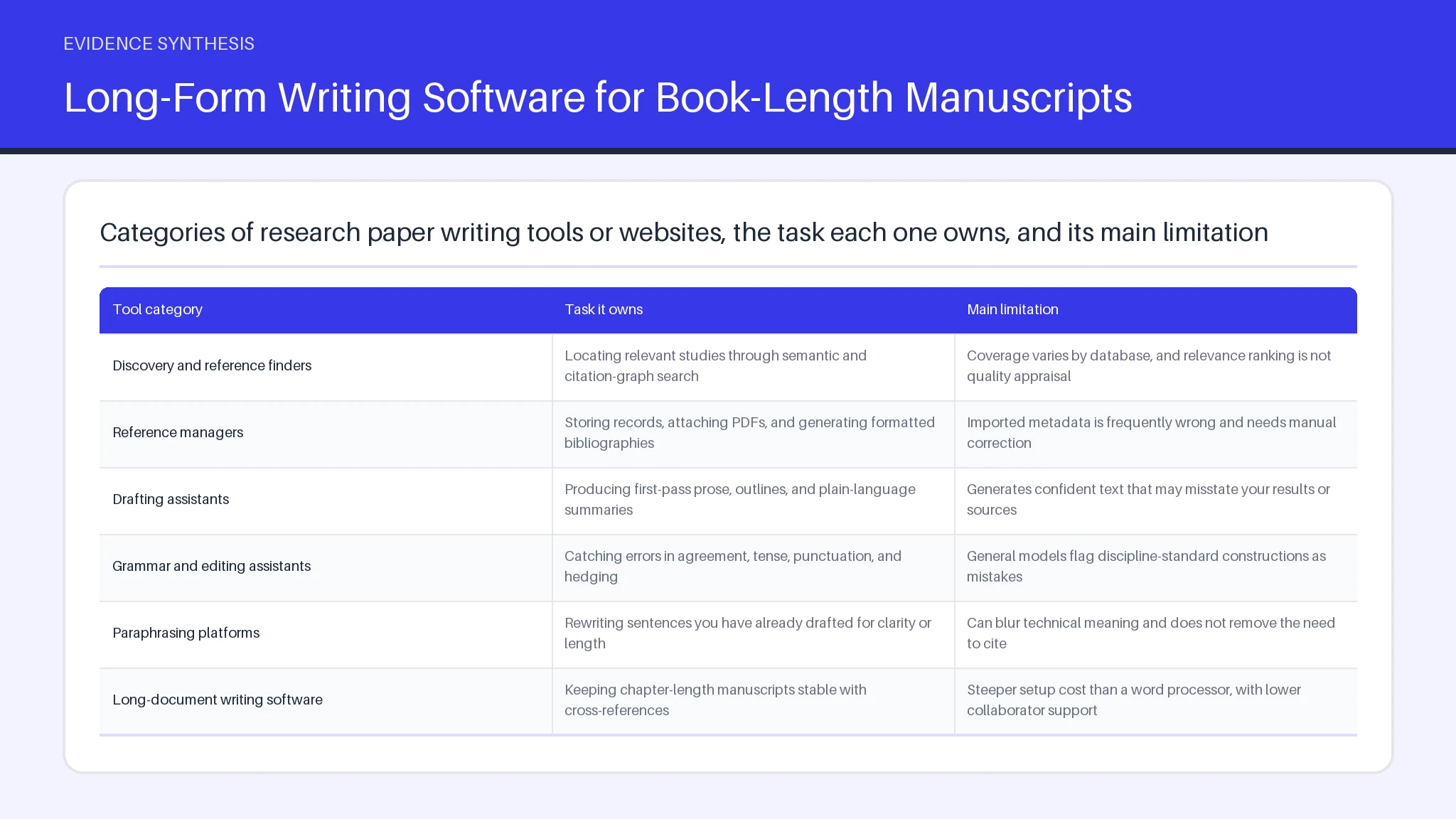
No single product is best for writing, and the best AI tools in any category are the ones that match your actual bottleneck. The honest answer to which app is best for research paper work in 2025 depends on whether your problem is finding, storing, writing, or polishing. The table maps the categories against the task they own.
| Tool category | Task it owns | Main limitation |
|---|---|---|
| Discovery and reference finders | Locating relevant studies through semantic and citation-graph search | Coverage varies by database, and relevance ranking is not quality appraisal |
| Reference managers | Storing records, attaching PDFs, and generating formatted bibliographies | Imported metadata is frequently wrong and needs manual correction |
| Drafting assistants | Producing first-pass prose, outlines, and plain-language summaries | Generates confident text that may misstate your results or sources |
| Grammar and editing assistants | Catching errors in agreement, tense, punctuation, and hedging | General models flag discipline-standard constructions as mistakes |
| Paraphrasing platforms | Rewriting sentences you have already drafted for clarity or length | Can blur technical meaning and does not remove the need to cite |
| Long-document writing software | Keeping chapter-length manuscripts stable with cross-references | Steeper setup cost than a word processor, with lower collaborator support |
How Academic Grammar Checkers Differ From General Ones
Academic grammar checkers differ from general ones in what they treat as an error. A general checker optimizes for brisk, direct prose, so it flags the passive voice, long noun phrases, and hedged claims. An academic checker treats those as conventions. The passive voice is standard in methods sections, hedging is how you report an effect that did not reach significance, and precise multi-word technical terms cannot be shortened without changing meaning. Tools tuned on Grammarly-style general corpora produce dozens of suggestions a careful academic writer should reject.
Three differences matter in practice. Academic checkers recognize domain vocabulary rather than marking it misspelled. They respect citation syntax instead of trying to repair in-text parentheses. And they apply field-appropriate register rules, so they do not push an academic argument toward blog cadence. Some bundle a plagiarism similarity check, which measures text overlap against an index and does not establish misconduct on its own.
The practical consequence for your writing process is that you should review suggestions in categories, not one by one. Accept mechanical fixes such as agreement, tense consistency, and punctuation across the whole document. Read style suggestions once, decide whether your field accepts the construction, then dismiss the category rather than relitigating it in every paragraph. That one change turns a 400-flag report into a 20-minute pass.
Among research paper writing tools or websites, editing software is the category where defaults cost the most time, so configure the academic setting before your first run.
What You Get From Premium Paraphrasing Platforms
Premium paraphrasing platforms give you controlled rewriting of text you already wrote, with modes that trade fluency against fidelity. The paid tiers typically add longer input limits, multiple rewrite registers such as formal or concise, sentence-by-sentence alternatives rather than one locked output, and a comparison view that shows what changed. For a writer trimming a 9,000-word draft to a 6,000-word limit, that comparison view is the feature that earns the subscription.
The useful applications are narrow and real. Tightening your own verbose paragraphs, smoothing prose written in a second language, and varying sentence openings across a long section are all tasks where paraphrasing saves hours. Researchers writing for journals with strict word ceilings use it to compress a discussion without losing a qualifier. A grammar pass afterward catches the agreement errors that rewriting introduces.
The limitation is semantic drift. Paraphrasing engines optimize for naturalness, so they will replace "associated with" with "caused" or drop a scope qualifier, and that is a substantive error in an academic claim. Read every rewritten sentence against the original before accepting it, particularly in results and limitations.
Paraphrasing a source does not remove the citation obligation. Rewording someone else's finding and omitting the reference is plagiarism regardless of how little verbatim text remains, and the same rule applies when you are summarizing prior work for literature reviews. General writing assistants such as Grammarly-class products include rewrite features too, so check whether you already have this capability before adding another subscription to your stack of research paper writing tools or websites.
Free AI Writing Apps for Scholarly Drafting
Free AI writing apps are most useful for scholarly drafting when you aim them at structure rather than content. Asking a model to turn your bullet-point findings into connected prose, to propose three section orderings for an argument, or to produce a 150-word plain-language summary of a paragraph you wrote yourself all work well, because you supply the substance and the tool supplies the sentence scaffolding. Asking it to write a results interpretation you have not reasoned through produces fluent text you will have to delete.
Free tiers constrain you in predictable ways. Expect message caps that reset on a timer, shorter context windows that cannot hold a full chapter, slower response during peak hours, and no guarantee that your text stays out of model training unless you opt out in settings. Before pasting unpublished data or a draft under review into any free account, check the data retention terms, because some funders and ethics approvals restrict where participant data may be processed.
A practical workflow for scholar-level drafting: write your own skeleton argument, ask the tool to flag gaps in the logic, then draft each paragraph yourself and use the tool only for the final clarity pass. That order keeps your reasoning intact and still cuts blank-page time.
Treat anything the model asserts about a published study as unverified. A Google Scholar or database lookup takes 30 seconds and is the difference between a real citation and a hallucinated one. Writing-support features inside free apps are improving quickly, but verification remains the scholar's job, not the software's, when you use research paper writing tools or websites for substantive scholarly work.
Long-Form Writing Software for Book-Length Manuscripts
Long-form writing software exists because word processors degrade at length. Past roughly 80 pages, general-purpose documents slow down, cross-references break, and figure placement shifts without warning. Dedicated long-document tools separate content from presentation, hold each chapter as its own file, and compile the whole manuscript on demand, which keeps a thesis or monograph stable through dozens of revision cycles.
Three capabilities justify the learning curve. Automatic numbering keeps every table, figure, and equation label correct after you insert a new one in chapter two. Stable cross-references update themselves rather than pointing at a section that moved. And programmatic bibliography handling regenerates references from a single database, so switching from one journal's formatting to another is a one-line change instead of a weekend of manual edits. Researchers submitting to multiple journals after a rejection recover that setup cost immediately.
The trade-offs are real. Markup-based systems demand syntax knowledge and produce cryptic compile errors. Collaborators who work in tracked changes may refuse to leave their word processor. Some platforms store your manuscript in a proprietary format, so confirm you can export clean, portable files before you start.
A reasonable compromise is drafting chapters in whatever tool your coauthors use, then assembling the final manuscript in long-document software once the writing is settled. That preserves comment threads during revision and still gives you reliable numbering, consistent layout, and a bibliography that matches the target format when academic papers go out the door.
Reference Finders That Build Citations Automatically
Reference finders build citations automatically by pulling structured metadata from a publisher record or an indexed database and pouring it into a style template. Give the tool a DOI, PubMed ID, ISBN, or URL and it returns a formatted entry in APA, Vancouver, Chicago, or whichever style you selected. For a paper with 70 sources, that mechanical step disappears from your schedule entirely.
The failure modes are consistent enough to check for directly. Preprints and conference proceedings arrive with missing volume or page data. Edited book chapters frequently credit the volume editor as the author. Corporate and government reports lose the issuing body. Non-English titles come back with stripped diacritics. Browser extensions that scrape a page rather than query a registry produce the worst records, so a Google Docs add-on that captures a citation from a search result page needs more scrutiny than one that resolves a DOI. Audit the first ten entries in every new project; the error pattern repeats, and once you know it you can fix the rest in minutes.
Automation does not transfer responsibility. A citation that points to a paper you never opened is a failure of academic integrity whether a human or a tool typed it, and that applies to an undergraduate essay as much as to a funded academic research program. Journals check reference accuracy, and reviewers notice when a cited study does not support the sentence attached to it. Researchers who verify as they write avoid that entirely. The companion piece on how citation generators work and what they miss covers the mechanics in more depth, which matters because clean referencing is a baseline expectation of academic writing.
Editing Assistants Trained on Technical Writing Conventions
Editing assistants trained on technical writing conventions evaluate a sentence against discipline norms rather than general readability. They know a methods paragraph is written in the past tense and often in the passive voice, that a limitations section should hedge, and that statistical reporting follows a fixed order of test statistic, degrees of freedom, and p value. A general editor fights all three. A technically trained one checks whether you followed them consistently.
The suggestions that save the most time are structural rather than cosmetic. These tools catch a variable named two different ways across sections, an abbreviation used before it is defined, an inconsistent decimal convention in a results table, and a claim in the discussion that overstates what the results section reported. Researchers reviewing their own work after months of drafting stop seeing these problems, which is exactly where a consistency checker earns its place among research tools.
Treat the grammar layer as a floor, not the goal. Clean sentences with a muddled argument still get rejected. Run the consistency pass after your structure is settled, so you are not polishing paragraphs you will cut.
Presentation conventions also differ by venue, and most editing assistants let you load a target style profile for reference formatting, heading depth, and number style. Setting that profile at the start of academic writing work keeps a long document aligned with one journal's expectations instead of requiring a reformatting pass at submission.
Resources That Strengthen the Quality of Your Draft
The resources that improve a draft most are reporting standards, institutional support, and structured feedback, and none of them are software. Reporting guidelines tell you exactly which items a journal expects to see, so a draft checked against the relevant checklist arrives with fewer reviewer queries. Our PRISMA 2020 guide covers the reporting standard for reviews, and for synthesis work the systematic review methodology guide sets out the sequence the standards assume.
Your library is the second underused resource. Subject librarians build search strategies, confirm database coverage, and hold training on reference management, usually at no cost. Writing centers read a draft for argument structure rather than grammar. Both reach parts of the research process that no editing assistant touches.
Structured peer feedback outperforms generic suggestions from software. Give a reader a specific question such as whether your limitations match your design, and you get a usable answer. A Grammarly-style pass tells you a sentence is long, which is not the same information.
Keep an academic integrity record alongside the draft: which research tools you used, for which task, and what you verified. Many institutions and journals now require a disclosure statement, and reconstructing that history at submission is harder than logging it as you go. Researchers who keep that log also find it easier to answer reviewer questions about method. Formatting and polish come last; an essay or a paper that is well argued and correctly cited survives review, and a beautifully formatted weak argument does not.
A Practical Toolkit for Producing a Research Paper
A workable toolkit for producing a research paper has four pieces: one place to search, one place to store references, one place to write, and one pass for language. Adding a fifth tool usually adds synchronization problems rather than capability.
Build it in that order. Start your search in a subject database suited to your specific research area rather than a general web engine, because coverage and indexing differ sharply by field. Import everything to a single reference manager and fix the metadata on arrival, which is cheaper than fixing 80 entries the night before submission. Draft in whatever environment your coauthors can open. Run one language pass at the end, with a Grammarly-class checker set to academic mode or a discipline-trained alternative, and review its suggestions by category.
Three mistakes recur. Splitting references across two managers produces duplicate and conflicting entries. Chasing perfect formatting during drafting wastes effort on text you will cut. And accepting grammar fixes without reading them introduces errors into technical sentences that were correct.
Choose tools that export cleanly. A reference library you can take out as BibTeX or RIS, and a manuscript you can export as a portable file, protect you when a subscription lapses or a coauthor uses different software. Researchers who test the export on day one avoid a bad surprise at submission. Platforms built for evidence synthesis, including Systematicly, sit alongside this toolkit rather than replacing it; teams comparing those options can review the feature comparison. Across the whole research process, the writer who verifies beats the writer who automates, and journals reward the difference. Clear academic writing and accurate references remain the two things reviewers check first.
Frequently asked questions
Which tool is best for research paper writing?
No single tool is best for writing, because the work splits into tasks that different software handles. A reference manager owns storage and bibliography generation, a discovery platform owns finding studies, a long-document editor owns manuscript assembly, and a language assistant owns the final polish. Pick by the step that currently costs you the most time, then add a second tool only when the first one is configured and in daily use.
What websites to use for research papers?
The websites worth using for research papers are indexed databases and repositories rather than general search engines. Discipline databases such as PubMed for biomedicine, ERIC for education, and the arXiv, SSRN, and bioRxiv preprint servers give you structured metadata and reliable coverage, and institutional repositories hold theses and reports that commercial indexes miss. A general academic search engine is a good entry point for scoping, but it should not be your only source, because its coverage is uneven and it indexes material that was never peer reviewed.
Can I use ChatGPT for research?
ChatGPT can support research without being a source of facts. It is useful for drafting prose from your own notes, explaining an unfamiliar method, suggesting search terms, and reorganizing an argument. It cannot confirm that a study exists, and it produces convincing citations for papers that were never written. The pillar guide on research paper structure and writing steps covers where it fits in a drafting workflow.
What are the top 5 research websites?
The five research websites most students need are a subject database for their field, a general academic search engine for cross-disciplinary scoping, a preprint server for current work, their own library catalog for books and licensed journals, and a government or agency portal such as a national statistics office for primary data. That combination covers peer-reviewed literature, gray literature, and raw figures.
What is a good website to open research papers for free?
Open access repositories are the reliable route to free full-text papers. PubMed Central, institutional repositories, and author-deposited versions on preprint servers are all legitimate and legal. Many authors also post accepted manuscripts on personal pages, and most will email a copy if you ask. Pirate mirrors are neither legal nor stable, and your library's interlibrary loan service usually fills a request within a few days at no charge.
What is the most reliable source for research?
The most reliable source is the one whose methods you can inspect and reproduce. Peer-reviewed primary studies with published protocols, registered trials, and official statistics from national agencies rank highest, with well-conducted systematic reviews above individual studies when a body of evidence exists. Reliability is a property of the study design and reporting, not of the venue alone, so appraise each paper rather than trusting a journal name.
What are the most trusted research sites?
Trusted research sites share three features: transparent indexing criteria, stable identifiers such as DOIs, and a declared relationship to peer review. Government databases, university repositories, journal publisher platforms, and recognized evidence libraries meet that bar. Whichever you use, cite every AI writing tool properly: name the tool, the version, the date, and the task it performed, and follow your institution's disclosure policy, because requirements differ between universities and journals.