Research Proposal: How to Write One Step by Step
A research proposal is a written plan that argues for a study before it happens. It tells a supervisor, committee, or funding panel what question you will answer, why that question is worth answering now, how you will gather and interpret evidence, and what you need in time, access, and money to finish. It is a persuasive document with a technical core: the argument fails if the method cannot deliver the answer you promise.
This guide is for graduate applicants writing a master's or doctoral proposal, early-career researchers preparing a first grant submission, and anyone who has been told to "tighten the methods" and is not sure what that means in practice. By the end you will have a model to copy from, an order of operations for drafting, a section-by-section breakdown of what each part must contain, and a realistic sense of how reviewers read. You will also see where a research proposal differs from the finished write-up it eventually becomes.
Three things separate a proposal that gets approved from one that comes back for revision. The first is a problem statement with two halves: a real-world problem and a specific gap in the published record. Many drafts supply only one. The second is internal consistency, sometimes called the golden thread, where the title, aims, questions, methods, and chapter outline all use the same language for the same concepts. The third is feasibility. Reviewers assess whether the analysis you describe can be done by you, with your access and your timeline, before the funding or candidature ends.
Length and format vary. A coursework proposal may run 1,500 words; a doctoral proposal commonly runs 3,000 to 5,000; a grant application is governed by the funder's page limits and scoring rubric. Those constraints change what you can include, but not what reviewers look for. The rest of this article works through examples, an ordered drafting process, the content of each section, assembly and formatting, the preparation work that happens before you write a word, and the habits that make reviewers say yes. If your question is still forming, settle that first with our guide to writing a research question that works.
Key takeaways
- A research proposal is a short, argued plan that shows a reviewer what you will study, why it matters, how you will do it, and what it will cost in time and resources.
- Most rejections come from a vague problem statement or a method that does not match the question, not from weak writing or formatting.
- Model your draft on examples from your own discipline and funder, because section names, length limits, and the weight given to feasibility vary widely between a master's program, a doctoral upgrade, and a grant competition.
- Write the aims, questions, and methods as one chain, then check that each sentence in the methods answers a specific question you listed earlier.
- Budget time for the parts reviewers read first: title, abstract, problem statement, and timeline. Formatting and reference checks belong at the end, not the start.
Research Proposal Examples You Can Model Your Draft On
A research proposal example is a complete or partial draft from a real submission that you read for structure and reasoning rather than for content to copy. The value is in seeing how someone turned a broad interest into a defensible plan: how they narrowed the topic, where they placed the gap, how much detail the methods carried, and how the timeline matched the ambition. A good example shows its seams. A polished one that hides its reasoning teaches you very little.
Useful examples come from four places. Your department's library of past accepted proposals is the most relevant source, because it reflects the exact expectations of the people who will assess you. Funders publish sample applications and scoring rubrics, which show how points are allocated. Registered protocols in public registries show what a fully specified plan looks like when the author expects to be held to it. Published methods papers show how a design is justified in print. Read at least two accepted examples and, if you can get one, a rejected proposal with reviewer comments attached, since the comments name the weaknesses more plainly than any guide.
Use examples as diagnostics, not templates. Map the example's structure to a one-line summary of each section, then write your own one-line summaries and compare. Where your summary is longer and vaguer, that section needs work. Never carry across phrasing, citations, or a method that does not fit your question. A qualitative design borrowed from an attractive example will fail quickly if your question asks about magnitude or effect.
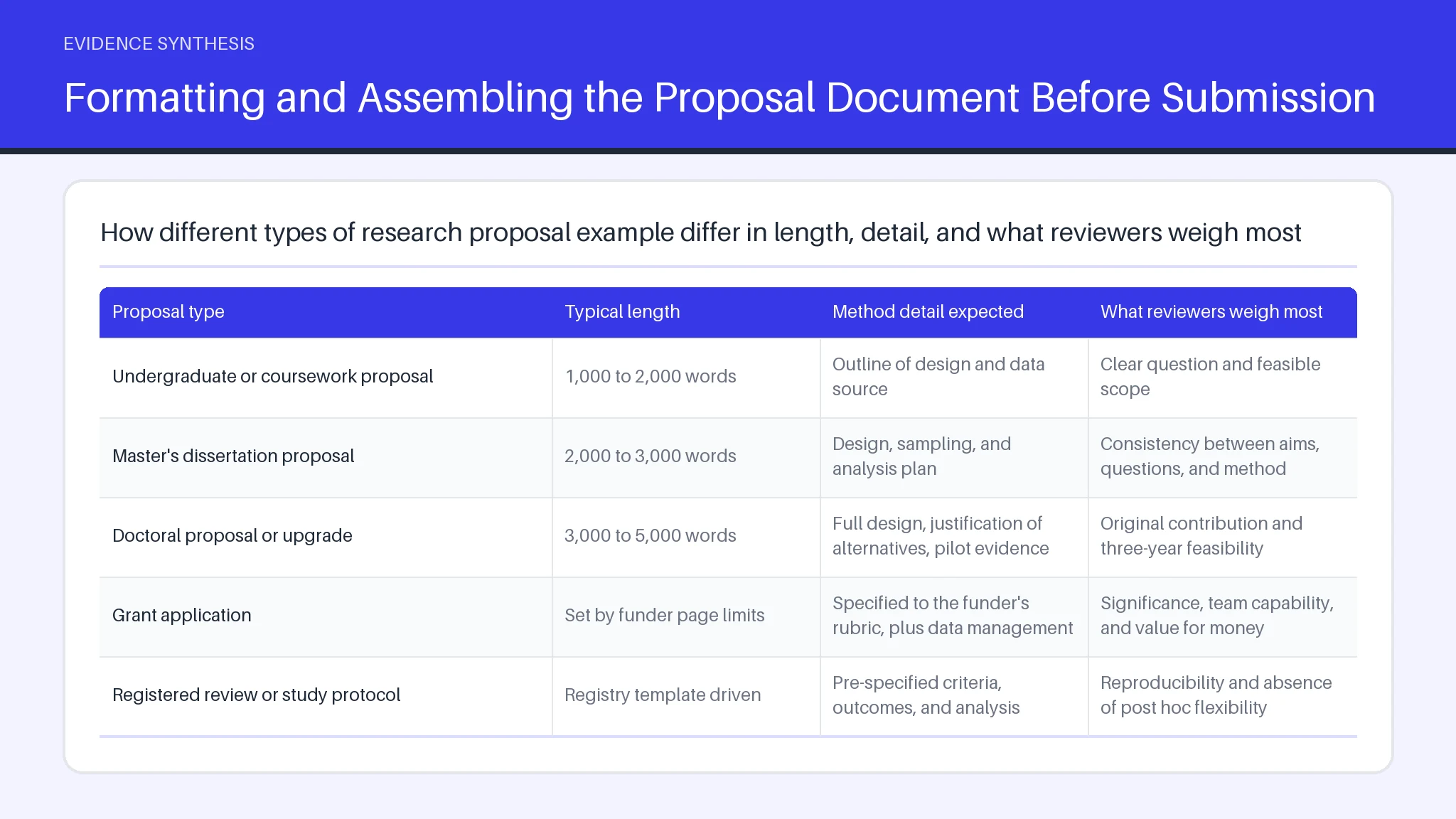
| Proposal type | Typical length | Method detail expected | What reviewers weigh most |
|---|---|---|---|
| Undergraduate or coursework proposal | 1,000 to 2,000 words | Outline of design and data source | Clear question and feasible scope |
| Master's dissertation proposal | 2,000 to 3,000 words | Design, sampling, and analysis plan | Consistency between aims, questions, and method |
| Doctoral proposal or upgrade | 3,000 to 5,000 words | Full design, justification of alternatives, pilot evidence | Original contribution and three-year feasibility |
| Grant application | Set by funder page limits | Specified to the funder's rubric, plus data management | Significance, team capability, and value for money |
| Registered review or study protocol | Registry template driven | Pre-specified criteria, outcomes, and analysis | Reproducibility and absence of post hoc flexibility |
If your project is an evidence synthesis, the proposal and the registered plan overlap heavily, and the detail required is closer to the last row than the second. Our systematic review guide covers how that plan is built and what a registry expects of it.
How to Write a Research Proposal Step by Step
Write a research proposal in a fixed order that moves from problem to plan, because every later section depends on the one before it. Drafting out of order is the most common reason a proposal reads as disconnected.
- Define the problem in two halves. Write one paragraph on the practical or theoretical problem, then one on what the published record does not yet settle. Name the specific studies that come closest and say what each leaves open.
- Fix the question and aims. Turn the gap into one primary question and no more than three subsidiary ones. State the aims as outcomes you will produce, not activities you will perform.
- Choose the design that answers the question. Justify it against at least one alternative you rejected, and say why the rejected option would not deliver the answer.
- Specify the method. Population, sampling, instruments, data sources, access and permissions, and the analysis you will run on each outcome. Name the software or statistical approach where it affects feasibility.
- Build the timeline and resources. Place milestones against real dates, including ethics approval, which often takes longer than people plan for.
- Write the abstract and title last, once the content is settled, then read the whole draft backward from methods to title to confirm that every term matches.
Expect two or three revision passes. The first fixes logic, the second cuts length, the third fixes references and formatting. If your design choices need defending in prose, our note on methodology versus methods explains the distinction reviewers expect you to hold.
What Goes Into Each Section of a Proposal
Each section of a research proposal carries one job, and reviewers notice when a section does someone else's work. The title names the variables and the population in under 20 words. The abstract compresses problem, question, method, and expected contribution into a single paragraph that stands alone. The introduction sets context and ends with the problem statement, not with a summary of the field.
The background or literature section is a selective argument, not a catalogue. It should move from broad context to the specific studies that frame your gap, and it should close by making the gap unavoidable. Keep a full survey of the field for the thesis chapter it belongs in; the proposal version exists to justify the question. For the longer version, see our page on planning a literature review.
The aims and objectives section states what the study will produce. Aims are the destination; objectives are the measurable steps toward it. Keep them numbered so the methods can refer back to them.
The methods section specifies design, participants or data sources, procedures, instruments, and analysis. The ethics section names approvals needed, consent, and data handling. The timeline maps milestones to dates. The expected outcomes section states what the field gains and names the limitations you already know about. Reviewers trust a proposal that admits a limitation more than one that claims none.
Formatting and Assembling the Proposal Document Before Submission
Assembly is the last stage of a research proposal, and it is worth a dedicated session rather than a rushed hour. Start by rereading the submission guidelines line by line and building a checklist from them: word or page limit, margins, font, line spacing, citation style, anonymization rules, and which items sit outside the word count. Many programs exclude the reference list and appendices from the limit, which changes what you can move where.
Order the document the way the guidelines specify, even when a different order reads better. A typical sequence is title page, abstract, table of contents for longer submissions, introduction, background, aims and objectives, methods, ethics, timeline, expected outcomes, references, and appendices. Number pages and headings so a reviewer can refer to a specific point in feedback without hunting for it.
Check references against the text in both directions: every in-text citation appears in the list, and every entry in the list appears in the text. Export from your reference manager once, late, and then proofread the output, because style conversions routinely break page ranges and capitalization. If your program requires a specific citation format, our rundown of APA formatting rules covers the details most drafts get wrong.
Finish with a plain-text read of headings alone. If a reader can follow your argument from the headings and the first sentence of each section, the document is assembled well. Submit as PDF unless told otherwise, and keep the editable source file.
The Preparation Process From Topic Scoping to Final Review
Preparation begins before drafting, and the work you need before you start is concrete: a scoped topic, a scan of what already exists, a named supervisor or program with its guidelines in hand, and an honest sense of your access to data, participants, or archives. Skipping any of these produces a proposal that reads well and cannot be executed.
Scope the topic by running a quick exploratory search and counting what comes back. If a database returns thousands of directly relevant studies, the topic is too broad; if it returns two, check whether the question is novel or simply unanswerable with available evidence. Reading those two closely, finding the flaw in one, and designing around it is a legitimate and persuasive way to establish a gap.
Next, settle feasibility. Confirm whether the dataset you plan to use is accessible, what the ethics timeline looks like at your institution, and whether the statistical analysis you have in mind matches your likely sample size. A power calculation done at this stage, even a rough one, saves a revision cycle later.
Then draft, leave the document alone for several days, and return to it as a reader rather than an author. Ask a colleague outside your subfield to read for clarity and someone inside it to read for method. Final review means checking the chain once more: title, aims, questions, methods, timeline. If any link uses different vocabulary from the others, fix the vocabulary before you fix the prose.
Tips That Make Reviewers Say Yes to Your Proposal
Reviewers approve proposals they can picture being completed. The strongest signal you can send is specificity: named data sources, a sample size with a justification, a defined analysis for each stated outcome, and dates attached to milestones. Vague verbs such as "explore," "examine," and "investigate" invite the question of how, so replace them with the actual procedure wherever the word count allows.
Common mistakes cluster in predictable places. A gap asserted rather than demonstrated is the first; show the gap with citations instead of claiming no one has studied it. A mismatch between question and design is the second, usually a qualitative method attached to a question about magnitude, or the reverse. An unrealistic timeline is the third, almost always because ethics approval, recruitment, or data access was given a fortnight each. Overclaiming significance is the fourth, and it costs credibility that the rest of the document then has to repay.
Three habits help. Write the limitations paragraph early and keep it honest, because a reader who finds a weakness you did not name stops trusting the rest. Ask a non-specialist to restate your question back to you after one reading; if they cannot, the framing is not clear enough. Build a reviewer's checklist from the assessment rubric, if one is published, and grade your own draft against it before submission. Tracking screening and extraction decisions in a shared workspace, whether a spreadsheet or a platform such as Systematicly, makes an evidence-based proposal easier to defend when questions come back.
Frequently asked questions
What are the 7 parts of a research proposal?
The seven parts most institutions expect are the title and abstract, the introduction with its problem statement, the literature background that establishes the gap, the aims and objectives, the methods, the timeline with resources and ethics, and the expected outcomes with references. Some programs split or merge these, so always check your own guidelines. If your submission asks for a budget or a data management plan, treat each as a separate part with its own heading rather than folding it into the methods.
What is a research proposal example?
A research proposal example is a past submission you read to see how a plan was argued, such as an accepted master's proposal where the title, aim, questions, objectives, and chapter headings all repeat the same key terms. One practical example: a student finds two studies on remote patient monitoring in rural clinics, identifies that neither measured adherence beyond six months, and proposes a twelve-month cohort study with a pre-specified adherence outcome. The gap is counted, not asserted, and the design follows directly from it.
What are the 5 steps of writing research proposals?
The five steps are: state the problem and the gap, convert the gap into one primary question with clear aims, select and justify a design that can answer that question, specify the method and analysis in enough detail that someone else could follow it, and set a timeline with resources and ethics against real dates. Write the abstract and title after these five are settled, then revise for logic, length, and references in separate passes.
What are some good ideas for research proposals?
Good proposal ideas sit where a real-world problem meets an unsettled question, and the best ones come from your own context rather than a list. Examples that work well include the effect of a recently changed policy in your region, an intervention that has been tested in one population but not yours, a measurement instrument whose validity has not been checked in a new setting, a replication of a widely cited finding with better data, and a synthesis of conflicting trials on a single outcome. Test any idea against three filters: is there accessible data, can you finish it in the time available, and would a reader in your field care about the answer.
What are 5 things all proposals should include?
Every proposal, whatever the format, should include a clearly stated question or hypothesis, a justification for why the work matters now, a method detailed enough to be judged feasible, a timeline with milestones, and an honest statement of limitations and ethical considerations. Those five hold across disciplines even when the section names change.
What are some research topic ideas for 2026?
Research topic ideas for 2026 track where evidence is thin and demand is high. Strong areas include the evaluation of AI-assisted decision support in clinical and educational settings, long-term outcomes of post-pandemic changes to service delivery, climate adaptation measures and their measured health effects, equity of access to new therapies across regions, and methods work on reproducibility and data sharing. Pick the narrowest version of any of these that you can still defend as significant.
What are current hot research topics?
Current hot research areas include machine learning applications and their evaluation, mental health service delivery and access, antimicrobial resistance, energy transition and its economic effects, and evidence synthesis methods themselves, including automation in screening and reporting. Popularity cuts both ways: a crowded field makes significance easy to argue and originality harder, so always check what has been published in the last eighteen months before committing. A quick scan of our journal and a structured search in a major database will tell you fast whether your angle is still open.