A research topic question generator turns a broad subject or a few keywords into candidate research questions. Treat the output as a draft. A PMC review of automatic question generation lists generating relevant questions from text for a given topic as an area where research could still progress. The standard stepwise approach applies: start with a broad subject, read what already exists, and list the information gaps. A research topic question generator speeds up the first step but cannot confirm that your question is new.
Key takeaways
- A generator speeds up drafting candidate questions. It does not check whether a question is new, feasible or ethical.
- Specific inputs naming a population, a setting and an outcome produce more researchable questions than one broad keyword.
- Original ideas usually come from information gaps: what is already known, what is still missing, and the questions that follow from the gap.
- Use FINER scores to rank and discard suggestions, then confirm novelty with your own literature review.
- Keep statistical significance separate from practical relevance when you judge whether a question is worth answering.
Common Questions About the Research Topic Question Generator
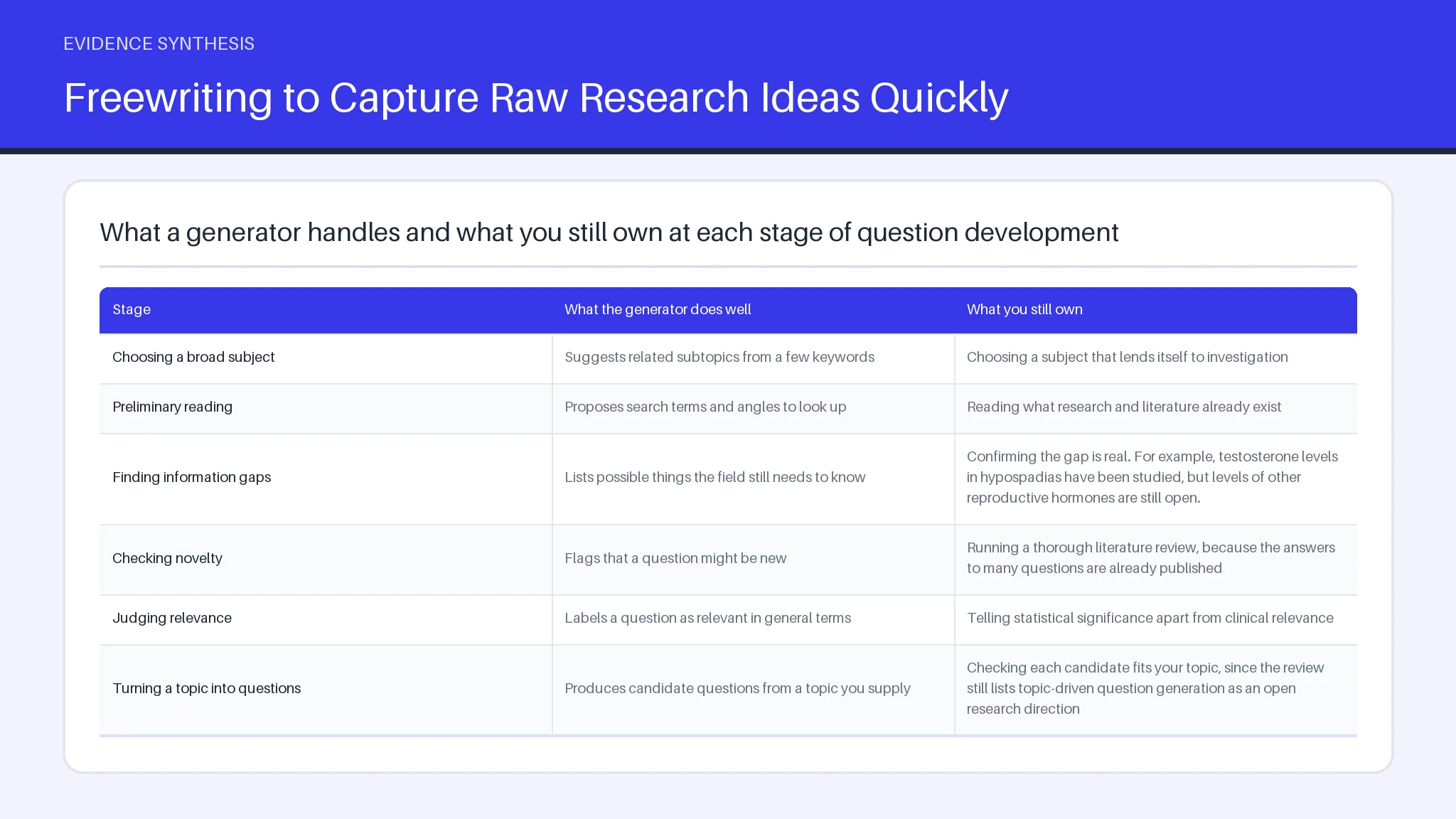
Most questions about a research topic question generator come down to one issue: which parts of question development the tool can handle and which parts stay with you. The table below sets this out stage by stage. It follows the stepwise approach to formulating a research question, the literature-check warning in "Formulating a good research question", and a review of automatic question generation.
| Stage | What the generator does well | What you still own |
|---|---|---|
| Choosing a broad subject | Suggests related subtopics from a few keywords | Choosing a subject that lends itself to investigation |
| Preliminary reading | Proposes search terms and angles to look up | Reading what research and literature already exist |
| Finding information gaps | Lists possible things the field still needs to know | Confirming the gap is real. For example, testosterone levels in hypospadias have been studied, but levels of other reproductive hormones are still open. |
| Checking novelty | Flags that a question might be new | Running a thorough literature review, because the answers to many questions are already published |
| Judging relevance | Labels a question as relevant in general terms | Telling statistical significance apart from clinical relevance |
| Turning a topic into questions | Produces candidate questions from a topic you supply | Checking each candidate fits your topic, since the review still lists topic-driven question generation as an open research direction |
The pattern is consistent. Generators are strong at breadth and weak at verification. The middle column takes seconds, while the right column can take weeks, so plan most of your time for the right column. A question that survives a thorough literature review is more likely to be novel, because it points to a real gap in knowledge. If the literature check is new to you, our guide on how to plan, judge and write a literature review covers the method. Once you have read the literature, run the generator again. Your reading usually gives you sharper keywords than the ones you started with.
Entering Your Keywords to Generate Research Topic Suggestions
The keywords you enter shape the suggestions more than any setting in the tool. A research topic question generator works only from the words you give it. One broad term such as "social media" returns generic questions, while three or four specific terms return questions you can test.
What you need before you start:
- A broad subject area and one reason it matters to you or your field.
- Two or three recent papers or reviews you have at least skimmed.
- Your information gaps: what your preliminary reading already tells you about the problem, and what you still need to know.
- The type of question your program expects, such as quantitative, qualitative or a review question.
Build your input in layers. Start with the core concept, then add a population, then a setting or time frame, then an outcome or mechanism you care about. "Sleep, first-year nursing students, clinical shift placements, academic performance" gives sharper questions than "sleep and students." Run the same input two or three times, changing one element each time, so you can see what each term does to the output.
Keep a log of every input and the questions it produced. When a supervisor or committee asks how you arrived at your question, the log shows how it developed.
Pinning Down the Target Population and Outcome in Your Question
Population and outcome are the two elements generated questions most often leave vague, and they decide whether you can design a study at all. "Does exercise improve mental health?" says nothing about who is studied or what is measured. A researchable version names a defined group, such as adults over 65 in assisted-living facilities, and a measurable outcome, such as depressive symptom scores after a set follow-up period.
When you review output from a research topic question generator, check each question for these elements:
- Population: the group your question is about, such as people with hypospadias in the published example of a broad subject, hormone levels among hypospadias.
- Outcome: what changes, and how it will be measured or observed.
- Comparison, where relevant: the group or condition it is compared with.
- Time frame: the period over which the outcome is assessed.
If a question is missing a population or outcome, add the missing piece as a constraint in your next prompt instead of fixing each question by hand. Ask for versions limited to one population, or versions that each use a different measurable outcome. Clinical and evidence-based practice questions often set out these elements with PICO, and our PICO question guide covers the templates. For examples of outcome wording in survey-based studies, see our samples of quantitative research questions.
One caution: a very narrow population can leave you with little evidence or data to work with. Before you commit, check that studies or datasets on that group exist.
Where Do Original Research Ideas Come From?
Original research ideas mostly come from information gaps: the space between what the literature already shows about a problem and what is still unknown. The stepwise approach published in PMC frames this with three prompts: what do you already know, what do you still need to know, and what questions follow from that need? Its worked example is simple. Studies already report testosterone levels in hypospadias, so an open question is the levels of other reproductive hormones.
To come up with a research idea using that logic:
- Choose a broad subject you can access and stay with, ideally one linked to your coursework, clinical work or available data.
- Do preliminary reading to see what has already been done. The limitations and future research sections of recent reviews are the quickest route to gaps that authors have already named.
- List what is known and what is missing in two columns.
- Turn each missing item into one or more questions.
- Check each question against the literature again before you commit to it.
Other good sources of ideas include problems you see in practice, conflicting results between studies, methods used in one field but not yet in another, and populations that existing studies left out.
A research topic question generator helps most at step four, where it can phrase a known gap several ways, and at step one, where it can suggest related angles. It helps least at step two, because it cannot judge your field's latest papers the way you need to. The authors of Pearls and pitfalls note that for many projects the literature review turns out to be both the start and the end of the research, because the answer is already published. Finding that out early is not a failure. It saves you months.
Freewriting to Capture Raw Research Ideas Quickly
Freewriting means writing fast without editing, so half-formed ideas reach the page before you start judging them. Don't fix spelling, check facts or delete weak lines while you write. The goal is volume, not polish.
Start from a broad subject of interest, as the stepwise approach in Formulation of Research Question, Stepwise Approach recommends. Then write about the "information gaps" around it:
- What do I already know about this problem?
- What do I still need to know?
- What questions does that need to know imply?
- What do people in my field argue about?
- Who is left out of the studies I know?
When you stop, read what you wrote and underline three kinds of words: groups of people, things that change or get measured, and settings or conditions. These terms make better input for a research question generator than a broad label because they carry your specific interest and context. Automated question generation is still a developing field. A review of automatic question generation methods lists generating relevant questions from text on a given topic as an open research direction. Treat any suggestions you get as drafts to check, not finished questions.
Freewriting doesn't replace reading, so test every promising idea against the literature before you commit to it. Formulating a good research question: Pearls and pitfalls notes that the published literature often already answers a question. A question that holds up after a thorough literature review may be novel, because it points to a real gap in knowledge. It may also be relevant, because new evidence on it could change clinical practice.
How the Research Topic Question Generator Scores Questions With FINER
A good research topic is one you can turn into a question that is feasible, interesting, novel, ethical and relevant. These five criteria are known as FINER. A generator that scores questions with FINER applies these labels to each suggestion, usually as a rating or a short note for each criterion. Our pillar guide explains how FINER and PICO test a draft question. This section covers how to read a tool's score.
- Feasible: A tool can spot obvious problems of scale, but it does not know your budget, access to participants or timeline. Treat this score as a first guess.
- Interesting: Only you, your supervisor and your audience can judge this. A high score means the topic sounds engaging, not that it suits you.
- Novel: Trust this score least. Only a thorough literature review can show that a question is new. According to Pearls and pitfalls, a question that holds up after that review can become novel, because it fills a gap in knowledge.
- Ethical: A tool may catch clear risks, such as research involving minors or vulnerable groups, but approval comes from your ethics board.
- Relevant: The same source separates statistical significance from clinical relevance. A study can produce a significant result that changes nothing in practice, so ask who would act differently if you answered the question.
Whatever FINER score a research question generator gives a candidate, the question can only be called novel and relevant after it passes a thorough literature review, because the answers to many questions are already in the published literature. Drop anything that scores poorly on feasibility or ethics, then take the top few questions to the literature. Score them again yourself after reading. Where your score differs from the tool's, you often learn the most about the question.
Does a Research Topic Question Generator Work in Other Languages?
Most generators built on general-purpose language models accept prompts and return questions in languages other than English. Working in another language does call for extra checks that English-only guides leave out. A question can read well and still fail when you search for evidence on it.
Three issues matter most:
- Terminology drift. Technical terms do not always translate directly. A generated question may use an everyday word where your field uses a precise term, or the reverse. Check key terms against textbooks or published papers in that language.
- Search vocabulary. Large biomedical databases such as PubMed index records with English-language subject headings. Even if you write your question in Spanish or Portuguese, plan to map its concepts to English index terms before you search. Our PubMed search guide explains how.
- Local relevance. A question framed for one health or school system may not apply to another. Relevance depends on where the answer will be used.
A practical workflow is to generate questions in the language you think in, because that is where your ideas are richest. Then ask the topic generator for an English version and compare the two side by side. Wherever the meanings differ, you have found an ambiguity to fix. If much of your evidence is published in another language, note that in your methods, because it affects which studies you can find and screen.
Combining Two Topics to Spark Fresher Research Angles
Combining two topics is a reliable way to find angles that single-topic prompts miss, because many gaps sit where two well-studied areas meet. Give a topic generator two subjects you know something about, such as "telehealth" and "medication adherence in older adults," and ask for questions that link them through a plausible mechanism.
Not every pairing is worth pursuing. A useful combination has three features: a reason the two topics should interact, existing research on each topic separately, and little direct research on the two together. That last feature is the information gap described earlier, with evidence on each side and little where they meet. A forced pairing with no mechanism gives you questions that sound fresh but that you cannot justify in a proposal.
Tips and common mistakes
- Change one input at a time so you can see what drives the output.
- Save prompts and outputs with dates as a record of how your question developed.
- Check your top three suggestions against recent reviews before you put in more time.
- Do not accept a question just because it reads well. Smooth wording does not show that a gap exists.
- Do not trust a novelty score without doing your own literature search.
- Do not narrow the population so far that no studies or data exist.
- Do not combine more than two topics at once. Doing so usually produces sprawling questions with too many variables.
Once a combined question passes these checks, work through the pillar guide's steps to finalize the wording. If you are planning a review, the PRISMA guide explains how to report your question.
Frequently asked questions
How many topics can I generate?
There is no target number to aim for. What matters is how many questions hold up once you check them. A stepwise guide to formulating research questions suggests starting from information gaps: what you already know about a problem and what you still need to know. It notes that this usually leads to only a few implied questions. A thorough literature review often shows that several candidates are already answered. Keep the ones that pass that review as both novel and relevant.
How are topics chosen?
Generators choose topics by predicting likely questions from the words you enter, so your keywords, population and outcome drive the results. Tools that apply FINER then rate each suggestion on feasibility, interest, novelty, ethics and relevance. Those ratings rest on general patterns, not your setting, and published reviews of automatic question generation describe topic-focused question generation as an area still developing. Use the ratings to sort suggestions, then confirm novelty and relevance yourself.
What makes a topic vague, and a question researchable?
A topic is vague when it names a subject without saying who is studied, what is measured or where the study takes place. A question is researchable when it defines:
- a specific population with clear limits
- an outcome you can measure or observe
- a setting or time frame
- a gap that a literature check confirms is still open
"Screen time and teenagers" is a topic. A question about daily screen time and sleep onset in a defined age group over one school term is something you can study.
How do I copy or save?
How you copy or save depends on the generator you use, so check that tool's own interface before you assume it keeps your work. What matters more is what you save with each question. A published stepwise guide to research question formulation starts with a broader subject, preliminary research on existing literature, and information gaps: what you already know and what you still need to know. Note each of these. Also record whether a thorough literature review already answers the question, because a question that passes that test may be novel and relevant.
What makes a topic worth exploring?
A topic is worth exploring when it fills a real gap, matters to people who would act on the answer, and fits your time, data and skills. Check whether the answer is already published. A thorough literature review often settles questions before a study begins. Then ask whether a result would change practice or policy, not just reach statistical significance. Finally, make sure the topic interests you enough to carry a project through months of work.