Exploratory research is a flexible study design that uses broad research questions to uncover new insights, as a PMC review of research designs explains. Descriptive designs, by contrast, start from clearly defined questions or hypotheses. In preclinical science, one analysis notes that exploratory studies mainly derive or test theoretical claims, while confirmatory studies test whether an intervention has clinical utility. That makes exploratory research an early step: in toxicology, guideline studies are used to confirm, refute or expand what exploratory studies report.
Key takeaways
- An exploratory study opens up a poorly understood problem with broad questions and a flexible design. Its main output is new insights and sharper questions, not proof.
- Qualitative methods such as interviews and observation are common, but quantitative designs such as cohort and case-control analyses can also serve an exploratory purpose.
- Exploratory findings are leads to test. Measurement is often uncertain, so promising results need a structured or confirmatory follow-up before anyone acts on them.
- Sample size follows the question. Treat exploratory findings as leads to confirm, not settled answers: a positive result may come from a measurement artifact, and a negative result may reflect flawed tools, the wrong treatment regimen, or limited experimenter skill.
What Is Exploratory Research?
An exploratory study is an investigation that sets out to understand an unfamiliar problem before anyone can frame precise, testable claims about it. Instead of measuring a known effect, researchers ask open questions, collect material broadly and let patterns emerge from what they see and hear. The aim is to generate candidate explanations, a clearer vocabulary and insights that later work can test.
Exploratory work is often qualitative, but the label describes purpose, not data type. A team might hold qualitative interviews with clinicians, read a scattered literature or examine routine records. What makes each of these exploratory is that the question stays open and the analysis is free to change direction as understanding grows.
A useful way to place it among other research methods is to compare it with the more structured and confirmatory designs that usually come later in a program of work on the same topic.
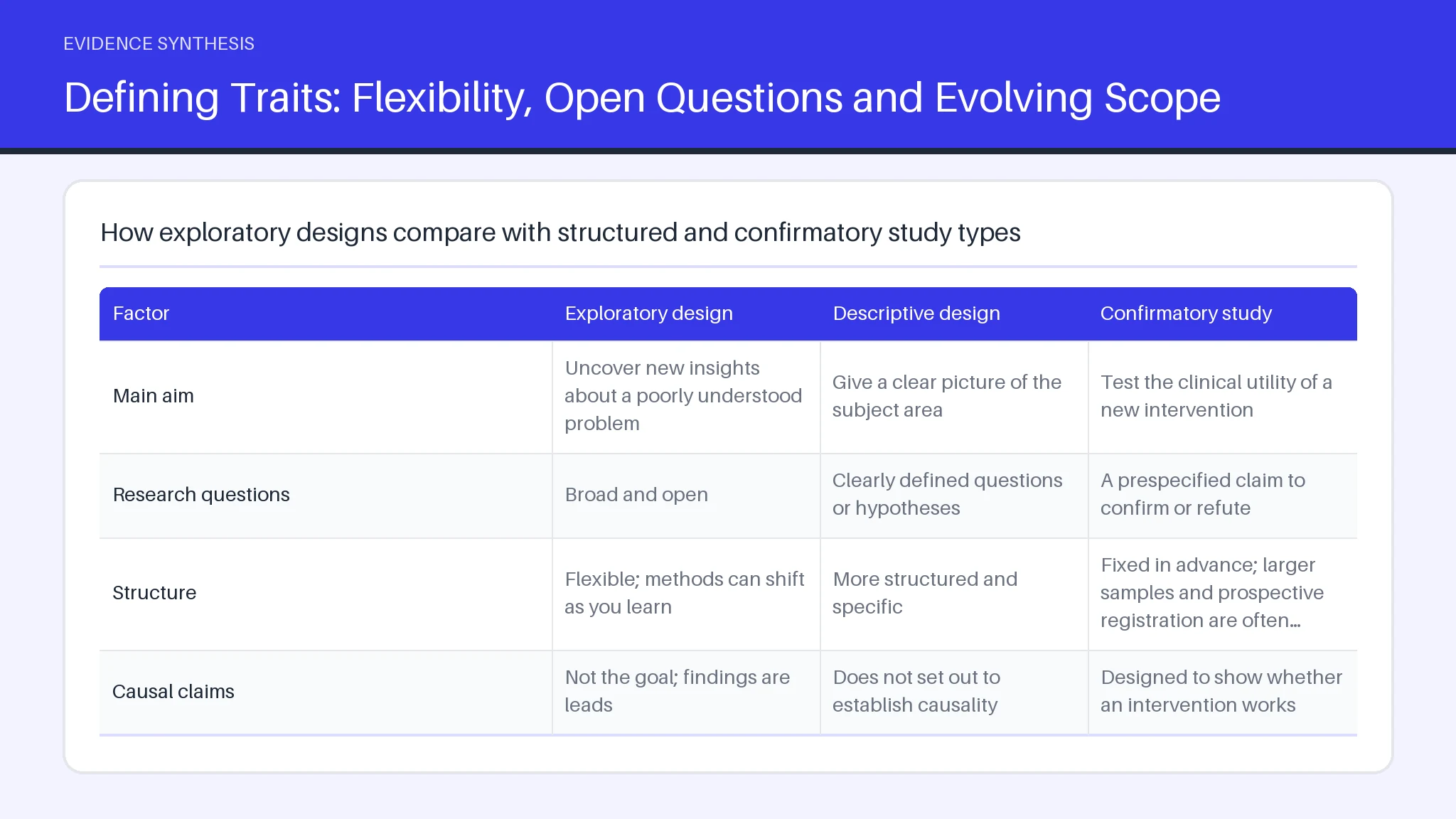
| Factor | Exploratory design | Descriptive design | Confirmatory study |
|---|---|---|---|
| Main aim | Uncover new insights about a poorly understood problem | Give a clear picture of the subject area | Test the clinical utility of a new intervention |
| Research questions | Broad and open | Clearly defined questions or hypotheses | A prespecified claim to confirm or refute |
| Structure | Flexible; methods can shift as you learn | More structured and specific | Fixed in advance; larger samples and prospective registration are often called for |
| Causal claims | Not the goal; findings are leads | Does not set out to establish causality | Designed to show whether an intervention works |
The first two columns follow the PMC review cited above. The confirmatory column draws on a PMC analysis of exploratory versus confirmatory preclinical studies, which argues that exploratory studies should mainly derive or test theoretical claims, while confirmatory studies should test the clinical utility of new interventions. In practice, if a decision will rest on your result, you probably belong in the third column, not the first.
Exploratory Research Examples: Identifying Problems Worth Studying
Exploratory research earns its place when a problem is visible but its causes, boundaries or vocabulary are not, and the most useful examples show it identifying which problem deserves a full study. Use it when the literature on a question is thin or contradictory, when a new population, technology or setting makes old findings unreliable, or when you cannot yet say what you would measure. Skip it when the question is already sharp and a structured study could answer it directly.
The four cases below show how an exploratory design works in different fields.
- Clinical service problem. A hospital team notices that many patients miss follow-up appointments after discharge. Open conversations with patients, nurses and schedulers reveal possible reasons, such as transport barriers or confusing letters, and those reasons become the questions for a later study.
- Product or market signal. A software company sees customers in one segment leaving after a few months. Usage logs and open-ended conversations point to onboarding gaps the team had not considered.
- Preclinical mechanism work. A lab probes whether a molecular pathway plays a role in a disease. The PMC preclinical analysis notes that much of the space in preclinical publications goes to molecular or cellular analyses rather than efficacy studies, a sign of how much basic science is exploratory in aim.
- Toxicology signals. Small exploratory studies reported effects of bisphenol A, and a PMC commentary on bisphenol A evidence argues that guideline-compliant studies with validated end points are needed to confirm, refute or expand exploratory findings like these.
Exploratory work can also be quantitative. A team might mine an existing registry or cohort dataset for surprising associations, and a sports physical therapy classification of research designs lists cohort and case-control designs under an exploratory heading within non-experimental research. Quantitative exploration differs from a hypothesis test in intent: the analysis looks for patterns to follow up, so its p-values and effect sizes are signals, not verdicts.
Conducting the study follows a loop rather than a straight line: state the problem, scan what is known, collect a first round of data, analyze it, and adjust your sources and questions before the next round. The benefit is speed and relevance, because researchers gain insights into what matters before committing to a costly protocol. The limitation is that findings cannot establish causation or stand alone as decision-grade evidence. What sets exploratory studies apart is that the research design is allowed to change mid-study, while a confirmatory research design is locked before data collection begins. Each qualitative theme or quantitative signal you find is a lead for that later, locked study.
Primary and Secondary Methods Used in Exploratory Studies
Exploratory studies draw on two families of sources: primary methods, where you collect new data yourself, and secondary methods, where you work with material that already exists. Most researchers start with secondary sources because they are cheaper, faster and show what is already known about the topic.
Primary methods include:
- In-depth, semi-structured interviews with people who experience or manage the problem
- Focus groups, which surface shared language and disagreement in one session
- Observation in the setting where the problem happens, such as a clinic, classroom or store
- Open-ended questionnaires and small pilot tests of a procedure or prototype
Secondary methods include:
- A preliminary scan of journal articles, reports and theses
- Secondary analysis of registries, routine records or earlier study datasets
- Published case reports and expert commentary
Primary qualitative methods give depth, while secondary sources give breadth and context, and most strong studies combine both. If your scan finds enough literature to map in a structured way, a scoping review may answer your question better than new fieldwork. Before collecting anything, sketch a loose framework: a short list of domains you expect to matter, so you can notice what fits and, more usefully, what does not. These research methods are not unique to exploratory work, and our research methods guide covers them in general terms. What differs here is how loosely you plan them and how readily you revise them as insights accumulate.
Key Advantage Options of Taking an Exploratory Approach
An exploratory approach pays off most when getting the question wrong would waste more than the study costs. Its main advantages are practical:
- It allows course correction. You can drop a line of inquiry that goes nowhere and follow one that looks promising, without breaching a fixed protocol.
- It grounds later work in reality. Talking to the people involved helps you generate testable ideas that reflect how the problem actually plays out.
- It is relatively cheap and fast. A handful of qualitative interviews or a review of existing records can reshape a project quickly.
- It supplies vocabulary and measures. The words participants use become questionnaire items, coding categories or outcome definitions.
- It reduces downstream waste. Preliminary work shows whether recruitment, data access and measurement are feasible before a large study commits to them.
These advantages come with real trade-offs, and good researchers state them openly. The PMC preclinical analysis points out that measurement uncertainty makes exploratory findings hard to read: a positive result may be an artifact of the assay, and a negative one may reflect faulty measurement tools, the wrong treatment regimen or limited experimenter skill. The bisphenol A commentary adds that basic exploratory studies play significant roles but are limited for assessing risks to human health, which is why government agencies rely on guideline-compliant studies with validated end points and appropriate group sizes. On a new topic, that is not a reason to avoid exploration. It is a reason to frame your output as a map of the topic, not a final answer.
Defining Traits: Flexibility, Open Questions and Evolving Scope
Three traits define an exploratory study: flexibility in method, open questions that resist early narrowing, and a scope that is expected to change as evidence comes in.
Open questions. Exploratory questions usually start with "how," "what" or "why" and avoid naming the answer in advance. The study does not begin with hypotheses; it exists to generate them.
Flexible methods. An interview guide is revised after the first few interviews, new prompts are added when participants raise something important, and surveys, if used, include open-ended items alongside any closed ones.
Evolving scope. The boundaries of the topic, the sample and even the setting can move. A study of missed appointments might widen to include caregivers once early qualitative data show that they make most scheduling decisions.
Openness is not the same as having no plan. A PMC paper on designing and assessing qualitative health research argues that quality standards should begin with a study's epistemological assumptions and objectives. It separates exploratory, descriptive and comparative studies as distinct types that differ in their primary objectives and in how much is already known about the topic. The implication is that reviewers should judge an exploratory study against exploratory standards, and researchers should say clearly which type they are running. Write your methodology so a reader can tell which decisions were planned and which were made in response to the data; our article on methodology versus methods explains how to justify those choices.
What Exploratory Research Aims to Achieve in Market Research
p>Exploratory market research aims to understand customers, markets or concepts well enough to know which questions a larger study should ask. Its core objectives are usually these:- Define the real problem. Falling sales or rising cancellations are symptoms; exploration looks for the causes behind them.
- Discover needs and language. Customers often describe a problem differently from the company, and that wording shapes later messaging and questionnaires.
- Identify variables worth measuring. Early conversations show which factors, such as price sensitivity, switching costs or trust, deserve a place in a structured study.
- Screen concepts early. Rough ideas or prototypes can be tested with a small group before money goes into development.
- Form hypotheses for later testing. The output feeds larger quantitative surveys or experiments that estimate how common a need is.
Common methods include in-depth customer interviews, small group discussions, in-store or in-home observations, social listening and reviews of support tickets or sales notes. Researchers in market settings face the same gap that health researchers do: what customers say and what they do can differ, so observations of real behavior are a useful check on interview accounts.
Write two or three objectives before fieldwork, each starting with a verb such as explore, understand or identify, and agree in advance what the team will do with the results. Treat preliminary findings as direction, not as market sizing: a dozen enthusiastic conversations do not prove demand. The insights earn their value when they shape what the next, larger study measures.
How to Collect Data for an Exploratory Study
Data collection for an exploratory study works best in short, deliberate cycles: gather a little, review it, and adjust what you collect next.
What you need before you start
- A one- or two-sentence problem statement and a draft research question you expect to refine
- A quick scan of what is already known about the topic
- Ethics approval and a consent process if you will involve people, or data-use permissions for records
- Realistic access to participants, sites or datasets
- A memo or decision log where you record what you changed and why
- A plan for storing all of your findings, including discordant ones, somewhere others can access them later
If the work sits inside a clinical trial program, endpoints and protocol drafting belong in the trial protocol itself, covered in our guide to writing a clinical trial protocol.
Then collect in this order:
- Review secondary sources to learn existing terms and debates.
- Run a first round of interviews or observations with participants who differ in role, experience or setting, so you see the phenomenon from several angles.
- Review each batch before the next, noting themes you expected and anything unexpected.
- Add case studies of unusual or extreme situations when they could explain something the main sample cannot.
- Revise prompts, sampling and sources based on what you have learned, and log each change.
Resist two temptations. Do not switch to a descriptive survey before you know what is worth counting, and hold back from writing formal hypotheses until the data give you reasons for them. Researchers who lock in too early lose the insights that make exploration worth doing.
How to Analyze and Interpret Exploratory Study Data
Analysis in an exploratory study is iterative: you code and compare material while data collection is still running, then turn recurring patterns into explanations that a later study can test.
- Get familiar with the data. Read transcripts and notes in full and memo your first impressions.
- Code openly. Label meaningful passages without a fixed scheme, then merge and split codes.
- Build and compare themes. Compare themes across participants, settings and case studies to see where the phenomenon looks different.
- Seek disconfirming cases. Look for data that contradict your working story.
- Challenge interpretations. Use team discussions in which a colleague argues against the main reading.
- State candidate hypotheses. Write each as a testable statement with its supporting evidence and gaps.
For quantitative exploratory data, plots, summary statistics and cross-tabulations do the same job as codes. Many comparisons on one dataset will throw up chance patterns, so treat any striking result as a lead.
Report negative and inconclusive findings too. The PMC preclinical analysis suggests data ontologies and databases for depositing exploratory findings so that discordant results stay accessible. It also notes that prospective registration of exploratory studies offers little when researchers doubt their own measurement techniques, so a transparent decision log is a practical middle ground. When findings later feed a systematic review or meta-analysis, that structured stage is where evidence synthesis software such as Systematicly fits, rather than the open-ended exploration itself.
Tips and common mistakes
- Do not report theme counts as prevalence estimates.
- Do not present candidate explanations as causal findings.
- Keep surprising cases; they often hold the most useful insights on the topic.
- Keep an audit trail across research methods and sources so others can follow your reasoning.
How Large Should an Exploratory Study Sample Be?
An exploratory study needs enough participants or cases to capture the range of views and situations that matter to the question, and no single number fits every design. Sample size depends on a few factors:
- Breadth of the question. A narrow question about one clinic needs fewer people than a question spanning several regions.
- Diversity of participants. The more the relevant characteristics vary, such as role, age, experience or setting, the more people you need to cover them.
- Richness of each data point. Long, in-depth interviews yield more per participant than short questionnaires.
- Method. With focus group discussions, plan the number of groups, not only the number of people.
For qualitative work, researchers can settle the study objective before planning interviews, because one framework for qualitative health research holds that design standards must begin with the study's epistemological assumptions and whether it is exploratory, descriptive or comparative. Define in advance how you will judge that point, for example by tracking new codes per batch, and report it. Thin qualitative data from many people is rarely as informative as rich data from fewer, well-chosen participants.
Small samples are a deliberate feature of exploratory work, not a flaw to apologize for, as long as your claims match them. The PMC preclinical analysis notes that larger samples carry extra costs and, in animal research, mean sacrificing more animals than necessary just to identify promising strategies. Larger, appropriately sized groups belong in confirmatory work, a point the bisphenol A commentary makes about guideline-compliant studies. For quantitative exploration, aim for enough data to see patterns with reasonable precision rather than powering a formal test.
Whatever research methods you combine, state your sample size, how you chose participants and why you stopped. Researchers reading your study can then judge how far its insights travel.
Frequently asked questions
What is meant by exploratory research?
Exploratory research is a flexible research design. It starts from broad questions and aims to uncover new insights. A published review of quantitative designs contrasts it with descriptive research, which uses more structured questions or hypotheses. In preclinical science, exploratory studies mainly derive or test theoretical claims, while confirmatory studies test whether an intervention has clinical utility. The two types work in cycles: later studies with validated methods confirm, refute or expand what exploratory research first suggests.
What is an example of exploratory research?
A well-documented example of exploratory research comes from toxicology: small laboratory studies of bisphenol A (BPA) that reported possible effects. Basic exploratory studies like these can use cutting-edge techniques that are not yet validated. To assess risk, government agencies instead rely on guideline-compliant studies with validated end points, appropriate doses and adequate group sizes, which confirm, refute or expand the exploratory findings. Preclinical exploratory research is another example. There, molecular or cellular analyses, such as gene expression or electrophysiology, aim to derive or test theoretical claims.
What is the difference between exploratory and descriptive research?
Exploratory studies are flexible, use broad questions and aim to uncover new insights, while descriptive studies are more structured, start from clearly defined questions or hypotheses and aim to give a clear picture of a subject without establishing causality, according to the PMC review of research designs. In practice, exploratory work often comes first and tells the more structured study what to count.
What's the difference between exploratory and explanatory research?
Exploratory studies ask what is going on and which factors might matter, while explanatory studies test why something happens by examining proposed cause-and-effect relationships, usually with a structured design and a prespecified analysis. Exploration produces candidate explanations, and explanatory work checks whether they hold. The two are stages in one line of inquiry; the PMC bisphenol A commentary describes exploratory and risk assessment studies as interactive and iterative, each informing the other.