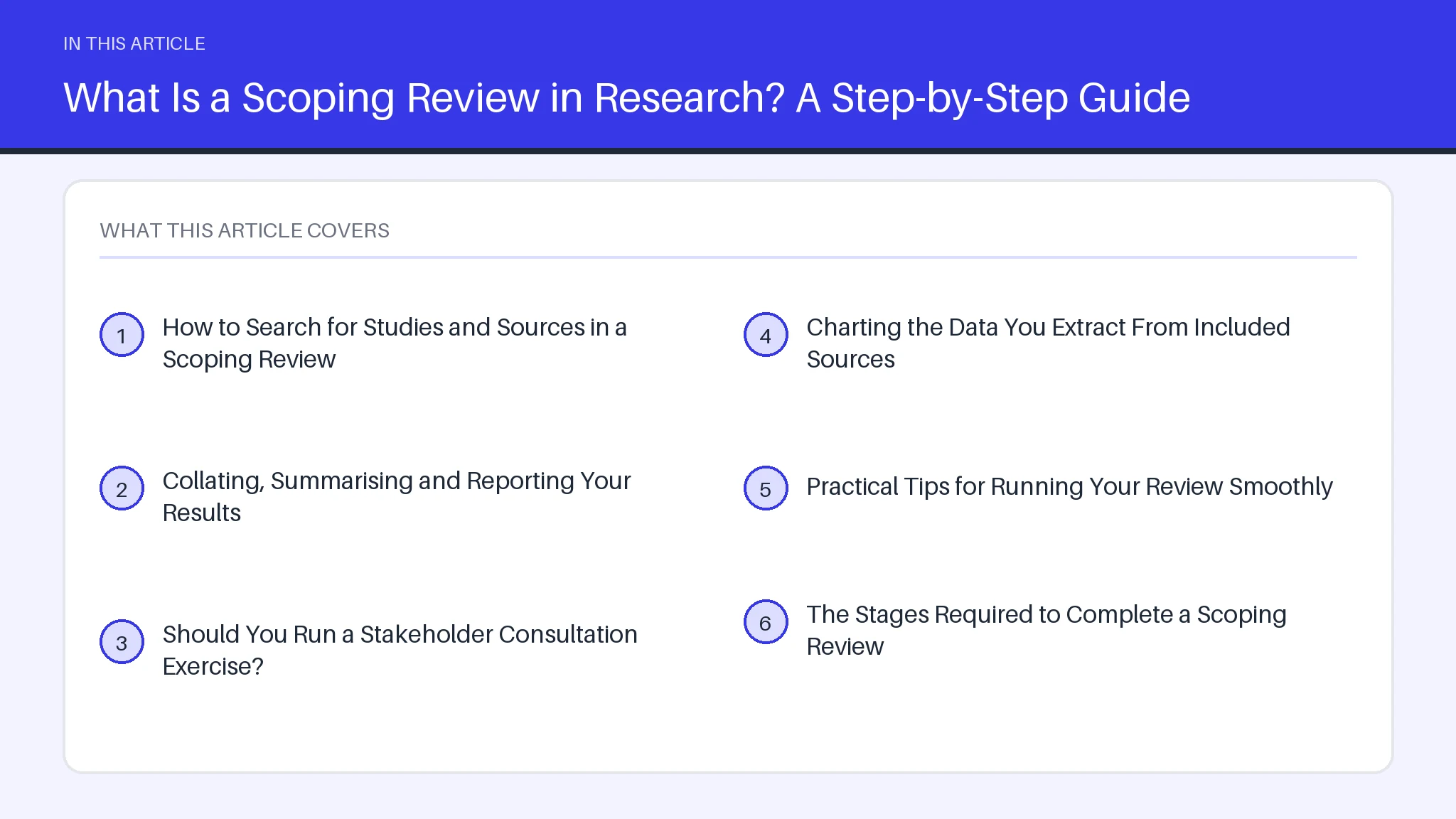
What Is a Scoping Review in Research? A Step-by-Step Guide
A scoping review is a structured way of mapping a body of literature: reviewers search systematically, apply stated inclusion criteria, chart what each included source contains, and report the size, range, and nature of the evidence on a topic. The question it answers is descriptive rather than comparative. Instead of asking whether one intervention works better than another, it asks what has been studied, by whom, with which methods, in which populations, and what nobody has examined yet.
Understanding what is a scoping review in research matters most for three groups: doctoral students sizing up a field before committing to a thesis question, grant teams needing evidence that a gap is real, and policy or clinical teams facing a topic too new or too sprawling for a narrow question. By the end of this walkthrough you will know what to prepare before you start, how each stage runs in sequence, how many databases a credible search needs, and which decisions to record so your reporting holds up under peer review.
For the wider picture of how this method sits alongside others, our pillar guide to what a scoping review is and when to use one covers method selection and reporting standards in depth.
Key takeaways
- A scoping review maps how much evidence exists on a broad topic, what it covers, and where the gaps sit, rather than pooling results to answer a narrow effectiveness question.
- It is a form of secondary research: reviewers analyze published and unpublished sources instead of collecting new data from participants, so the review itself is not a primary study.
- Study designs are included for relevance to the mapping question, which means qualitative, quantitative, mixed methods, and gray literature sources can all sit in the same chart.
- Formal risk of bias assessment is optional in a scoping review, so the output describes the shape of a literature base instead of grading how trustworthy its conclusions are.
- A written protocol with explicit inclusion criteria, a planned database list, and a charting form prevents the scope creep that stalls most first attempts.
How to Search for Studies and Sources in a Scoping Review
Searching for a scoping review is built for breadth, not precision. Because the purpose of a scoping review is to describe the extent of a literature base, a search that misses whole pockets of work produces a misleading map. Most teams run a three-part strategy: an initial limited search in two databases to harvest the vocabulary authors actually use, a full search across all planned sources using that vocabulary, then forward and backward citation chasing on every included record.
Before you start, you need a drafted scoping question, a provisional source list agreed with a librarian, a screening and charting workspace, and at least two people available to screen. Methodological guidance for a scoping review does not fix a database count, but published reviews in health and social sciences commonly search three to five bibliographic databases plus gray literature, and fewer than three is hard to defend as comprehensive. Qualitative studies can be included: relevance to the mapping question, not design hierarchy, decides inclusion. Tracking those decisions centrally, whether in a spreadsheet or in software such as Systematicly, keeps the audit trail intact. This is also where the practical answer to what is a scoping review in research becomes visible in the work: you are building an inventory, so every exclusion needs a reason you can state.
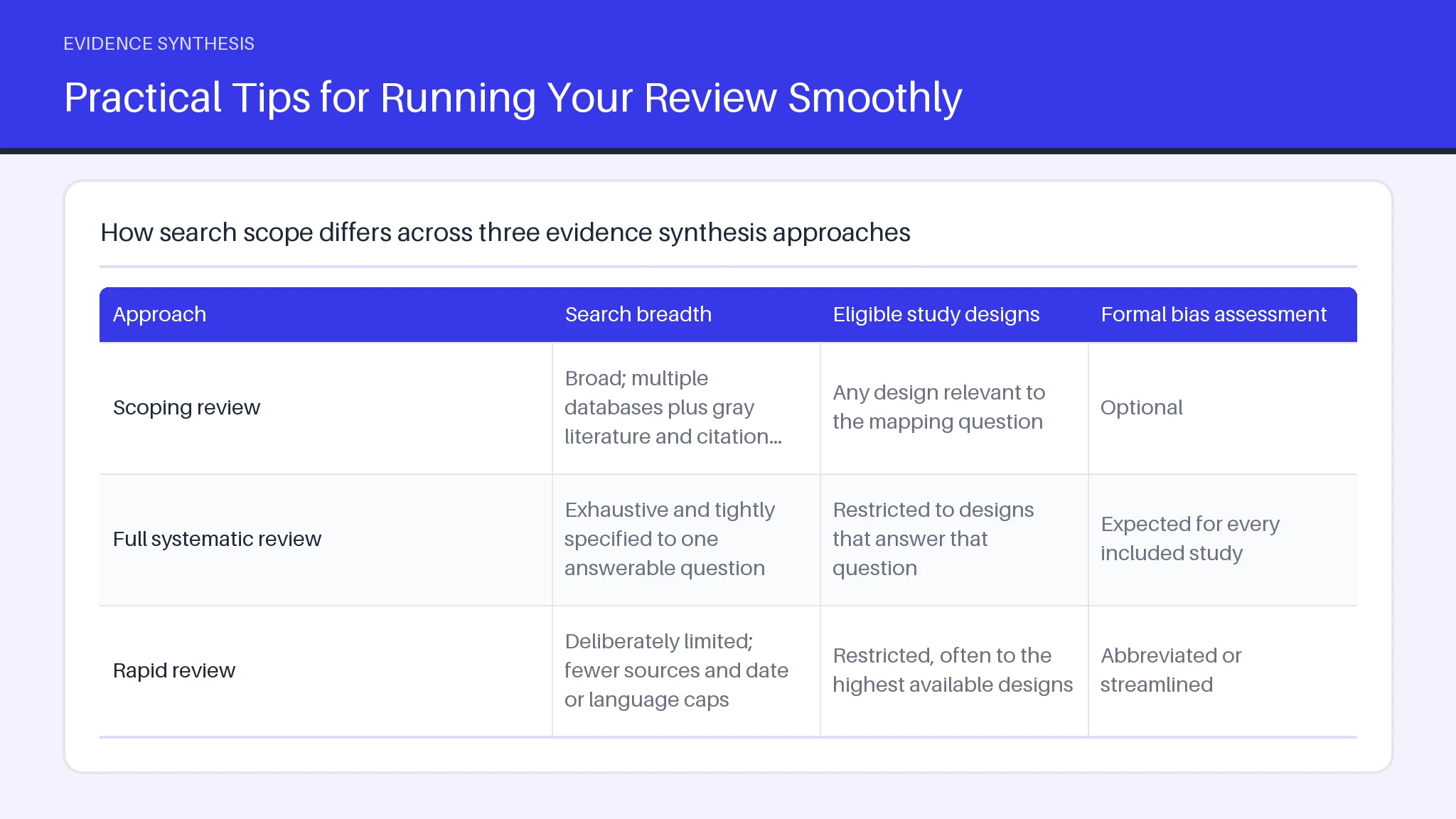
| Approach | Search breadth | Eligible study designs | Formal bias assessment |
|---|---|---|---|
| Scoping review | Broad; multiple databases plus gray literature and citation chasing | Any design relevant to the mapping question | Optional |
| Full systematic review | Exhaustive and tightly specified to one answerable question | Restricted to designs that answer that question | Expected for every included study |
| Rapid review | Deliberately limited; fewer sources and date or language caps | Restricted, often to the highest available designs | Abbreviated or streamlined |
Suggested visual: a three-column flow graphic labeled Initial limited search, Full multi-database search, and Citation chasing, each with its output. Alt text: three-stage scoping review search workflow from vocabulary harvesting to citation chasing.
Collating, Summarising and Reporting Your Results
Collating results in a scoping review means describing the literature rather than synthesizing an effect. The standard output has three layers: a numeric account of how many sources met your inclusion criteria and which databases supplied them, a descriptive summary organized around the categories in your charting form, and a narrative reading of what the pattern means for the topic.
Report counts before interpretation. State how many records each source returned, how many survived each screening stage, and how many full texts were unavailable, because those numbers let a reader judge whether your criteria were applied consistently. Then present the descriptive layer in tables or charts grouped by year, country, population, and study design. Where a cluster is thin or absent, say so plainly; that is how a review helps readers identify gaps rather than merely counting papers.
Reporting follows the PRISMA extension for scoping reviews, and our PRISMA reporting guide sets out the checklist items. Keep methodological limitations in their own paragraph, including any protocol deviation, so the record stays honest. Understanding what is a scoping review in research pays off here: the deliverable is a defensible map, not a verdict, and a systematic account of the map beats a systematic-sounding conclusion you cannot support.
Should You Run a Stakeholder Consultation Exercise?
Stakeholder consultation is an optional stage, and it earns its place when your topic has practitioner or patient implications that the published literature may not reflect. Clinicians, service users, policy staff, and subject librarians often know about program evaluations, agency reports, and in-progress work that no bibliographic search returns. Bringing them in before you lock the protocol can reshape the inclusion criteria for the better.
Run it at one of two points. Early consultation tests whether your question matches a real decision and whether your planned databases cover the right fields. Late consultation asks whether your charted map reads as credible to people working in the area, which is a useful check on reviewers who are examining a field from outside it. Keep a written record of what changed as a result; unrecorded input looks like informal opinion rather than method.
Skip it when timelines are fixed and your topic is purely methodological. A systematic account of why you skipped a stage is better practice than a token exercise. Published guidance for both scoping work and systematic evidence synthesis treats consultation as a strength to declare, not a requirement to fake.
Charting the Data You Extract From Included Sources
Charting is the scoping equivalent of data extraction, and it works best as an iterative form rather than a fixed one. Build a draft charting framework from your protocol, pilot it on five to ten included sources with two reviewers working independently, compare results, then revise the fields before full extraction begins. Disagreement at the pilot stage usually signals a vague field definition, not a careless reader.
A workable form captures citation details, country and setting, population, study design, sample size, the concept or intervention examined, outcomes or themes reported, and any funding statement. Add topic-specific fields that your question actually needs, and drop fields you will never report. Where a source omits a field, record it as not reported instead of leaving a blank, because the frequency of missing information is itself a finding worth stating.
Quality assessment is optional at this stage, so note the choice in your protocol and repeat it in the write-up. Any mid-review change to the charting form counts as a protocol amendment and belongs in the methods section. Knowing what is a scoping review in research keeps this stage proportionate: you are describing a systematic picture, and a systematic charting process is what makes the findings reproducible.
Practical Tips for Running Your Review Smoothly
Most scoping projects stall for predictable reasons, and nearly all of them trace back to an unresolved decision made early. The fixes below address the mistakes that cost teams the most time.
- Pilot your inclusion criteria on 50 abstracts before full screening. If two reviewers disagree on more than a fifth of them, the criteria need rewriting, not more meetings.
- Set the title and abstract screening rule in advance: one screener with verification is defensible in a scoping review, while dual independent screening is stronger and slower. Record whichever you choose.
- Freeze the search date and rerun the search only once, shortly before submission, to catch emerging studies. Continuous re-searching is the single most common cause of an unfinished review.
- Keep the charting framework and the protocol in the same version-controlled document so a field change cannot quietly drift from the plan.
- Decide early whether you will run quality assessment. Adding it late forces a rework of every charted record.
A comprehensive map of one topic beats a shallow pass over three. If your question needs pooled effect estimates instead, a full systematic review is the better fit, and our systematic review methodology guide explains how those findings differ.
The Stages Required to Complete a Scoping Review
Six stages make up a scoping review, five of them required and one optional. The sequence comes from the Arksey and O'Malley framework and its later refinements by the Joanna Briggs Institute, and every credible scoping project moves through them in order.
- Identify the research question. Keep it broad enough to map a field but bounded by population, concept, and context.
- Identify relevant studies. Plan the sources, run the search, and document every query so another reviewer could repeat it.
- Select studies. Apply your stated criteria to titles, abstracts, then full texts, logging exclusion reasons at the full-text stage.
- Chart the data. Extract the fields your scoping question needs into a piloted form.
- Collate, summarize, and report the results. Present counts first, descriptive categories second, interpretation last.
- Consult stakeholders. Optional, and valuable when practice relevance matters.
Scoping work differs from a rapid evidence product mainly in how much of the search it is willing to cut; our rapid review guide covers that trade-off. A scoping review that skips a stage should say which one and why.
How the Review Process Works From Start to Finish
The process runs as one continuous chain in which each stage constrains the next. Your question fixes the key concepts; those concepts fix the search vocabulary; the vocabulary fixes what the databases return; the returns feed screening; and screening feeds extraction. Break the chain anywhere and the final map stops matching the stated methodology.
In practice that means writing the protocol first. It should name the question, the concepts, the sources, the inclusion and exclusion rules, the screening model, and the charting fields. Registering or publishing the protocol before screening begins is good practice, and it is the step that distinguishes a planned review from a retrospective justification. The PRISMA reporting standards, whose full name is the preferred reporting items for systematic reviews and meta-analyses, provide the scoping extension checklist you will report against.
Once screening starts, treat every inclusion decision as a record with a reason attached. Extraction then becomes mechanical rather than interpretive. Plan a rerun of the search near the end so emerging work is not missed, and expect the reporting phase to take longer than the searching phase. Unlike a full systematic review, you are not weighing effect sizes, so the writing effort shifts into describing structure clearly.
Can Qualitative Studies Be Included as Evidence?
Qualitative studies belong in scoping work and routinely form the bulk of included sources. Because the method describes the extent and nature of a literature rather than estimating an effect, design hierarchy does not govern eligibility. Interview studies, ethnographies, case studies, mixed methods evaluations, theses, conference abstracts, and agency reports all qualify if they meet the stated inclusion criteria in the review protocol.
That breadth carries an obligation. Set the inclusion rules by concept, population, context, and source type rather than by design label, and state which document types you accepted so readers can judge the overview you produce. Chart qualitative sources with fields they can actually fill, such as setting, participant group, method of analysis, and reported themes; forcing them into a sample size and outcome grid produces empty cells and a distorted picture.
Reviewers often ask about appraisal. Formal quality assessment is optional in this method, so the honest framing is that a scoping review describes what exists without grading how far each finding can be trusted. When trustworthiness is the question, our guide to critical appraisal covers the checklists used in systematic evidence synthesis, and extraction for appraisal purposes needs different fields entirely.
A Step by Step Walkthrough of Each Review Stage
Each stage has a concrete deliverable, and naming that deliverable is the fastest way to know whether you have finished it.
- Question and definitions. Output: a one-sentence scoping question plus written definitions of every ambiguous term. Without them, two reviewers will screen to different standards.
- Protocol. Output: inclusion and exclusion rules, source list, screening model, and charting fields, dated and version controlled.
- Search. Output: the full query string for every database, the date run, and the number of records returned per source.
- Screening. Output: counts at each stage and reasons for every full-text exclusion. The inclusion log is your audit trail.
- Charting. Output: a completed data extraction table with no blank cells, using not reported where a source is silent.
- Reporting. Output: counts, descriptive tables, a gap statement, and a methodological limitations paragraph that names any deviation.
Sharpening the question is usually the highest-value hour of the project, and our guide to writing a research question helps there. Scoping methodology rewards this discipline because the systematic record, not the conclusion, is what reviewers check, including the extent to which your topic boundaries held.
Suggested visual: a six-row stage-and-deliverable table graphic. Alt text: six scoping review stages paired with the document each one produces.
Frequently asked questions
Can one person do a scoping review?
One person can complete a scoping review, and single-reviewer scoping projects appear regularly in the published literature, particularly as thesis chapters. The compromise is reliability: without a second screener, there is no way to measure agreement, so the standard mitigation is to have a supervisor verify a sample of screening decisions and the full charting form, then state that arrangement in the methods.
What is another name for a scoping review?
Scoping reviews are also called evidence maps, mapping reviews, or scoping studies, and some authors write systematic scoping review to signal that the search and screening followed a documented protocol. The labels overlap in use, so judge any review by its stated methods rather than its title.
What level of study is a scoping review?
In evidence hierarchy terms, a scoping review is secondary research, not a primary study and not a graded level of evidence. It summarizes existing work without pooling results or rating certainty, so it cannot sit on the same rung as a randomized trial or a meta-analysis. It answers a different kind of question: how much evidence exists, and of what kind.
Can you provide an example of a scoping review?
A typical published example maps interventions for a broad population, such as a review charting digital mental health programs for university students across 60 studies in 14 countries, grouping them by delivery format, outcome measured, and country, then noting that almost none evaluated long-term follow-up. The output is a description of coverage and a named gap, not an effectiveness claim.
How long does a scoping review usually take?
Most teams spend six to twelve months on a scoping review, with the screening and charting stages consuming the largest share. Narrow questions with tight date limits and an experienced team run faster; broad topics with heavy gray literature components run longer, especially when documents must be requested from agencies.
Why would you do a scoping review?
Run one when the literature is too varied, too new, or too large for a precise question. Scoping work suits mapping the range of available methods, clarifying how a concept is defined across fields, identifying a gap ahead of a grant application, and deciding whether a full synthesis is feasible at all.
How many studies are needed for a scoping review?
No minimum number of studies applies. Published scoping reviews range from a dozen sources to several hundred, and a small yield is a legitimate result because it demonstrates a sparse evidence base. What matters is that the search was broad enough and documented well enough for readers to trust the count.