Qualitative research collects non-numerical information, such as interview transcripts, field notes and open-ended responses, to explain how and why people experience something. Quantitative research collects numerical measurements to find out how much, how often, or whether a difference is real. That is the core of qualitative vs quantitative: one approach builds an understanding of meaning and context, and the other measures and tests.
This guide is for students, clinicians and evidence review teams who need to choose an approach, defend that choice, or read studies built on either one. It covers how the two differ in goals, data, sampling and analysis, and what they have in common. It also shows how to combine them in a mixed-methods design without ending up with two disconnected studies, and how each type of evidence feeds into a later synthesis.
Key takeaways
- Quantitative studies measure variables and test whether a difference or relationship holds. Qualitative research explains how and why through words, images and observed behavior.
- Your question decides the approach. If you can already name the variables to measure, a quantitative design fits. If the problem is still unclear, start qualitatively.
- Each approach has a built-in limit. Measurement offers little insight into context, and interpretive work is harder to show as rigorous.
- A study only counts as mixed methods when the two strands are integrated. Collecting both kinds of data without linking them is called multi-methods.
- In a systematic review, measured outcomes can be pooled in a meta-analysis, while qualitative studies need their own synthesis methods.
Qualitative vs Quantitative: Key Differences
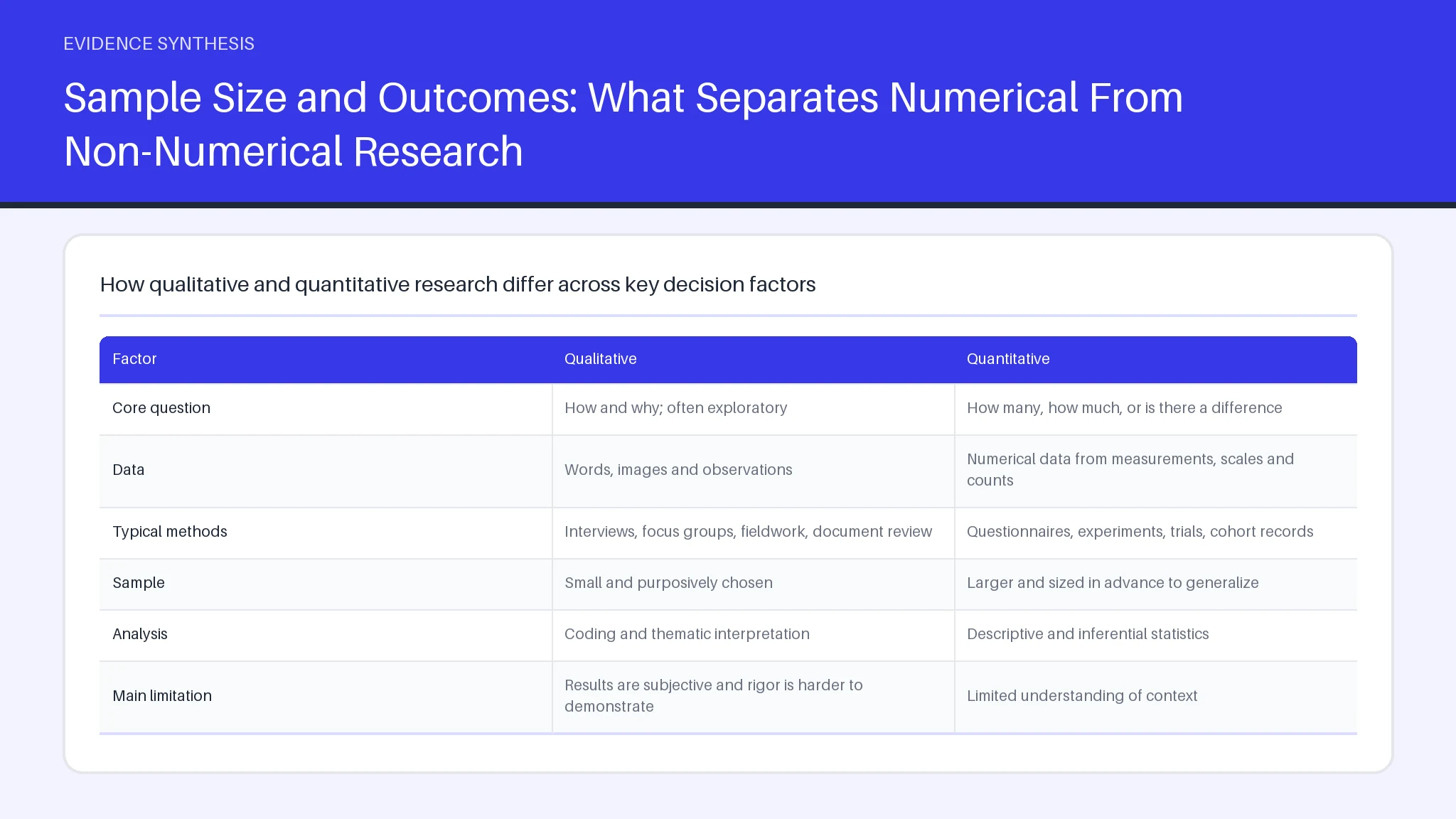
The qualitative vs quantitative choice comes down to five practical factors: the question, the data, the sample, the analysis and the kind of claim you can make at the end. Neither approach is more rigorous by default, and each has strengths that suit different problems.
| Factor | Qualitative | Quantitative |
|---|---|---|
| Core question | How and why; often exploratory | How many, how much, or is there a difference |
| Data | Words, images and observations | Numerical data from measurements, scales and counts |
| Typical methods | Interviews, focus groups, fieldwork, document review | Questionnaires, experiments, trials, cohort records |
| Sample | Small and purposively chosen | Larger and sized in advance to generalize |
| Analysis | Coding and thematic interpretation | Descriptive and inferential statistics |
| Main limitation | Results are subjective and rigor is harder to demonstrate | Limited understanding of context |
The limitations row follows a review of mixed methods in pre-hospital research. Most research methodologies fall somewhere along this spectrum, and a comprehensive project often uses both. Our guide to methodology versus methods explains how to justify your choice in writing.
Qualitative vs Quantitative Research at a Glance
Quantitative research starts with a defined question and, usually, hypotheses that predict a measurable result. Qualitative work more often starts with an open question and lets concepts emerge from what participants say and do. This starting point shapes every later stage of qualitative vs quantitative research, from sampling to the form of the final claim.
Before you commit to either one, have three things in place: a clearly worded research question, a realistic idea of who you can recruit, and a plan for how the results will be used. One quick test settles many qualitative vs quantitative decisions. If you can already name the variables you would measure, a quantitative design fits. If you cannot, start qualitatively.
What Are the Advantages of Quantitative Research?
Quantitative research offers precision, replicability and reach. A review of mixed methods in pre-hospital care notes that with appropriate sample selection, results should generalize to the wider population. Standardized measures let other teams repeat a study and check the result. The approach is also the natural fit for testing hypotheses about cause and effect, which is why the evidence for pre-hospital treatment has come mainly from randomized controlled trials and cohort studies. The trade-off is depth. Numbers show that something changed but not why, so findings can be accurate yet still hard to act on.
Goals, Data Types and Methods: How the Two Approaches Contrast
Qualitative and quantitative work have different goals. Qualitative work aims to understand people's views, beliefs, experiences and cultures, while quantitative work aims to measure, predict and test. The data types follow from those goals. Qualitative studies collect narratives, transcripts, field notes and documents. Quantitative studies collect numerical data from surveys with closed questions, experiments, clinical measurements and routine records.
The methods then follow from the data. A trial of a new triage protocol produces statistical estimates of its effect. Interviews with the paramedics using it produce insights into why they do or don't follow it. Both sets of findings are valid because they answer different questions. If you are writing closed questions, our article on questionnaire design for quantitative work covers the details.
Sample Size and Outcomes: What Separates Numerical From Non-Numerical Research
Sample size is one of the clearest differences between qualitative and quantitative work. Quantitative studies need enough participants to detect an effect and represent a population, so surveys and trials are often sized with a power calculation before recruitment begins. Qualitative studies use smaller, purposively chosen samples because the aim is depth rather than representativeness. Recruitment often continues until new interviews stop adding new themes.
Outcomes differ too. In a quantitative vs qualitative comparison of outcomes, the first usually ends in an effect size with a confidence interval, and the second ends in a set of themes supported by quotes. Neither carries over neatly to the other. Qualitative findings should not be reported as percentages of a population, and survey averages rarely provide insights into individual reasoning.
Techniques for Analyzing Interviews and Open-Ended Responses
Thematic analysis is the most common way to analyze interviews and open-ended responses. Researchers read transcripts closely, label meaningful passages with short codes, group the codes into themes, and check those themes against the full dataset. Other options include:
- Framework analysis, which sorts data into a matrix so analysts can compare cases under the same headings.
- Grounded theory, which builds an explanatory theory by constantly checking new data against emerging concepts.
- Content analysis, which counts how often categories appear and so borrows from quantitative research methods.
Whatever the technique, the quality of qualitative data analysis depends on transparent decisions. Keep a codebook, have a second coder review a sample of transcripts, maintain an audit trail, and use quotes that show where each theme came from. Done well, this work uncovers motivations and insights that closed questions miss.
Can Descriptive and Numerical Methods Work Together in One Study?
Descriptive and measurement-based methods can work together in one study, and the combination is called mixed methods research. A pre-hospital research review cites Creswell's definition: the integration of quantitative and qualitative data within one overall study.
Integration is the defining step. Statistical analysis shows how widely a pattern holds, while qualitative data explains the mechanisms and context behind it. Together they give a fuller account of complex phenomena than either source alone. A study that gathers both kinds of data without integrating them is termed multi-methods. So the qualitative vs quantitative data question changes from which kind to collect to how and when the two will meet. Before you analyze anything, plan a structured way to handle results that disagree, so that neither the objective-looking numbers nor the richer interviews win by default.
What Qualitative and Quantitative Research Have in Common
Qualitative and quantitative research share the same foundations: a focused question, systematic data collection, transparent analysis and an honest account of limitations. Both are empirical, and both can be done well or badly.
Qualitative research is the systematic study of experiences, views and behavior through words, images and observation, with the aim of understanding meaning and context. Quantitative research, such as randomized controlled trials and cohort studies, works with numerical quantitative data, and with appropriate sample selection its results should be generalizable, although it offers a limited understanding of context. The two differ in the type of evidence, not in their level of rigor.
Use qualitative research when a problem is poorly understood, when you need to know why people act as they do, or when you are developing a new measure or intervention. Choose a quantitative design when the variables are defined and you need quantitative data to estimate size, frequency or effect.
Analyzing qualitative and quantitative data takes the same discipline. Qualitative research data are coded and interpreted, while quantitative data are cleaned, summarized and tested. Each needs a documented plan and a second person to check key decisions. In a systematic review, quantitative data from comparable studies can be pooled in a meta-analysis, while findings from qualitative research are combined through qualitative evidence synthesis. Either way, report how studies were found and selected. Our PRISMA guide covers that step.
How to Structure a Mixed-Methods Research Design
A mixed-methods design should settle three questions before any data are collected: what the overarching aim is, why mixed methods are needed, and how and when the data will be integrated. A practical mixed-methods guide recommends the same checklist. Then pick one of Creswell's three basic designs:
- Sequential explanatory: the quantitative strand comes first, and qualitative data then explains its results.
- Sequential exploratory: interviews come first and generate hypotheses that a quantitative strand tests.
- Convergent: both strands run in parallel and are merged at analysis.
Qualitative methods can also sit inside a trial as a process evaluation. To integrate results, use a joint display: structured tables or charts that line up each quantitative vs qualitative result by concept. Avoid two common mistakes. The first is treating contradictory results as a failure, when the discrepancy often sharpens the question. The second is publishing the strands separately without a comprehensive account of how they connect. Neither strand is purely objective, so document your integration decisions.
Frequently asked questions
What are the 7 types of quantitative research?
Textbooks group quantitative designs in different ways, but seven types appear on most lists: descriptive, correlational, causal-comparative, quasi-experimental, experimental, survey and longitudinal research. Each produces quantitative data, meaning information recorded as counts or measurements that can be summarized and tested. The main difference between them is how much control the researcher has. Descriptive and survey designs observe, while experimental designs assign participants to conditions. Our explainer on longitudinal and cross-sectional designs covers choices about timing.
What are the different types of qualitative research?
The main types of qualitative research are phenomenology, ethnography, grounded theory, case study and narrative inquiry. All of them work with qualitative data, which is descriptive information such as interview transcripts, field notes, images and documents. Phenomenology examines lived experience. Ethnography studies a culture or setting through immersion. Grounded theory builds theory from the data. Case studies examine one bounded example in depth. Narrative inquiry focuses on the stories people tell about their lives.
What are the four types of quantitative methods?
The four quantitative methods taught most often are descriptive, correlational, quasi-experimental and experimental designs. Descriptive designs measure a situation as it is. Correlational designs test whether two variables move together without changing either one. Quasi-experimental designs test an intervention without random assignment, often using existing groups. Experimental designs assign participants at random, which gives the strongest basis for causal claims. For example question wording, see our question samples organized by design type.
What are 5 examples of quantitative research?
Five common examples are a randomized controlled trial measuring whether a drug lowers blood pressure, a national health survey estimating how common a condition is, a cohort study following smokers and nonsmokers over time, a correlational study linking hours of sleep to exam scores, and a follow-up study that uses quantitative methods to test hypotheses first generated from interview findings.
Each one collects numerical data for statistical analysis. With appropriate sample selection, the results should be generalizable, but they offer limited insight into context.
What is the 5 example of qualitative?
Here are five common examples of qualitative studies:
- In-depth interviews with patients about living with chronic pain
- Focus groups with nurses about a new handover process
- Ethnographic observation of a busy emergency department
- A case study of how one hospital adopted electronic records
- Analysis of policy documents to trace how a guideline changed
Each of these produces themes and explanations rather than measurements.
What are two examples of quantitative?
Two clear examples of quantitative data are a patient's blood pressure reading and the number of hospital admissions in a month. Both are measured or counted, so they can be averaged and tested. This shows the difference between qualitative and quantitative data: quantitative information is measured, while qualitative information is described. A patient's account of how their readings make them feel is qualitative. The same topic can produce both kinds.
What are the disadvantages of quantitative research?
The main disadvantage of quantitative studies is their limited understanding of context. They show what happened and how often, but rarely why. They also need larger samples, which adds cost and time. Their fixed instruments can miss issues the researchers did not anticipate, and they can find statistical significance for differences too small to matter in practice. Qualitative and quantitative methods can be combined to offset these limits, which is the main reason for doing mixed-methods research.